
Worried about chasing high prices in US stocks? The investment with the highest certainty currently has an annualized return of over 5%, which you may not yet know.
As the US stock market fluctuates at high levels and long-term bonds plummet, the fear of chasing high US stocks while worrying about being trapped by long-term bonds, buyingshort-term US bonds with a yield of over 5%is becoming a mainstream approach for investors.
According to Morningstar's data, the inflow of funds into short-term and medium-term US bonds with maturities of 1 to 6 years in the first eight months of this year amounted to $29.3 billion, compared to the same period last year.Increased by 70.3%On the other hand, the funds flowing into US Treasury bonds with a maturity of more than 6 years decreased to $36.9 billion, compared to the same period last year.Decreased by 11.5%。
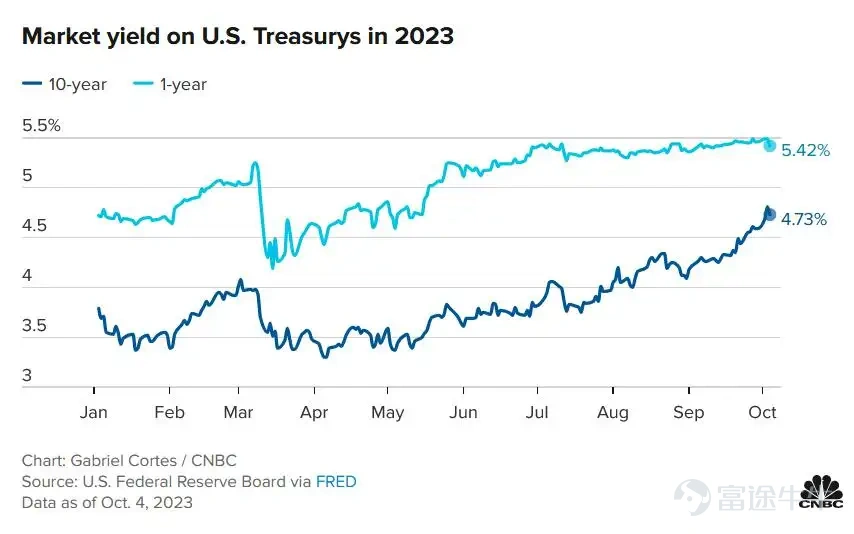
The Federal Reserve's aggressive rate hikes and hawkish stance kept short-term US bond yields high for most of 2023.The yield on 1-year US Treasuries was about 100 basis points higher than that of 10-year US Treasuries.This means global investors can avoid longer-term bonds with relatively low liquidity for additional returns and premiums.
Especially since the third quarter, while 10-year US Treasury bond yields surged, short-term government bonds remained relatively stable. Investors holding long bonds may face paper losses, but.Investors holding short-term bonds will not...
![As the US stock market fluctuates at high levels and long-term bonds plummet, the fear of chasing high US stocks while worrying about being trapped by long-term bonds, buyingshort-term US bonds with a yield of over 5%is becoming a mainstream approach for investors. According to Morningstar's data, the inflow of funds into short-term and medium-term US bonds with maturities of 1 to 6 years in the first eight months of this year amounted to $29.3 billion, compared to the same period last year.Increased by 70.3%On the other hand, the funds flowing into US Treasury bonds with a maturity of more than 6 years decreased to $36.9 billion, compared to the same period last year.Decreased by 11.5%。 The Federal Reserve's aggressive rate hikes and hawkish stance kept short-term US bond yields high for most of 2023.The yield on 1-year US Treasuries was about 100 basis points higher than that of 10-year US Treasuries.This means global investors can avoid longer-term bonds with relatively low liquidity for additional returns and premiums. Especially since the third quarter, while 10-year US Treasury bond yields surged, short-term government bonds remained relatively stable. Investors holding long bonds may face paper losses, but.Investors holding short-term bonds will not...[Chuckle] Adam Coons, the portfolio manager of Winthrop Capital Management, stated: "Currently, the yield on 2-year US Treasuries is over 5%, which is a level unseen in the past 20 years. In addition, the yield on 2-year US Treasuries is 3.5 percentage points higher than the yield of the S&P 500 Index, which is the largest difference between the two in the past 20 years...](https://nnqimage.futunn.com/999986/editor_image/41cc31fa7c843cdca126099e4ced6f96.webp/big?imageMogr2/ignore-error/1/format/webp)
Adam Coons, portfolio manager at Winthrop Capital Management, said, 'Currently, the yield on 2-year US Treasury bonds is over 5%, a level not seen in nearly 20 years. In addition, the yield on 2-year US Treasury bonds is 3.5 percentage points higher than the return on the S&P 500 index, the largest gap between the two in 20 years.'
Berkshire Hathaway, owned by Warren Buffett, has also increased its purchases of US Treasury bonds in the third quarter of this year, buying a total of $20 billion in two separate transactions. In an interview, Buffett said, 'The only question this week is whether we should buy $10 billion of 3-month or 6-month US Treasury bonds.'The only question this week is whether we should buy $10 billion of 3-month or 6-month US Treasury bonds.」
Why is buying short-term bonds a wise choice? Isn't it better to continue buying US stocks?
Buffett buys short-term US Treasury bonds aggressively, and Wall Street giants are voicing their support.
Data shows that Berkshire Hathaway reduced its stock investment portfolio in the second quarter and slowed its buyback pace, bringing its cash reserves close to a historical high of $147.4 billion.More than $120 billion is used to invest in short-term US treasury bonds.。
Although one of Buffett's inherent long-term investment strategies is to earn regular returns by holding dividend-paying notes, selling stocks to buy bonds is also an action that the stock god is using to demonstrate that holding cash with better liquidity may be more important for the current market. Especially considering that holding short-term bonds currently yields over 5%, the highest level since 2001.
![As the US stock market fluctuates at high levels and long-term bonds plummet, the fear of chasing high US stocks while worrying about being trapped by long-term bonds, buyingshort-term US bonds with a yield of over 5%is becoming a mainstream approach for investors. According to Morningstar's data, the inflow of funds into short-term and medium-term US bonds with maturities of 1 to 6 years in the first eight months of this year amounted to $29.3 billion, compared to the same period last year.Increased by 70.3%On the other hand, the funds flowing into US Treasury bonds with a maturity of more than 6 years decreased to $36.9 billion, compared to the same period last year.Decreased by 11.5%。 The Federal Reserve's aggressive rate hikes and hawkish stance kept short-term US bond yields high for most of 2023.The yield on 1-year US Treasuries was about 100 basis points higher than that of 10-year US Treasuries.This means global investors can avoid longer-term bonds with relatively low liquidity for additional returns and premiums. Especially since the third quarter, while 10-year US Treasury bond yields surged, short-term government bonds remained relatively stable. Investors holding long bonds may face paper losses, but.Investors holding short-term bonds will not...[Chuckle] Adam Coons, the portfolio manager of Winthrop Capital Management, stated: "Currently, the yield on 2-year US Treasuries is over 5%, which is a level unseen in the past 20 years. In addition, the yield on 2-year US Treasuries is 3.5 percentage points higher than the yield of the S&P 500 Index, which is the largest difference between the two in the past 20 years...](https://nnqimage.futunn.com/999986/editor_image/07454dcceaa03e878f1091c076c7997f.webp/big?imageMogr2/ignore-error/1/format/webp)
In addition, at a recent investment conference, the new bond king Gundlach also stated that if it were 2016, investors would need to purchase junk bond indexes with leverage to achieve a 5% annual return from US bond investment portfolios, and hope that the issuers would not default. However, overcoming this challenge now is not very difficult, as the goal can be achieved by buying short-term bonds. As of now,The 6-month US bond yield has already approached 5.6%.。
Faced with the Federal Reserve's "longer-term high interest rate" stance, Gundlach believes that this yield poses a significant challenge to the stock market. After all, capital is profit-driven.Buying US bonds can provide a risk-free yield of 5.5%, which then reduces the attractiveness of buying stocks by a large extent.

The profit-to-earnings ratio (PE ratio) of the S&P 500 index constituents relative to bond yields has dropped to its lowest level in nearly 20 years.
Compared to long-term government bonds, if you buy short-term government bonds with a 5% interest rate that will mature next year, then you will have the opportunity to buy long-term government bonds with an interest rate higher than 5% next year (after maturity).
However, if you buy 10-year government bonds with an interest rate of less than 5% now, although investors who hold them until maturity can expect to receive the face value interest and the entire principal, considering the possible 'higher and longer' US bond interest rates in the coming years, investors who hold long bonds may see negative US bond returns for several years.
US stocks vs short-term US bonds: Is now a good time to buy the latter?
If we consider asset allocation from an economic cycle perspective, you can refer toPring's Business Cycle Framework(Note: Pring's Business Cycle Framework considers government intervention and regulation in the economy based on the Merrill Lynch Clock, thereby more accurately dividing the economic cycle stages.)
The complete Pring's Business Cycle goes through the following stages: the economic cycle drives production, production drives inflation, inflation affects interest rates, which in turn affect the economic cycle. Therefore, the economic cycle has six stages:
![As the US stock market fluctuates at high levels and long-term bonds plummet, the fear of chasing high US stocks while worrying about being trapped by long-term bonds, buyingshort-term US bonds with a yield of over 5%is becoming a mainstream approach for investors. According to Morningstar's data, the inflow of funds into short-term and medium-term US bonds with maturities of 1 to 6 years in the first eight months of this year amounted to $29.3 billion, compared to the same period last year.Increased by 70.3%On the other hand, the funds flowing into US Treasury bonds with a maturity of more than 6 years decreased to $36.9 billion, compared to the same period last year.Decreased by 11.5%。 The Federal Reserve's aggressive rate hikes and hawkish stance kept short-term US bond yields high for most of 2023.The yield on 1-year US Treasuries was about 100 basis points higher than that of 10-year US Treasuries.This means global investors can avoid longer-term bonds with relatively low liquidity for additional returns and premiums. Especially since the third quarter, while 10-year US Treasury bond yields surged, short-term government bonds remained relatively stable. Investors holding long bonds may face paper losses, but.Investors holding short-term bonds will not...[Chuckle] Adam Coons, the portfolio manager of Winthrop Capital Management, stated: "Currently, the yield on 2-year US Treasuries is over 5%, which is a level unseen in the past 20 years. In addition, the yield on 2-year US Treasuries is 3.5 percentage points higher than the yield of the S&P 500 Index, which is the largest difference between the two in the past 20 years...](https://nnqimage.futunn.com/999986/editor_image/bd1e8947eeaa3b03b7e82b6eccdf77b4.png/big?imageMogr2/ignore-error/1/format/webp)
From the three dimensions of liquidity, GDP, and inflation/unemployment rate, it can be determined that the current US economy is in the late stage of overheating and transitioning to stagflation.
1. The liquidity of the US dollar is gradually tightening.
The indicator measuring the liquidity of the US dollar (the liability side of the Federal Reserve-reverse repo- TGA account, which is basically equivalent to bank reserves) carries the risk of further decline. Considering that one of the main reasons for the strong performance of US stocks in the second quarter is that this indicator continues to rise (the US Treasury releasing TGA funds, the Federal Reserve providing short-term loans due to the bank crisis), entering the third quarter, the reduction and maturity of Federal Reserve loans and the replenishment of funds by the US Treasury through issuing bonds will cause this indicator to return to a downward trend.
![As the US stock market fluctuates at high levels and long-term bonds plummet, the fear of chasing high US stocks while worrying about being trapped by long-term bonds, buyingshort-term US bonds with a yield of over 5%is becoming a mainstream approach for investors. According to Morningstar's data, the inflow of funds into short-term and medium-term US bonds with maturities of 1 to 6 years in the first eight months of this year amounted to $29.3 billion, compared to the same period last year.Increased by 70.3%On the other hand, the funds flowing into US Treasury bonds with a maturity of more than 6 years decreased to $36.9 billion, compared to the same period last year.Decreased by 11.5%。 The Federal Reserve's aggressive rate hikes and hawkish stance kept short-term US bond yields high for most of 2023.The yield on 1-year US Treasuries was about 100 basis points higher than that of 10-year US Treasuries.This means global investors can avoid longer-term bonds with relatively low liquidity for additional returns and premiums. Especially since the third quarter, while 10-year US Treasury bond yields surged, short-term government bonds remained relatively stable. Investors holding long bonds may face paper losses, but.Investors holding short-term bonds will not...[Chuckle] Adam Coons, the portfolio manager of Winthrop Capital Management, stated: "Currently, the yield on 2-year US Treasuries is over 5%, which is a level unseen in the past 20 years. In addition, the yield on 2-year US Treasuries is 3.5 percentage points higher than the yield of the S&P 500 Index, which is the largest difference between the two in the past 20 years...](https://nnqimage.futunn.com/999986/editor_image/c6d3ea4b2d7e396d84706eb33174de6a.webp/big?imageMogr2/ignore-error/1/format/webp)
2. US inflation is still high.
Since the Federal Reserve has raised interest rates to over 5% this year, inflation in the US, which is cyclical, has started to decline. However, with the support of continued employment growth and the escalating conflict between Israel and Palestine potentially stimulating a rise in US energy prices, the Federal Reserve's efforts to lower the inflation rate to the ideal level seem to have become more complicated.
![As the US stock market fluctuates at high levels and long-term bonds plummet, the fear of chasing high US stocks while worrying about being trapped by long-term bonds, buyingshort-term US bonds with a yield of over 5%is becoming a mainstream approach for investors. According to Morningstar's data, the inflow of funds into short-term and medium-term US bonds with maturities of 1 to 6 years in the first eight months of this year amounted to $29.3 billion, compared to the same period last year.Increased by 70.3%On the other hand, the funds flowing into US Treasury bonds with a maturity of more than 6 years decreased to $36.9 billion, compared to the same period last year.Decreased by 11.5%。 The Federal Reserve's aggressive rate hikes and hawkish stance kept short-term US bond yields high for most of 2023.The yield on 1-year US Treasuries was about 100 basis points higher than that of 10-year US Treasuries.This means global investors can avoid longer-term bonds with relatively low liquidity for additional returns and premiums. Especially since the third quarter, while 10-year US Treasury bond yields surged, short-term government bonds remained relatively stable. Investors holding long bonds may face paper losses, but.Investors holding short-term bonds will not...[Chuckle] Adam Coons, the portfolio manager of Winthrop Capital Management, stated: "Currently, the yield on 2-year US Treasuries is over 5%, which is a level unseen in the past 20 years. In addition, the yield on 2-year US Treasuries is 3.5 percentage points higher than the yield of the S&P 500 Index, which is the largest difference between the two in the past 20 years...](https://nnqimage.futunn.com/999986/editor_image/ac0b291745db3fd08ffaf0de7ff41a7c.png/big?imageMogr2/ignore-error/1/format/webp)
3. The US economy is still strong.
![As the US stock market fluctuates at high levels and long-term bonds plummet, the fear of chasing high US stocks while worrying about being trapped by long-term bonds, buyingshort-term US bonds with a yield of over 5%is becoming a mainstream approach for investors. According to Morningstar's data, the inflow of funds into short-term and medium-term US bonds with maturities of 1 to 6 years in the first eight months of this year amounted to $29.3 billion, compared to the same period last year.Increased by 70.3%On the other hand, the funds flowing into US Treasury bonds with a maturity of more than 6 years decreased to $36.9 billion, compared to the same period last year.Decreased by 11.5%。 The Federal Reserve's aggressive rate hikes and hawkish stance kept short-term US bond yields high for most of 2023.The yield on 1-year US Treasuries was about 100 basis points higher than that of 10-year US Treasuries.This means global investors can avoid longer-term bonds with relatively low liquidity for additional returns and premiums. Especially since the third quarter, while 10-year US Treasury bond yields surged, short-term government bonds remained relatively stable. Investors holding long bonds may face paper losses, but.Investors holding short-term bonds will not...[Chuckle] Adam Coons, the portfolio manager of Winthrop Capital Management, stated: "Currently, the yield on 2-year US Treasuries is over 5%, which is a level unseen in the past 20 years. In addition, the yield on 2-year US Treasuries is 3.5 percentage points higher than the yield of the S&P 500 Index, which is the largest difference between the two in the past 20 years...](https://nnqimage.futunn.com/999986/editor_image/dde66aeeef4337e0984c66f28f06b3d8.png/big?imageMogr2/ignore-error/1/format/webp)
Most of the US GDP comes from consumption. Currently, the absolute value of US consumption is still increasing, but the growth rate is slowing down. Taking inflation (prices) into account, the absolute amount of US consumption is definitely worsening.
![As the US stock market fluctuates at high levels and long-term bonds plummet, the fear of chasing high US stocks while worrying about being trapped by long-term bonds, buyingshort-term US bonds with a yield of over 5%is becoming a mainstream approach for investors. According to Morningstar's data, the inflow of funds into short-term and medium-term US bonds with maturities of 1 to 6 years in the first eight months of this year amounted to $29.3 billion, compared to the same period last year.Increased by 70.3%On the other hand, the funds flowing into US Treasury bonds with a maturity of more than 6 years decreased to $36.9 billion, compared to the same period last year.Decreased by 11.5%。 The Federal Reserve's aggressive rate hikes and hawkish stance kept short-term US bond yields high for most of 2023.The yield on 1-year US Treasuries was about 100 basis points higher than that of 10-year US Treasuries.This means global investors can avoid longer-term bonds with relatively low liquidity for additional returns and premiums. Especially since the third quarter, while 10-year US Treasury bond yields surged, short-term government bonds remained relatively stable. Investors holding long bonds may face paper losses, but.Investors holding short-term bonds will not...[Chuckle] Adam Coons, the portfolio manager of Winthrop Capital Management, stated: "Currently, the yield on 2-year US Treasuries is over 5%, which is a level unseen in the past 20 years. In addition, the yield on 2-year US Treasuries is 3.5 percentage points higher than the yield of the S&P 500 Index, which is the largest difference between the two in the past 20 years...](https://nnqimage.futunn.com/999986/editor_image/75d65b91809938cea4fa9d89a297470f.png/big?imageMogr2/ignore-error/1/format/webp)
Based on the above analysis, the current US economy is transitioning from the late stage of overheating to stagflation.At this time, both US stocks and commodities have entered the stage of high consolidation. Bond interest rates continue to rise.
Until the US economy enters stagflation or even a recession, the impact of economic downturn on corporate profits will have a negative effect on stocks, and the rising interest rates will also impact the price of long-term bonds. At this time, investors have little confidence in the allocation of capital markets.Therefore, holding cash (short-term US bonds) is the wisest choice.
![As the US stock market fluctuates at high levels and long-term bonds plummet, the fear of chasing high US stocks while worrying about being trapped by long-term bonds, buyingshort-term US bonds with a yield of over 5%is becoming a mainstream approach for investors. According to Morningstar's data, the inflow of funds into short-term and medium-term US bonds with maturities of 1 to 6 years in the first eight months of this year amounted to $29.3 billion, compared to the same period last year.Increased by 70.3%On the other hand, the funds flowing into US Treasury bonds with a maturity of more than 6 years decreased to $36.9 billion, compared to the same period last year.Decreased by 11.5%。 The Federal Reserve's aggressive rate hikes and hawkish stance kept short-term US bond yields high for most of 2023.The yield on 1-year US Treasuries was about 100 basis points higher than that of 10-year US Treasuries.This means global investors can avoid longer-term bonds with relatively low liquidity for additional returns and premiums. Especially since the third quarter, while 10-year US Treasury bond yields surged, short-term government bonds remained relatively stable. Investors holding long bonds may face paper losses, but.Investors holding short-term bonds will not...[Chuckle] Adam Coons, the portfolio manager of Winthrop Capital Management, stated: "Currently, the yield on 2-year US Treasuries is over 5%, which is a level unseen in the past 20 years. In addition, the yield on 2-year US Treasuries is 3.5 percentage points higher than the yield of the S&P 500 Index, which is the largest difference between the two in the past 20 years...](https://nnqimage.futunn.com/999986/editor_image/2e6d276a3822396b8d8b629cd1f62230.png/big?imageMogr2/ignore-error/1/format/webp)
In fact, from the perspective of long-term asset allocation, short-term bonds are not suitable for long-term investment holding, but more suitable for short-term liquidity management. In this way, when the economy enters the recovery phase and the stock market performs better, there will be more sufficient funds available.
How can investors "cheat on their homework"?
On Futu, you can directly purchase US Treasury bonds, with a minimum purchase amount of $1,000 and interest rates mostly above 5%. OpenFutubull, click on Discover > Wealth Management > Bonds. (*Note: US Treasury bonds are open for trading to all investors; certain bond products are only available for professional investors.)
![As the US stock market fluctuates at high levels and long-term bonds plummet, the fear of chasing high US stocks while worrying about being trapped by long-term bonds, buyingshort-term US bonds with a yield of over 5%is becoming a mainstream approach for investors. According to Morningstar's data, the inflow of funds into short-term and medium-term US bonds with maturities of 1 to 6 years in the first eight months of this year amounted to $29.3 billion, compared to the same period last year.Increased by 70.3%On the other hand, the funds flowing into US Treasury bonds with a maturity of more than 6 years decreased to $36.9 billion, compared to the same period last year.Decreased by 11.5%。 The Federal Reserve's aggressive rate hikes and hawkish stance kept short-term US bond yields high for most of 2023.The yield on 1-year US Treasuries was about 100 basis points higher than that of 10-year US Treasuries.This means global investors can avoid longer-term bonds with relatively low liquidity for additional returns and premiums. Especially since the third quarter, while 10-year US Treasury bond yields surged, short-term government bonds remained relatively stable. Investors holding long bonds may face paper losses, but.Investors holding short-term bonds will not...[Chuckle] Adam Coons, the portfolio manager of Winthrop Capital Management, stated: "Currently, the yield on 2-year US Treasuries is over 5%, which is a level unseen in the past 20 years. In addition, the yield on 2-year US Treasuries is 3.5 percentage points higher than the yield of the S&P 500 Index, which is the largest difference between the two in the past 20 years...](https://nnqimage.futunn.com/999986/editor_image/6e7090ba49ba35bbb2b8e3a2f771174d.jpg/big?imageMogr2/ignore-error/1/format/webp)
For more information on buying bonds, you can refer to the related course "Bonds Investment That Everyone Understands》
In addition, Futubull has also compiled some common short-term US Treasury Bond ETFs for mooers' reference (Note: as opposed to bonds paying interest generally one or two times a year, bond ETFs typically pay interest in the form of dividends at the beginning of each month, for details, please refer to the relevant ETF prospectus):
$SPDR Bloomberg Barclays 1-3 Month T-Bill ETF (BIL.US)$: Asset management scale of 27.632 billion US dollars, BIL tracks the market-weighted index of all publicly issued zero-interest US government bonds, with maturities of at least 1 month, but less than 3 months.
$iShares 0–1 Year Treasury Bond ETF (SHV.US)$: Asset management scale of 19.912 billion US dollars, SHV tracks the market-weighted index of US Treasury debt securities issued by the US Department of the Treasury, with remaining maturities from 1 to 12 months.
$Schwab Strategic Tr Short-Term Us Treasury Etf (SCHO.US)$: Asset management scale of 12.396 billion US dollars, SCHO tracks the market-value weighted index of US Treasury debt issued by the US Department of the Treasury, excluding STRIPS, with remaining maturities from 1 to 3 years.
$iShares 0-3 Month Treasury Bond ETF (SGOV.US)$: Asset management scale of 12.286 billion US dollars, SGOV tracks the market-value weighted index of US government bonds maturing within three months.
Mooers are also welcome to share their specific reasons for being bullish or bearish on future investments in the comments section.
Risk Disclaimer: The above content only represents the author's view. It does not represent any position or investment advice of Futu. Futu makes no representation or warranty.Read more


Comments (17)
to post a comment
74
36