
Q2營收超預期,英特爾走出困境?

Get back to profit! Intel's second-quarter results and third-quarter guidance exceeded expectations, and the stock price rose more than 7% after the market丨Financial News
On Thursday, July 27, Intel announced its results for the second quarter ended July 1 this year.$Intel (INTC.US)$
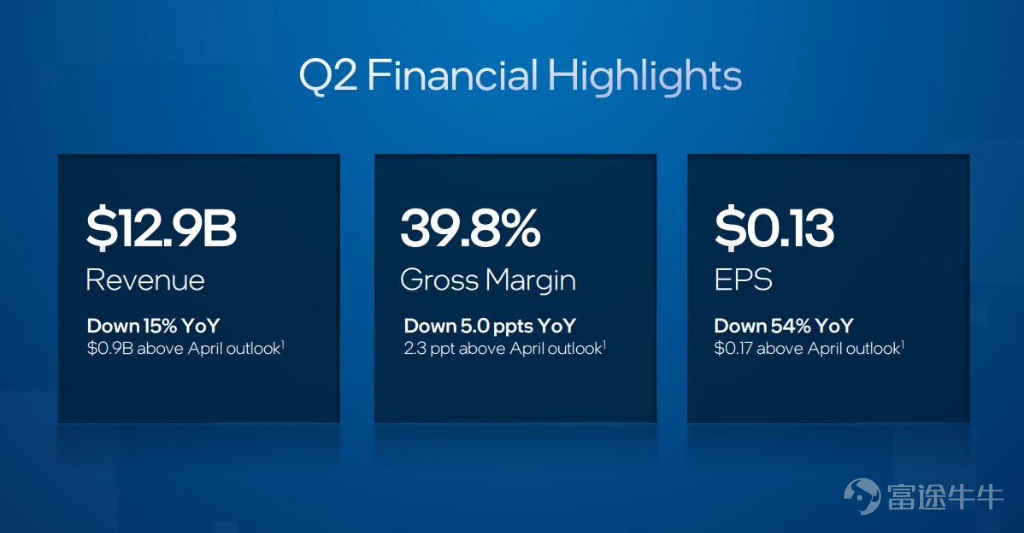
According to financial reports, Intel's revenue for the second quarter fell 15% year on year to 12.9 billion US dollars, higher than market expectations of 12.02 billion US dollars. The gross margin for the second quarter fell 0.7 percentage points year-on-year to 35.8%, and adjusted gross margin was 39.8%. Earnings per share for the second quarter were $0.35, and non-GAAP earnings per share fell 54% to $0.13.

The company's second-quarter revenue and net profit both exceeded the highest range of the company's own guidelines. However, Intel's gross margin is still far below the 60% level it has maintained for many years, when the company had dominant market share and production facilities.

In the second quarter, Intel provided shareholders with a quarterly dividend of 12.5 cents per share. Additionally, the company said it is on track to achieve $3 billion in cost savings in 2023.
Intel expects a modest recovery in the second half of the year. The company expects third-quarter revenue of US$12.9 billion, slightly lower than analysts' expectations of US$13.28 billion; adjusted revenue for the third quarter was US$12.9 billion to US$13.9 billion, with a median value higher than analysts' expectations of US$13.28 billion. The company expects third-quarter earnings of $0.04 per share and non-GAAP earnings of $0.2 per share. Intel expects gross margin for the third quarter to be 43%, higher than market expectations of 41%.
Market analysts believe that Intel's performance guidance for the third quarter exceeded expectations, meaning that market demand for PC components is improving, and the industry's long-awaited recovery may have begun. Analysts believe that Intel's performance guidelines also show that after the slump in demand for PC chips hit its business hard, Intel has come out of trouble.The company's management had promised improvements in the second half of the year, and now investors have seen fresh evidence. However, the company is still in the early stages of turning a loss into a profit, depending on whether Intel can once again establish its once rock-solid leadership position in chip technology. Many investors still have doubts about whether Intel can recover in the second half of the year. In the AI boom since the end of last year, chip manufacturers such as Nvidia and AMD have risen sharply, yet Intel is regarded by the market as relatively lagging behind in the AI field.
Although Intel is already showing signs of recovery, it's still a long way from its heyday. In 2021, the company had quarterly sales of over $20 billion.
Driven by the company's second-quarter results and third-quarter guidance exceeding expectations, Intel once rose more than 7.5% after the US market on Thursday.

Looking at the split business, Intel's customer computing business revenue fell 12% to 6.78 billion US dollars in the second quarter, higher than market expectations of 6.10 billion US dollars; data center and artificial intelligence business revenue fell 15% to 4 billion US dollars, higher than market expectations of 3.82 billion US dollars; revenue from the network and innovation business plummeted 38% to 1.4 billion US dollars; MobilEye business revenue fell slightly by 1% to 454 million US dollars; and Intel Foundry's services business surged 307% year over year to US$232 million.


In terms of operating profit margins, the operating profit margin of Intel's customer computing business in the second quarter was 15%, the operating loss rate of the data center and artificial intelligence business was 4%, the operating loss rate of the network and innovation business was 14%, the operating profit margin of the MobilEye business was 28%, and the operating loss rate of the Intel Foundry service business was 62%.

Although Intel's stock price has risen nearly 30% this year by Thursday's close, its performance is still inferior to the overall increase in the US chip sector. The Philadelphia Semiconductor Index has risen 49% since this year.

Risk Disclaimer: The above content only represents the author's view. It does not represent any position or investment advice of Futu. Futu makes no representation or warranty.Read more

Comments
to post a comment
2
2