
English
Back
Open Account
台積電Q2淨利繼續下滑,Q3會反彈嗎?
华尔街见闻
joined discussion ·

Weak Consumer Electronics Market Weighs on Taiwan Semiconductor, Q2 Profit Drops 23% | Earnings Insights

The flourishing wave of AI has provided Taiwan Semiconductor, which has been struggling against headwinds in the semiconductor industry, with a lifeline. Over the past three months, a surge of AI-related orders has partially offset the impact of the consumer electronics downturn, but in the short term, the newly added AI demand still provides relatively limited support to Taiwan Semiconductor’s performance.
At 4 PM on Thursday, July 20th, Beijing time, the world's largest semiconductor manufacturer, Taiwan Semiconductor, announced its Q2 results as of June 30.$Taiwan Semiconductor (TSM.US)$
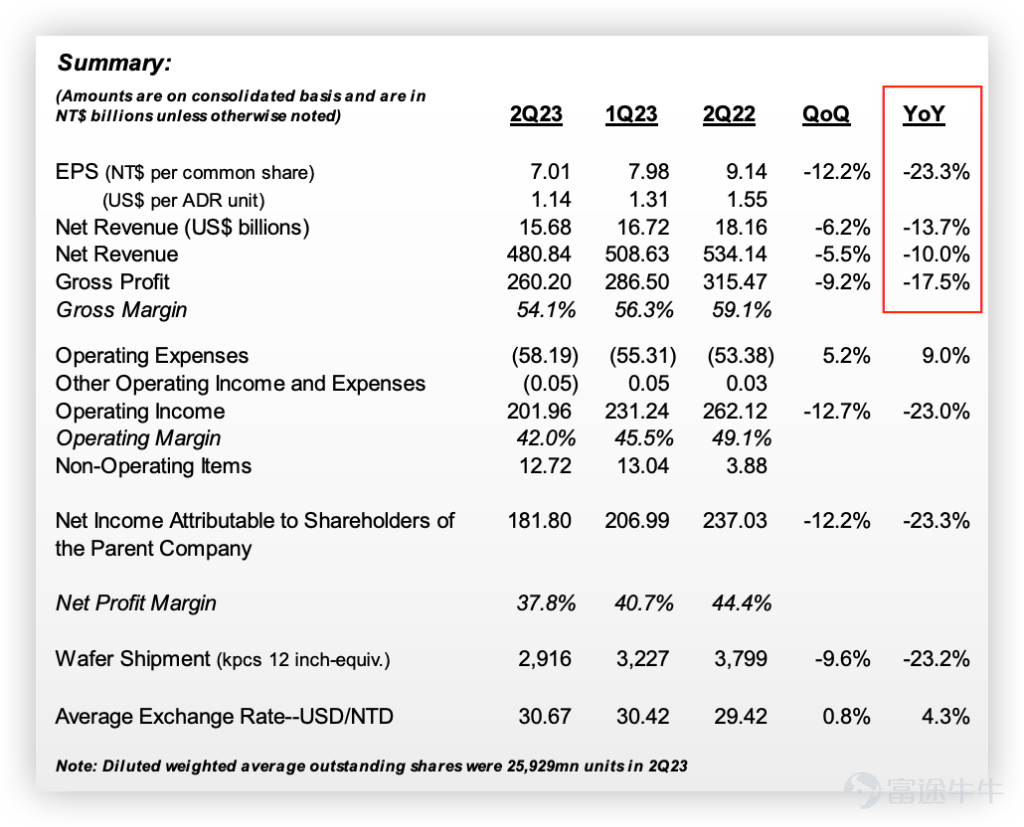
The financial report showed that Taiwan Semiconductor's revenue for this quarter was NT$480.84 billion, a year-on-year decrease of 10% (or 13.7% in US dollars), marking the first quarterly profit decline in four years and the fourth consecutive month of declining revenue.This quarter's net profit decreased by Plummeted by 23%, decreasing from NT$237 billion in the same period last year to NT$181.8 billion. On a quarterly basis, revenue for this quarter fell by 5.5%, while net profit dropped by 12.2%.
However, considering the overall downturn in the industry, Taiwan Semiconductor has demonstratedstrong resilience. Revenue for this quarter was largely in line with previous guidance, and although net profit saw a significant decline, itoutperformed Wall Street's consensus expectation of a 27% drop.
The surging wave of AI has provided a lifeline for Taiwan Semiconductor, which has been struggling against headwinds in the semiconductor industry. Over the past three months, a flood of AI-related orders has partially offset the impact of the downturn in the consumer electronics sector. However, in the short term, the new AI-driven demand has had only limited effect on boosting Taiwan Semiconductor’s performance. On Thursday afternoon, July 20th, Beijing time, the world's largest semiconductor manufacturer, Taiwan Semiconductor, announced its Q2 financial results as of June 30.$Taiwan Semiconductor (TSM.US)$ The earnings report showed that Taiwan Semiconductor's revenue for this quarter was NT$480.84 billion, a year-on-year decline of 10% (or 13.7% in dollar terms),marking the first quarterly profit decline in four years and the fourth consecutive month of falling revenue.Net profit for this quarter dropped by23%, from NT$237 billion in the same period last year to NT$181.8 billion. On a quarter-over-quarter basis, revenue fell by 5.5%, while net profit declined by 12.2%. However, considering the overall sluggishness of the industry, Taiwan Semiconductor has already shownFull cold resistance capability, this season's revenue was generally in line with the previous earnings guidance, and although net profit saw a significant decline, it was better than Wall Street’s consensus expectation of a 27% drop.。 In terms of profitability, this quarter's gross margin was 54.1%, operating margin was 42.0%, and net profit margin was 37.8%, all showing a slight decline from the previous quarter. From the perspective of wafer process technology, shipments of the 5-nanometer process accounted for 30% of total wafer revenue this quarter; the 7-nanometer process accounted for 23%, and...
In terms of profitability, the gross margin for this quarter was 54.1%, the operating margin was 42.0%, and the net profit margin was 37.8%, all showing slight declines compared to the previous quarter.
In terms of wafer technology nodes, shipments of the 5-nanometer process accounted for 30% of total wafer revenue this quarter; the 7-nanometer process accounted for 23%, and advanced processes of 7 nanometers and above represented 53% of total wafer revenue.
The surging wave of AI has provided a lifeline for Taiwan Semiconductor, which has been struggling against headwinds in the semiconductor industry. Over the past three months, a flood of AI-related orders has partially offset the impact of the downturn in the consumer electronics sector. However, in the short term, the new AI-driven demand has had only limited effect on boosting Taiwan Semiconductor’s performance. On Thursday afternoon, July 20th, Beijing time, the world's largest semiconductor manufacturer, Taiwan Semiconductor, announced its Q2 financial results as of June 30.$Taiwan Semiconductor (TSM.US)$ The earnings report showed that Taiwan Semiconductor's revenue for this quarter was NT$480.84 billion, a year-on-year decline of 10% (or 13.7% in dollar terms),marking the first quarterly profit decline in four years and the fourth consecutive month of falling revenue.Net profit for this quarter dropped by23%, from NT$237 billion in the same period last year to NT$181.8 billion. On a quarter-over-quarter basis, revenue fell by 5.5%, while net profit declined by 12.2%. However, considering the overall sluggishness of the industry, Taiwan Semiconductor has already shownFull cold resistance capability, this season's revenue was generally in line with the previous earnings guidance, and although net profit saw a significant decline, it was better than Wall Street’s consensus expectation of a 27% drop.。 In terms of profitability, this quarter's gross margin was 54.1%, operating margin was 42.0%, and net profit margin was 37.8%, all showing a slight decline from the previous quarter. From the perspective of wafer process technology, shipments of the 5-nanometer process accounted for 30% of total wafer revenue this quarter; the 7-nanometer process accounted for 23%, and...
Can AI Save Taiwan Semiconductor?
It is worth noting that some analysts believe that Taiwan Semiconductor’s smaller-than-expected decline in performance this quarter is mainly due to its benefit from the rise of artificial intelligence.
OpenAI's chatbot, ChatGPT, triggered a wave of frenzied AI hype in the first half of the year. For large-scale AI model training, NVIDIA GPUs are almost the only choice.From cloud service providers like Microsoft and Amazon to a host of tech companies eager to enter the AI space, NVIDIA GPUs have been almost entirely bought out.According to previous reports, since the beginning of this year, orders from ByteDance alone may have approached the total sum of NVIDIA’s commercial GPU sales in China last year.
Taiwan Semiconductor is precisely the main contract manufacturer for NVIDIA's GPUs.
This is also reflected in its financial performance. This quarter, Taiwan Semiconductor’s revenue pillar—high-performance computing (HPC) business, where GPU manufacturing is located—declined by 5% quarter-on-quarter, showing significant improvement compared to the previous quarter’s -14% drop.
The surging wave of AI has provided a lifeline for Taiwan Semiconductor, which has been struggling against headwinds in the semiconductor industry. Over the past three months, a flood of AI-related orders has partially offset the impact of the downturn in the consumer electronics sector. However, in the short term, the new AI-driven demand has had only limited effect on boosting Taiwan Semiconductor’s performance. On Thursday afternoon, July 20th, Beijing time, the world's largest semiconductor manufacturer, Taiwan Semiconductor, announced its Q2 financial results as of June 30.$Taiwan Semiconductor (TSM.US)$ The earnings report showed that Taiwan Semiconductor's revenue for this quarter was NT$480.84 billion, a year-on-year decline of 10% (or 13.7% in dollar terms),marking the first quarterly profit decline in four years and the fourth consecutive month of falling revenue.Net profit for this quarter dropped by23%, from NT$237 billion in the same period last year to NT$181.8 billion. On a quarter-over-quarter basis, revenue fell by 5.5%, while net profit declined by 12.2%. However, considering the overall sluggishness of the industry, Taiwan Semiconductor has already shownFull cold resistance capability, this season's revenue was generally in line with the previous earnings guidance, and although net profit saw a significant decline, it was better than Wall Street’s consensus expectation of a 27% drop.。 In terms of profitability, this quarter's gross margin was 54.1%, operating margin was 42.0%, and net profit margin was 37.8%, all showing a slight decline from the previous quarter. From the perspective of wafer process technology, shipments of the 5-nanometer process accounted for 30% of total wafer revenue this quarter; the 7-nanometer process accounted for 23%, and...
Moreover, according to Taiwan’s DigiTimes, since the first quarter of this year, AI chip design companies in mainland China have been expanding their chip orders using Taiwan Semiconductor’s 7-nanometer process.
Mainland China’s AI HPC chip suppliers were not included on the export ban list, with at least dozens of companies continuing to invest. Since the first quarter of this year, two leading chip design companies have expanded their orders for Taiwan Semiconductor’s 7-nanometer chips.
Considering Taiwan Semiconductor’s nearly unshakable position as the “shovel maker,” major Wall Street firms like Goldman Sachs had already successively raised Taiwan Semiconductor’s target price as early as early June, believing that the massive demand for AI chips would become a key growth driver for the company over the next 3-5 years.
During the earnings call,Taiwan Semiconductor CEO C. C. Wei subtly revealed that current AI-related demand has already “exploded” in terms of orders, stating that the company would not be able to “fully resolve” the supply shortage of AI chips until the end of 2024. Additionally, he noted that Taiwan Semiconductor has incorporated artificial intelligence into its capital expenditures and long-term sales outlook, estimating that approximately 50% of revenue growth forecasts stem from the AI sector.
Is the consumer electronics market rebounding from its bottom?
As the world's largest semiconductor manufacturer, Taiwan Semiconductor has been under pressure due to the downturn in the consumer electronics market.Despite a rapid increase in orders related to AI chip manufacturing, Taiwan Semiconductor’s performance this quarter was still weighed down by the weak overall performance of smartphones.
According to Samsung Electronics’ earnings guidance released earlier this month, the company may experience its worst quarterly revenue decline since 2009 in the second quarter. Multiple institutions predict that Samsung Electronics' semiconductor business will incur losses exceeding 10 trillion Korean won in 2023, indicating that the already year-long winter of consumer electronics demand is not over yet.
However, according to data from research firm Canalys, the consumer electronics market may be nearing its bottom.
The company stated that global smartphone shipments plummeted by 11% during the second quarter of this year, marking the sixth consecutive quarterly decline. However, the backlog of unsold phones is decreasing. Canalys analyst Le Xuan Chiew noted that smartphone vendors are striving to reduce inventory of older models to make room for the release of new models.
Lithography machine manufacturer ASML also recently indicated that orders for lithography machines rebounded somewhat in the second quarter. This could bean early signal of recovery in the consumer electronics market.
However, during the earnings call, Taiwan Semiconductor CEO C. C. Wei stated thatfuture performance will still largely depend on the macroeconomic outlook.
Looking ahead to the third quarter, Taiwan Semiconductor’s guidance remains relatively conservative. The company expects its revenue to range between $16.7 billion and $17.5 billion (NT$519.2 billion to NT$544.2 billion), marking a slight rebound from this quarter butbelow market expectations.In addition, Taiwan Semiconductorfurther lowered its full-year revenue guidance to a 10% decline,revised down from the previous single-digit percentage drop.
The surging wave of AI has provided a lifeline for Taiwan Semiconductor, which has been struggling against headwinds in the semiconductor industry. Over the past three months, a flood of AI-related orders has partially offset the impact of the downturn in the consumer electronics sector. However, in the short term, the new AI-driven demand has had only limited effect on boosting Taiwan Semiconductor’s performance. On Thursday afternoon, July 20th, Beijing time, the world's largest semiconductor manufacturer, Taiwan Semiconductor, announced its Q2 financial results as of June 30.$Taiwan Semiconductor (TSM.US)$ The earnings report showed that Taiwan Semiconductor's revenue for this quarter was NT$480.84 billion, a year-on-year decline of 10% (or 13.7% in dollar terms),marking the first quarterly profit decline in four years and the fourth consecutive month of falling revenue.Net profit for this quarter dropped by23%, from NT$237 billion in the same period last year to NT$181.8 billion. On a quarter-over-quarter basis, revenue fell by 5.5%, while net profit declined by 12.2%. However, considering the overall sluggishness of the industry, Taiwan Semiconductor has already shownFull cold resistance capability, this season's revenue was generally in line with the previous earnings guidance, and although net profit saw a significant decline, it was better than Wall Street’s consensus expectation of a 27% drop.。 In terms of profitability, this quarter's gross margin was 54.1%, operating margin was 42.0%, and net profit margin was 37.8%, all showing a slight decline from the previous quarter. From the perspective of wafer process technology, shipments of the 5-nanometer process accounted for 30% of total wafer revenue this quarter; the 7-nanometer process accounted for 23%, and...
Charles Shum, an analyst at Bloomberg Intelligence, commented:
The headwinds facing smartphone demand have proven stronger than anticipated, affecting the robust growth of AI chip orders. Although Taiwan Semiconductor reported sales that exceeded consensus estimates, after adjusting for currency effects, its performance still landed in the middle of the guidance range. In my view, thishighlights the impact of sluggishness in the smartphone industry on its overall results. Moving forward, market conditions warrant close monitoring, especially signs of recovery in smartphone demand, to assess their potential influence on the profit trajectory in the second half of the year.
Challenges in U.S. factory construction: Lack of skilled workers delays production start until 2025
During the earnings call, Taiwan Semiconductor executives also noted challenges in their overseas expansion plans. The Arizona plant in the United States, with an investment of up to $40 billion, has faced slow construction progress due to a shortage of skilled workers. The production launch of the 4-nanometer wafer facility has been postponed from the end of 2024 to 2025.
In February this year, The New York Times reported that the cost for Taiwan Semiconductor to build a factory in the United States was ten times higher than building one in Taiwan Province. Additionally, Taiwan Semiconductor was "not accustomed" to working with American workers. The report cited a ** engineer who complained that some American workers would refuse to take on tasks if assigned multiple jobs, rather than "striving to complete all work."
The surging wave of AI has provided a lifeline for Taiwan Semiconductor, which has been struggling against headwinds in the semiconductor industry. Over the past three months, a flood of AI-related orders has partially offset the impact of the downturn in the consumer electronics sector. However, in the short term, the new AI-driven demand has had only limited effect on boosting Taiwan Semiconductor’s performance. On Thursday afternoon, July 20th, Beijing time, the world's largest semiconductor manufacturer, Taiwan Semiconductor, announced its Q2 financial results as of June 30.$Taiwan Semiconductor (TSM.US)$ The earnings report showed that Taiwan Semiconductor's revenue for this quarter was NT$480.84 billion, a year-on-year decline of 10% (or 13.7% in dollar terms),marking the first quarterly profit decline in four years and the fourth consecutive month of falling revenue.Net profit for this quarter dropped by23%, from NT$237 billion in the same period last year to NT$181.8 billion. On a quarter-over-quarter basis, revenue fell by 5.5%, while net profit declined by 12.2%. However, considering the overall sluggishness of the industry, Taiwan Semiconductor has already shownFull cold resistance capability, this season's revenue was generally in line with the previous earnings guidance, and although net profit saw a significant decline, it was better than Wall Street’s consensus expectation of a 27% drop.。 In terms of profitability, this quarter's gross margin was 54.1%, operating margin was 42.0%, and net profit margin was 37.8%, all showing a slight decline from the previous quarter. From the perspective of wafer process technology, shipments of the 5-nanometer process accounted for 30% of total wafer revenue this quarter; the 7-nanometer process accounted for 23%, and...
Taiwan Semiconductor Chairman C. C. Wei stated during a conference call following the earnings announcement that efforts were being made to send skilled technical workers from Taiwan to the United States to address this issue.
Risk Disclaimer: The above content only represents the author's view. It does not represent any position or investment advice of Futu. Futu makes no representation or warranty.Read more
Lol
1
Sob
1
Thumbs Up
7
Respect
1
46K Views
Report
Comments
Write a Comment...
10
14