

聚焦2023巴菲特股东大会!

The 2023 Buffett Shareholders' Meeting is here! Here are the full highlights of the five and a half hour question and answer
On Saturday, May 6, starting at 9:15 a.m. Central Time (10:15 p.m. Beijing time), Buffett, who turned 93, and his old partner, Munger, 99, will attend the Q&A session at Berkshire Hathaway's Annual Shareholders' Meeting on August 30 this year.
This is the second time that an annual shareholders' meeting has been held offline since the COVID-19 pandemic, and the 59th time Buffett has attended a lengthy Q&A session. As proof of vaccination is no longer required, outsiders expect a significant increase in the number of participants this time, possibly returning to 30,000 people before the pandemic.
It is worth noting that the macro background at the time of this conference was quite unsettled: The US banking industry is in turmoil, debt ceiling negotiations are at an impasse, the economy is on the brink of recession, geopolitical conflicts continue to heat up, artificial intelligence is bringing major opportunities and risks. Investors with a “pilgrimage” mentality are eagerly looking forward to hearing the “Omaha Prophet” reviews and investment wisdom of the “Prophets of Omaha” on the era of great change.
Consistent with the tradition of offline meetings before 2020 was disrupted by the pandemic, shareholder admission cards will be issued at Omaha CHI Health Center on Friday local time, and a product shopping day for Berkshire's subsidiaries will be held. Before Saturday's Q&A session begins, Berkshire will release its first quarter earnings report at 8 a.m. EST, and there will also be a 5 km “invest in yourself” jogging event on Sunday morning.
Wall Street News previously sorted out in detail the key points of interest at this year's Buffett shareholders' meeting. Buffett admits that last year's Q&A session spent too much time on a few questions, and the number of questions will increase this year. It is expected that about 60 questions will be answered in five and a half hours.
Investors are most concerned about: Stock buybacks, Buffett, and the transition of Greg Abel, vice chairman of the company that manages all uninsured businesses, the current hottest topics such as the current topical issue of oil and gas in the context of California's ban on the sale of new internal combustion locomotives until 2035, why they are optimistic about the Japanese stock market, and the impact of the European and American banking crisis, the US debt ceiling, and the impact of artificial intelligence.
Although the Berkshire Shareholders' Meeting, known as the “Spring Festival Gala in the Investment Industry,” usually ends in a “happy and peaceful” atmosphere due to the charisma of Buffett and Munger, who are in their nineties, shareholders will still present some sharp issues this year, including a proposal to separate the roles of CEO and Chairman and ask Buffett to step down as chairman.
Although Berkshire “cliché” once again recommended that shareholders reject the relevant proposal on the grounds that Buffett has 31.5% of Berkshire's voting rights and that the board of directors supports him as the controlling shareholder and also serves as the chairman of the board and CEO, related proposals have continued to emerge in recent years, which also highlights people's anxiety about whether the aging Buffett can successfully take over and maintain the corporate culture.
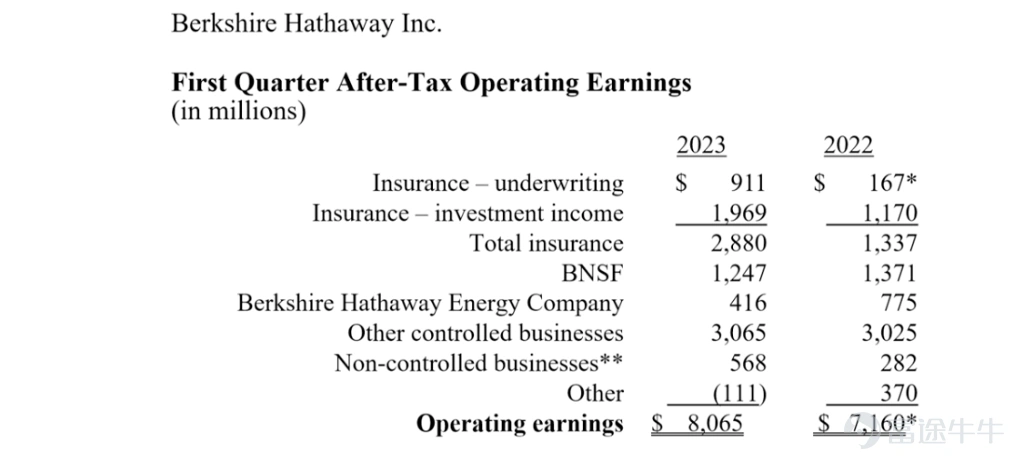
On Saturday morning local time, Berkshire Hathaway released its first quarter earnings report. Revenue was US$85.393 billion, up 20.5% year on year, and operating profit, including profits from wholly-owned subsidiaries, was US$8.065 billion, up 12% year on year, mainly due to a sharp rebound in the insurance business. Among them, insurance underwriting profit jumped 445% year over year to US$911 million, and insurance investment income jumped 68% to US$1.969 billion.
Financial reports show that Berkshire's cash reserves increased by more than 2 billion US dollars to 13.6 billion US dollars from 1,280 US dollars in the fourth quarter of last year, breaking the 1,300 US dollar mark, the highest since the end of 2021. The company also bought back 4.4 billion US dollars of shares, significantly higher than the 2.8 billion US dollars at the end of last year, and the largest repurchase amount since the first quarter of 2021. Berkshire's company bought back 2.9 billion US dollars of shares.
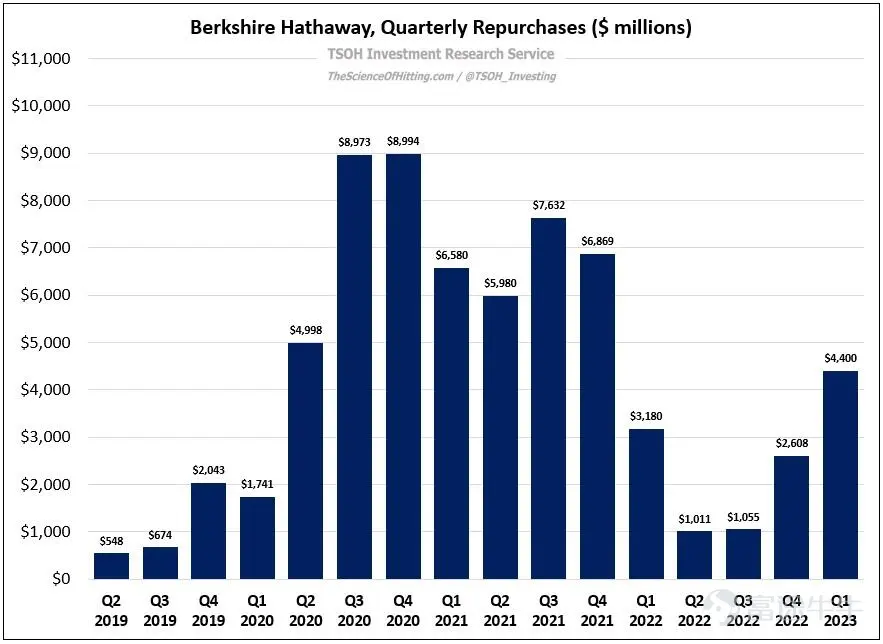
Notably, Buffett almost “just threw away and didn't buy” in the first quarter. He sold shares worth 13.3 billion US dollars during the quarter, but the amount of shares purchased was only a fraction. Due to unrealized gains from stock investments, including Apple, Berkshire's net income during the quarter, including short-term investment income, increased from 5.6 billion US dollars in the same period last year to 35.5 billion US dollars.
On February 25, Buffett published an annual open letter to shareholders on Berkshire Hathaway's official website. Wall Street News has translated the “stock god”'s investment wisdom in full.
The following is a real-time update of the Buffett Shareholders' Meeting Q&A session (based on the Central US Time where the meeting is located)
15:36 At the end of the Q&A session at Berkshire Hathaway Shareholders' Meeting, Buffett said he unfortunately did not answer the 60th question this year, “Fight again next year!”
15:33 How to pass on your wisdom to your grandchildren, should you invest in family traditions or personal behavior?
Buffett said that I generally don't like seeing what my grandchildren do, and I wouldn't say it either. Munger said it's easy to make decisions when you're young (ignorant).
Munger also claimed that his grandchildren did not exactly follow his ideas; he accepted it very calmly. This seems to be the natural process of life. Buffett said he feels he and his kids have gotten smarter over the past few decades. Munger retorted, saying Buffett needed some help to do it.
15:25 Buffett said that if you look at Berkshire's earnings report, don't look at unrealized investment gains and losses, because it doesn't reflect the long-term benefits of the investment, but bank assets “held until maturity” are also unrealized profits and losses, which has caused industry turmoil. Why are banks' financial reporting standards different from Berkshire's?
Buffett said that the changes in the balance sheet are correct, but the income statement (income statement) should not show unrealized profit or loss; otherwise, it has nothing to do with shareholders' interests, because it is an unrealized investment profit or loss. We want shareholders to know what they have, and especially what they can reap in the long run.
The balance sheet can tell whether the deposit can be recovered and reflect this information. Part of this statement is true; banks need to decide whether the balance sheet represents value. Apple's income statement can change a lot while we talk. If it's a bank, it's not a good tool. But it's a good tool for consumers. You have to pay attention to what kind of value you have. Management has an obligation to do so. What I said to my shareholders was the same as what I said to my family.
15:17 Supply chain issues occurred in the Asian region during the COVID-19 pandemic. After experiencing this, some people decided to shift production locally. If companies do this, should the government support them?
Munger said that if you think moving to Mexico is less expensive to produce products, it's logical. However, you wouldn't want all production to be moved away and a production site emptied.
Buffett mentioned that Berkshire started out as a textile manufacturer. He believes that economic prosperity means that society can take care of people who have lost their jobs due to the transfer of economic activity elsewhere. The government's duty is to enjoy the benefits of capitalism without making a group suffer too much. Societies can withstand the negative effects of improved trade. Let's hope that all countries will succeed, not let America succeed at the expense of the entire world.
15:09 Does the size of the Federal Reserve's current balance sheet worry you?
Buffett stated that he is not worried about the Federal Reserve, supports the Fed's mission to reduce the inflation rate, nor is he worried about the Fed's balance sheet, even though he joked that “that is a big number, and I like to look at these big numbers.”
Buffett said that seeing the Fed's balance sheet increase from 800 billion US dollars to 2.2 trillion US dollars made him think of the phrase “cash is never garbage.” However, he opposed crazy money printing, which caused inflation to skyrocket, just as the US experienced at the end of World War II. Munger shared the same view, saying that there will be negative consequences if we continue to print money to solve short-term problems.
15:03 The global trend is that zero-emission vehicles are nearing mass adoption. Do you see opportunities in the industry and which car manufacturer and technology are you optimistic about?
Buffett said that the automobile industry is very competitive. 5 to 10 years from now will definitely not be the same, but it is impossible to predict how it will develop. It can only be said that even if one company changes cars, it cannot control the entire market.
14:54 See's candy (See's candy)'s operating performance, whether to open a new store, and NetJet's performance after it was acquired.
Buffett said that Hishi Candy is an excellent brand. We have tried various methods in this world to expand the appeal of Hishi Candy to places other than California, but the appeal of this brand is limited, and it only stays close to the western part of the US.
Munger said that NetJets is excellent and believes that it is now worth as much as any airline. Buffett said that NetJets is growing in size, saying it's an amazing company. He didn't really answer how NetJets performed compared to expectations at the time of Berkshire's acquisition.
Munger said he used to fly economy class from Los Angeles to the annual meeting site. When they met wealthy Berkshire shareholders on the plane, those shareholders applauded him. He loved that feeling.
14:47 Berkshire emphasized that properly aligned incentives (properly aligned incentives) gave its subsidiaries more autonomy. Can you discuss this in detail?
Buffett said that when they own a company, managers like their own business, but it's not OK if they don't like the complexity brought about by a listed company, because others will point their hands and fingers. I've had five bosses in my life and I love them all. But nothing compares to working for yourself. There's a lot to be gained from working here, including freedom.
14:33 The minimum 15% tax for enterprises can be extended if tax returns are delayed in calculating the commercial tax law? For example, can new energy be used to save taxes?
15% is definitely something to do. Wouldn't be sad or disapproved; willing to pay 15% tax. If we have to pay, we're happy to do it. Previously, we paid the federal government 52% tax. I don't think there's any way to avoid US policy. The new law has yet to be implemented, and it is unclear what the consequences will be. How to protect conservative marginal interests.
14:25 How to distribute cash to shareholders. There is more and more cash. Over $100 billion in cash.
Berkshire stock is undervalued than expected. What we want to do is buy great businesses. Going public can be difficult. Sometimes bids are put forward, and after they are submitted, others also compete. A private enterprise would be relatively easy. Some companies that seem to be good have encountered quite a few obstacles when it comes to acquisitions. Some good companies don't want to sell the whole company. If we don't find a good company, we may still buy back our shares. There aren't as many opportunities now as before, but because of decisions made before, they are still making money and the returns are stable.
14:22 Considering Musk's success in the business, did Munger change his opinion on Musk, and did Musk overestimate himself?
Munger said that Musk did overestimate himself, but he is very talented, so he would overestimate someone who is talented without being overrated. Without setting himself impossible goals, Musk wouldn't be able to achieve what he has today. He likes to do that, and Munger himself and Buffett wanted to do something easier.
Buffett said we don't want to compete with Musk on many things. Musk is smart, probably with an IQ over 170, and says he can't use the word fanatical. Munger said, in fact, it's fanaticism. Buffett said that it was a commitment to solve the impossible; for Buffett himself and Munger, it was a form of torture.
14:11 Two months ago, some media said that oil producers may have peaked in production. Can you explain Berkshire's large holdings in oil stocks?
Buffett said that no other place in the US can have as many oil reserves as the Permian Basin (Permian). However, shale oil wells are also rapidly declining. They may produce 12,000 to 15,000 b/d on the first day of opening, and may be exhausted in a year or a year and a half.
Berkshire loved Occidental Petroleum's resources and industry position in the Permian Basin, so we took a stake in it. I really like Occidental Petroleum's management, and I'm familiar with them. Occidental Petroleum has done a lot of good things, and it is profitable to build many new wells:
“Not as much hype suggests, Berkshire won't buy a controlling interest in Occidental Petroleum; the management is already great. “I'm not sure if I'll continue to buy more shares in oil companies in the future, but I'm very happy with my current holdings.”
14:03 We have the possibility of transitioning to new energy sources. Is investment in new energy sufficient now? Can Berkshire Energy's old energy portion be retired and completed according to established emissions standards?
Wind power has already begun in Iowa. It's very windy there in Wyoming. Competitors are also changing resources accordingly. When it comes to generating electricity from various sources in the US, I hope to generate 70% or 80% of revenue. We will continue to invest for the next 20 years. It requires significant investment. I hope to invest heavily and place my assets in these places. Berkshire's energy company is already making some of these changes. We already have 4 billion dollars, and will pursue 3 billion dollars, for a total investment of 7 billion dollars.
Munger said that I don't think anyone knows what will happen with global warming.
13:58 Paramount Global, an entertainment media company owned by Berkshire, recently announced poor performance in its quarterly report, cutting 80% dividend. What does Buffett think of the streaming media industry, and is the shareholding investment decision based on fundamentals or the potential for a company to become an acquisition target?
Buffett said that individual stocks are not evaluated. Our business is not to provide stock advice. But it's not good news for any company to cut dividends. In his opinion, the streaming media business is worth watching. In the 30s and 40s, Disney was unique in making cartoons, but now it's a different world. Viewers' attention won't increase dramatically, and the amount of time they spend watching streaming will not increase.
When talking about the film business, Buffett said that film talents make money, and agents also make money. But everyone only has this much time in a day, and they only have two eyes. He also said that talent will always be rewarded.
13:52 Berkshire sells some consumer goods to one retailer, and some to several. How do you decide which distributors are?
Buffett said that some brands are highly recognizable. Even though it can be sold at Walmart, the status is still different. We looked at a variety of retail methods. I slowly learned what I needed to avoid. Walmart is good for us when it comes to distribution. However, some products are not products that people can buy in 20 minutes, so we need to have multiple distributors, and their prices need to be reasonable. We hope to have multiple partners with distribution capabilities like Walmart.
13:43 In the 2022 shareholder letter, you mentioned that the most important factor in Berkshire's success was taking advantage of “America's success” and not making major bad decisions. How can we avoid investing and making bad decisions in life?
Buffett and Munger both recommend that young people spend less money than they earn, that is, measure income and expenses, and try to avoid credit card debt. Because interest rates are too high, you need to make more money to beat interest rates on credit card debt. Try not to get into debt other than your mortgage.
Buffett's life wisdom also includes: don't criticize others forever, don't belittle others to express your opinions. There's also a broad suggestion: a kind person won't be without friends and don't act unkind.
Munger, on the other hand, said that we should learn to stay away from toxic environments and people, stick to lifelong learning, and be full of gratitude. If you haven't succeeded in doing the above, it may take a lot, a lot of luck. But you can't just rely on luck, but win the game on your own:
“Toxic people want to trick you, drag you down, hurt you, and get them out of your life quickly. You need to know how people manipulate others and then avoid doing it yourself. You should write down your obituary and find a way to achieve the mentioned accomplishments.”
13:26 A 13-year-old girl attending the Berkshire Convention for the sixth time. She asked that the US has issued large amounts of debt, the Federal Reserve has monetized the debt, and China, Brazil, Saudi Arabia, etc. are all decoupling from the US dollar. In this environment, when will the dollar's monetary reserve position be threatened?
Buffett believes that there is no candidate to replace the US dollar as a reserve currency. He said that no one knows the situation better than Federal Reserve Chairman Powell, but he has no control over fiscal policy.
Buffett said that no one knows how long a banknote can last until it gets out of control, especially when this kind of currency is a global reserve currency.
Buffett believes that it is easy for the US to print large amounts of money, and they should be very careful. If there is too much money, once the spirit of inflation is released from the bottle, it will be difficult to recover, and people will lose trust in the currency.
Buffett said that he can't predict what the outcome will be; it won't be a good outcome anyway. Now this is a very politicized decision. Munger said that at some point, winning votes by printing money would be counterproductive.
Buffett said that the best personal defense is the ability to make money on one's own.
Referring to Japan's monetary policy and fiscal policy, Munger said that Japan has done strange things with yen. The Japanese should accept and respond to the economic policies implemented by Japan. Buffett added that if the yen were a reserve currency, those things couldn't have happened. Buffett said he admires Japan. Japan has a more cohesive society, but America should not follow Japan's example. Printing money over and over is insane.
13:18 What are the differences between the business models of major banks and regional banks?
Previously, I bought a bank and invested 19 million US dollars. At that time, I invested 17 million US dollars in insurance companies. If the bank merger bill doesn't pass, we'll buy more banks. However, the Banking Act was passed in 1970, and we must diversify our investments; there is no way to invest all of them in the banking industry. The banks I saw at the time didn't have many bad debts; it was a very healthy industry back then. People were also very honest back then. At that time, the banking industry was more attractive than the insurance industry. At that time, it was possible to develop a very healthy industry. Earn a good return on your bank investments. Then we had some bank shares, and then we sold them. More were sold during the pandemic.
I don't know how shareholders of big banks and regional banks will go next. I personally use regional banks as well. But as far as investment banks and owning banks are concerned, some events will determine their future. Politicians will participate during this period, and some people who don't understand the system will participate. The communication between them is imperfect. The American public is perplexed about the current state of banks. Many people don't know what the consequences are. Different events create different consequences. I don't know exactly what deposit and stickiness are. We are very careful about owning banks. We now also hold heavy positions with a bank, Bank of America, and I love their business and management. I don't know what's going to happen next; the past few months have surprised me.
Munger said that there has been a lot of speculative gambling now, and I'm very uncomfortable with this situation.
13:00 Rating of the banking crisis, risks and opportunities in this industry.
Buffett quipped that Munger can be described in popular terms in the banking industry today: “Available for Sale” (available for sale) and “held to maturity” (held until maturity).

Buffett believes that the situation in the banking industry is not much different from the situation that has always existed in this industry in the past. “Panic is contagious and always has been.” Buffett said his father lost his job in 1931 due to bank overcrowding.
Buffett said that in the past, if you saw people lining up at the bank, the right reaction was to join the queue. Now it's 2023, and we've seen that the regulatory agency FDIC can return deposits to every depositor, but people are still worried. In his opinion, this should not have happened, and the information was conveyed very poorly. Politicians, institutions, and media are not communicating the changes in the situation very well.
Buffett said that the incentives for bank regulation are too confusing, and many people want them to go wrong. This is insane. If people feel that deposits are no longer sticky, it is because the times of life have changed. Because of online banking services, we may run out of money within a few seconds.
Buffett said that those who do wrong must be punished. Bank directors have the power to hold the CEO to account. If a bank goes out of business, both the CEO and directors should be convicted; otherwise, no lesson can be taught.
Munger said, “I'm very old-fashioned; I prefer banks that don't do investment banking.
Buffett went on to say that bank savers will not lose money; those who lose money should be shareholders and bondholders, as well as those who use commercial real estate to borrow money when the loan period has not been extended. The people responsible for the problems must be punished in order to change their behaviour.
11:57 Let a person actually run his own company to see his talents. What are the future behaviors of Berkshire company managers that shareholders should be wary of?
Buffett said that it is difficult to find a suitable Berkshire successor, and he is very happy that CEO successor Abel “is a very satisfying candidate.” Berkshire is an autonomous driving model. It can operate well for a long time. It is difficult to judge whether the management of a very successful company is excellent, because such a high-quality company itself will run on its own for a long time (just like Berkshire).
11:49 Future voting control issues, who will have ownership over voting control? Can they meet their ESG goals? Which vote will have more weight?
Buffett said that from the perspective of wealth management, assets are managed. Big companies, like index funds, want a world where they have very small expenses on asset management, and this kind of success is relatively easy to replicate. It's a great way to bring in money.
11:43 Regarding electric vehicle owners buying car insurance from car manufacturers instead of insurance companies, how should Geico respond?
Jahn, vice chairman in charge of Berkshire's insurance business, said he hasn't seen a very successful case. Geico is in talks with equipment manufacturers to find a way to provide insurance at the point of sale. Auto insurance's profit margin is 4%, which is a very small figure. The number of companies involved in car insurance has increased, and it is even more difficult to make money in this industry.
Buffett said GM had auto insurance for decades. It's not a new idea for car companies to make their own insurance; at least there's no magic, but it's very difficult to do. Uber has signed quite a few insurance policies over a period of time. But it's not a big deal for Geico. It's hard to do a better job of matching risk and price than Geico and its rival Progressive.
11:35 Some investors named Benjamin Graham, the “father of value investing,” and Buffett as pioneering figures in “planting trees to keep future generations cool”. Can you listen to two elderly people over 90 years old talking about Berkshire after 100 years?
Buffett praised Benjamin Graham's influence on him, saying it shaped his view of investing. Graham's book “The Smart Investor”, written in 1949, has been in the top 300 to 350 of Amazon's book sales rankings until now. No book has ever been ranked this high. This book is a classic and has been a bestseller until today.
For Berkshire, Buffett hopes it will always be a company owned by shareholders and be beneficial to society. He said that Berkshire has strong capital and excellent human resources. “There is no reason to question that we won't become a classic of the times like this book.”
Munger mentioned an interesting thing, that is, more than 50% of Graham's own investment income comes from a stock, which is now an insurance company owned by Berkshire, Geico. He said that Graham chose Geico to invest in various high-profile and cheap companies at the time and bought an excellent company that was underrated. This method was followed by Berkshire.
Buffett immediately claimed that this shows that when necessary, we must act decisively. If one or two correct decisions are made, we will win, and we need to find the right one among many foolish things.
11:33 Berkshire once quickly bought and sold TSMC's shares. Why did they suddenly want to sell 80% of their 5 billion US dollar holdings in a few months?
Buffett said Taiwan's TSMC is one of the most important companies with the best management in the world. As far as chip companies are concerned, we think this company still has a leading position. This is a great company, and the people inside are amazing. If we can't find the right assets in the US, we'll allocate them elsewhere. The assets we have allocated, those in Japan and Taiwan, are all very good.
11:24 Regarding the current issue of the valuation of internet companies between the US and China, some Chinese technology companies have done things that US companies cannot. What do you think?
Both Buffett and Munger believe that the tense relationship between China and the US will cause unnecessary harm to both countries. Munger said that it is foolish for the US to clash with China. What we should do is live in harmony with China. The US should have extensive free trade with China.
Buffett said that there will be competition between China and the US, but there is always a need to judge how far things can progress if there is no response from each other. Both countries will be competitive, and both can prosper and develop.
11:19 Apple currently holds 35% of Berkshire's holdings and is close to the upper limit of the dangerous range. How do you evaluate it?
Buffett said that Apple has not reached 35% of our investment, and its shareholding in Apple is 5.6%, but the contribution to our operating profit is huge. Apple is mainly stock buybacks. We can't own more than 20% of Apple, and there is no special increase in our holdings. That is, the number of shares in circulation has only decreased after the repurchase, and watching our shareholding ratio is higher.
Berkshire has many businesses, and holding Apple has a great advantage. They keep buying back their shares, and they don't need us to do anything; the value of their holdings is rising. Apple's industry is different from many other companies; Apple is one of the better companies than our own subsidiaries. Our railway business is already very good, but it still can't keep up with the high quality of Apple's business.
Buffett said that Apple is a very good business, with high profit margins, high user loyalty, and close relationships with consumers. Two years ago, Berkshire sold some Apple shares due to tax considerations. This decision was foolish. Good opportunities aren't easy to identify. We want good businesses, and we want plenty of liquidity. Other than that, there are no limits.
Apple's position on consumers is that they are willing to pay $1,500 or whatever for a phone. The same people pay $35,000 to own a second car, and if they had to give up their second car or give up their iPhone, they would give up their second car. I mean, this is an extraordinary product. None of us own 100% of this good stuff, but we're very, very happy to own 5.6% of the shares, and we're happy with any 0.1% increase in our holdings.
11:07 Businesses need to build good products and be competitive. How to choose between short-term profits and building long-term moats?
Buffett said, take control of your destiny. No pressure from Wall Street, no investor meetings. He also said that he will continue to seek investment opportunities in Japan and was “surprised” by the five Japanese trading companies that increased their holdings last month.
Buffett first took a stake in these companies on his 90th birthday in August 2020. The latter is similar to a corporate group, including Mitsubishi Corp (Mitsubishi Corp), Mitsui (Mitsui), Itochu Corp (Itochu Corp), Marubeni (Marubeni), and Sumitomo (Sumitomo).
Buffett said that they as a whole brought about 14% of the profit from the Berkshire acquisition. They also paid considerable dividends and sometimes bought back stocks. At the same time, Berkshire can eliminate currency risk through yen financing, which costs only 0.5%. Last month, Buffett revealed that Berkshire had increased its shares in five major trading companies. Buffett said this time that he now holds 7.4% of the shares in these trading companies, and if they don't agree, they won't hold more than 9% of the shares.
Buffett said that Berkshire is the largest corporate borrower outside of Japan (that is, the issuer of corporate yen debt) and will continue to issue yen bonds. Berkshire has some direct business there, and we have some amazing partners working for us.
Buffett said he wanted to introduce CEO successor Abel to Japanese trading company executives because he realized that Berkshire would continue to invest and build relationships in Japan. Buffett predicts that investment in Japan will continue to add value to Berkshire in the next few years.
11:02 The reinsurance industry has had high returns over the past 15 years but competition is fierce. Berkshire doesn't seem to have allocated more capital to operate in the field of property loss insurance. Can you explain Allegany, which completed its acquisition last year?
Vice Chairman Jahn, who is responsible for the insurance business, said that Allegany's key business is the reinsurance industry. Berkshire will not make any adjustments to its management and business strategy after the acquisition. The company was very successful before, and he hopes to be successful in the future.
In terms of property damage insurance, pricing over the past ten years has not been very advantageous. It is hoped that more capital can be allocated this year to obtain attractive returns. Berkshire's current property damage insurance portfolio is already large. It is operating at the upper limit of coverage, and the profit margin is very unbalanced. For example, if another hurricane occurs in Florida, it may lose a disproportionately large amount of money, or even lose 15 billion US dollars, which is equivalent to the profit of the entire portfolio, but the current situation is much better than before.
10:52 Can you share a story we haven't heard yet, describing the personalities and talents of Berkshire's two vice presidents as leaders?
Buffett said that Jahn, who is in charge of the insurance business, came to my office in 1986. He is a good person. He runs the company in the traditional way. The operation method is high enough. He has not tried to change the system; he has been improving the system. He had zero experience with insurance at the time, but he experienced the various ways American businesses operate. When I was chatting with him, I decided to hire him and give him some start-up capital so that he could enter the market and make a difference. Jahn's position is irreplaceable, and he is now one of the top ten most powerful insurance managers in the world. When I read his resume, I never looked at which school he graduated from, but he just happened to go to a very good university.
10:38 Japanese investors asked Buffett, you said not to bet with the US. Will the US maintain its current solid state of affairs in the future, or is it at its own risk?
Buffett: There are a lot of tests in between. Munger and I have lived almost half the history of the entire country. The US has 25% of GDP. The United States has two oceans nearby. Canada and Mexico are neighbors. America is the best place in the world to live.
The challenges facing America right now are enormous. I hope the whole world can be integrated and well integrated. It is necessary to re-clarify what democracy actually is and which path it should follow. But no matter what, the world is much better now than it used to be.
Munger said that I'm not as optimistic as Buffett; we need to have fewer expectations, and now there are many threats to our culture. The fund managers I saw, I really don't like what they do; I don't want anyone to get into this industry.
10:26 More people are beginning to pay attention to environmental protection. The new energy industry is encouraged by the government. What are the prospects for new energy development? How do you see the future development of the new energy industry?
Abell, the vice chairman who joined the company because Berkshire bought MidAmerican, said that the world is undergoing an energy transition. Originally, they wanted the US to have at least a unified development plan, but now they have to make plans according to the different rules of each state. Berkshire, which owns three utility companies in the US, hopes to reduce its carbon footprint by 50% from 2005 by 2030.
He hopes to achieve more in the next ten years to match the energy transition, “but it will be a long process. Ultimately, it depends more on how technology evolves.”
Buffett said that the US government was not very effective in solving the climate change issue, mainly because the government was unable to forcibly reverse the direction of enterprise development in peacetime, and it was even more difficult when 50 states were required to cooperate. Because the government was unable to determine the flow of capital, and America's industrial capacity orientation did not have a unified goal and plan in terms of energy transformation, the US is progressing very slowly.
10:21 Now the rail derailment is being criticized, and BNSF is also regulated
Buffett said that the team is now dealing with the BNSF issue and has reached an agreement on the transportation of Indian settlements. How many vehicles are transported through the land every day. Lessons have been learned and commitments have been made to respect signed agreements and mitigate the impact of the accident.
In the railway industry, derailment is a situation that always occurs in the industry. There are more than 1,000 train derails in the entire industry every year. We have very heavy truck trains. Sometimes, a very minor mistake can lead to a serious mistake.
Railroad construction is not an easy thing. Our train design is at the same level as it was in the late 19th century. This will happen again in 10-20 years. Be careful with some volatile hazardous substances. But as a large company across the US, we sometimes have to do that.
10:13 About inheritance plans
Buffett said he's seen a lot of arguments in rich families. In my family, I don't sign wills unless my three kids can read, understand, and give advice on wills. When talking about estate planning, Munger said that you only need to hold shares.
Regarding Berkshire's next generation heir, Buffett said that it would be unwise to say now who will succeed Abel and Jain in their current positions, because many things are likely to change. Munger said that many excellent talents have emerged from the Berkshire subsidiary. Berkshire changes managers less frequently than other companies, which is an advantage.
10:00 How does AI affect value investing?
Buffett said that value investing opportunities come from other people making “stupid and wrong decisions.” Munger said that value investors should now be used to accepting less profit because competition is more intense, and “smart people are trying to win and beat others with wisdom.” However, these acts of mutual crushing exist in fields where value investors are not required to enter. According to Munger, “the world is too shortsighted.”
9:56 Munger once told the media that the US commercial real estate storm is imminent, and that the US banking industry will have many related bad debts. Which sector and geographical division will be worse? How does Berkshire view commercial real estate and related loans?
Munger said he doesn't think the potential storm in commercial real estate will have a big impact on Berkshire because Berkshire is not active in the commercial real estate sector. I started out in real estate. “Real estate is hard to do; I prefer what Berkshire is doing now.” He said the “hollowing out” of cities in the US and other parts of the world would be very serious and unpleasant.
Buffett said that those commercial real estate buildings won't go away, but owners will rotate, and often those who end up providing loans become the ones who get the property. He believes that how to determine the value of a building actually depends on how much money the owner can borrow without recourse. He believes, “We are beginning to see the consequences of a period of high borrowing interest rates in the commercial real estate sector.” Previously, there was a trend of excessive borrowing, but now it is difficult to borrow.
9:53 Will artificial intelligence have more negative or more positive effects, especially on the stock market and society as a whole. Will any industry or company be affected?
Munger said that if you go to the BYD factory in China, you'll see robots everywhere. Robots will be used more and more around the world. I myself am baffled by the hype, especially the one involving artificial intelligence. “I think old fashioned intelligence (old fashioned intelligence) is more effective than artificial intelligence.”
Buffett said that although he also expects artificial intelligence to “change everything in the world,” he believes it will not surpass human intelligence. There is no single function in artificial intelligence that can replace Berkshire Vice Chairman Ajit. Bill Gates took me to see their latest technology before, and it's progressing much faster than I had imagined:
“AI can really do a lot of things. This concerns me a little because we have no control over it. Our original intention in inventing AI was good. We have no choice in the future; we have to accept it. AI can change the face of the world, but it can't change how we think and act.”
9:42 Auto insurance company Geico and Burlington Northern Santa Fe Railroad Transport Company (BNSF) lost a lot of market share last year to competitors, competitive challenges, and how to deal with the company's strategies?
Ajit Jain (Ajit Jain), Berkshire's vice chairman in charge of the insurance business, said Geico is “not afraid of hardship and danger” to improve telematics (telematics). The technology will allow insurers to collect customer driving data, including mileage and driving speed, to help with car insurance pricing policies.
Ajit said Geico is rapidly narrowing the technology gap with competitors (mostly Progressive). 90% of new businesses will offer telematics options, yet less than half of customers are willing to adopt it. He admits, “Technology improvements are needed to a greater extent than I expected. This is a big challenge, and there is still a long way to go to improve technology.”
In particular, he mentioned that the auto insurance company Geico suffered a pre-tax underwriting loss of 1.9 billion US dollars in 2022, but achieved a huge underwriting profit of 700 million US dollars in the first quarter of this year, which is an improvement. However, there are two factors that are different from the past. Geico released last year's reserves, and the first quarter is usually a year of good performance and is seasonal.
He estimates that Geico's overall ratio will eventually be “slightly below” 100. He said the goal was to reach a comprehensive ratio of 96, but that would cause the loss of policyholders. (The comprehensive ratio tracks how much an insurance company loses for every dollar it earns.)
Greg Abel (Greg Abel), Berkshire's vice chairman in charge of non-insurance business, said that the BNSF railway business still needs to be improved. For example, in terms of precision schedule railroading (precision schedule railroading), Berkshire management closely monitors operating indicators and strives for more efficiency every day. The company also made great progress last year, but last year was a “year of safe restart”. Facing supply chain problems, port difficulties, and personnel shortages caused by the pandemic, it is confident that it will have extraordinary results in the long term.
Buffett pointed out that in the past ten years, the insurance industry has established many listed companies. But none of them wanted anyone to own it. Those companies claim to be technology companies, but even so, they still need to match interest rates with risk. Every company uses technology.
Buffett said that in the past ten years, only one insurance company has achieved overwhelming success, and that is Berkshire Hathaway Specialty Insurance, an insurance company owned by Berkshire.
9:38 Will you be controlled by emotions when investing? How do you make a trade-off between conservative and radical when making decisions?
Buffett said that we have also made bad investment decisions, but we don't remember making emotional decisions. Munger said he hopes to make rational, unemotional decisions, especially when it comes to making investor and business decisions.
9:37 If deposits above the $250,000 deposit insurance limit in Silicon Valley banks are not covered, what impact will it have on the US economy?
Buffett admits that it would be disastrous, so government agencies, Congress, and regulators did not hesitate to bail out the market, so that all deposits were secured.
Buffett mentioned that the FDIC already has a deposit insurance cap of $250,000. He said that is what the regulations say, but that is not the way the US will act. The US government won't protect only up to $250,000 in deposits, just as the government won't let the debt ceiling cause default.
9:20 Explain Berkshire's first quarter earnings report
The underwriting profit and investment income of the insurance business both increased significantly year over year, and the operating profit after tax of BNSF's railway business and energy business both declined year over year. Operating performance classified as “Other Controlled Businesses” and “Uncontrolled Businesses” increased slightly compared to the same period last year.
Buffett mentioned that “the environment is very different from six months ago” and that there is too much inventory. He said that Berkshire's return on investment is currently good. The insurance underwriting business has nothing to do with market activity, and is even more related to natural disasters such as earthquakes. This year's coverage is probably better than last year's. The insurance business is not affected by the business cycle.
Buffett admits that the “period of incredible growth” of the economy is coming to an end, and it is expected that “most” Berkshire companies may report lower earnings, and “nothing is certain.”
9:15 Opening remarks
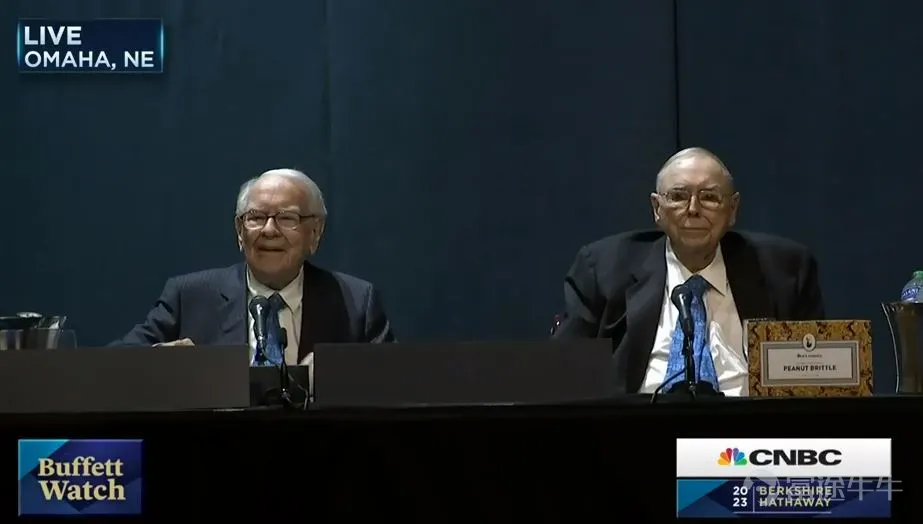
Buffett said he plans to answer at least 60 questions this time. He jokingly called Charlie Munger “King Charles of Berkshire (King Charles)” and won applause. Buffett also introduced Berkshire's Vice Chairman of Non-Insurance Business Greg Abel and Ajit Jain, Vice Chairman of Insurance Business Ajit Jain.
Risk Disclaimer: The above content only represents the author's view. It does not represent any position or investment advice of Futu. Futu makes no representation or warranty.Read more


Comments
to post a comment
18
49