
Is coffee expansion into lower-tier counties a good business opportunity?
Facing an increasingly competitive coffee market, where will the next growth come from? Currently, coffee brands are adopting an expansion model targeting lower-tier cities for growth.
In the first quarter of the fiscal year 2023, Starbucks$Starbucks (SBUX.US)$opened 69 new stores in China, entering 10 new cities including Qingyuan, Wenshan, and Xinyu. Its Chief Operating Officer, Belinda Liu, stated that Starbucks values not only prefecture-level markets nationwide but also county-level markets.
Previously, Starbucks focused on first- and second-tier cities, mainly promoting medium to high-priced specialty coffee. However, with the market becoming increasingly saturated, Starbucks has shifted its focus to lower-tier cities.
Luckin Coffee$Luckin Coffee (LKNCY.US)$On January 30, Luckin Coffee also released its 'First Round of New Retail Partner Recruitment Plan for 2023,' which included many county-level cities among the 33 newly added cities, signaling Luckin’s acceleration into these emerging markets.
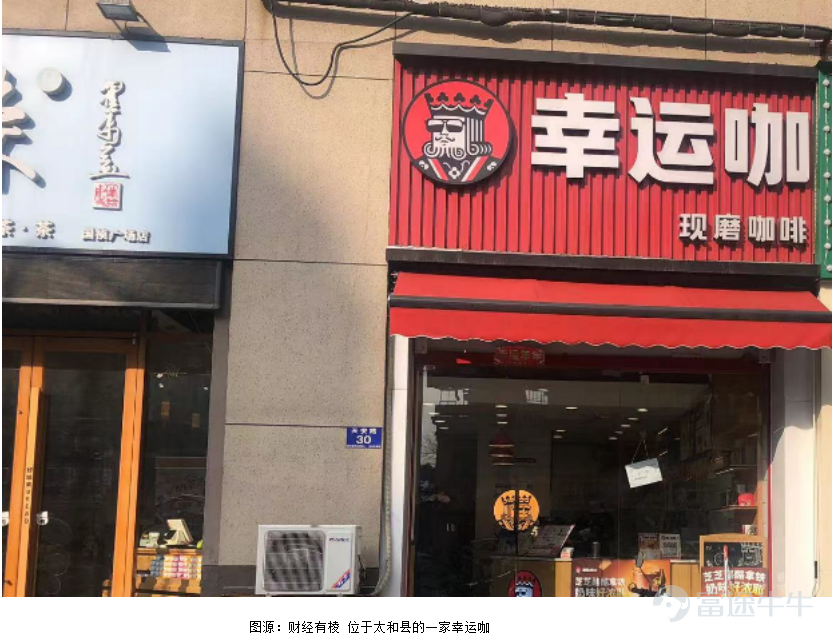
MIXUE Ice Cream & Tea's coffee brand, Lucky Coffee, added nearly 1,500 new stores in 2022, primarily distributed in third- and fourth-tier cities across the country. This indicates that the two leading forces attacking lower-tier markets have long been in competition. With Starbucks now joining the fray, a three-way battle is inevitable.
Data shows that by the end of 2021, the permanent resident population of county towns in China’s 1,472 counties was approximately 160 million, while the urban areas of 394 county-level cities had around 90 million residents, accounting for nearly 30% of the national urban population. This undoubtedly represents a market with enormous potential.
But does the demand for coffee in county-level markets really reach such heights? And how does it differ compared to first- and second-tier cities?
01, County Coffee Becomes Synonymous with Growth
Taihe County and Jieshou City are located in the northwestern part of Anhui Province, under the jurisdiction of Fuyang as county-level cities. In 2021, the per capita GDP of Taihe County and Jieshou City were 37,073.6 yuan and 59,700 million yuan respectively, indicating an economic development level that ranks as average within Anhui Province.
As county coffee becomes synonymous with growth, the presence of Luckin Coffee, Starbucks, and Lucky Coffee can already be seen in these two counties. Data from Narrow Gate Catering Insights shows that as of the end of 2022, the three companies had 8,171, 6,882, and 1,805 chain stores respectively, ranking 1st, 2nd, and 4th among the top five coffee brands.
Finance reports reveal that after on-site visits, it was found that Lucky Coffee is following the same store expansion strategy as Mixue Ice City, while Luckin Coffee and Starbucks are directly replicating their first and second-tier city models.
In the case of Lucky Coffee, the overall area of a single store is generally around 20-30 square meters, offering limited seating for customers. However, this setup facilitates rapid store expansion.

Since Mixue Ice City has long been targeting lower-tier markets, it already has a large number of franchisees in county-level cities. This allows Lucky Coffee to save significant time and resources in recruiting new franchisees. Industry insiders have revealed that many counties in China have the same owner behind both Lucky Coffee and Mixue Ice City.
On the other hand, over the past few years, physical businesses in county towns have faced multiple challenges such as the pandemic and insufficient consumption. Street-front shops similar in size to Lucky Coffee now experience high vacancy rates. This means that whether through franchising or direct operation, Lucky Coffee can quickly find suitable locations for its stores.
As a result, in 2022, the number of Lucky Coffee stores doubled, growing from about 500 at the end of 2021 to its current scale.
In terms of pricing, Lucky Coffee aligns with Mixue Ice City by adopting a low-price strategy. The freshly ground coffee currently sold at Lucky Coffee ranges between 5 to 10 yuan, with only a few items priced above 10 yuan.

However, Lucky Coffee also faces two key issues. First, the variety of products is relatively limited. While instant coffee and light snacks have been added alongside freshly ground coffee, the total number of products remains much smaller compared to Luckin Coffee and Starbucks. Fewer product options will inevitably reduce the revenue generated by individual stores.
Second, although Lucky Coffee is a sub-brand under Mixue Ice City, its brand recognition in county towns is limited compared to Mixue Ice City's strong penetration in these areas.
Zhang Wenwen (pseudonym), a consumer from Jieshou City, told us that she was unaware that two Lucky Coffee stores had opened locally and was unfamiliar with the products they offered.
In contrast, Starbucks and Luckin Coffee have positioned their stores within high foot-traffic commercial zones in county towns.
For example, the Starbucks Taihe Hanlin Plaza store, which is located in a business district that not only features well-known brands like Haidilao and Zhanji Pastry, but also has a McDonald's currently under renovation, with an expected opening later this year. Additionally, these stores cover an area of at least 70 square meters, adopting the third-space model commonly seen in first- and second-tier cities.

The Guozhen Plaza, where Luckin Coffee is situated, is also one of the busiest commercial areas in Jieshou.

In terms of product variety and pricing, both stores allow ordering through mini-programs, largely consistent with those in first- and second-tier cities. For instance, the large-sized Lucky Cheese Latte sold at the Jieshou Guozhen Plaza store and Beijing Lenovo Bridge store costs around 14 yuan.

However, it is important to note that while Luckin and Starbucks directly replicate the operational experience of their stores in first- and second-tier cities, which offers several advantages such as facilitating unified store management and helping reduce operational costs, subsequent challenges have also emerged.
First, the pace of store expansion has been slower than expected. Currently, in many county-level cities, vacant storefronts are scarce in bustling commercial districts with heavy foot traffic. This situation may prevent Starbucks and Luckin from quickly finding suitable locations or lead them to abandon a county market due to excessively high transfer fees and rent.
Secondly, local dining establishments within county towns have more down-to-earth survival strategies and are most familiar with the consumption and leisure habits of locals. This often causes incoming coffee brands to struggle, as young people in these counties have limited acceptance of the 'third space' concept.
A post-95s individual from Taihe County, Hu Zirui (pseudonym), told Financial Edge that he and his friends mainly relieve stress by watching videos and playing games on non-workdays. When dining out or gathering, they usually choose local small restaurants or food stalls rather than coffee shops. After all, the vibrant atmosphere of a county town is truly the place to unwind.
02. Increasing customer traffic remains the biggest challenge
Therefore, although Luckin Coffee, Starbucks, and other rapidly expanding chains face different issues, figuring out how to cultivate and develop consumers' long-term coffee-drinking habits, increase foot traffic, and boost daily coffee sales should be a common challenge for all three.
Data shows that consumers in first- and second-tier cities who have developed a coffee-drinking habit consume 326 cups and 261 cups per year respectively, whereas the national average stands at just 9 cups annually. Thus, fostering coffee consumption habits among county residents remains a daunting task.
The findings from the Caijing Youleng field visits corroborate this point. Even between 10 a.m. and 12 p.m. on Sunday, there were large numbers of vacant seats in the rest areas at Luckin Coffee and Lucky Cafe stores. Only about a dozen food delivery drivers came to pick up orders.


Although the foot traffic at Starbucks Taihe Hanlin Plaza is higher than that of Luckin Coffee and Lucky Cafe, this store opened just before the Lunar New Year last year and still has some novelty appeal for local consumers in the short term. Looking ahead, the foot traffic at Starbucks may decline further.

Chen Wei (pseudonym), a consumer from Taihe County, told us that the average monthly salary in Taihe County ranges between 2,500 and 4,000 yuan, with an income of 5,000 yuan considered high. Given the relatively low incomes, young people face high housing prices and expensive wedding dowries in the county, making them reluctant to spend lavishly. Therefore, Chen Wei believes that Starbucks, with its coffees costing thirty to forty yuan per cup, is something young people might indulge in only occasionally, but not frequently.
At the same time, there are multiple reasons contributing to the low foot traffic for coffee shops in smaller cities.
First, the core group of coffee consumers currently consists mainly of women and Generation Y individuals. However, due to a lack of economic momentum in county-level areas and limited employment opportunities, 'small-town youth' are forced to seek opportunities in more economically developed regions through education, labor work, or business ventures.
This has also led to a surge in consumption during holiday peaks when young people return home. Zhang Huihui (pseudonym), an employee at Lucky Cafe in Taihe County, told us that after the 25th day of the twelfth lunar month last year, coffee sales in the store increased fivefold compared to normal days due to the mass return of these young people.
However, since many returning individuals left earlier this year, around the fifth day of the Lunar New Year, the daily coffee sales quickly plummeted back to just a few dozen cups. Relying on a brief peak during the Spring Festival to offset the everyday operational costs of a single store appears unrealistic.
Secondly, the reason why consumers in first- and second-tier cities have developed a habit of frequent coffee consumption lies in its stimulating effects during high-intensity overtime work and the resulting psychological dependency.
However, Hu Shuai (pseudonym), the owner of a company in Jieshou City, told us that there is no tradition of overtime in the area, and he himself is reluctant to assign employees extra work hours.
Clearly, in a county without a culture of overtime, not only do young people living there have limited demand for coffee, but many typical coffee-drinking scenarios are also absent.
For example, breakfast serves as a daily and high-frequency scenario for coffee sales in first- and second-tier cities. Based on this, coffee brands have successively introduced breakfast combinations such as 'coffee with rice rolls' and 'coffee with spicy soup' that integrate local snacks. However, it is difficult for these to enter the breakfast market in county towns.
Finally, many townships are too far from the main urban areas, making it hard for the delivery systems relied upon by coffee brands to cover these regions. Whether it's Meituan, Ele.me, or even Starbucks’ own delivery capacity, none support deliveries at the township level.

Therefore, coffee delivery within county towns covers only a limited population.
Even if brands sell group-buying packages via Douyin live streaming, young people in townships often choose to cancel their orders due to the inability to deliver, leading to very low voucher redemption rates and limited performance contributions to stores.
Moreover, middle-aged and elderly people living in county towns have their own social culture, which coffee finds hard to penetrate. Business socializing in county towns typically happens over dinner tables rather than in coffee shops, making it highly unlikely for meetings to take place in cafes.
Section 03: Can the market improve in the future?
Thus, to address the issues faced by coffee in county towns, it is necessary to stimulate the genuine development of the local economy, creating strong pull factors to attract more young people back to their hometowns. However, achieving this is fraught with difficulties.
First, compared to provincial capitals and key cities, the financial resources allocated to county towns are limited. Without sufficient funds, local infrastructure cannot be improved, nor can external businesses be attracted.
At the same time, local businesses in county towns instinctively resist external companies, resulting in a business environment in county towns that lags significantly behind that of first- and second-tier cities.
Complicated interpersonal relationships and the tendency of local employees to form cliques that are difficult to manage also discourage many entrepreneurs from investing in county towns.
Therefore, the industries currently supporting many counties in the country are still mainly agriculture, traditional manufacturing, and labor-intensive industries transferred from developed regions. However, these industries generally suffer from low added value and profit margins, making them unable to attract more young people. Consequently, there is little hope for significant improvement in the county economies in the future.
Moreover, relatively speaking, the penetration rate of new tea drinks among young people in county towns is also higher than that of coffee.
In the main urban areas of Jieshou City and Taihe County, it is not uncommon to see popular new tea drink brands such as Mixue Ice City, Guming, Tianlala, and Hushang Ayi. Among the customers purchasing these drinks, high school students can often be spotted. As these new tea drink brands continue to expand into lower-tier markets, they will likely draw even more customers away from coffee brands.
Under the compounding effects of these issues, county-based coffee brands, especially franchisees, are finding it extremely difficult to turn a profit.
Liu Wei (pseudonym), a Luckin Coffee franchisee in a certain area of Fuyang City, told Financial Edge: 'I joined Luckin at the beginning of last year. According to Luckin’s requirements, the annual rent for a store in a county town exceeds 100,000 yuan. Including subsequent renovation, marketing, and various 'relationship maintenance fees' within the county, I have already invested 400,000 yuan upfront.'
After opening for business, ongoing costs such as employee wages, utilities, property management fees, and a 20% commission fee from food delivery platforms have left outlets selling only a few dozen cups per day still operating at a loss. Liu Wei himself is uncertain when he will break even.
For coffee brands, they may have enough patience and financial resources to wait for an increase in coffee penetration in county towns to bring about growth in the market. However, if their franchisees cannot achieve profitability in the long term, they will inevitably withdraw en masse later on.
In fact, the various problems facing coffee businesses in county towns are not isolated cases. Business models and trendy cultural activities that were previously targeted at young people in first- and second-tier cities, such as cat cafes and tea gatherings, often face obstacles when entering county towns.
So, is it worthwhile to enter the lower-tier markets? The answer is undoubtedly affirmative, as the consumption potential of lower-tier markets remains largely untapped. Promoting the economic development of counties has always been a major strategy in the broader macroeconomic landscape.
For example, in this year’s No. 1 Document, county economies have been given unprecedented importance, with references to counties mentioned thirty-five times. It particularly emphasized 'the need to comprehensively promote the construction of county-level commercial systems and vigorously develop new models such as collaborative delivery and instant retail.'
Therefore, the development of county-level economies is worth looking forward to.
However, specifically for coffee in county-level markets, it may require more patience to cultivate. Only by establishing a business model that differentiates itself from first- and second-tier cities while truly aligning with the consumption culture and spending power of county economies can coffee genuinely become a mainstream consumer product.
Risk Disclaimer: The above content only represents the author's view. It does not represent any position or investment advice of Futu. Futu makes no representation or warranty.Read more
Comments
to post a comment
5