
FF 91 returns to China, Jia Yueting's 'self-rescue'?
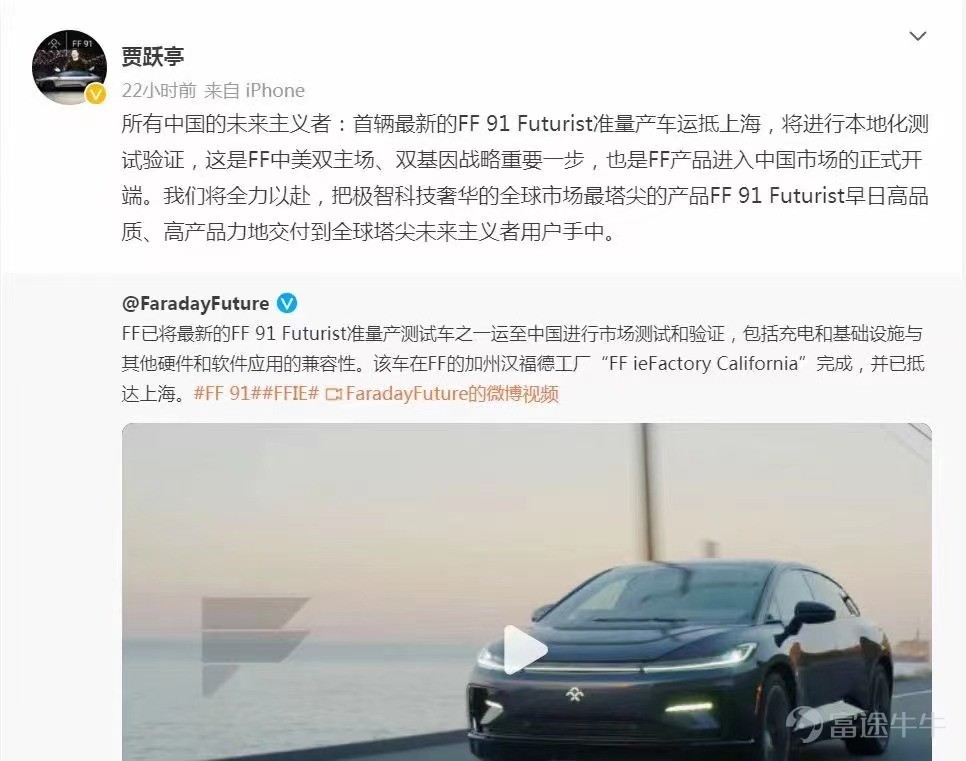
After entering 2023, Faraday Future made a series of significant announcements: On January 18, Faraday Future$Faraday Future Intelligent Electric Inc. (FFIE.US)$Announced the signing of a strategic cooperation agreement with Huanggang City, and Jia Yueting suddenly appeared on the Weibo hot search again; On February 6, Faraday Future announced an additional $135 million in financing and disclosed that mass production would begin by the end of March; On February 8, Faraday Future announced that, in order to accelerate the advancement of its dual home strategy in China and the US, it had shipped the latest pre-production version of the FF 91 Futurist to China for local testing and validation; On February 15, Jia Yueting posted on Weibo that the Faraday Future pre-production test vehicle had arrived in Shanghai.

In this light, Faraday, which has long been labeled as Jia Yueting's 'PPT car' for running away, seems to be showing signs of getting on track. Partnering with Huanggang, although still fraught with uncertainties, at least gives the public some initial hope for product implementation.
Jia Yueting’s dream of building cars has been a bumpy road. Whether he can use this opportunity to achieve a 'self-rescue' is the biggest suspense.
01 Partnering with Huanggang to integrate into the trillion-yuan automotive industry cluster
The greatest significance of Faraday Future partnering with Huanggang lies in its ability to integrate into Hubei Province's automotive industry chain cluster, a major hub for China's auto sector.
The automotive industry is the largest pillar industry in Hubei Province. In 2022, Hubei produced 1.896 million vehicles, ranking fifth nationwide. Of these, 293,000 were new energy vehicles, representing a year-on-year increase of 98%.

Hubei is one of the provinces with the most complete automotive industry chains and the most prominent clusters in the country. It possesses capabilities in new energy vehicle R&D and production as well as the development of key three-electric components, along with a reserve of key talent and a foundation for technological innovation and development.
Building a trillion-yuan automotive industry cluster and becoming a highland for the development of new energy and intelligent connected vehicles have become important goals for Hubei Province in recent years.
To that end, Hubei Province issued in January the 'Three-Year Action Plan (2022-2024)' and the 'List of Key Industry Tasks' aimed at the development of new energy vehicles, striving to reach a provincial automotive industry output value exceeding the trillion-yuan mark by 2024, with the new energy vehicle industry surpassing 300 billion yuan.
According to local media reports, Hubei's new energy vehicle industry will enter an 'overtaking' mode. The province's automobile industry corridor continues to extend eastward — towards Huanggang — driven by the 'Wuhan-Ezhou-Huanggang integration' development trend, which is also the confidence behind Huanggang’s cooperation with Faraday Future.
Huanggang itself has a certain foundation for developing the new energy vehicle industry. In 2021, Huanggang had a total of 136 automobile and parts manufacturing enterprises, of which 108 were above the designated size, with a total output value of 10.06 billion yuan. The output value of new energy vehicles was 2.61 billion yuan, a year-on-year increase of 11%.
However, so far, the only new energy passenger vehicle production project in Huanggang is the WM Motor Huanggang Smart Manufacturing Base. However, WM Motor’s recent situation has not been good, even facing shutdowns. Data from the China Passenger Car Association shows that in 2022, WM Motor's sales were less than 30,000 units, a year-on-year decrease of 33.3%.
But Huanggang, which is actively promoting its new energy vehicle industry, clearly will not stop here. Partnering with Faraday Future represents another bold attempt to realize its dream in the new energy vehicle sector.
It is reported that the construction of Faraday Future's China headquarters is expected to be jointly funded by the Huanggang municipal government's guidance fund, relevant industrial funds, and Faraday Future.
Faraday Future currently faces a severe shortage of funds. If Huanggang can invest to help it produce domestically, Faraday Future could also boost Huanggang's economy.
However, informed sources revealed that there remains some uncertainty in the Strategic Cooperation Framework Agreement signed between Huanggang and Faraday Future, as the aforementioned cooperation framework agreement is non-binding. Legal experts have stated that this means the related agreements can be canceled at any time without constituting a breach or leading to claims for breach of contract.
Notably, this strategic cooperation agreement, signed in the third quarter of 2022, was not promptly disclosed by Huanggang. It was also not listed as a major investment project in the Huanggang municipal government work report at the beginning of 2023. The Publicity Department of the Huanggang Municipal Committee confirmed to the media that the above-mentioned cooperation agreement is merely a directional and framework agreement, with specific details still under discussion.
In the industrial map released by Huanggang in 2022, new energy and intelligent connected vehicles occupy an important segment.
02 How to Save the Market and 'Self-Save' When Stock Price Hits Rock Bottom
Since going public on the US stock market via a SPAC, Faraday Future has raised about 1 billion US dollars in financing. As of February 15, its stock price has dropped by 95.06% compared to its IPO price, with a market value of less than 500 million US dollars.
How will Jia Yueting save the market and 'save himself'?
On February 14, Faraday Future's Chinese employees held a car reception ceremony at their office in Shanghai to welcome the arrival of the FF 91 Futurist pre-production vehicle in China. At 9 a.m. on the same day, they hosted a global investor business communication and special shareholders' meeting voting online conference and planned to hold an extraordinary shareholders' meeting on February 28.
The starting price of the FF 91 Futurist in the US is 200,000 USD, and the expected domestic price after adding tariffs would be over 2 million RMB. Will there be buyers for such a high price tag domestically?
In fact, although competition in the mid-to-low-end market of domestic new energy vehicles has become extremely fierce, premium brands still have significant room for growth.
According to BeyonCa data, it is projected that by 2025, 45% of passenger cars priced above 500,000 RMB will be new energy vehicles, and by 2030, this figure will increase to 75%.
Data from the China Association of Automobile Manufacturers shows that in 2022, sales of premium brand passenger vehicles reached 3.886 million units, accounting for 16.5%. However, within the new energy market, sales of premium models are only just beginning, with sales in the 350,000 RMB and above segment reaching only 864,000 units.
Global automotive information platform MarkLines expects that by 2030, the share of luxury cars in China is expected to exceed 20%.
Although the high-end market shows good growth potential, it has long been targeted by various domestic brands, which have already started to lay out their strategies. On January 5, BYD launched its premium car brand 'Yangwang' and its core technology 'Yi Si Fang.' A rugged U8 model priced in the millions as well as a pure electric performance supercar U9 were also unveiled simultaneously.
Similarly, recent reports indicate that Nio Capital will invest tens of millions of USD in the seed round of the EV startup Zhixing. The first model will be an ultra-premium SUV priced in the millions, produced on Nio’s NT 3.0 platform, with an expected release in 2025 and simultaneous overseas launch.
At the same time, there are reports that NIO$NIO Inc. USD OV (NIO.SG)$They will create their own 'Maybach,' positioned as a million-yuan luxury sedan, with an expected launch in 2024.
On January 29, a set of domestic spy shots of what is suspected to be the Polestar 4 were exposed. Reportedly, the Polestar 4 is positioned as a mid-to-large Coupe SUV and will be released in 2023. Its main competitors will be the upcoming Porsche Macan EV and other luxury mid-size SUVs. Referring to the price range of the Polestar 3, the new car’s price may not be lower than 900,000 yuan.
As the only mass-produced electric vehicle priced at the million-yuan level domestically, the HiPhi Z GT by HiPhi also made its global debut recently.
Hyper SSR, the first supercar from Hyper (Hyperspace), a brand under GAC Aion, has a pre-sale price starting at 1.286 million yuan and is expected to begin mass production and delivery in October 2023.
In fact, the brands mentioned above seem more reliable than Faraday Future because 'brand identity' is like 'personal identity.'
At the same time, compared to those who can slowly capture the market and refine their products, Jia Yueting seems to be running out of time. Capital won't remain patient forever, and his room for strategic maneuvering is relatively limited.
Faraday Future was initially positioned as a high-end brand, believing that its advanced electric vehicle and energy-saving technology would bring new development opportunities to China's auto market and provide consumers with a new consumption experience.
The problem, however, is that even established luxury brands such as Mercedes-Benz, Porsche, and BMW struggle to sell electric vehicles priced above 500,000 yuan or even a million yuan. Where does Jia Yueting's confidence come from?

Therefore, whether Jia Yueting can use Faraday Future to achieve 'self-rescue' this time remains an unknown.
Risk Disclaimer: The above content only represents the author's view. It does not represent any position or investment advice of Futu. Futu makes no representation or warranty.Read more

Comment (1)
to post a comment
1