
美版“雙十一”來襲,能提振零售股嗎?

[Industry Nuggets] Black Friday is here, can the US retail industry recover? Read the past and present life of the US retail industry in one article
Today is “Black Friday”. As a barometer of the retail industry's Christmas sales performance every year, this day marks the beginning of the Christmas shopping season, that is, the beginning of the peak season for the US retail industry. The retail industry is closely related to everyone's life. To a certain extent, the retail industry has shaped today's commercial society and modern life. Whether it's traditional stores, shopping malls, or current e-commerce, they have given birth to many bullish stocks with huge gains. Walmart, Amazon, JD, Pinduoduo... These companies have changed people's lives and created huge wealth. What is the essence of retail? And how did it develop? Can this year's Black Friday help the US retail industry recover? Let's all have a talk~
1. How to understand retail?
The retail industry is an industry that points to end consumers (including individuals and social groups) to provide necessary products and services. It is the final stage of the commodity distribution industry, connecting manufacturers, wholesalers, and consumers.
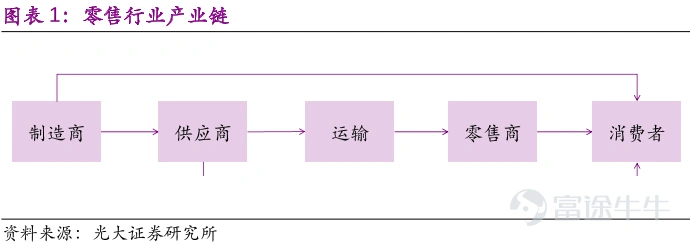
It can be divided into various business formats such as convenience stores, discount stores, supermarkets, warehousing member stores, and online stores according to factors such as business method, product structure, service function, location selection, business district, size, target customers, and whether there is a fixed place of business.
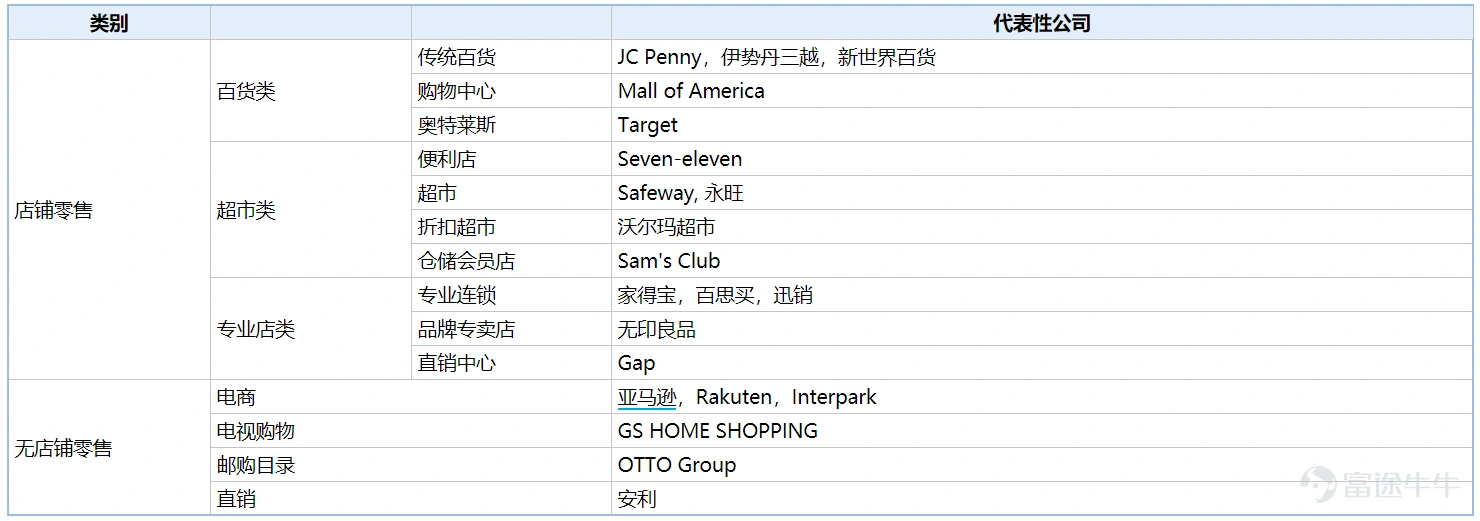
II. Looking at the retail format from the perspective of changes in the US retail industry
The retail industry is changing all the time; change is absolute; constant change is relative. Changes in retail formats are inextricably linked to social development, technological progress, and changes in demographic trends. Coupled with the diverse needs of consumers, retail enterprises with different strategies and business models have different advantages. We can understand common retail formats through four major changes in the US retail industry.
1. grocery store
Before the 20th century, most of the main places where residents in various regions of the world bought daily necessities were grocery stores, small street stores, and small franchise stores at gatherings. For example, if they bought beef, they went to a butcher shop, and when they bought bread, they went to a bakery. This period was characterized by:
(1) Retailers exist in the form of small stores and have no bargaining power; they only buy goods at a “high price” from intermediaries and then sell them to customers at a higher price. Prices are not transparent, and the purchase costs and operating costs are high;
(2) Due to inconvenient transportation, customers are often regular customers living nearby, and the coverage and sales of the store are very limited;
(3) There are few types of products, and consumers have no brand concept.
2. department stores
In the late 19th century, with the development of productivity, the variety of products gradually became rich, and department stores were born. Their innovative business methods include:
(1) Display a large number of products for customers to choose at will, and product sales are clearly priced, and prices are transparent;
(2) Customers are free to enter and leave the store, and can return or exchange at will if they are not satisfied with the purchase.
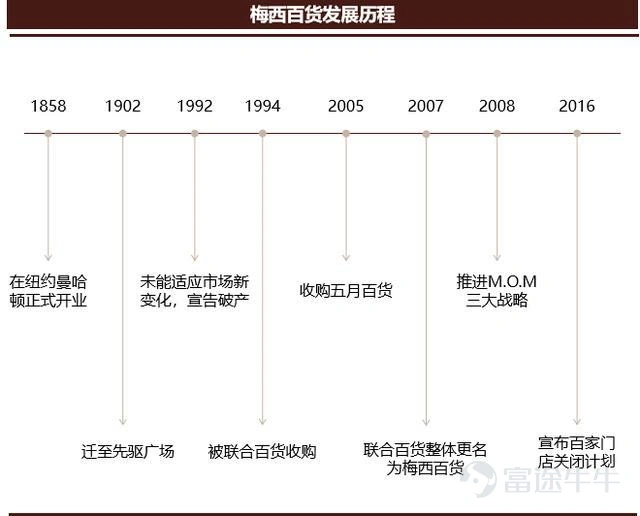
The well-known Macy's is an industry giant that transformed from a grocery store to a department store and gained a scale advantage through mergers and acquisitions in the midst of a wave of department store openings spawned by American urbanization, but it gradually weakened under the double impact of e-commerce and the pandemic.
3. supermarkets
After the economic crisis in the 1930s, insufficient purchasing power of residents and the development of technology promoted the emergence and development of supermarkets for product packaging and product storage, which had the following impact on retail innovation and society:
(1) The business policy of open sales, customer choice, and small profit and multiple sales has reduced operating costs and achieved low sales prices;
(2) Centralizing all kinds of products that are distributed to save time for consumers;
(3) Changes in product packaging have promoted the emergence of brands.
Later, the promotion and application of electronic technology created the popularity of barcodes, refrigerators, and automobiles, which can effectively improve operation and management efficiency, creating conditions for consumers to make large-scale purchases and long-distance purchases, and promoted the emergence of discount supermarkets, warehousing member stores, convenience stores, etc.
The retail giant Walmart has successfully occupied the high, middle, and low end retail markets through a combination of discount stores, Sam's Club stores, shopping malls, and community stores.
4. e-commerce
At the end of the 20th century, the development of network technology broke the spatial and temporal boundaries of the retail market and reshaped the way merchants sold. Its impact was mainly reflected in:
(1) The importance of store selection in retailer operations has decreased;
(2) Consumers have changed from “in-store shopping” to “home shopping”, leading to changes in how merchants sell, and sellers need to make organizational adjustments;
(3) Retailers' networked operations have reduced operating expenses, but market competition has become more intense, and retail profits have been further reduced.
The advent of online sales has given birth to two giants, Amazon and eBay, which have disruptively changed the way consumers shop. Under the impact of e-commerce, traditional retailers have also transformed, creating retail enterprises with different positions, strategies and business models.
3. Black Friday is here, can the US retail industry recover?
The author personally estimates that retail sales data in the US will be more polarized. Compared to those reflecting the spending power of grassroots citizens, such as supermarket chains, etc., sales performance may be poor, reflecting that grassroots citizens face inflationary pressure and need to cut back and forth. However, luxury sales may be relatively strong. First, the US dollar continues to be strong, and it still has a certain advantage over the purchasing power of foreign products. Second, high-income people spend around Thanksgiving.
Recently, the US stock retail sector can focus on. After Thanksgiving on Thursday, the US will enter the peak holiday shopping season. Among these, “Black Friday” (the second day of Thanksgiving) and “Cyber Monday” (the Monday after Black Friday) (the Monday after Black Friday) are the most powerful. Historical experience shows that the US shopping season is coming soon, and the volatility of consumer stocks will increase. At the same time, most of the earnings reports for retail stocks this quarter exceeded market expectations, and stock prices ushered in a wave of upward spikes. Compared with previous quarters, the pressure was reduced from time to time. Retail data from a few days ago also showed that under inflation, retail sales data in the US is still strong.
Write at the end
After understanding the basic situation and investment logic of retail stocks, what are the thoughts and gains of mooer? Investment guru Peter Lynch introduced his retail stock selection method in “Overcoming Wall Street”: choosing stocks while shopping, so here's the question:
(1) In the process of everyday shopping, what are your thoughts on the retail/retail company?
(2) What is the retail stock you are most optimistic about? What kind of investment logic is behind it?
(3) Do you think Black Friday will boost the retail industry in the US, and why?
mooer can choose a question to leave a comment for discussion in the comment area. Effective recommendations and quality answers will have a chance to get 66 point rewards~~
What other investment and research methods would you like to know? The comment section tells Futubull that we will read the next article in the series and arrange the columns as appropriate~~
Key References
Guoxin Securities|Exploring the Growth Genes of Retail Giants
Future Consumption|US Retail History: Implications for Dynamic Innovation and Real-time Transformation
21st Century Economic Report | Retail industry value analysis, reading this is enough
Risk Disclaimer: The above content only represents the author's view. It does not represent any position or investment advice of Futu. Futu makes no representation or warranty.Read more


Comments (13)
to post a comment
24
12