

November 2022 “Howard Marx's Memorandum — What Really Matters”
2022 Oaktree Capital Management, LP All rights reserved
Memorandum: To Oaktree Capital (Oaktree Capital) Customers
From: Howard Marks (Howard Marks)
I've drawn some ideas from several memos I've written this year, along with some recent thoughts and conversations, to form the subject of this memo: What really matters or should be important to investors. I'll start by exploring what's unimportant.
What Doesn't Matter: Short-Term Events
In the memo“The Illusion of Cognition”(The Illusion of Knowledge, September 2022), I'm against macro-forecasting, and as far as our field of expertise is concerned, macro-forecasting mainly involves prospects for the next one to two years. In my memorandum “Dare to Differ” (July 2022), I addressed the most frequently asked question at the Oak Investors Conference held in London on June 21: How serious will inflation become? How much will the Federal Reserve raise interest rates to deal with inflation? Will these rate hikes cause a recession? How bad will the recession be and how long will it last? I told the participants that, to be sure, these things are all about the short term, and here are my thoughts on the short term:
• Most investors are unable to excel at predicting such short-term phenomena.
• Therefore, they should not expect much from opinions on these topics (their own or others').
• They are unlikely to make significant adjustments to their portfolios based on these views.
• The adjustments they make are also unlikely to always be correct.
• So these aren't really important.
For example, in response to the first wave of the global financial crisis, the Federal Reserve began cutting the federal funds rate in the third quarter of 2007. Interest rates were also reduced to zero around the end of 2008, and remained at that level for 7 years thereafter. At the end of 2015, the only question I was asked was “When will the rate hike start? ”, and my answer was consistent: “Why do you care about this? If I said 'February, 'what would you do? So if I change my mind later and say “May,” what would you do? If everyone knows that interest rates are about to rise, what difference does it make from which month?” No one has ever been able to give a convincing answer. Investors might think it's professional performance to ask such questions, but I doubt they can explain the reason behind it.
The vast majority of investors are uncertain about what macro events are about to occur, or how the market will react to what has already happened. In “The Illusion of Knowledge” (The Illusion of Knowledge), I detailed how unforeseen events can make economic and market predictions “fall by a thousand miles.” Generally speaking, most predictions are extrapolations, and in most cases things don't change, so the inference is usually correct, but it doesn't generate additional profit. On the other hand, accurately predicting trend deviations can be lucrative, but this is difficult to do, and difficult to act accordingly. Here are some of the reasons why most people can't predict the future well and thereby repeatedly achieve excellent performance.
Why is it so difficult to profit from macro predictions? Don't most of us know what might happen? Can't we just buy the securities of the companies that are most likely to benefit from it? In the long run, it might be possible, but I want to address a topic Bruce Karsh has been highlighting recently, which is the main reason why profiting from a short-term focus is extremely challenging: It's hard to know what predictions about events have been reflected in securities prices。
We often see in the media that one of the key mistakes people always make is to believe that changes in securities prices are the result of events: favorable events lead to price increases, and negative events cause prices to fall. I think this is what most people believe — especially first-level thinkers — but this is not true; The price of a security is determined by the event and the investor's reaction to the event, which is largely dependent on the gap between the outcome of the event and investors' expectations。
How can we explain a company that reports an increase in earnings but its share price falls? The answer is, of course, that companies are reporting lower than expected growth, which has disappointed investors. Therefore, at the most fundamental level, what is important is not simply judging whether the event itself is favorable or not, but rather how the event compares to expectations.
In my first few years at work, I spent a few minutes every day browsing earnings reports published in the Wall Street Journal. But after a while, I suddenly realized that since I didn't know what the market expected, I couldn't tell whether announcements made by companies I wasn't tracking were good news or bad news.
Investors can be experts on a small number of companies and their securities, but no one knows enough about macro events to (1) understand the macro expectations behind securities prices, (2) predict macro events, and (3) predict how these securities will react. Where can potential buyers find out what investors who set the price of securities can expect in terms of inflation, GDP, or unemployment? Sometimes it is possible to infer expectations from asset prices, but when actual results come out, facts often prove that the level of inference is incorrect.
Furthermore, in the short term, securities prices are highly susceptible to random and exogenous events, and their influence may outweigh the impact of fundamental events. Macro events and short-term fluctuations in a company's market value are unpredictable, and they do not necessarily predict or relate to the company's long-term prospects. So they shouldn't be given too much attention. For example, companies often intend to reduce current returns by investing in future business; therefore, the low returns reported in the current period may mean high future returns rather than continued low returns. To know the difference, you must have a deep understanding of the business.
No one should take it for granted that securities pricing is a reliable process and follows an accurate set of rules. Events are unpredictable; they can change due to unpredictable effects; and investors are also unpredictable in their reactions to events. With so much uncertainty, most investors are unable to improve their investment performance by focusing on short-term events.
Through observation, it can be clearly seen that fluctuations in securities prices far outweigh fluctuations in economic output or corporate profits. What is the reason for this? The truth must be that in the short term, price fluctuations are more affected by fluctuations in investor sentiment than changes in the long-term prospects of companies. Since psychological fluctuations are more important than changes in fundamentals in the short term and are hard to predict, most short-term trades are a waste of time... or worse.
What Doesn't Matter: The “Deal” Mindset
Over the years, I've often included in my memo some of the jokes my dad told in the 1950s because I believe humour often reflects the truth of the human condition. Given its relevance here, I'll take a moment to recount a joke I shared earlier:
The two friends met on the street and Joe asked Sam what was new. “Oh,” he answered, “I just got a really nice box of sardines.”
Joe: “Great, I love sardines. I'd like some. How much is it? ”
Sam: “$10,000 per can. ”
Joe: “What! How can a can of sardines cost $10,000? ”
Sam: “These are the best sardines in the world. Each one is pure pedigree and certified. They are caught with nets rather than hooks; boned by hand; and packed with the finest extra virgin olive oil. Also, the labels on the cans are made by famous artists. $10,000 is already a very affordable price. ”
Joe: “But who would eat $10,000 sardines? ”
Sam: “Oh, these sardines aren't meant to be eaten; they're meant to be traded. ”
The reason I'm adding this old joke is because I believe most people use stocks and bonds as trading tools rather than assets they own.
If you ask Warren Buffett to describe the basis of his investment approach, he might first insist that stocks should be viewed as the owners' equity of the business. Most people start businesses not with the intention of selling them in the short term, but to run a business, enjoy profitability, and expand their business. Of course, founders ultimately do these things to make money, but they probably see money as a by-product of running a successful business. Buffett said investors who buy shares should see themselves as partners who share the same goals as the owners.
But I think few people can do that. Most people buy stocks in order to sell them at a higher price,Think stocks are meant to be traded, not owned. This means they are abandoning the owners' way of thinking and instead gambling or speculating on stock price movements. The results are often unpleasant.
A 2012 study by the DALBAR Institute showed that from 1992 to 2012, investors' annualized returns were three percentage points less than the S&P 500, and the average holding period for a typical investor was six months. 6 months!! When you've held shares for less than a year, you haven't gained ownership and participated in the growth of the business through the stock market. Instead, you're just speculating on short-term news and expectations, and your returns are based on how others react to these news stories. Overall, this attitude makes you earn three percentage points less per year than initially investing in S&P 500 funds and then doing nothing. (“Fidelity's Best Investor Has Passed Away,” TheConservation Income Investor, April 8, 2020)
For me, buying for a short-term deal is like forgetting your sports team's chance to win the championship and betting on who will win the next game, the next time, or the next game. Let's think about the logic. You bought a stock because you thought it was worth more than what you paid for it, and the seller thought it was fully priced. If one day things go well, in your opinion, it will be fully priced, which means you'll sell it. However, the guy you sold it to would buy it because he thought it would be worth more. We used to say that this process relies on the “stupid theory”: no matter what price I pay for a stock, someone will always buy from me at a higher price, even though I'm selling because I think its value has peaked.
Every buyer is motivated by the belief that the value of the stock will eventually surpass today's price (sellers probably disagree). The key question is the mindset behind these purchases. Are buyers buying because it's a business they want to keep for years? Or are they just betting that the price will rise? On the surface, these deals may look the same, but I wanted to know the thought process and thus understand the meticulousness of the logic.
Every time you trade stocks, one party is wrong and the other is right. But if what you're doing is betting on hot trends and therefore on how the stock will go next month, quarter, or year, can you really trust that you're more likely to bet than your counterparty? Perhaps the loss of active management can be attributed to many active managers betting on stock price trends in the short term rather than choosing companies they want to hold for many years. It's all about the underlying way of thinking.
As early as 1969, when I lived with my father for the first few months of my career at First National City Bank (First National City Bank), I had a long discussion with him on this topic. (It's so nice for me to think back to those days; he was so much younger than I am now.) I told him that I don't think the motivation for buying stocks should be to see the price increase, and I suggested that the motivation might be to expect dividends to grow over time. He countered that no one is buying stocks for dividends — they are buying because they think the stock price will rise. But what are the triggers for the share price increase?
Wanting to own a company because of its commercial value and long-term profit potential is a good reason to become a shareholder. If these expectations are fulfilled, there is reasonable reason to believe that its stock price will rise. Otherwise, buying in the hope that stocks will appreciate is at best an attempt to guess which industries and businesses investors will prefer in the future. Ben Graham (Ben Graham) once said, “In the short term, the market is a voting machine, but in the long run, it's a weighing machine.” As Charlie Munger (Charlie Munger) once told me, while neither are easy, carefully weighing long-term value can create excellent results than trying to guess short-term hot spots.
What Doesn't Matter: Short-Term Performance
Given the potential drivers of short-term investment performance, the reported results can be extremely misleading; here I'm mainly talking about excellent returns during periods of market growth. I think there are three elements to success in an upward period: agitation, timing, and skill — and if you're aggressive enough at the right time, you don't need much skill at all. We all know that in times of rising markets, the highest returns are usually those with the highest risk, beta coefficient, and correlation in the portfolio. If this investor has always been bullish and has always maintained aggressive positions, then having such a portfolio does not represent outstanding skill or insight. Finally, random events can have an overwhelming impact on returns for a given quarter or year — whether positive or negative.
One of the themes I have repeatedly emphasized in my memo is that the quality of decisions cannot be determined by results alone. Even when well-founded and based on all available information, decisions often have negative results. On the other hand, we all know some people (and sometimes ourselves) who have “mistaken and misunderstood”. Hidden information and random events can frustrate the decisions of even the best thinkers. (However, when results are analyzed over a longer period of time and based on a larger number of decisions, better decision makers are more likely to show a higher probability of success.)
Obviously, investors shouldn't put too much emphasis on quarterly or yearly returns. Investment performance is only one result of the full range of possible returns, and in the short term, it may be significantly affected by random events. As a result, returns in a single quarter may be a very weak indicator of investor strength. Decide whether a manager is highly skilled based on a quarter or year,
Or whether an asset is suitable for long-term allocation, such as forming opinions about baseball players based on a single run, or forming opinions about horse racing based on a single game.
Actually, short-term performance isn't that important. However, most of the investment committees I have attended have placed the performance of the most recent quarter at the top of the agenda and spent a significant amount of time focusing on discussions at each meeting. Discussions are often extremely deep, but rarely lead to significant action. So why would we even do this? This is the same reason investors are concerned about predictions, as described in “The Illusion of Knowledge” (The Illusion of Knowledge): “Everyone does this,” and “it's irresponsible not to do it.”
What Doesn't Matter: Volatility
Other than to express my strong disagreement with people's view that volatility is synonymous with risk or risk itself, I haven't dabbled too much on the subject of volatility. I have presented my opinion that the scholars who founded the “Chicago School” investment theory in the early 1960s (1) wanted to test the relationship between return on investment and risk, (2) needed a numerical value that could be entered into the calculation to quantify risk, and (3) unquestionably chose volatility as a substitute for measuring risk for the simple reason that it was the only quantifiable indicator available. I define risk as the probability of a bad outcome, and volatility is at best an indicator of the presence of risk. But volatility is not a risk per se. That's all I wanted to say on this issue.
What I want to talk about now is the extent to which thoughts and concerns about volatility have distorted the investment community during my 50+ years in the business. In the late 1960s, I had the privilege of attending graduate school at the University of Chicago Business School and being one of the first students to take new theoretical courses, which became a huge advantage for me later. I learned about the effective market hypothesis, capital asset pricing models, random drift theory, the importance of risk avoidance, and the role of volatility as risk. When I started getting involved in the real world of investing in 1969, volatility wasn't a topic, but practice quickly caught up with theory.
In particular, the Sharpe ratio is used as a measure of risk-adjusted return. It is the ratio of an investment portfolio's excess return (the portion of its return that exceeds the yield on treasury bonds) to its volatility. The higher the return per unit of volatility, the higher the risk-adjusted return. Risk adjustment is an important concept, and performance should definitely be assessed based on the risk taken to achieve the return. Everyone uses Sharp ratios, and Oak is no different because it's the only quantifying tool available. (If investors, advisors, and clients don't use Sharpe ratios, they have no other metrics available, and if they try to replace volatility with fundamental risk in their assessments, they'll find no way to quantify it.) Just as volatility suggests risk, the Sharpe ratio may suggest risk-adjusted performance, but since volatility itself is not a risk, the Sharpe ratio can only be a very flawed measure.
Take one of the asset classes I began studying in 1978: high-yield bonds. At Oak, we believe it is possible to obtain returns slightly above the benchmark when the risk is significantly lower than the benchmark, which is reflected in the higher Sharpe ratio. But the real risk of high-yield bonds — the risk we're concerned about and has historically been reduced — is the risk of default. We don't pay much attention to reducing volatility, and we haven't taken any deliberate measures in this regard. We believe that the high Sharpe ratio may be a result of or related to the steps we have taken to reduce default.
In our field of fixed income or “credit,” volatility is particularly irrelevant. Bonds, notes, and loans represent contractual commitments requiring regular interest accrual and due repayment. In most cases, when investors buy bonds with a yield of 8%, regardless of whether the price of the bond rises or falls during its term, the investor will basically get an 8% yield at maturity. I say “basically” because if the price falls, investors will have the opportunity to reinvest interest at a yield of more than 8%, so the return on their holding period will slowly rise. Therefore, the downturn in prices, which have been displeased by many, is actually a good thing — as long as it doesn't indicate a default. (Note that “volatility” usually doesn't live up to its name, as described in this paragraph. Strategists and media often warn that “the market may fluctuate in the future.” What they really meant was “the price may drop in the future.” (No one is worried, and no one cares about upward price fluctuations.)
It is important to recognize that preventing volatility is generally not free. Reducing volatility in order to reduce volatility is actually a bad idea: it can be assumed that, all else being equal, favoring low-volatility assets and strategies will bring lower returns. Only managers with excellent skills or excessive alpha returns (see page 10) can overcome this negative assumption and reduce returns less than reduce volatility.
However, as many customers, employers, and other clients are unable to withstand sharp ups and downs (mostly declines), asset managers often take steps to reduce volatility. Think about what happened after the bursting of the tech bubble in 2000, when the stock market fell for three consecutive years, and institutional investors began to pour into hedge funds. (This is the first time since 1939 to 1941 that there have been three consecutive declines.) Hedge funds — which used to be in the “small workshop” category, mostly in the hundreds of millions of dollars and focused on raising high-net-worth individuals — performed much better than stocks during the decline. Institutional investors are attracted by the low volatility of such funds, so they invest in them in the amount of one billion dollars.
Hedge funds generally provide the stability institutional investors need. But in this big shuffle, the idea of getting high returns with low volatility disappeared. Instead, hedge fund managers are aiming for low volatility itself because they know it's what institutional investors are looking for. As a result, over the past 18 years or so, hedge funds have generally provided the expected low volatility, but this has been accompanied by conservative single-digit returns. There were no miracles.
Why am I listing these? Because volatility is a temporary phenomenon (assuming there is no bankruptcy due to volatility), most investors shouldn't take volatility as seriously as they seem. As I described in “I Beg to Differ” (I Beg to Differ), many investors have the advantage of focusing on long-term investments... if they know how to benefit from them. The following investors should not pay too much attention to volatility:
• Long-standing entities, such as life insurance companies, endowment funds, and pension funds;
• Not limited to one-time divestment;
• Basic business activities are not affected by downward fluctuations;
• Don't worry about being pressured by the client to make mistakes; and
• There are no short-term debts to be paid.
Most investors don't meet some of these aspects, and very few have all of the conditions at the same time. However, as far as these characteristics are concerned, investors should use their ability to withstand volatility, as many investments with high return potential may be susceptible to high volatility.
Warren Buffett is always full of punchlines. On this topic, he brilliantly explained: “We prefer 15% volatile returns over 12% stable returns.” Investors who would rather make the opposite choice, that is, they think a flat return of 12% is preferable to a volatile return of 15%, should ask themselves whether their aversion to volatility is mainly due to financial reasons or emotions.
Of course, the choices made by employees, investment committee members, and hired investment managers may have to take realistic considerations. Managers responsible for institutional portfolios may have valid reasons to avoid ups and downs because the organizations or clients they serve may be able to withstand financial fluctuations, but eventually feel psychologically unwell. What everyone can do is do their best in a specific environment. But I think most importantly: in many cases, people pay far more attention to volatility than they should.
Off topic
Although I'm talking about volatility, I'd like to talk about an area that hasn't been covered recently: private equity funds. The first nine months of 2022 were among the worst performing periods for the stock and bond markets in history. However, many private equity and private debt funds have reported only minor losses since the beginning of the year. I am often asked what this means and if it reflects reality.
Perhaps the reports on the performance of private equity funds are accurate. (I know and believe Oak's report is accurate.) But I recently read an interesting article in the Financial Times with an inflammatory title — “Volatility Flattening in Private Equity, Manipulation of Returns, and 'False Happiness'” by Robin Wigglesworth. Here's a summary of the content:
Today, the growing performance gap between public and private equity markets is a hot topic. Investors are often seen as dumb deceivers, deceived by “return manipulation” by cunning private equity giants. But what if they are complicit? ...
This is an opinion put forward by three University of Florida scholars in a new paper. Based on nearly two decades of private equity real estate fund data, Blake Jackson, David Ling, and Andy Naranjo concluded: “Private equity fund managers manipulate returns to cater to investors.”
... Jackson, Ling, and Naranjo's... core conclusion is that “general partners don't seem to be manipulating mid-term returns to defraud their limited partners, but because limited partners want them to”.
Similar to how banks design financial products to cater to investors seeking current returns, or companies pay dividends to meet investors' demand for dividends, we believe that private equity fund managers improve the performance of interim performance reports to meet the needs of some investors to manipulate returns.
... If general partners improve or smooth returns... Investment managers within a limited partner organization can report artificially increased Sharpe ratios, alphas, and revenue returns, such as internal rate of return (IRR), to their trustees or other supervisors. The median tenure of these investment managers is four years, and they usually expire a few years before private equity funds achieve a final return. Therefore, doing so may improve their career stability within the management agency or their future position in the job market...
This may help explain why, with global stock markets falling 22% this year, private equity firms actually reported an average increase of 1.6% in the first quarter of 2022, and only declined slightly since then. (November 2, 2022. (The bold text was added by the author)
If both the general partner and the limited partner are satisfied with the unusually excellent returns, are the results questionable? Is the performance performance of private equity assets accurate? Is the reported low volatility true? If the current business environment is challenging, shouldn't the price of public and private equity be affected in the same way?
But there is another set of related questions: Is it unreasonable for general partners to refuse to write down private equity investments in companies with weak short-term performance but promising long-term prospects? Although private equity investments may not have been fully written off this year, are the price fluctuations of open market securities exceeding their intended level, thereby exaggerating changes in long-term value? Of course, I think open market securities prices often reflect excessive psychological fluctuations. So should private equity prices follow suit?
As with most things, any inaccuracies in the report will eventually come to light. Eventually, private equity debts will expire, and private equity will have to sell their holdings. If the returns reported this year underestimate the actual decline in value, the performance since then may look surprisingly poor. I'm sure this will prompt many academics (and maybe some regulators) at that time to question whether private equity is overpriced in 2022. Let's wait and see.
What Doesn't Matter: Overtrading
In “Selling Out” (Selling Out, January 2022), I expressed a strong personal opinion that most investors trade too often. Since it is difficult to make the right decisions multiple times in a row, transactions involve costs, and can often be the result of fluctuating investor sentiment, it is best to reduce unnecessary transactions.
When I was a little boy, there was a popular saying: don't just sit still, find something to do. But when it comes to investing, I'm going the other way around: don't follow blindly, but it doesn't hurt to sit back. Develop a mindset that makes money is not about buying and selling; rather, making money by holding (preferably). Think more, trade less. Make fewer, but more important deals. Excessive diversification reduces the importance of each transaction; it also allows investors to trade without sufficient investigation or sufficient confidence. I think most portfolios are too diversified and overtraded.
In “The Illusion of Knowledge” (The Illusion of Knowledge) and “Selling Out” (Selling Out), I spent a lot of time reminding investors how difficult it is to improve returns through short-term market timing, and I quoted the great investor Bill Miller (BillMiller) as a quote: “Time, not timing, is the key to building wealth in the stock market.”
In response to this question, a consultant recently asked me, “How can you earn money if you don't try to enter and exit the market properly?” My answer is that our job is to build portfolios that perform well over a long period of time, and the market is unlikely to improve the performance of the portfolio unless you can grasp the timing very accurately, but I don't think this is often the case. “What about you?” I asked. “If you help clients set up the right asset allocation and don't make adjustments after a month, does that mean you won't be able to earn money?”
Similarly, on the day “The Illusion of Knowledge” (The Illusion of Knowledge) was published, an old friend asked me, “But you have to establish an opinion (about short-term events), don't you?” My answer was nothing more than: “No, if you don't have an advantage in doing this, then don't do it. Why would you bet on the outcome of a coin toss, especially if it costs money?”
I'll end the discussion on this subject with a great quote:
A recent piece of news garnered much attention about the internal performance evaluation of Fidelity Fund accounts, which was designed to determine which type of investors received the best returns between 2003 and 2013. Client account audit reports show that the best investors have either passed away or are not active—those who changed jobs and “forgot” to change their old 401 (k) and kept their current investment options, or those who have passed away and had their assets frozen when the estate management agency handled them. (“Fidelity's Best Investor Has Passed Away,” The Conservative Income Investor, April 8, 2020)
Since the reporter couldn't find Fidelity's research report, and apparently Fidelity couldn't find it either, this story is probably a hoax. But I still love this idea because the conclusion fits my point of view very well. Of course, I'm not saying that improving investment performance is worth “dying,” but for investors, simulating this kind of scenario by sitting and waiting for the “rise” may be a good idea.
So what really matters?
What really matters is how your holdings will perform over the next five or ten years (or more), and how the value at the end of the period compares to the initial investment cost and your needs. Some people say that the long term is a set of short periods, and if you do everything right, you will succeed in the long run. They might think the path to success includes frequent trading to use relative value assessments, predictions of popular movements, and predictions of macro events. But I obviously wouldn't do that.
In the long run, holding index funds is probably the best option for most individual investors and anyone who understands the limitations of achieving excessive returns. Investment professionals and others who think they need or want to participate in active management may benefit from the following suggestions.
I think most people would be more successful if they paid less attention to short-term or macro-trends and worked harder to gain insight into the basic outlook for years to come. They should:
• Research companies and securities and evaluate factors such as their profit potential;
• Buy companies whose prices are attractive in relation to their growth potential;
• Continue holding as long as the company's profit prospects and price attractiveness remain the same; and
• Positions are only adjusted when the above conditions cannot be reconfirmed or a better option appears.
At the London Investors Conference mentioned in the opening section — I was discussing (and discouraging) excessive focus on the short term — I said that at Oak, we thought the essence of working was (i) buying debts that will be paid as promised (or providing equal or higher returns when not promised), and (ii) investing in businesses that will become more valuable over time. I will always adhere to this principle.
The above description of an investor's job is pretty succinct... some might say it's too simplistic. But that's essentially it. It's easy to set broad goals and processes. The hard part is to execute better than most people: this is the only way to outperform the market. Since average decisions are reflected in securities prices and only produce average performance, excellent results must be based on superior insight. But I can't tell you how to do better than the average investor.
There's still a lot to be addressed, and I'm going to suggest some of the key factors I think I need to keep in mind. You'll find recurring themes from other memos and the first few pages of this memo, but I don't think I should be sorry to repeatedly emphasize the important things:
• Mitigate short-term effects — it's important to focus on the long term. Think of securities as proof of holding a business interest rather than a trading card.
• Decide whether you believe in the effective market theory. If so, is the level of market inefficiency enough for you to outperform the market, and are you capable of taking advantage of this inefficiency?
• Decide whether your strategy is more aggressive or defensive. Would you try to find more profitable orders, or focus on avoiding losing trades, or both? Would you try to earn more when rising or losing less when falling, or both? (Hint: “having both” is harder than implementing one or the other alone. (Generally speaking, people's investment style is consistent with their personal personality.)
• Based on your or your customer's financial situation, needs, wishes, and ability to withstand fluctuations, imagine what your normal risk stance (when you balance aggressiveness and defense) should look like. Consider whether you'll change your balance based on market conditions.
• Have the right attitude about rewards and risks. Understanding that “the greater the potential for return, the better” can be a dangerous rule, since amplifying the potential for return often comes with increased risk. On the other hand, thorough risk aversion also usually results in a denial of return
The ability to overcome difficult times by adhering to an adequate margin of safety, or when the situation does not progress as expected.
• Don't try to predict the macro; study the micro almost frantically to understand your subject better than others. Understand that you can only succeed if you have a cognitive advantage and be realistic about whether you have that advantage. Realize that “hard work alone is not enough.” Accept my son Andrew's view that simply having “quantitative information about what is currently at your fingertips” won't give you better-than-average results, because everyone else has that information, too.
• Recognize that psychological fluctuations are far greater than fundamental fluctuations, and that the former is often moving in the wrong direction or at the wrong time. Understand the importance of resisting such fluctuations. If possible, profit from countercyclical and reverse thinking.
• Study the conditions of the investment environment — particularly investor behavior — and examine where things stand in terms of cycles. Know that understanding where the market is in its cycle will greatly influence whether holding chips is beneficial to you.
• Buy debt when you're satisfied with the yield, not for trading purposes. In other words, if you think the yield can cover the risk, then buy a bond with a yield of 9% and you will be satisfied with this 9% yield. Don't buy bonds with a yield of 9%, hoping to generate 11% returns through the opportunity of a rise in face value brought about by falling interest rates.
Crucially, stock investors should have the following as their primary goals: (i) participate in the long-term growth of the economy and business, and (ii) benefit from the magic of compound interest. Imagine investing $1 in 1926, with an annual return of 10.5% after the S&P 500 (or its predecessor), that $1 is now worth over $13,000, despite 16 recessions, a great depression, several wars, a world war, a global pandemic, and multiple geopolitical crises.
Take participation in long-term investments and ensure average performance as the foundation, and actively work to improve to “add the icing on the cake”. This is probably contrary to the attitude of most active investors. Improving investment results through overallocation and underallocation, short-term trading, market timing, and other proactive measures is not easy. Believing you can do these things successfully requires assuming you're smarter than a bunch of very smart people. Think twice because the requirements for success are high (see below).
Don't be fooled by overtrading. Think of buying and selling as expense items rather than profit centers. I love the idea of an automated factory of the future, with just one person and one dog; the dog's job is to keep people from touching the machine, and the human job is to feed the dog. Investors should find a way to keep their portfolios untouched most of the time.
Special conclusion: asymmetry
“Asymmetry” is a concept I've been thinking about for decades, and I think it's becoming more important as time goes on. It's also a term I use to describe the essence of excellent investment, and it is also a measure of investor performance.
First, some definitions:
• Next, I'll discuss whether investors have an “alpha.” Alpha is technically defined as a return that exceeds the benchmark return (excess return), but I prefer to view it as an excellent investment skill. It is the ability to identify and utilize inefficient markets as they arise.
• Inefficiency — mismatch or mispricing — represents a situation where the price of an asset deviates from its fair value. These deviations may be expressed as “bargains” or, conversely, “high premiums.” • Over time, “bargains” will definitely perform better than other investments after risk adjustment. A “high premium” is just the opposite.
• “Beta” is the relative volatility of an investor or portfolio, also known as relative sensitivity or systemic risk.
Investors who believe in the effective market hypothesis believe that the return on an investment portfolio is equal to the return on the market multiplied by the beta coefficient of the portfolio. That's all it takes to explain the results, because there are no pricing mismatches (and therefore no “alpha” product) that can be exploited in an effective market. Thus, alpha is a skill that enables investors to perform better than simply relying on market returns and beta factors. Another way of saying it is that having Alpha allows investors to enjoy profit potential that is disproportionate to potential losses: asymmetry. In my opinion, asymmetry is achieved when investors can repeat some or all of the following:
• Earn more money when the market rises than you lose when the market falls;
• Hold more profit orders than loss orders;
• Earning more profit in a profitable trade than loss in a losing trade;
• Performs well when their aggressive or defensive preferences are proven to be timely and appropriate, but vice versa, not bad;
• Performs well when its industry or strategy is favored, but vice versa; and
• Build an investment portfolio so that most unexpected events have a positive impact on the portfolio.
For example, most of us have inherent preferences to be either aggressive or defensive. As far as this is concerned, it is not surprising if aggressive investors perform well during periods of market growth, or defensive investors are better when the market falls. To determine whether investors have alpha and provide asymmetry, we must consider whether aggressive investors can avoid all losses due to aggressiveness when the market falls, and whether defensive investors can avoid missing out on too many gains when the market rises. In my opinion, “excellence” lies in the asymmetry of results produced in good times and adversity.
In my opinion, if there is inefficiency in the market where the investor is located, and the investor has alpha ability, then the impact will be reflected in asymmetry in returns. If its returns don't reflect asymmetry, then the investor has no alpha (or no identifiable inefficiency). Conversely, if an investor doesn't have alpha, their returns won't be asymmetrical. It's that simple.
To simplify things, here's my take on asymmetry. This discussion is based on my book “Mastering the Market Cycle: Getting the Odds on Your Side” (Mastering the Market Cycle: Getting the Odds on Your Side) published in 2018. Although I seem to be talking about the situation of a single good year and a single bad year, these observations can only be considered valid if these patterns can be maintained for a meaningful period of time.
Let's measure the performance of a manager:

The managers mentioned above clearly did not add any value. You might as well invest in index funds (the fees are probably much lower).
The two managers didn't add any value either:
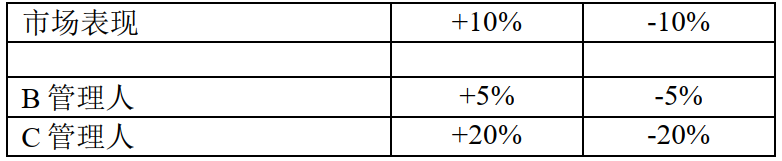
Manager B is only a manager with a beta coefficient of 0.5 without alpha, while manager C is a manager without alpha with a beta coefficient of 2.0. You can invest half of your capital in an index fund and place the other half under the mattress to get the same results as manager B, and as for manager C's performance, you can get it by doubling your investment with borrowed funds and investing all of it in an index fund.
However, the following two managers do have alphas because they show asymmetry:
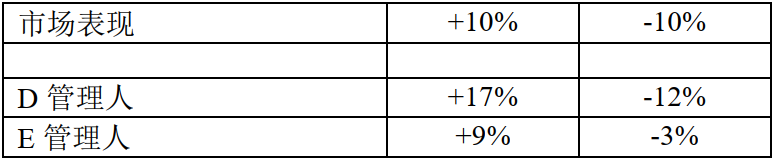
The returns from these two managers reflect more gains in rising markets than losses in falling markets. Manager D can be considered an enterprising manager with an alpha; he achieved a 170% market return when the market rose, but only took 120% of the loss when the market fell. Manager E is a defensive manager with an alpha; its return reflects 90% of gains in rising markets, but only bears 30% of losses in falling markets. This asymmetry can only be attributed to the presence of Alpha. Risk-averse customers prefer to invest in D managers, while risk-averse customers prefer E managers.
The following manager is really outstanding:

She beat market performance on both “offensive and defensive ends”: when the market rises, her increase is greater than the market; at the same time, when the market falls, her decline is less than the market. She rose so much when she was in the market that you might want to describe her as aggressive. However, since she declined less when the market fell, this description was less appropriate. Either she doesn't have a preference for aggressive or defensive types, or her alpha is enough to offset that preference.
Finally, this should be one of the greatest managers of any time:

Manager G made positive gains in rising markets, as well as in falling markets. He clearly doesn't have an aggressive/defensive preference because he has performed very well in both market situations. His alpha was enough to buck the trend when the market went down and get positive returns. When you find Manager G, you should (i) conduct full due diligence on his reported performance, (2) invest heavily in him if the situation is true, (3) hope he won't accept too much funding so that his competitiveness will disappear due to size, and (4) please send me his phone number.
Lastly, what matters most? asymmetry.
• In summary, asymmetry is reflected in the manager's ability. When the situation develops according to his wishes, he can perform excellently; when the situation is unfavorable, it can also be less bad.
• There is a famous saying, “Never confuse brains with a bull market (Never confuse brains with a bull market).” Managers with the skills needed to achieve asymmetry are special because they can reap good benefits from factors other than rising markets.
• If you think about it carefully, the core of active investment business is completely asymmetry. If the manager's performance does not exceed the level that can be explained by the market return and the relative risk position he assumes (this stems from his choice of market sector, strategy, and risk appetite), then he is not earning rewards for his real skills.
Without asymmetry (see A, B, and C managers on page 11), active management has no value and should not be paid. In fact, if an active investor doesn't have outstanding skills or insight, all the choices he makes will be in vain. By definition, average investors and below-average investors don't have alpha, nor do they achieve asymmetry.
The biggest problem is how to get asymmetry. Most of the things people are concerned about — the unimportant things I've described on pages 1-8 of this article — don't provide asymmetry. As I said before, the average value of all investors' thinking results generated the market price, which apparently also produced an average return. Asymmetry can only be demonstrated by a relatively small number of people with excellent skills and insight.The key is to identify them.
November 22, 2022
This material expresses the author's views as of the date indicated, and such views are subject to change at any time without notice. Oak has no responsibility or obligation to update the information contained in this material. Furthermore, Oak does not state that past investment performance is an indicator of future performance, and you must not make such assumptions. In fact, whenever there is an opportunity to profit, there is also a possibility of loss. This material is for informational purposes only and may not be used for any other purpose. The information contained in this material does not constitute and shall not be construed as an offer to provide consulting services or an offer to sell or solicit the purchase of any securities or related financial instruments in any jurisdiction. Some of the information contained in this material relating to economic trends and performance is based on or taken from information provided by independent third party sources. Oaktree Capital Management, L.P. (“Oak”) believes that the source of the information obtained is reliable, but cannot guarantee the accuracy of the information, nor has it independently verified the accuracy or completeness of the information or assumptions made based on the data. This material (including the information contained in this material) may not be copied, reproduced, republished, or published in any way without Oak's prior written consent. To the extent that this material or part of its content is in Chinese, such Chinese translations are for reference only, and if there is any difference between the Chinese translation and the English manuscript, the English manuscript shall prevail. Oaktree Capital (Hong Kong) Limited is available in English for this material. Oak, its affiliates, or any of their respective officers, partners, employees, affiliates, shareholders or agents are (i) not responsible for any inaccuracies, errors, or omissions in the translation of this material, and (ii) have no obligation to notify any recipient of any inaccuracies, errors, or omissions in the translation.
Risk Disclaimer: The above content only represents the author's view. It does not represent any position or investment advice of Futu. Futu makes no representation or warranty.Read more


Comments (7)
to post a comment
39
149