

美元指數持續走高,對市場影響幾何?

Global exchange rates are collapsing, and the panic index is surging
On September 26, major global exchange rates continued to fall, with the British pound collapsing against the US dollar, plummeting to its lowest level since 1971. The pound once dropped by 4.9%, reaching 1.0327 dollars per pound, before stabilizing around 1.05 dollars per pound, which was 2.9% lower than the previous trading day's closing price.
Amid the collapse of the pound, the only indicators rising were the US Dollar Index and the VIX fear index.
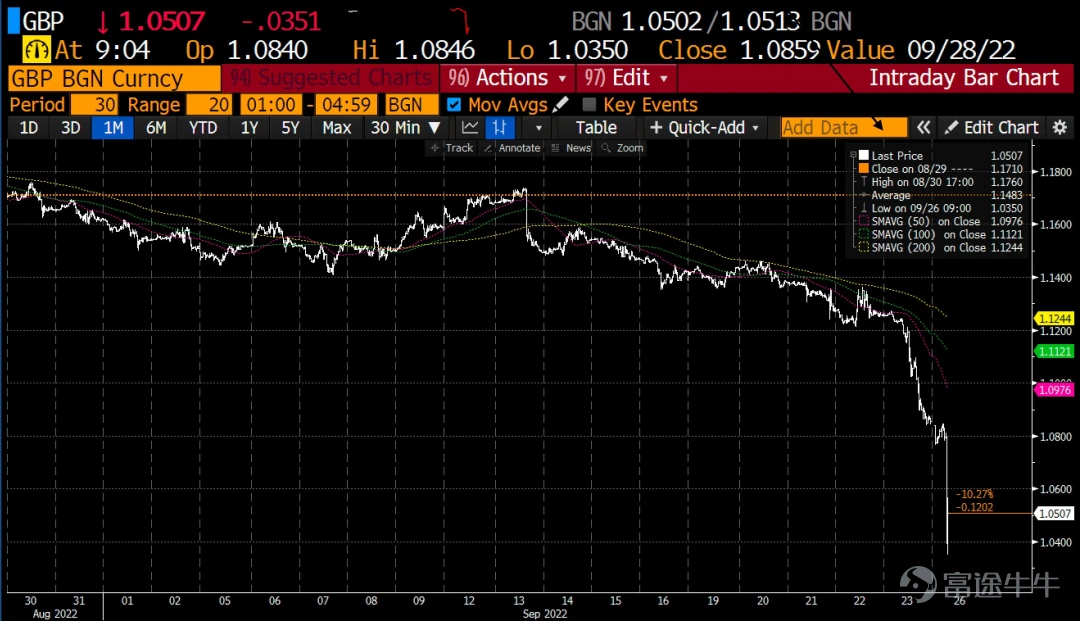
The sudden sharp decline in the pound was mainly due to the UK government announcing last week the most aggressive tax-cut plan since 1972, reducing taxes on workers' wages and businesses in an effort to stimulate the UK economy, which has fallen into recession.
The main measure of the tax cuts is to reverse all previously planned tax increases. According to UK government estimates, the total amount of tax cuts will reach 45 billion pounds by 2026-2027.
Due to the need to issue a large amount of new debt to fund the tax cuts and energy subsidy programs, investment banks are concerned that this could undermine the Bank of England's efforts to contain inflation.
The UK government holds two views: one is that the new Prime Minister, Liz Truss, believes that economic growth should be promoted through tax cuts and reforms.
The other view comes from the Conservative Party’s tax hike policy. The Conservative Party believes that due to the impact of the Russia-Ukraine conflict, soaring energy prices in Europe have kept inflation high. Under the unpredictable trajectory of the energy crisis, the UK should choose to raise taxes and cut fiscal spending to avoid potential crises.
The UK's new finance minister said, 'High energy costs are not the only challenge facing the UK; British economic growth has not reached its expected level.'
Low growth leads to reduced income, forcing tax hikes to fund public services, which further diminishes the returns on investment and labor, dampening economic stimulus and growth.
The result of this vicious cycle is that the tax burden is expected to reach its highest level since 1940. We are determined to break this cycle. We need to find a new strategy focused on growth for a new era.'
It is worth noting that Truss's tax cut policy primarily targets the wealthy and businesses. Truss hopes to loosen restrictions for this group, promote consumption among the wealthy, and increase the UK’s attractiveness to businesses in order to stimulate the British economy.
Currently, following the announcement of the tax cuts, the pound has seen a sharp decline, which is increasing the risk of a pound crisis. Meanwhile, the yield on 10-year UK government bonds rose by 22 basis points to 4.05%, reaching its highest level since 2010.
The market has already voted with their feet regarding confidence in the UK, reacting very negatively.
The former US Treasury Secretary believes that the UK’s adoption of such radical economic policies is creating conditions for the pound to fall below parity against the dollar. Such aggressive policies are naive and overly optimistic. He also stated that he would not be surprised if the pound eventually falls below parity against the dollar.
In his view, the UK will transform itself from an emerging market into a declining market.
Since Brexit, the Bank of England has fallen far behind the curve. Now, with these radical fiscal policies, the UK will pay the price for implementing poor macroeconomic policies.
From Brexit to the Bank of England falling far behind the curve, and now to these fiscal policies, the UK will be remembered for adopting some of the worst macroeconomic policies over a long period.
As can be seen from the chart below, global currencies have experienced significant depreciation trends recently, especially the euro, yen, pound, and won, raising the likelihood of crises in various countries.
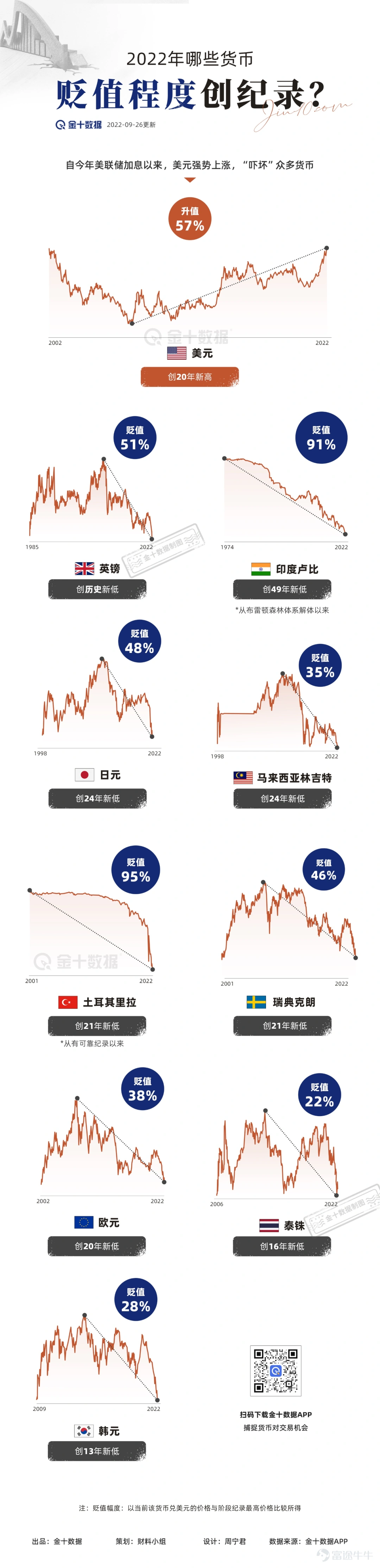
In this round of depreciation, although the renminbi exchange rate has seen a noticeable acceleration in depreciation recently, major global economies and China are at different stages of monetary policy cycles.
Major global economies are raising interest rates, while China is cutting them. A corresponding depreciation is to be expected and unavoidable.
On September 26, the central bank increased the foreign exchange risk reserve ratio for forward sale transactions from 0 to 20%. Such a move has been triggered five times in history, aiming to slow down the depreciation of the renminbi. Along with previous reductions in the foreign exchange deposit reserve ratio, these are considered routine operations to adjust the exchange rate.
Conclusion
It is impossible to stop the trend of depreciation; the only thing that can be achieved is to prevent the speed of depreciation from accelerating.
Some institutions have mentioned that the central bank's tools for stabilizing the exchange rate include but are not limited to: activating the countercyclical factor, adjusting the foreign exchange deposit reserve ratio, modifying the risk reserve for forward sales, tightening offshore renminbi liquidity, and strengthening capital account controls.
As the renminbi's exchange rate depreciates, the A-share market has also been significantly affected, with trading volume shrinking drastically to a two-year low. Market sentiment has hit rock bottom, and investors generally believe another battle to defend the 3000-point level is imminent.
Risk Disclaimer: The above content only represents the author's view. It does not represent any position or investment advice of Futu. Futu makes no representation or warranty.Read more


Comments (2)
to post a comment
41
18