嗶哩嗶哩Q2淨虧損擴大,你如何評價?

Bilibili's Vertical Screen Shakes Up the Video Industry
Text by: Lü Xinyi
It's just adding a vertical display format into a horizontal video platform. How much of a splash can such a small change make?
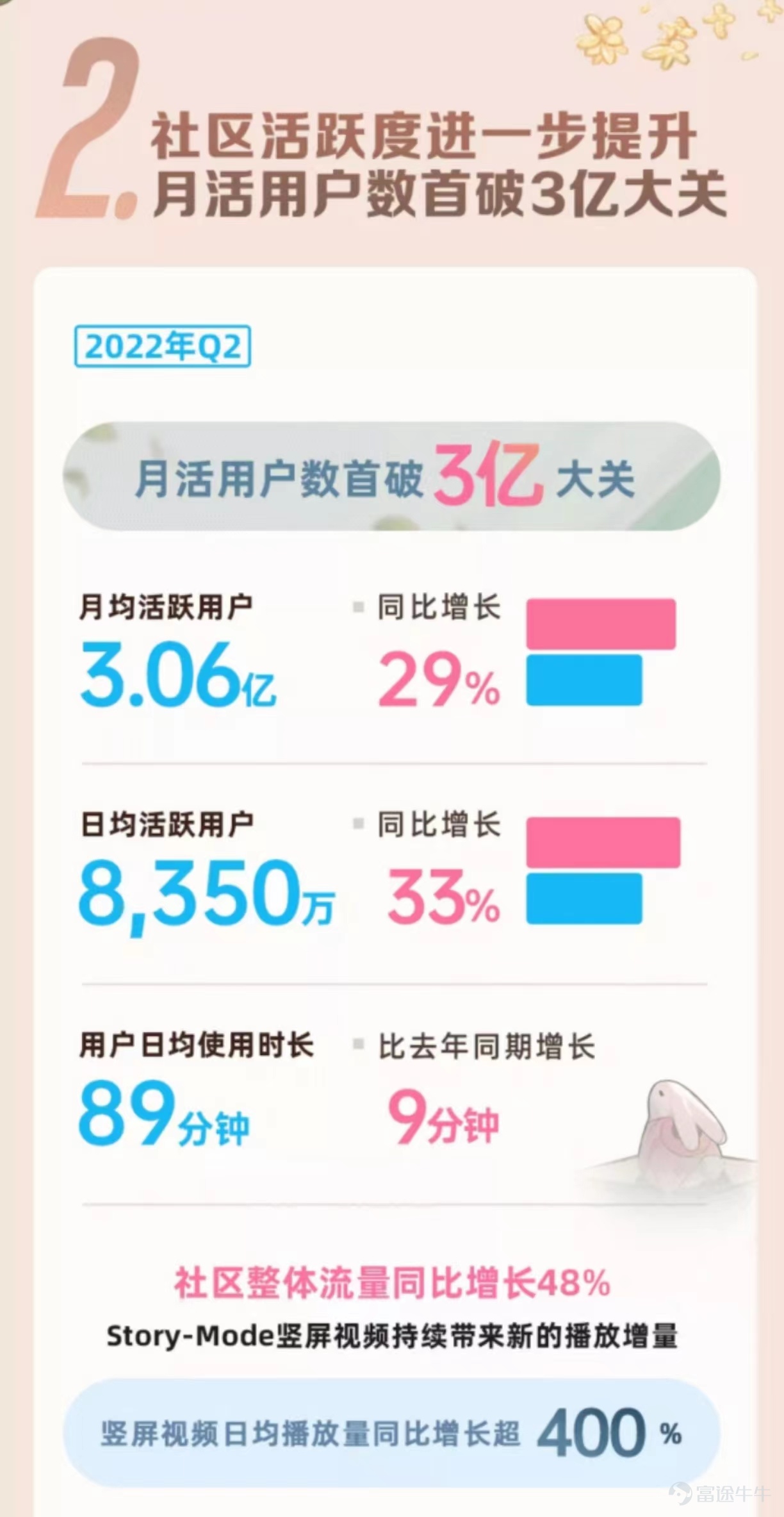
In 2021, Bilibili$Bilibili (BILI.US)$In 2021, Bilibili (B站) launched Story-Mode, a vertical short-video format on its main platform. According to the Q2 earnings report this year, vertical videos have continued to bring new viewership growth to Bilibili, with daily average views increasing over 400% year-over-year. Chen Rui noted that some of the new UP hosts who gained millions of followers in Q2 attributed their fan growth to vertical videos.
This minor tweak is seen by Chen Rui as a win-win for all parties: reducing creators' production costs, lowering the barrier for users to watch, and attracting more advertisers. Chen Rui has high hopes for the future of vertical screen mode, believing it will be one of the key drivers for user and advertising growth.
According to the earnings report, in Q2, Bilibili had 306 million monthly active users, an increase of 29% year-over-year, and 83.5 million daily active users, up 33% year-over-year. The average daily user engagement was 89 minutes, with overall community traffic increasing by 48% year-over-year.

The market response is more telling than the data. The birth of Bilibili’s vertical screen mode stems from the maturity of its commercialization, algorithms, and PUGV (Professional User Generated Video). With a solid foundation laid early on, it has attracted many creators from other platforms. They simply need to re-upload works already posted on other platforms to Bilibili’s vertical format to gain followers quickly. One example is the blogger 'Tuhetou Wuyanzu.'
In other words, the vertical screen mode has helped Bilibili capture a larger share of the video industry pie. In Chen Rui’s view, this trend will continue for another three years, and Bilibili’s short videos will continue to stir up the industry. However, judging from market feedback, things may not be so simple.
Bilibili’s Vertical Screen: A Boon for Some Creators, a Bane for Others
“In the future, there will be more viral hits in vertical videos. There are already signs of this, such as the blogger 'Shancheng Xiaolixun,'” said Chen Rui.
The blogger 'Shancheng Xiaolixun' is a senior hairdresser with over a decade of experience. He began posting on various short-video platforms in 2018, but initially saw little success. The turning point came a year later when he stopped merely sharing haircut videos and started focusing on character packaging and creating a unified style. He also added contrast in his scripts and storylines.

Such adjustments occasionally bring Shancheng Xiaolixun videos with over 100,000 likes. Over three years, he has amassed one million followers, joining the club of million-follower bloggers. However, such a scale is considered only mid-tier on short video platforms.
In January this year, Bilibili’s vertical screen mode attracted Shancheng Xiaolixun. He officially joined Bilibili and released videos. Up to now, his videos have accumulated over 13 million views and have been repeatedly recommended on Bilibili's popular list. After being active for half a year, his followers exceeded 3 million. This achievement was reached much faster than the 4 million followers he gained after several years on other platforms, showing an unprecedented growth rate. According to data from Bilibili Huohuo, the average number of coins invested in Shancheng Xiaolixun's recent ten videos is 20,000.
Creators like Shancheng Xiaolixun who focus on vertical screen content have shown astonishing growth after migrating to Bilibili. Previously, Shuainong Niaoge, who had over 3 million followers on Douyin, quickly gained one million followers just ten days after joining Bilibili. He now has more than 2.8 million followers.
Short-form vertical videos are more suited to creators from platforms like Douyin and Kuaishou, who excel at producing fast-paced, engaging content and know how to polish their work to capture users' attention within a short time. Therefore, when external creators migrate to Bilibili, they find it easier to adapt to vertical screen mode and often become top performers in that format.
It can be said that the vertical screen mode has enriched Bilibili's content ecosystem and improved community activity. On the evening of September 8th, during Bilibili’s Q2 earnings call, Chen Rui stated that the vertical screen mode is friendly to UP masters with smaller followings, reducing production costs while also helping them gain followers quickly. The vertical screen viewing experience also lowers the barrier for users, attracting more active users to Bilibili’s main platform. Finally, this model will attract more advertisers, helping Bilibili expand its advertising revenue opportunities. Currently, the penetration rate of vertical screen mode in DAU has exceeded 20%, and importantly, the proportion of users liking content has reached 30%.
The vertical screen mode enriches the platform and brings more traffic pools, expanding the pie and attracting not only creators from external platforms. Recently, top blogger Wushi Finance, who previously left Bilibili, announced his return. After leaving Bilibili, although he briefly received traffic support on other platforms, his traffic has significantly declined in the past six months. This once top financial blogger born on Bilibili also sees Bilibili's new changes.
However, not all bloggers can benefit from this.
Bilibili’s native UP masters are accustomed to creating in-depth, medium-to-long-length videos. According to available information, blogger Dawaxing believes, 'This change in content format affects more small-to-medium UP masters. When a UP master has over 200,000 followers, the impact isn’t as significant.'
Moreover, most of Bilibili’s content focuses on learning, anime, and educational explanations, which are better suited to horizontal screen PC-based viewing due to their longer duration. This is Bilibili’s inherent DNA. Thus, bloggers specializing in this area may struggle to adapt to vertical screen content creation and miss out on this fast track.
In short, the advent of vertical screen mode has allowed Bilibili to attract a broader range of creators and users. However, these groups’ characteristics may not fully align with Bilibili’s core identity, resulting in content lacking the 'Bilibili flavor.' For a platform that has always emphasized community atmosphere, Bilibili seems to need further balancing.
Finally, there is the challenge on the technology front. Short video platforms use algorithms to firmly grasp user preferences, thereby extending the time users spend on the platform. However, B站 (Bilibili) operates under a PUGC model and has always prioritized content quality in its recommendation mechanisms and algorithms, which differ from those of short video platforms. Since it aims to build a short video platform within its main site, B站 (Bilibili) will need to refine its recommendation mechanisms and algorithm logic moving forward.
A new window of opportunity or an unnecessary move?
Chen Rui's optimism about the vertical screen mode does not merely stop at the user growth it brings to the platform.
According to financial reports, B站 (Bilibili)'s advertising revenue reached 1.16 billion yuan in Q2, a year-on-year increase of 10%. In the same quarter, B站 (Bilibili)'s value-added service business revenue hit 2.1 billion yuan, growing by 29% year-on-year. Gaming business revenue reached 1.05 billion yuan. Notably, especially the Story-Mode vertical screen ad product saw rapid traffic growth, gaining popularity among advertisers. The platform has enriched its content categories, attracting more advertisers. This means that the vertical screen mode has brought tangible advertising income to B站 (Bilibili).

From the business revenue, it can be seen that gaming is no longer the main force for B站 (Bilibili), with advertising and value-added services taking the lead. B站 (Bilibili)'s value-added services include e-commerce, live streaming, memberships, etc. Advertising and value-added services are now important sources of revenue and will be the future direction of B站 (Bilibili)'s development.
The emergence of the vertical screen mode benefits advertising revenue and value-added services.
In addition to the vertical screen mode attracting advertisers, the primary way creators on B站 (Bilibili) currently engage in product promotion is through comment section links, known as 'blue chain' product promotions, redirecting users via the blue chain to product detail pages on partner platforms like JD.com and Taobao for purchase. Currently, the blue chain product promotion performance in vertical screen mode is comparable to that of horizontal screen mode.
B站 (Bilibili) itself relies heavily on the community atmosphere formed by interactions such as bullet comments, comments, and likes as its main competitive advantage. During the earnings call, Chen Rui stated that currently, B站 (Bilibili)'s interaction count exceeds its DAU (Daily Active Users), which in turn exceeds its MAU (Monthly Active Users). This indicates that even though the product promotion process is hidden in the comment section, it does not affect user operations whatsoever.
An example can shed some light: UP主 Crazy Little Yang Ge created a promotional video for Cheetos, garnering over 6 million views. Even when presented in vertical screen format, it did not affect the promotional effect of the blue chain in the comment section. The top blue chain alone received nearly 7,000 likes.
In fact, the model of using comment section links for product promotion is not new. B站 (Bilibili)'s vertical screen mode in terms of commercialization can be said to be exploring while standing on successful precedents, allowing the vertical screen mode to demonstrate its commercial vitality in a short period of time.
It can be foreseen that this will be an important window for B站's future commercialization. However, the emergence of any new thing has two sides. Setting aside the favorable factors, the vertical screen mode actually hides some unease. First, simply turning a video from horizontal to vertical, such a simple adjustment is, for B站, a very risky attempt.
Such results can be seen through a set of data. The retention rate of the first batch of official members who passed the community exam 13 years ago is still as high as 65%. This indicates that B站 has extremely high user stickiness, with users relying on B站 for the long term and being more accustomed to B站's horizontal screen style. "Previously, double-clicking on B站 paused the video, but double-clicking in the vertical screen likes it; the interaction is very disjointed," said Xiao Bing, a senior user of B站.
Looking at the homepage via PC and mobile, the vertical screen mode is interspersed within the recommendation page. On the surface, there is no difference, except for the two characters 'vertical screen' below the video serving as a reminder. Since it is hidden within the recommendation page rather than having a separate new entry point, if interaction consistency cannot be achieved at this time, it will be a difficult-to-get-used-to operation for users.
Since B站 launched the vertical screen mode, there have been numerous complaints on social media. Some of B站's content creators (UP主) have even posted videos teaching users how to disable the vertical screen mode. Some users feel that B站's move is somewhat redundant. Therefore, from the user perspective, the vertical screen mode still requires a long period of user education, during which B站 will also face the risk of losing users.
B站, which has always emphasized user growth, now has reached 300 million monthly active users. The importance of user scale to a content platform goes without saying. Whether it can retain users more accustomed to the old ways while opening new windows remains an unknown.
Risk Disclaimer: The above content only represents the author's view. It does not represent any position or investment advice of Futu. Futu makes no representation or warranty.Read more


Comments
to post a comment
3
5