傑克遜霍爾年會召開,鮑威爾“放鷹”!

Powell is 'serious,' and the market finally believes it
Powell has dispelled all expectations that the Fed will pause its tightening policy or cut interest rates next year
Over the past week, Wall Street has been speculating about what message Powell, the Federal Reserve chairman, is preparing to deliver at the Jackson Hole Economic Symposium. On Friday morning (August 26) local time, Powell stated in his speech that although the U.S. economy is slowing down, the Fed remains committed to combating inflation through restrictive monetary policies.
This speech, which could have lasted 30 minutes, was delivered in just 10 minutes. Powell made it clear that if sufficiently strong action is not taken, the consequences will be more 'painful' than acting conservatively.
Ed Yardeni, chief investment strategist at Yardeni Research, said, 'Powell's speech was brief and tough in tone, dispelling any expectations that the Fed would pause tightening or cut rates next year.'
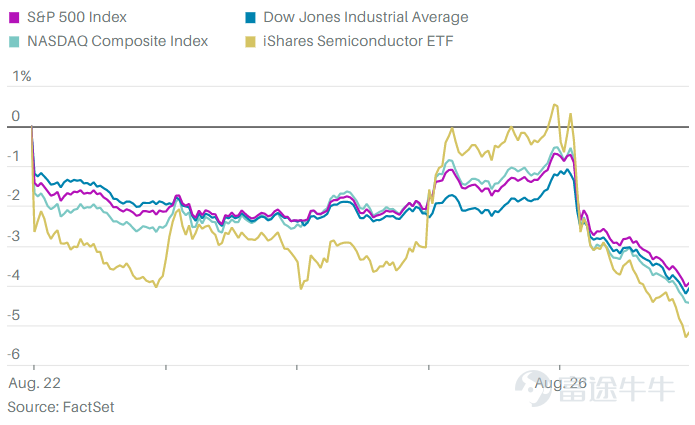
Following Powell's remarks, U.S. stocks plummeted, ending a two-day rally. The Dow Jones Industrial Average closed down over 1,000 points, a 3% drop, marking its worst day since May 18. The S&P 500 fell 3.4%, while the Nasdaq Composite dropped 3.9%, both recording their largest declines since mid-June.
According to Barron’s, the only surprising aspect of Powell’s speech this time was that the market was spooked, as Powell had essentially been conveying the same message for some time, and now the market has finally started to listen.

‘Pain’ is the necessary cost of fighting inflation
Powell noted that restoring price stability will take some time and bring some pain to households and businesses, but unfortunately, it is the price that must be paid to lower inflation.
Powell referred to previous efforts by the Fed to lower inflation. He mentioned that history shows that failing to act swiftly to stabilize prices could ultimately lead to a greater blow to the labor market in the long run. Powell also indicated that reversing policy too quickly would be counterproductive, a statement aimed at reducing investor expectations that the Fed might soon pause or ease policy after significant rate hikes.
Powell acknowledged that recent U.S. economic growth has slowed from the historical highs of 2021, but recently released economic data is far from sufficient for the Fed to believe that inflation is dropping significantly.
As for the near-term outlook, Powell did not specify how much the Fed would raise interest rates at its meeting at the end of September, only saying that 'another significant rate hike may be appropriate.' He also mentioned, 'As monetary policy tightens further, at some point it might be possible to slow down the pace of rate hikes.'
Powell emphasized the need to control inflation expectations, as these expectations influence consumer behavior and could potentially exacerbate price pressures. He cited former Federal Reserve Chairman Volcker, stating that 'controlling inflation expectations' is one of the tasks the Fed must accomplish in order to restore price stability.
Ian Shepherdson, chief economist at Pantheon Macroeconomics, pointed out that the Fed cannot ease monetary policy until there is a significant decline in inflation toward its target level and a noticeable slowdown in wage growth. The message from Powell is that the Fed believes these two conditions are unlikely to be met as quickly as the market expects.

If data improves over the next month, the likelihood of a 50-basis-point rate hike in September will increase.
Although Powell did not specify the magnitude of the September rate hike, he indicated that it would depend somewhat on 'the overall data and the evolving economic outlook.' Analysts currently believe a smaller rate hike is more likely.
Mark Freeman, chief investment officer at Socorro Asset Management, said in an email to Barron's after Powell's speech: 'While Powell did not rule out another 75-basis-point rate hike, key economic data on employment and inflation will be released before the Fed's next meeting, which will ultimately determine whether the hike will be 50 or 75 basis points. If the data meets the Fed’s expectations, a 50-basis-point hike is our current base-case scenario.'
Gerard MacDonell, an economist at 22V Research, also believes that Powell did not definitively commit to another 75-basis-point rate hike.
Anders Persson, chief investment officer of Nuveen’s global fixed income division, expects that Powell will emphasize the importance of economic data when the Fed makes its interest rate decision next month. He believes that what Powell is doing is 'trying to signal that the Fed is now leaning more hawkish, rather than committing to the actual size of the rate hike.'
The market’s concern is not about how much will be raised in September, but when the rate hikes will stop.
Data from CME Group's FedWatch Tool also shows that after Powell's speech, the futures market priced in a 61% probability of a 75-basis-point rate hike by the Fed in September, down from 64% the previous day.
Barron's noted that yesterday’s sharp drop in US stocks indicates that what truly worries the market is not the magnitude of the next rate hike, but when the rate hikes will stop and how long rates will remain high, even if this means triggering a recession. Thomas Mathews, a market economist at Capital Economics, said: 'We don’t think the Fed is ready to 'pivot,' meaning that for some time, the Fed will remain a bearish factor facing the markets.'
Highly valued growth stocks are facing particularly strong pressure, with the tech-heavy Nasdaq Composite Index falling 4.4% this week because these high-valuation growth stocks are the most sensitive to rising interest rates. Stocks like NVIDIA (NVDA) and Trade Desk (TTD), with price-to-earnings ratios of 42.7 times and 57.9 times respectively, are still not cheap at current levels.
However, investors seem unable to resist growth stocks. According to Goldman Sachs, in the second quarter of this year, growth-oriented mutual funds increased their holdings of stocks trading at 20 times enterprise value-to-sales or higher, such as Snowflake (SNOW), Trade Desk, and NVIDIA. This strategy worked well during the stock market rebound from the June lows, but could have the opposite effect if the Federal Reserve raises interest rates more than investors expect.$Snowflake (SNOW.US)$
Wolfe Research strategist Chris Senyek wrote in a research note: 'Powell's speech will continue to put downward pressure on the stock market, with the greatest impact felt by 'growth' and 'long-duration' sub-sectors and stocks.'
Barron's believes that from now until the Fed’s next meeting at the end of September, investors should prepare for significant stock market volatility.
By Guo Liqun, contributor to the Chinese edition of Barron's
Edited by Peng Ren
Copyright Notice:
Original article from Barron’s (barronschina). Reprinting prohibited without permission.
(The content of this article is for reference only and does not represent the inclination of investment advice by Barron's; the market involves risks, and investments must be made with caution.)
Risk Disclaimer: The above content only represents the author's view. It does not represent any position or investment advice of Futu. Futu makes no representation or warranty.Read more


Comments
to post a comment
20
33