
國際運價大跌,港A航運股集體走低

[Shipping Knowledge] What are the classifications of shipping? How to interpret freight rate indexes? Is the BDI universal?
Classification of shipping
Depending on the type of goods being transported, freight can be roughly divided into bulk cargo, oil transportation, container shipping, miscellaneous goods, liquefied gas transportation, chemical transportation, and some special item transportation, such as semi-submersible ships and ships used for tanker drilling, etc.
The entire bulk trade can be roughly divided into three categories, which are transported by ships or maritime transportation methods.Using bulk carriers, container shipping, and oil tankers.Research on shipping in the market mainly focuses on bulk cargo, oil transportation, and container shipping. Discussions on the good and bad conditions of the shipping market and its fluctuations are also analyzed from these three aspects.
The three main ship types in maritime transportation, with containers being the most common. People often see ships at the sea carrying neatly stacked boxes, transporting daily light industrial products or small household items, and many coastal cities have container terminals for loading and resting.
Bulk carriers and oil tankers are less commonly encountered in daily life. They are only visible when ships dock at ports. During the transportation process at sea, they do not sail close to shore, so opportunities to see them are limited. In terms of the global trade classification of maritime transportation, whether it is bulk cargo, general cargo, or other miscellaneous goods carried by bulk carriers, they collectively account for almost half of the total maritime freight volume. This means that the condition of bulk cargo transportation has a significant impact on the entire shipping market. Bulk carriers mainly transport bulk cargo such as iron ore, coal, and grains, which are loaded into the ship's hold for transportation. Oil tankers primarily transport crude oil or refined oil, and the loading and unloading processes pump the oil into tanks inside the ship under pressure for transportation. Container shipping involves loading goods into standardized boxes, securing and fastening them to the deck, to prevent shifting during marine transportation.
Taking China as an example, as a major exporting country, it has specific shipping routes for goods destined for the USA, Europe, South America, and other regions.When looking at the increases in freight rates on various routes, it actually depends on the economic conditions of the corresponding exporting countries.For example, when exporting to Europe, you need to consider the economic situation in Europe, such as its GDP, PMI, etc.
A simple explanation of maritime transportation index.
What is the shipping index?
The business sector of the many publications we see every day is usually filled with a series of indices such as S&P, ZEW, and CPI, which are powerful tools used by investment professionals to help measure economic health. For the maritime shipping industry responsible for transporting the vast majority of global trade goods overseas, the shipping index is the best way to assess market performance.
Based on the type, size, age, and region of the ships, many shipping indices have been developed, each with different backgrounds and purposes.
Some well-known shipping indices include: Clarkson index, Howe Robinson index, and Harper Petersen Index (HARPEX), as well as various types of indices reflecting freight and charter levels in the container sector. Freight rate indices in the same market sector include the China Container Freight Index (CCFI) and the Shanghai Containerized Freight Index (SCFI). The well-known shipping consultancy Drewry also developed the Drewry Containerized Freight Index.
At the same time, the Dow Jones Global Shipping Index is more like a typical stock index, as it mainly tracks the stock performance of 25 companies in the shipping industry.Among all these shipping indices, the Baltic Dry Index (BDI) has a particularly important significance in measuring the health of the world economy.
BDI index
When analyzing the prosperity of the shipping market, we often focus on dry bulk cargo as an important research subject. So, how can we understand the situation of dry bulk cargo? We can look at the BDI.
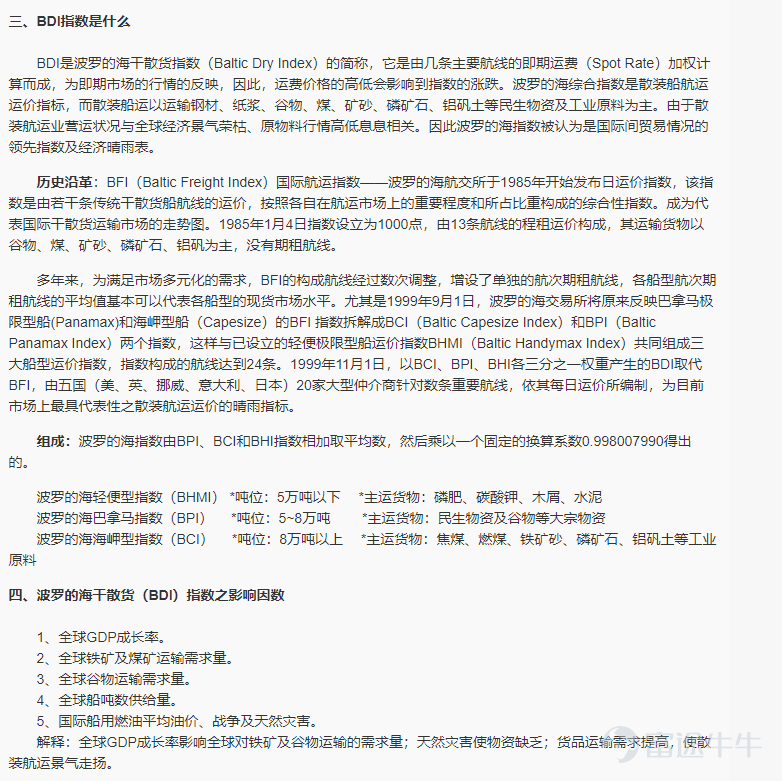
BDI is the abbreviation of the Baltic Dry Index, which is calculated by weighting the spot rates of several major shipping routes, reflecting the market situation of the spot market. Therefore, the high and low freight prices will affect the rise and fall of the index. BDI is the Baltic Dry Freight Rate Index, which reflects the overall situation of dry bulk cargo. It is the weighted average of the four types of dry bulk cargo indices BCI, BPI, BSI, and BHSI, with each index accounting for 25% of the weight, forming the BDI.
The Baltic Composite Index is a bulk shipping freight rate index, and bulk shipping mainly transports steel, pulp, grain, coal, iron ore, phosphate rock, bauxite, and other consumer goods and industrial raw materials. Due to the close relationship between the operation of bulk shipping industry and the global economic situation and the price of raw materials.The Baltic Index is considered a leading indicator of international trade and an economic barometer.

BDI was created by the Baltic Exchange, headquartered in London. It is a comprehensive index of dry bulk freight rates and is therefore regarded by many industry insiders and even scholars as a comprehensive indicator of the dry bulk shipping market. As BDI is a maritime freight rate index, securities analysts use it as a tool to analyze the trend of shipping stocks. As BDI represents the maritime freight rates of raw materials, scholars use it as an early warning indicator for predicting economic trends. Some even equate forward freight agreements (FFAs) based on BDI-indexed shipping types and routes with BDI itself.
In fact, the trend of the BDI index can indeed reflect the market's demand for metals, minerals, grains, and building materials. These "BDI materials" are the basic raw materials for manufacturing final products, so the index is considered by many as a leading economic indicator for industrial production and economic activities, laying a foundation for political and economic decision-making.
For example, China's need to import a large amount of iron ore to support infrastructure construction can be reflected through BDI. The abundant harvest of Brazilian agricultural products may also be reflected in BDI. By using comprehensive satellite data monitoring the actual trade flow of different types of ships, it is not only possible to better understand the actual movement of goods, but also to have a clearer understanding of the transportation distance of goods. Of course, BDI can only show the supply and demand balance in the field of bulk commodity shipping, and although many analysts view it as a leading indicator of growth, they often forget that BDI is not only a demand-driven index, but they should also consider factors related to the supply of shipping capacity.
Container Index
There are many indices for container transportation.CCFI and SCFI are indexes released by China, one is China Container Freight Index, and the other is Shanghai Containerized Freight Index.From wind or other channels, we can also see container import freight indexes, as well as indexes for different ports such as Tianjin port, and so on.
However, the two indexes mentioned earlier, one represents the overall situation of China, focusing on exports mainly from China, because China is a major exporting country, its export data is more convincing and representative. SCFI is observed because Shanghai leads the entire export project index of China, its changes are the most sensitive and have the largest magnitude, SCFI can reflect the fluctuation of the container shipping market more quickly and accurately.
On the other hand, the shipping market has three major sectors, each with its corresponding supply and demand that do not intersect. For example, bulk cargo cannot be transported by oil tankers because bulk cargo requires cargo holds for loading. Oil tankers correspond to liquid crude oil or refined oil, which cannot be placed in open bulk cargo holds but must be loaded into the ship's oil tanks via pipelines.
Containers need to be stacked on the deck of the ship and are not suitable for bulk cargo or oil transport. Therefore, although the shipping market is made up of three major sectors, each sector has its own supply and demand which result in different trends in freight rates for each sector.
The ups and downs of freight rates are naturally influenced by supply and demand. The development of the shipping industry (marine transportation) has obvious cyclical characteristics, closely related to the rotation of economic cycles and the overall performance of the world economy, known as the 'King of Cycles'.

In addition, the stock prices of such companies usually fluctuate significantly, where freight rates directly impact stock prices. Investing in such companies requires a certain level of investment and risk tolerance from investors.
As investors, we often see the rise in stock prices of companies in the industry accompanying the widening gap in shipping demand brought about by the outbreak of a commodity bull market.
Taking COSCO Shipping Holdings (whose main business is container shipping and terminals) as an example, the investment logic and performance support behind the market trend at the end of 2021 mainly stem from the demand expansion in the shipping industry brought about by the economic recovery after the easing of the pandemic. Of course, geopolitical disruptions and rising oil prices also have some influence on the shipping industry.
How to analyze the market using shipping indices?
In terms of domestic macro research, it is often preferable to consider PMI and BCI together in order to have a clearer understanding of the overall economic situation.

If we analyze the entire dry bulk market (not the entire shipping market) and look at the BDI, there is no problem. However, if we are involved in iron ore, it is more accurate to look at the BCI, as the impact of iron ore transportation is most pronounced on the BCI.
For those involved in coal and grain trade, it is more effective to pay attention to the BPI because changes in the BPI directly correspond to the trend in freight rates for these two commodities. The BSI and BHSI correspond to relatively smaller dry bulk cargoes, such as grain, cement, fertilizers, nickel ore, copper ore, and other similarly-sized cargoes.
Regarding oil shipping indices, two that are highly recommended and widely followed are the BDTI (Baltic Dirty Tanker Index) and the BCTI (Baltic Clean Tanker Index), which correspond to the Baltic Dirty Tanker Index and the Baltic Clean Tanker Index respectively.
These two indices, similar to the dry bulk indices, are recognized by those involved in maritime shipping (either oil shipping or bulk cargo shipping) as authoritative indices issued by the Baltic Exchange.
Taking an objective view of the role of the BDI.
Many domestic financial and shipping information platforms, and even professional shipping media, often like to mention the BDI when discussing the shipping market, and sometimes even bring up the BDI when talking about container or crude oil shipping markets. This practice is to a certain extent, very unscientific. The shipping market has different indices based on ship types, sizes, and regions.The BDI only represents a small part of the entire shipping market, specifically the spot market freight rate trends in the dry bulk shipping market, and is not related to the liner market. Other shipping markets such as tankers, LNG, etc., have their own freight rate indices.In addition to the BDI, the Baltic Exchange also has two other well-known freight rate indices: the Baltic Exchange Dirty Tanker Index (BDTI) for crude oil shipping and Baltic Exchange Clean Tanker Index (BCTI) for refined oil shipping. Similarly, there are also container shipping indices such as CCFI and SCFI, as mentioned earlier.
Risk Disclaimer: The above content only represents the author's view. It does not represent any position or investment advice of Futu. Futu makes no representation or warranty.Read more


Comments (8)
to post a comment
119
64