
English
Back
Open Account
7月遊戲版號發放,港A遊戲股走高
表外表里
joined discussion · ·

Wrongly paid attention to Tencent in the past five years.

"At the beginning of 2017, holding Tencent$TENCENT (00700.HK)$It's been almost 5 years, and it's still negative returns. Is it because of misjudgment? The profit has indeed increased; to say the holding period is short, it's almost 5 years, how much longer does it need to be? A value investor complained on Xueqiu. A sigh, and the responses kept coming. Domestic value investors also expressed confusion and resentment. In a way, their complaints are somewhat reasonable. After all, in these five years, Tencent's profit has tripled; the competitiveness of each business line remains at the top 3 level; the social moat is so wide that even with a telescope, the opponent cannot be seen. But the market feedback is indeed flat. It is said that a good company is worth holding for the long term, but not making money after holding Tencent for 5 years makes it difficult for many people to accept. Simply put, it must be due to overvaluation. However, such a superficial explanation is not enough to be convincing. Based on this, a deep restoration of the inside and outside situations at these two time points has been done, and some analysis has been carried out, with the following three insights: 1. Under the drive of product cycles, we need to beware of the sustainability of the cycle. 2. Business transformation caused by technological iteration requires anticipating the competition trends. 3. For business with high sensitivity to macro and regulatory factors, regular examinations of the coordinate system are needed. First, be alert to the sustainability of the high prosperity driven by the product cycle. In late June, Tencent began its third round of layoffs this year, with a focus on optimizing the Interactive Entertainment Group (IEG) department. According to the disclosure of relevant employees: in better departments, the layoff rate is about 20% to 30%...
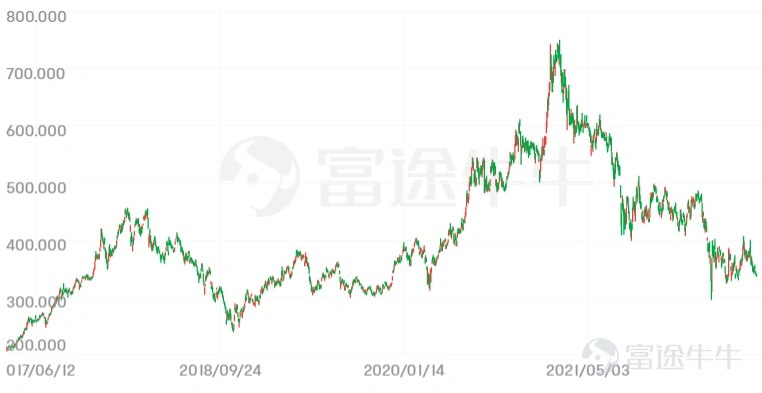
At the beginning of 2017, holding Tencent...$TENCENT (00700.HK)$Almost 5 years, still negative returns. Can it be said that the judgment was wrong, when the profit did indeed increase? Can it be said to be a short holding period, when it's almost 5 years?
A value investor, lamented on Xueqiu. A sigh, and plenty of responses. Domestic value investors also expressed their confusion and discontent one after another.
In a way, their complaints are somewhat reasonable.
After all, in these five years, Tencent's profit has tripled; the competitiveness of each business line is still at the top 3 level; the social moat is so wide that even with a telescope, there is still no sign of opponents.
But the market feedback is indeed flat.
"At the beginning of 2017, holding Tencent$TENCENT (00700.HK)$It's been almost 5 years, and it's still negative returns. Is it because of misjudgment? The profit has indeed increased; to say the holding period is short, it's almost 5 years, how much longer does it need to be? A value investor complained on Xueqiu. A sigh, and the responses kept coming. Domestic value investors also expressed confusion and resentment. In a way, their complaints are somewhat reasonable. After all, in these five years, Tencent's profit has tripled; the competitiveness of each business line remains at the top 3 level; the social moat is so wide that even with a telescope, the opponent cannot be seen. But the market feedback is indeed flat. It is said that a good company is worth holding for the long term, but not making money after holding Tencent for 5 years makes it difficult for many people to accept. Simply put, it must be due to overvaluation. However, such a superficial explanation is not enough to be convincing. Based on this, a deep restoration of the inside and outside situations at these two time points has been done, and some analysis has been carried out, with the following three insights: 1. Under the drive of product cycles, we need to beware of the sustainability of the cycle. 2. Business transformation caused by technological iteration requires anticipating the competition trends. 3. For business with high sensitivity to macro and regulatory factors, regular examinations of the coordinate system are needed. First, be alert to the sustainability of the high prosperity driven by the product cycle. In late June, Tencent began its third round of layoffs this year, with a focus on optimizing the Interactive Entertainment Group (IEG) department. According to the disclosure of relevant employees: in better departments, the layoff rate is about 20% to 30%...
It is said that a good company is worth holding for a long time, but holding Tencent for 5 years without making money is somewhat hard to accept.
Simply put, the high valuation is definitely the reason.
But such a shallow explanation is not convincing enough. Based on this, a deep analysis of the situation at these two time points has been carried out, and there are three insights as follows:
1. Be cautious about the sustainability of the high prosperity driven by the product cycle.
2. Predict the trend of competition based on the business changes caused by technological iteration.
3. Regularly conduct a physical examination of the macro and regulation-sensitive businesses.
Under the drive of product cycle, we should be vigilant about the sustainability of the cycle.
In late June, Tencent began its third round of layoffs this year, with a focus on optimizing the IEG (Interactive Entertainment Group) department. According to employees, the layoffs ranged from 20% to 30% in better departments, while some smaller departments were completely disbanded.
In response to this, some employees couldn't help but ask, "Why are we laying off and reducing salaries when the game revenue is still high?"
Yes, from 2017 to the present, the gross margin of Tencent's gaming business has always been over 50%. So why has it come to the point of massive layoffs?
Let's take a look at a set of data comparisons:
In 2017, Tencent occupied 13 spots in the top 30 of the best-selling games list, and most of the self-developed or agency games ranked at the top.
In 2021, Tencent only occupied 7 spots in the top 30 of the best-selling games list, and the games that supported the list were mostly products from 2017. The only new face is "The Legend of Yulgang".
"At the beginning of 2017, holding Tencent$TENCENT (00700.HK)$It's been almost 5 years, and it's still negative returns. Is it because of misjudgment? The profit has indeed increased; to say the holding period is short, it's almost 5 years, how much longer does it need to be? A value investor complained on Xueqiu. A sigh, and the responses kept coming. Domestic value investors also expressed confusion and resentment. In a way, their complaints are somewhat reasonable. After all, in these five years, Tencent's profit has tripled; the competitiveness of each business line remains at the top 3 level; the social moat is so wide that even with a telescope, the opponent cannot be seen. But the market feedback is indeed flat. It is said that a good company is worth holding for the long term, but not making money after holding Tencent for 5 years makes it difficult for many people to accept. Simply put, it must be due to overvaluation. However, such a superficial explanation is not enough to be convincing. Based on this, a deep restoration of the inside and outside situations at these two time points has been done, and some analysis has been carried out, with the following three insights: 1. Under the drive of product cycles, we need to beware of the sustainability of the cycle. 2. Business transformation caused by technological iteration requires anticipating the competition trends. 3. For business with high sensitivity to macro and regulatory factors, regular examinations of the coordinate system are needed. First, be alert to the sustainability of the high prosperity driven by the product cycle. In late June, Tencent began its third round of layoffs this year, with a focus on optimizing the Interactive Entertainment Group (IEG) department. According to the disclosure of relevant employees: in better departments, the layoff rate is about 20% to 30%...
Note: The red text represents games that have been converted to mobile games.
The business climate disparity is huge, reflected in the data as in 2017, Tencent's game revenue growth rate reached 38%; but in Q1 2022, the game revenue growth rate was zero.
"At the beginning of 2017, holding Tencent$TENCENT (00700.HK)$It's been almost 5 years, and it's still negative returns. Is it because of misjudgment? The profit has indeed increased; to say the holding period is short, it's almost 5 years, how much longer does it need to be? A value investor complained on Xueqiu. A sigh, and the responses kept coming. Domestic value investors also expressed confusion and resentment. In a way, their complaints are somewhat reasonable. After all, in these five years, Tencent's profit has tripled; the competitiveness of each business line remains at the top 3 level; the social moat is so wide that even with a telescope, the opponent cannot be seen. But the market feedback is indeed flat. It is said that a good company is worth holding for the long term, but not making money after holding Tencent for 5 years makes it difficult for many people to accept. Simply put, it must be due to overvaluation. However, such a superficial explanation is not enough to be convincing. Based on this, a deep restoration of the inside and outside situations at these two time points has been done, and some analysis has been carried out, with the following three insights: 1. Under the drive of product cycles, we need to beware of the sustainability of the cycle. 2. Business transformation caused by technological iteration requires anticipating the competition trends. 3. For business with high sensitivity to macro and regulatory factors, regular examinations of the coordinate system are needed. First, be alert to the sustainability of the high prosperity driven by the product cycle. In late June, Tencent began its third round of layoffs this year, with a focus on optimizing the Interactive Entertainment Group (IEG) department. According to the disclosure of relevant employees: in better departments, the layoff rate is about 20% to 30%...
In other words, Tencent's game department is currently in a "period of pain", how could the daily lives of various departments not be affected.
So the new question arises, why did Tencent's game completely change in just 5 years? In fact, the problem was already hidden in 2017.
Looking backIn 2017, the gaming industry was still in a seller's market.Users didn't have as high aesthetic standards for games as they do now, and they were basically being led by manufacturers.
With Tencent's control over traffic entry points such as WeChat, QQ, and MyApp, they were way ahead in the publishing field and became the biggest winner.
As shown below, at that time, no matter if it was a well-known product or a mediocre second-tier work, Tencent had the ability to put it on the bestseller list from the beginning. This way, even if the life cycle was short, the revenue it brought in was not bad.
In contrast, Netease's games usually have low rankings in the first week, and then perform well, slowly climbing up.
"At the beginning of 2017, holding Tencent$TENCENT (00700.HK)$It's been almost 5 years, and it's still negative returns. Is it because of misjudgment? The profit has indeed increased; to say the holding period is short, it's almost 5 years, how much longer does it need to be? A value investor complained on Xueqiu. A sigh, and the responses kept coming. Domestic value investors also expressed confusion and resentment. In a way, their complaints are somewhat reasonable. After all, in these five years, Tencent's profit has tripled; the competitiveness of each business line remains at the top 3 level; the social moat is so wide that even with a telescope, the opponent cannot be seen. But the market feedback is indeed flat. It is said that a good company is worth holding for the long term, but not making money after holding Tencent for 5 years makes it difficult for many people to accept. Simply put, it must be due to overvaluation. However, such a superficial explanation is not enough to be convincing. Based on this, a deep restoration of the inside and outside situations at these two time points has been done, and some analysis has been carried out, with the following three insights: 1. Under the drive of product cycles, we need to beware of the sustainability of the cycle. 2. Business transformation caused by technological iteration requires anticipating the competition trends. 3. For business with high sensitivity to macro and regulatory factors, regular examinations of the coordinate system are needed. First, be alert to the sustainability of the high prosperity driven by the product cycle. In late June, Tencent began its third round of layoffs this year, with a focus on optimizing the Interactive Entertainment Group (IEG) department. According to the disclosure of relevant employees: in better departments, the layoff rate is about 20% to 30%...
It is worth noting that, in the previous game bestseller list TOP30, Tencent's 13 products, 6 of them are 'reskin' games which are mobile adaptations of PC games.
The reason for this is that products with PC game IP already have influence and user base, combined with Tencent's traffic resources, they can quickly gain popularity. For example, "Tian Long Ba Bu Hand Tour" quickly reached 2nd on the bestseller list and has since remained stable in the top ranks.
But despite the strong momentum of development, around 2017, there were signs of change in the game market:
With the scale of mobile game users reaching saturation, and the overall sales revenue growth rate gradually slowing down, mobile games have shifted from incremental competition to stock competition.
"At the beginning of 2017, holding Tencent$TENCENT (00700.HK)$It's been almost 5 years, and it's still negative returns. Is it because of misjudgment? The profit has indeed increased; to say the holding period is short, it's almost 5 years, how much longer does it need to be? A value investor complained on Xueqiu. A sigh, and the responses kept coming. Domestic value investors also expressed confusion and resentment. In a way, their complaints are somewhat reasonable. After all, in these five years, Tencent's profit has tripled; the competitiveness of each business line remains at the top 3 level; the social moat is so wide that even with a telescope, the opponent cannot be seen. But the market feedback is indeed flat. It is said that a good company is worth holding for the long term, but not making money after holding Tencent for 5 years makes it difficult for many people to accept. Simply put, it must be due to overvaluation. However, such a superficial explanation is not enough to be convincing. Based on this, a deep restoration of the inside and outside situations at these two time points has been done, and some analysis has been carried out, with the following three insights: 1. Under the drive of product cycles, we need to beware of the sustainability of the cycle. 2. Business transformation caused by technological iteration requires anticipating the competition trends. 3. For business with high sensitivity to macro and regulatory factors, regular examinations of the coordinate system are needed. First, be alert to the sustainability of the high prosperity driven by the product cycle. In late June, Tencent began its third round of layoffs this year, with a focus on optimizing the Interactive Entertainment Group (IEG) department. According to the disclosure of relevant employees: in better departments, the layoff rate is about 20% to 30%...
With saturation of competition, the choice of games returns to the hands of players,"Channel is king" is gradually shifting to "Product is king".
In 2021, the China Mobile Gaming Industry Open Cooperation Conference called for: Content development is the soul.
In our article, 'Cracks in Tencent's gaming empire,' we also discussed how miHoYo's game 'Genshin Impact' and other games bypass Tencent and still capture the market.
Various indications indicate the trend of 'content is king.' However,Compared to the advantage in channels, Tencent's advantage in research and development is not significant.
Moreover, in the new situation, Tencent faces more severe competition in channels.
As shown in the figure below, the rise of acquisition channels such as Douyin and niche channels such as Bilibili and TapTap has weakened Tencent's channel advantage to some extent.
"At the beginning of 2017, holding Tencent$TENCENT (00700.HK)$It's been almost 5 years, and it's still negative returns. Is it because of misjudgment? The profit has indeed increased; to say the holding period is short, it's almost 5 years, how much longer does it need to be? A value investor complained on Xueqiu. A sigh, and the responses kept coming. Domestic value investors also expressed confusion and resentment. In a way, their complaints are somewhat reasonable. After all, in these five years, Tencent's profit has tripled; the competitiveness of each business line remains at the top 3 level; the social moat is so wide that even with a telescope, the opponent cannot be seen. But the market feedback is indeed flat. It is said that a good company is worth holding for the long term, but not making money after holding Tencent for 5 years makes it difficult for many people to accept. Simply put, it must be due to overvaluation. However, such a superficial explanation is not enough to be convincing. Based on this, a deep restoration of the inside and outside situations at these two time points has been done, and some analysis has been carried out, with the following three insights: 1. Under the drive of product cycles, we need to beware of the sustainability of the cycle. 2. Business transformation caused by technological iteration requires anticipating the competition trends. 3. For business with high sensitivity to macro and regulatory factors, regular examinations of the coordinate system are needed. First, be alert to the sustainability of the high prosperity driven by the product cycle. In late June, Tencent began its third round of layoffs this year, with a focus on optimizing the Interactive Entertainment Group (IEG) department. According to the disclosure of relevant employees: in better departments, the layoff rate is about 20% to 30%...
On the other hand, after nearly a decade of the 'end-to-end' era, the high certainty dividend brought by the development of classic end-game IPs is also coming to an end.
The final result is as mentioned above, in 2021, still relying on the games from 2017. And these old games are becoming harder to sustain.
As shown in the figure below, the life cycle of the popular games 'Honor of Kings' and 'PUBG Mobile' has entered the later stage, although the revenue is still considerable, the growth has stagnated, only maintaining stability.
"At the beginning of 2017, holding Tencent$TENCENT (00700.HK)$It's been almost 5 years, and it's still negative returns. Is it because of misjudgment? The profit has indeed increased; to say the holding period is short, it's almost 5 years, how much longer does it need to be? A value investor complained on Xueqiu. A sigh, and the responses kept coming. Domestic value investors also expressed confusion and resentment. In a way, their complaints are somewhat reasonable. After all, in these five years, Tencent's profit has tripled; the competitiveness of each business line remains at the top 3 level; the social moat is so wide that even with a telescope, the opponent cannot be seen. But the market feedback is indeed flat. It is said that a good company is worth holding for the long term, but not making money after holding Tencent for 5 years makes it difficult for many people to accept. Simply put, it must be due to overvaluation. However, such a superficial explanation is not enough to be convincing. Based on this, a deep restoration of the inside and outside situations at these two time points has been done, and some analysis has been carried out, with the following three insights: 1. Under the drive of product cycles, we need to beware of the sustainability of the cycle. 2. Business transformation caused by technological iteration requires anticipating the competition trends. 3. For business with high sensitivity to macro and regulatory factors, regular examinations of the coordinate system are needed. First, be alert to the sustainability of the high prosperity driven by the product cycle. In late June, Tencent began its third round of layoffs this year, with a focus on optimizing the Interactive Entertainment Group (IEG) department. According to the disclosure of relevant employees: in better departments, the layoff rate is about 20% to 30%...
The five games released in Q1 2022 have little attention except for 'Return to Empire', and the rankings of other games are outside the top 100 bestsellers.
The game industry is changing, and the success factors of Tencent's gaming business are to some extent undermined. The product cycle is going from strong to weak, and the prosperity of the business is facing challenges.
Secondly, the business changes caused by technological iterations require the prediction of competitive trends.
'Tencent's greatest strength is to write its own history. I hope to empower advertisers with the capabilities of the platform through advertising.'
This is Liu Shengyi, the newly appointed chairman of Tencent Advertising in 2017, expressing his outlook on the future of the advertising business.
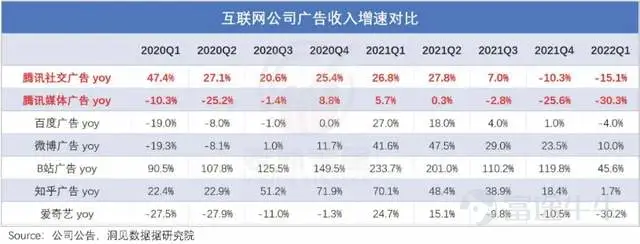
The words are very inspiring, after all, Tencent's advertising business revenue grew by 49% year-on-year in that year.
But in the past two years, 'sincerity' seems to no longer work. It can be seen that Tencent's advertising business in Q1 2022 has a negative growth of 18%, which is basically the worst among a group of internet companies.
"At the beginning of 2017, holding Tencent$TENCENT (00700.HK)$It's been almost 5 years, and it's still negative returns. Is it because of misjudgment? The profit has indeed increased; to say the holding period is short, it's almost 5 years, how much longer does it need to be? A value investor complained on Xueqiu. A sigh, and the responses kept coming. Domestic value investors also expressed confusion and resentment. In a way, their complaints are somewhat reasonable. After all, in these five years, Tencent's profit has tripled; the competitiveness of each business line remains at the top 3 level; the social moat is so wide that even with a telescope, the opponent cannot be seen. But the market feedback is indeed flat. It is said that a good company is worth holding for the long term, but not making money after holding Tencent for 5 years makes it difficult for many people to accept. Simply put, it must be due to overvaluation. However, such a superficial explanation is not enough to be convincing. Based on this, a deep restoration of the inside and outside situations at these two time points has been done, and some analysis has been carried out, with the following three insights: 1. Under the drive of product cycles, we need to beware of the sustainability of the cycle. 2. Business transformation caused by technological iteration requires anticipating the competition trends. 3. For business with high sensitivity to macro and regulatory factors, regular examinations of the coordinate system are needed. First, be alert to the sustainability of the high prosperity driven by the product cycle. In late June, Tencent began its third round of layoffs this year, with a focus on optimizing the Interactive Entertainment Group (IEG) department. According to the disclosure of relevant employees: in better departments, the layoff rate is about 20% to 30%...
So, where exactly is the problem?
It can be seen that around 2017, during the peak period of 4G network penetration, with the popularity of smartphones, the focus of advertising also shifted from traditional PC to mobile. Analysys data shows that in 2016, mobile advertising growth exceeded that of PC.
With the dividends being released, the industry has successively started laying out information flow advertising, entering a rapid development stage for information flow advertising.
"At the beginning of 2017, holding Tencent$TENCENT (00700.HK)$It's been almost 5 years, and it's still negative returns. Is it because of misjudgment? The profit has indeed increased; to say the holding period is short, it's almost 5 years, how much longer does it need to be? A value investor complained on Xueqiu. A sigh, and the responses kept coming. Domestic value investors also expressed confusion and resentment. In a way, their complaints are somewhat reasonable. After all, in these five years, Tencent's profit has tripled; the competitiveness of each business line remains at the top 3 level; the social moat is so wide that even with a telescope, the opponent cannot be seen. But the market feedback is indeed flat. It is said that a good company is worth holding for the long term, but not making money after holding Tencent for 5 years makes it difficult for many people to accept. Simply put, it must be due to overvaluation. However, such a superficial explanation is not enough to be convincing. Based on this, a deep restoration of the inside and outside situations at these two time points has been done, and some analysis has been carried out, with the following three insights: 1. Under the drive of product cycles, we need to beware of the sustainability of the cycle. 2. Business transformation caused by technological iteration requires anticipating the competition trends. 3. For business with high sensitivity to macro and regulatory factors, regular examinations of the coordinate system are needed. First, be alert to the sustainability of the high prosperity driven by the product cycle. In late June, Tencent began its third round of layoffs this year, with a focus on optimizing the Interactive Entertainment Group (IEG) department. According to the disclosure of relevant employees: in better departments, the layoff rate is about 20% to 30%...
At this time, Tencent's "new officials" focus on reforming its media business to promote social advertising business.
"In the advertising ecosystem in the USA, social advertising accounts for 20% of the overall internet advertising. In China, currently social advertising only accounts for about 8%-9% of internet advertising." said Liu Shengyi.
By leveraging its large user base, artificial intelligence technology, and data analysis capabilities, the precise delivery of advertisements on Moments and WeChat Official Accounts has shown outstanding results:
In the first batch of information flow advertisements on Moments, high-end brand advertisements like BMW China were targeted towards the "rich" crowd in first and second-tier cities who can afford iPhones. Most "losers" received advertisements for vivo smartphones and Coca-Cola.
Precise targeting, high advertising ROI, this meets the demand for advertisers to integrate brand and sales effectiveness, allowing Tencent to increase ad quotes.
As per the 2017 Q2 conference call:The growth of advertising business revenue is mainly due to the significant improvement in advertising positioning technology, which allows us to increase advertising quotes.
In other words,In 2017, Tencent took advantage of its technological advantages and caught the wave of information flow advertising and industry iteration, achieving rapid growth.
In fact, we are currently in a new phase of iteration opportunities:
Starting in 2021, the penetration rate of 5G continues to grow rapidly, the development and popularization of high-speed networks and smart devices have catalyzed the growth momentum of video content.
"At the beginning of 2017, holding Tencent$TENCENT (00700.HK)$It's been almost 5 years, and it's still negative returns. Is it because of misjudgment? The profit has indeed increased; to say the holding period is short, it's almost 5 years, how much longer does it need to be? A value investor complained on Xueqiu. A sigh, and the responses kept coming. Domestic value investors also expressed confusion and resentment. In a way, their complaints are somewhat reasonable. After all, in these five years, Tencent's profit has tripled; the competitiveness of each business line remains at the top 3 level; the social moat is so wide that even with a telescope, the opponent cannot be seen. But the market feedback is indeed flat. It is said that a good company is worth holding for the long term, but not making money after holding Tencent for 5 years makes it difficult for many people to accept. Simply put, it must be due to overvaluation. However, such a superficial explanation is not enough to be convincing. Based on this, a deep restoration of the inside and outside situations at these two time points has been done, and some analysis has been carried out, with the following three insights: 1. Under the drive of product cycles, we need to beware of the sustainability of the cycle. 2. Business transformation caused by technological iteration requires anticipating the competition trends. 3. For business with high sensitivity to macro and regulatory factors, regular examinations of the coordinate system are needed. First, be alert to the sustainability of the high prosperity driven by the product cycle. In late June, Tencent began its third round of layoffs this year, with a focus on optimizing the Interactive Entertainment Group (IEG) department. According to the disclosure of relevant employees: in better departments, the layoff rate is about 20% to 30%...
Short video platforms such as Douyin and Kuaishou have quickly emerged. They have gathered huge traffic and kept users inside the app for a long time based on personalized push content distribution models.
The more intuitive and dynamic display of short videos makes it easier for product promotion, and the conversion efficiency of ads is relatively higher. Advertisers naturally allocate more advertising budgets to short videos.
In this round of iteration, ByteDance has replaced Tencent and reaped the biggest dividend.In 2021, the advertising revenue upgraded to enter the "billion-dollar club".
"At the beginning of 2017, holding Tencent$TENCENT (00700.HK)$It's been almost 5 years, and it's still negative returns. Is it because of misjudgment? The profit has indeed increased; to say the holding period is short, it's almost 5 years, how much longer does it need to be? A value investor complained on Xueqiu. A sigh, and the responses kept coming. Domestic value investors also expressed confusion and resentment. In a way, their complaints are somewhat reasonable. After all, in these five years, Tencent's profit has tripled; the competitiveness of each business line remains at the top 3 level; the social moat is so wide that even with a telescope, the opponent cannot be seen. But the market feedback is indeed flat. It is said that a good company is worth holding for the long term, but not making money after holding Tencent for 5 years makes it difficult for many people to accept. Simply put, it must be due to overvaluation. However, such a superficial explanation is not enough to be convincing. Based on this, a deep restoration of the inside and outside situations at these two time points has been done, and some analysis has been carried out, with the following three insights: 1. Under the drive of product cycles, we need to beware of the sustainability of the cycle. 2. Business transformation caused by technological iteration requires anticipating the competition trends. 3. For business with high sensitivity to macro and regulatory factors, regular examinations of the coordinate system are needed. First, be alert to the sustainability of the high prosperity driven by the product cycle. In late June, Tencent began its third round of layoffs this year, with a focus on optimizing the Interactive Entertainment Group (IEG) department. According to the disclosure of relevant employees: in better departments, the layoff rate is about 20% to 30%...
Tencent, on the other hand, did not fail to make efforts:
Since the launch of Weishi in 2013, as many as 17 short video products have been introduced to support product growth with strong traffic, billions of resources, and the endorsement of influencers.
However, despite various attempts, it did not produce a breakthrough success.
It wasn't until 2020 when the launch of Video Number took place, that it was hoped to fill the gap in short video, continuously elevating its strategic position.
In fact, during the Q1 2022 conference call, the management's response to an analyst's inquiry about the poor ad business situation and when it would recover was the potential commercialization of Video Number.
Despite Video Number's DAU exceeding half a billion, the commercialization in terms of advertising is yet to start and the commencement date is uncertain.
Third, for businesses with high sensitivity to macro and regulatory factors, regular health checks are required.
Compared with the above-mentioned business, the regulatory risks faced by Tencent's financial technology business are particularly prominent, and the restrictions have always been there:
In 2017, the central bank issued the "Notice on the Implementation of Matters Related to the Centralized Custody of Customer Reserve Funds by Payment Institutions", stating that payment institutions should deposit reserve funds in proportion, and reserve funds will no longer generate interest after centralized custody, which has caused Tencent to lose interest income from reserve funds.
In 2020, after Ant Group's listing was suspended, the regulation of the financial technology industry has been tightened step by step.
"At the beginning of 2017, holding Tencent$TENCENT (00700.HK)$It's been almost 5 years, and it's still negative returns. Is it because of misjudgment? The profit has indeed increased; to say the holding period is short, it's almost 5 years, how much longer does it need to be? A value investor complained on Xueqiu. A sigh, and the responses kept coming. Domestic value investors also expressed confusion and resentment. In a way, their complaints are somewhat reasonable. After all, in these five years, Tencent's profit has tripled; the competitiveness of each business line remains at the top 3 level; the social moat is so wide that even with a telescope, the opponent cannot be seen. But the market feedback is indeed flat. It is said that a good company is worth holding for the long term, but not making money after holding Tencent for 5 years makes it difficult for many people to accept. Simply put, it must be due to overvaluation. However, such a superficial explanation is not enough to be convincing. Based on this, a deep restoration of the inside and outside situations at these two time points has been done, and some analysis has been carried out, with the following three insights: 1. Under the drive of product cycles, we need to beware of the sustainability of the cycle. 2. Business transformation caused by technological iteration requires anticipating the competition trends. 3. For business with high sensitivity to macro and regulatory factors, regular examinations of the coordinate system are needed. First, be alert to the sustainability of the high prosperity driven by the product cycle. In late June, Tencent began its third round of layoffs this year, with a focus on optimizing the Interactive Entertainment Group (IEG) department. According to the disclosure of relevant employees: in better departments, the layoff rate is about 20% to 30%...
However, although regulations have always been in place, the impacts brought by these two incidents are different:
In 2017, the regulatory environment was still relatively loose, and there was still a large space for the growth of the industry's business scale.The contradiction for players in the industry is not regulation, but competition.
In Tencent's Q1 2017 conference call, it mentioned:The current focus is still on expanding the coverage of WeChat Pay to more users and merchants, increasing the frequency of their use of WeChat Pay, and gradually expanding the coverage and influence of WeChat Pay.
It can be seen that at that time, WeChat and Alipay were busy launching the "Green Oasis Plan" and the "Blue Ocean Action", conducting marketing and promotion activities around the meal ordering service, in order to stimulate merchant enthusiasm and increase industry penetration rates.
The same situation applies to online financial services. Alipay, needless to say, has an asset management scale of over 300 billion yuan as of the end of January 2018. Tencent's "Licaitong" had a loan balance of over 100 billion yuan managed as of the end of 2017. During the same period, they also began collaborating with insurance companies to provide customized insurance products.
This is reflected in the data. In 2017, Tencent's other business income grew rapidly, driving a continuous improvement in gross margin.
"At the beginning of 2017, holding Tencent$TENCENT (00700.HK)$It's been almost 5 years, and it's still negative returns. Is it because of misjudgment? The profit has indeed increased; to say the holding period is short, it's almost 5 years, how much longer does it need to be? A value investor complained on Xueqiu. A sigh, and the responses kept coming. Domestic value investors also expressed confusion and resentment. In a way, their complaints are somewhat reasonable. After all, in these five years, Tencent's profit has tripled; the competitiveness of each business line remains at the top 3 level; the social moat is so wide that even with a telescope, the opponent cannot be seen. But the market feedback is indeed flat. It is said that a good company is worth holding for the long term, but not making money after holding Tencent for 5 years makes it difficult for many people to accept. Simply put, it must be due to overvaluation. However, such a superficial explanation is not enough to be convincing. Based on this, a deep restoration of the inside and outside situations at these two time points has been done, and some analysis has been carried out, with the following three insights: 1. Under the drive of product cycles, we need to beware of the sustainability of the cycle. 2. Business transformation caused by technological iteration requires anticipating the competition trends. 3. For business with high sensitivity to macro and regulatory factors, regular examinations of the coordinate system are needed. First, be alert to the sustainability of the high prosperity driven by the product cycle. In late June, Tencent began its third round of layoffs this year, with a focus on optimizing the Interactive Entertainment Group (IEG) department. According to the disclosure of relevant employees: in better departments, the layoff rate is about 20% to 30%...
In the current situation, from a demand perspective, the monetary liquidity environment is more abundant than in 2017, which is more conducive to business expansion.
In the first half of 2017, influenced by factors such as two interest rate hikes by the Federal Reserve, better-than-expected domestic macroeconomic conditions, and strengthened regulation, overall money market rates increased. In the second half of the year, they stabilized overall.
In the first half of 2022, the central bank successively lowered the one-year and five-year LPR, reducing borrowing costs and stimulating the scale of the credit business.
However, Tencent's attitude towards fintech business is completely different.
In the 2020 Q4 conference call, it was mentioned:The strategic focus of the company's financial technology business is to actively cooperate with regulatory agencies, prioritize risk management, rather than pursue scale.
The 2021Q4 conference call reiterated:We closely cooperate with the regulators, monitoring data as an independent operator. If we obtain the operating license, we will operate within the compliance scope.
In other words, under intensified regulatory pressure,The development of financial business must be carried out within the regulatory framework, especially the scale expansion of lending business will be limited by regulatory constraints.
To a certain extent, this will compress the revenue growth and profit space of financial regulatory business, thereby affecting the market's valuation level.
Given its increasing share of Tencent's revenue, under continued risk uncertainty, it may affect the overall valuation level of the company.
"At the beginning of 2017, holding Tencent$TENCENT (00700.HK)$It's been almost 5 years, and it's still negative returns. Is it because of misjudgment? The profit has indeed increased; to say the holding period is short, it's almost 5 years, how much longer does it need to be? A value investor complained on Xueqiu. A sigh, and the responses kept coming. Domestic value investors also expressed confusion and resentment. In a way, their complaints are somewhat reasonable. After all, in these five years, Tencent's profit has tripled; the competitiveness of each business line remains at the top 3 level; the social moat is so wide that even with a telescope, the opponent cannot be seen. But the market feedback is indeed flat. It is said that a good company is worth holding for the long term, but not making money after holding Tencent for 5 years makes it difficult for many people to accept. Simply put, it must be due to overvaluation. However, such a superficial explanation is not enough to be convincing. Based on this, a deep restoration of the inside and outside situations at these two time points has been done, and some analysis has been carried out, with the following three insights: 1. Under the drive of product cycles, we need to beware of the sustainability of the cycle. 2. Business transformation caused by technological iteration requires anticipating the competition trends. 3. For business with high sensitivity to macro and regulatory factors, regular examinations of the coordinate system are needed. First, be alert to the sustainability of the high prosperity driven by the product cycle. In late June, Tencent began its third round of layoffs this year, with a focus on optimizing the Interactive Entertainment Group (IEG) department. According to the disclosure of relevant employees: in better departments, the layoff rate is about 20% to 30%...
To reverse the situation, the way out lies in a change of regulatory attitude, but currently, this is an unknown factor.
Summary
The environment has changed, Tencent has not changed, this is the core issue.
The gaming business has transitioned from a seller's market to a buyer's market, and the business climate has declined. The advertising business has been iterated by the short video model. The financial business is limited in scale expansion under high regulatory pressure, and three pressures are superimposed, causing Tencent's overall entry into a weak cycle.
It is crucial to closely track and grasp the changes in these factors, as well as the impact they bring, in order to maintain investment sensitivity. The current stock price reflects that the negative factors have been fully recognized by the market, and the key now is to capture the reversal signals.
When will Tencent, who has been absent from three rounds of game version approvals, have its turn? When will the signal of video accounts that are constantly releasing loaded advertisements be truly realized?
When positive catalysts appear and fundamental improvements have certainty, the odds and win rate of investing in Tencent will significantly increase.

This article is from: Biaowai Biaoli, author: Zhang Ranran, He Jinyi, editor: Fu Xiaoling.
Risk Disclaimer: The above content only represents the author's view. It does not represent any position or investment advice of Futu. Futu makes no representation or warranty.Read more
Angry
1
Emm
4
Respect
1
Lol
1
Thumbs Up
44
Heart
2
131K Views
Report
Comments (16)
Write a Comment...
16
53
229