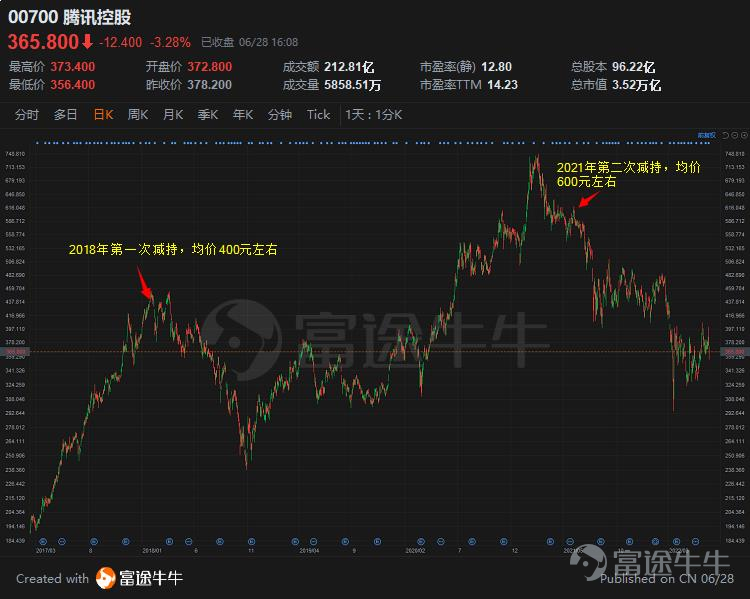

騰訊遭第一大股東減持,如何解讀?

Can Tencent change its fate? Can the rebound of Chinese concept stocks continue? (Get 66 points for attention and comments)
While facing shareholding reduction on one side, it is also engaging in repurchasing.
Two days after June 28,$TENCENT (00700.HK)$repurchased another 0.84 million shares, accumulating 2.5 million shares in 3 days, spending over 0.9 billion Hong Kong dollars in the process.
Two days after June 28,$TENCENT (00700.HK)$repurchased another 0.84 million shares, accumulating 2.5 million shares in 3 days, spending over 0.9 billion Hong Kong dollars in the process.
As time goes back, the root cause of the matter lies in the major shareholder in South Africa reducing their holdings of Tencent, delivering a blow to the Hong Kong stock market on Monday afternoon, causing Tencent Holdings' stock price to drop to 356 Hong Kong dollars on Tuesday.

How should we interpret the shareholding reduction incident?With Tencent's stock price currently at 350-400 yuan, is it overvalued, undervalued, or is it just at a normal market price?
Does it look familiar? Finscience published an article on May 18th."Is Tencent's valuation expensive over the next 10 years? Is there a new "story"?"
At that time, weLooking at valuation indicators such as P/E ratio and P/S ratio,Tencent's valuation is already at its historical low. Subsequently released financial reports also show that Tencent's mainstream business continues to maintain steady growth.
After the release of the financial report,Tencent's stock price dropped to a low of 330 Hong Kong dollars, then began to quickly rebound, once again rising above 400 Hong Kong dollars.

And from a technical indicator,Looking at the Bollinger Bands, tencent's stock price has basically maintained a narrow range of shock trends in the past four months.Obviously, this time tencent's stock price has withstood the market test.
There are no major concerns in the business, the valuation is not expensive, the technical trend is normal, all of which can be important factors to acknowledge tencent's stock price.
And in the past month, Chinese concept stocks have seen a wave of rebound. For example,$Alibaba (BABA.US)$Rebounding by over 60% from the low point,$PDD Holdings (PDD.US)$Rebounding by over 100%.$Bilibili (BILI.US)$The rebound amplitude is also close to doubling.
At this point, investors should understand that,What truly determines the company's stock price is ultimately the company's intrinsic value.
And in the past month, Chinese concept stocks have seen a wave of rebound. For example,$Alibaba (BABA.US)$Rebounding by over 60% from the low point,$PDD Holdings (PDD.US)$Rebounding by over 100%.$Bilibili (BILI.US)$The rebound amplitude is also close to doubling.
While in the overall sector, focusing on popular$China Concept Stocks (LIST2517.US)$as an example, has rebounded from the low point of 687 points to over 1000 points.
It can be said that after more than a year of continuous significant decline, the short-term trend of Chinese concept stocks showing clear signs of recovery seems to convey a message:
What truly determines the company's stock price is ultimately the company's intrinsic value.
When we trace the reasons for the recovery of Chinese concept stocks, it mainly stems from the following two points.
Firstly, after a deep adjustment, the overall valuation level of Chinese concept stocks has reached a historical relative low point,stock selloffs are decreasing while bottom-fishing funds are increasing, thereby fueling oversold rebound trends.
Secondly, one of the important reasons that led to the decline of Chinese concept stocks was policy risk, which may also show signs of easing.For example, previously, the platform economy was widely affected by anti-monopoly policies, leading to a sharp drop in the stock prices of related companies. However, in recent months, as the previous regulations have been effective, the policy direction has started to shift towards supporting the healthy development of the platform economy.
Overall, the emergence of bearish factors in Chinese concept stocks is a bullish situation, and it is reasonable for the market to heat up.
So,How to seize the investment opportunities as Chinese concept stocks rebound in the future?Here are three strategies proposed for your reference.
The first strategy is to focus on sectors where policy risks have significantly eased.
Previously, some industries were affected by bearish policy factors, and many investors sold off related stocks to avoid risks, leading to a significant drop in stock prices.
In these industries, there are still policy risks in some industries, such as the bulk procurement risk of some pharmaceutical companies, and the rectification policy of the education and tutoring industry.
However, there are still some industries undergoing a change in policy direction. For example, as mentioned above, platform economy-related companies, including some e-commerce platforms, social platforms, lifestyle platforms and other internet economy platforms, as well as gaming sectors stimulated by the resumption of game approvals.
The stock prices of these industry companies may fall due to policy impact, but when policy risks ease, stock prices may also rise again.
The second approach is to focus on high-quality stocks.
Although the recent Chinese concept stocks market has shown signs of warming up, the overall market sentiment remains hesitant,while high-quality stocks have fundamental support, high safety margins, which may be the choice of many investors.
So how do we define high-quality stocks? There are mainly two ways.
The first type is leading companies in high-growth industries. When buying stocks, the first thing to consider is the industry. Industries in the growth stage generally have companies developing rapidly with an overall upward trend. Therefore, we first need to identify high-growth industries, which usually have low industry penetration rates, large industry development space, and very fast industry growth rates. For example, more than ten years ago, the smart phone industry chain was a rapidly growing industry. Currently, there are many high-growth sub-industries within the entire new energy industry chain.
In high-growth industries, the highest quality stocks are usually leading companies. These companies have revenue growth rates faster than industry growth rates, hold a very large market share, and although they may not be profitable now, their profit prospects are very promising.
The second type is cash cow companies in stable growth industries. In most fast-growing industries, when the penetration rate reaches a high level, they enter a mature stage where the industry shifts to stable growth. In such industries, there are also excellent companies. These companies usually have relatively small capital expenditures, very stable cash flows, high profit margins, and high shareholder return on equity. Such companies are usually referred to as cash cow companies.
Although these companies may have average growth rates, on one hand, they have stable profits and cash inflows every year, with a very high safety margin, and on the other hand, they have sufficient cash reserves, making it more likely to explore new business opportunities and develop new growth points.
The third approach is to focus on stocks that have experienced significant declines.
The recent rebound in Chinese concept stocks may still be a rebound from oversold levels at present.As for whether it will evolve into a reversal trend, further observation may be needed.
So, in a rebound from a oversold situation, The most elastic stocks may also be those that have previously fallen the most.。Therefore, from a short-term perspective of betting on rebounds, stocks that have experienced the deepest declines in the past may also be good choices to focus on.
The above are three strategies to consider during the revival of Chinese concept stocks. Of course, each strategy is not isolated and can also be combined. For example, if a stock has excellent fundamentals, but has experienced a significant decline due to policy bearishness and market reasons, and recently political risks are beginning to ease, then it may need to be considered a top priority.
Risk Disclaimer: The above content only represents the author's view. It does not represent any position or investment advice of Futu. Futu makes no representation or warranty.Read more


Comments (85)
to post a comment
114
231