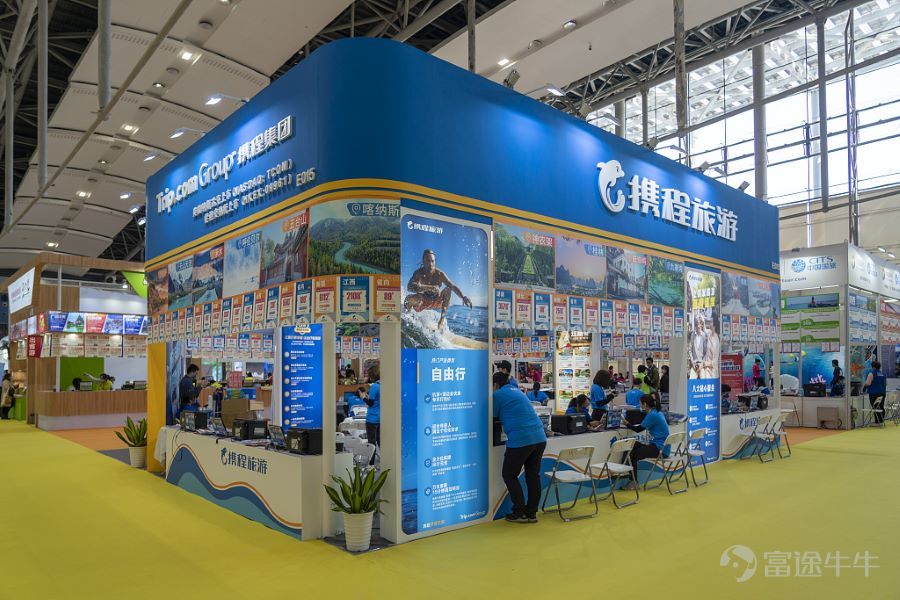

As the dark clouds of the pandemic dissipate, Trip.com is well-prepared for the travel gold rush.
Due to travel restrictions during the domestic pandemic, this online travel agency suffered significant losses in the first quarter, but expects substantial profits on the horizon.

Key focus.
* Trip.com recorded a loss of 0.989 billion yuan in the first quarter, with a 12% decrease in revenue from the previous quarter.
* Despite the poor performance, the company remains optimistic about the potential boom in outbound tourism from China after the relaxation of travel restrictions.
Author of this article: An Kelun
Today, operating an online travel agency in China is very difficult.
$Trip.com (TCOM.US)$Feeling the pain of this, the Shanghai-based online travel industry giant recently announced what appears to be a lackluster first-quarter performance. However, company executives are still optimistic, believing that the company will catch the global tourism gold rush, which will soon arrive in China once the country reopens its borders.
First, the bad news. Trip.com reported a loss of 0.989 billion yuan (approximately 0.148 billion dollars) in the first three months of this year, reversing last year's profit of 1.78 billion yuan. Total revenue for the quarter amounted to 4.1 billion yuan, down 12% from the previous quarter, and roughly the same as the same period last year.
Trip.com CEO Sun Jie stated that the company has weathered the ups and downs of the tourism industry for many years and fully utilized the experiences and lessons learned during the pandemic. She said that the key to survival is to hold onto cash, and the company has ample cash, with cash holdings of 33.3 billion yuan as of the end of March.
Although the performance is not impressive, trip.com's executives have a convincing story to tell investors and analysts - and it seems to have been recognized.
After the earnings were released on Tuesday, the company's stock in Hong Kong rose by 25% at one point, eventually closing 16% higher. It later gave back some of the gains, but still ended 12% higher than before the announcement.
Such an increase looks particularly strong, considering that no matter how exaggerated the claims, they cannot hide the impact of China's travel restrictions on trip.com and its peers to control the spread of the epidemic. Trip.com has been working to increase revenue from international markets that are not severely affected by China's restrictions. But over half of its business still comes from domestic sources.
Data from the aviation analysis company OAG shows that in June, the number of aircraft seats on flights to and from Chinese airports was close to 64 million, a decrease of over 20% compared to June 2019 before the epidemic. Nearly 62.2 million of these seats were on domestic flights, accounting for 97.3% of the total, as China significantly reduced international travel.
After the containment measures are lifted, domestic travel often recovers rapidly. However, for trip.com, the real money comes from outbound travel by Chinese people, a business that has been almost stagnant over the past two years.
The performance of its peers is even better.
Unlike trip.com, some other major Chinese online travel agencies that primarily focus on domestic travel achieved profitability in the first quarter.$TONGCHENGTRAVEL (00780.HK)$During the same period, the profit reached 2.45 billion yuan. Although both are online travel agencies, a large portion of trip.com's registered users live in smaller third-tier cities, which have been spared the most severe containment measures in China. Travelers living in these areas can continue to travel domestically, contributing to trip.com's strong financial performance.
China's largest resort operator.$FOSUN TOURISM (01992.HK)$It is the owner of the popular Club Med brand and has managed to avoid the downturn in performance because 75% of its revenue comes from outside China, allowing it to profit from the rebound in the US and European tourism markets in the first quarter. In the first three months of this year, Fosun Tourism achieved net revenue of 4.2 billion yuan from its core resort and tourism destination business, more than four times that of the same period last year.
In contrast, Trip.com stated that it has been severely affected by the COVID-19 pandemic. The pandemic has led to varying degrees of lockdown in first-tier cities such as Shenzhen, Shanghai, and Beijing, greatly exacerbating its quarterly losses.
Due to the continued lockdown in these cities until the second quarter and no signs of the Chinese government relaxing its international travel ban, the outlook for Trip.com's performance in the second quarter is not optimistic.
"Industry-wide airline passenger volume has declined by 70% to 90% this quarter," said Trip.com CFO Wang Xiaofan in this week's earnings conference call. "Compared to the same period in 2019, hotel industry revenue per available room has declined by 40% to 60%, with a large part of it stemming from epidemic prevention requirements."
Therefore, the company expects the second quarter to be relatively weak," Sun Jie told analysts.
Trip.com's stock listed on the Hong Kong Stock Exchange fell more than 19% from its 12-month high of HKD 289.80, while its stock listed on the NASDAQ fell even more, reaching 23%. However, the company's price-to-sales ratio on the US stock market is still 6.2 times higher than that of Tongcheng's 4.4 times, far higher than that of global tourism giants. $Expedia (EXPE.US)$1.6 times.
This premium is partially attributed to the overall optimistic sentiment of trip.com's executives, which to a certain extent has boosted the stock price rebound after the financial report release, because both investors and management believe that the future will be brighter. Ultimately, China cannot keep its borders closed forever. When the borders reopen, millions of Chinese people who have saved a lot of money will be busy making bookings on travel websites like trip.com.
Outside of China, with countries reopening and relaxing restrictions, long-haul travel has regained its momentum. In many markets, the demand for seats and hotel rooms has exceeded the supply, causing a surge in the profitability of the tourism industry. The prices are high, but people don't mind. Everyone just wants to travel and is willing to pay the extra cost for it.
Trip.com is not the only Chinese giant company waiting for reopening. One of China's largest hotel operators$H World Group (HTHT.US)$manages nearly 8000 hotels with over 0.75 million rooms and suffered a net loss of 630 million yuan in the first quarter due to the pandemic.
However, with hope for a bright future, H World Group has opened more than 300 new hotels in three months, and over 2200 more hotels are in preparation. Such confidence in the Chinese tourism market!
A non-Chinese airline executive recently stated that the current travel environment is the most profitable he has seen in 30 years. After two years of depression caused by the COVID-19 pandemic, the global tourism industry is experiencing a gold rush. Once the Chinese market reopens, trip.com and its investors will reap the rewards - this explains why everyone has been so excited this week despite the quarterly losses.
"While our short-term prospects may not seem optimistic, the travel demand remains strong, making the long-term outlook even brighter," said Liang Jianzhang, Chairman of trip.com. "As governments around the world continue to reopen, the global tourism industry is continuing to recover at a strong pace. We expect that once the restrictions are relaxed, China will also experience a similar situation."
Risk Disclaimer: The above content only represents the author's view. It does not represent any position or investment advice of Futu. Futu makes no representation or warranty.Read more
Comments
to post a comment
2