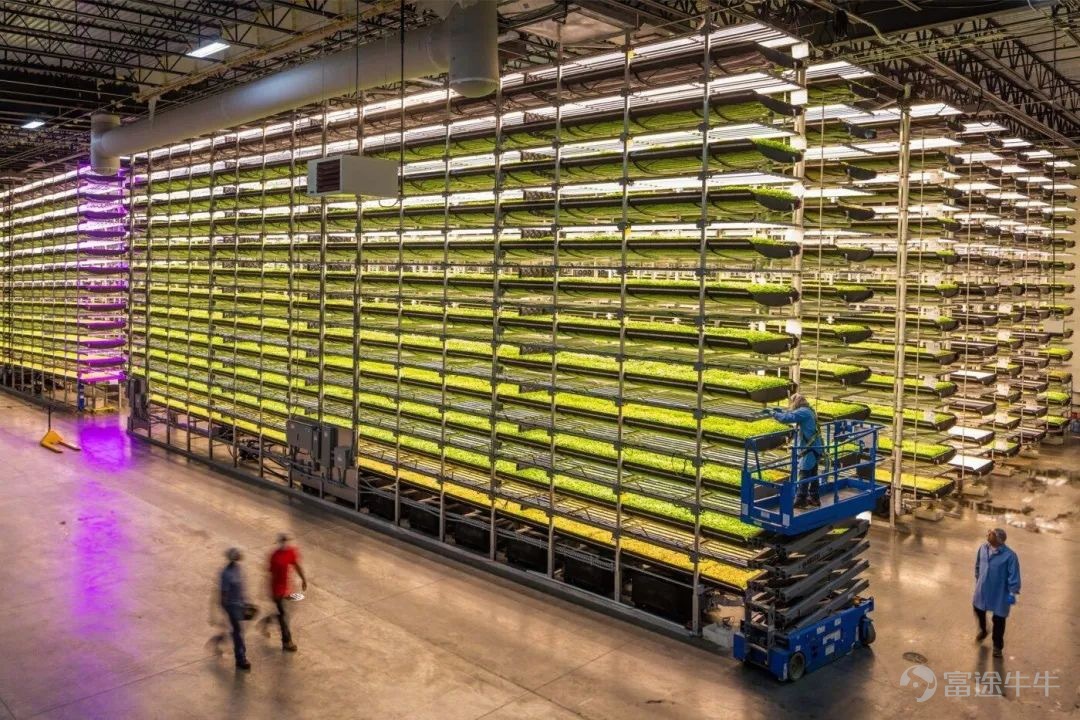

Product value added 20 times, productivity increased 390 times! Will vertical farming, which works upward, be the next trend?
Vertical farming was first proposed by Columbia University professor Dixon Despamir in the US. He hoped that well-lit buildings made of glass and steel could produce the food people needed. This kind of farm is built in a vertical high-rise building. Every room covered with LED lights is planted with fruits, vegetables, and food such as tomatoes, cucumbers, and watermelons. It is not affected by the weather, crops can always grow under optimal conditions, there is no need for pesticides or herbicides, no agricultural pollution emissions, and it can even be freed from the demand for soil. Mr. Tieding, director of the Agricultural Research Center of Yuanyi think tank and chief editor of agricultural ginseng, believes that scientific, green, and fresh agricultural products meet the needs of urban consumers, and that relatively high-income urban consumer groups can also drive vertical agricultural agricultural products to quickly open up sales channels. According to statistics, in 2018, the market value of vertical agriculture was about 2.3 billion US dollars. Meanwhile, total investment and financing increased from 60 million US dollars in 2016 to 414 million US dollars in 2018. As the market expands, the market value of vertical agriculture-related enterprises is also rising rapidly. In June 2019, the German portable vertical farm startup Infarm raised 100 million US dollars; in 2018, Bowery B financing received 90 million US dollars in financial support; in 2017, Plenty received 200 million US dollars in Series B financing...

As an emerging agricultural model, vertical agriculture has had a huge impact on agricultural production and also provided new competitiveness for the development of agricultural products.
(1) Technology empowers products and increases product value
Since traditional land and sunlight are freed from traditional land and sunlight, scientific facilities are intensively used for planting and cultivation within buildings, so agricultural products from vertical agriculture have been empowered by science and technology with remarkable results. The Techno Farm plant in Keihanna Science City in Japan has more than doubled crop production and can produce nearly 11 million lettuce plants a year. Moreover, unlike natural light, which is affected by time and geography, LED lights on vertical farms can scientifically change lighting according to crop needs, or provide continuous light for 24 hours without interruption to meet the photosynthesis needs of crops and shorten the growth cycle.
Bowery Farming vertical farms in the US can not only use artificial means to create a suitable environment for vegetables to grow, but also control specific factors that affect the flavor of vegetables, such as regulating specific temperature, moisture, and fertilizer to make the arugula produced more spicy, or make the balsamic lettuce smoother or more bitter. It is even possible to produce “bespoke vegetables” that meet specific consumer needs. In 2020, 4.5 ounces (about 127 grams) of green leafy vegetables produced by Bowery Farming will cost $3.99 (about 28 yuan), and the price of each catty of vegetables can reach $15! Compared with the average price of 28 types of vegetables monitored by the Ministry of Agriculture and Rural Affairs of 4.09 yuan/kg (June 16), even if the price of leafy green vegetables is calculated at 5 yuan/kg, the value-added space for products produced on vertical farms has increased by as much as 20 times! Also adding significant value to agricultural products is vertical farming company Oishii's Mugen indoor vertical farm in Jersey City. The Omakase strawberry grown there is a rare and unique variety that initially only appeared seasonally in the fields of the Hida Mountains in central Honshu, Japan. But by relying on automation and bee pollination, Oishii has recreated the environmental characteristics of the Japanese origin in an indoor vertical farm, allowing these strawberry plants to grow all year round and mature at an ideal rate, gaining extra sweetness.
Currently, it costs $1.82 to buy a medium Omakase strawberry, and $2.50 for a large strawberry. However, the price of the special edition “First Flower Strawberry” is 50 US dollars/box/6 sticks, and the price of one is over 8 US dollars. This kind of green vegetable and fruit produced in a sterile and disease-free environment through scientific and technological means has a short growth cycle and can meet the specific needs of consumers for specific products, greatly increasing the added value of ordinary agricultural products.

(2) Increased land utilization and increased production efficiency
In addition to increasing the added value of products, vertical agriculture has also effectively saved land area, increased land utilization, and increased production efficiency. As the world's largest vertical farming company, AeroFarms practices agricultural cultivation all year round in the US. Due to the creation of a suitable growth environment under manual control, AeroFarms has an annual productivity of 390 times higher than that of commercial farms, yet uses 95% less water than ordinary crop cultivation. In a 7,000-square-meter space, using patented cultivation techniques such as aeronautical cultivation, vegetables can be harvested every 16 days, with a total annual output of about 900,000 kilograms.
At the AeroFarms site, many cultivated crops are removed from the soil and planted in media to ensure that they are not affected by soil pests and diseases. They are placed in trays stacked on top of vertical pillars. These 10-meter-high pillars save land use with maximum efficiency. Since no substrate has high absorption efficiency and no pests, pesticides can not be used, so the production efficiency of agricultural products has been greatly improved. Similarly, at Vertical Harvest Vertical Farm in downtown Jackson, Wyoming, USA, a small plot of 0.1 acres (about 0.61 acres) produces 100,000 pounds (about 45.36 tons) of agricultural products every year. High land utilization and high productivity make more people optimistic about vertical agriculture.

(3) Green and environmentally friendly, no ecological pollution
In addition to being scientific and efficient, vertical farms also have one of the most critical advantages — environmental protection. Since natural land is not directly used, internal circulation can be formed within the production room to prevent nutritional waste liquid or fertilizer from flowing into nature without treatment. Singapore's Sky Greens vertical farm is a leader in green production. Since Singapore relies heavily on imports of crops and urban green space covers an area of up to 50%, Singapore pays more attention to the health and safety of agricultural products, and Sky Greens vertical farms also pay more attention to low carbon emission reduction to meet the nature of crop growth.
The planting tray in Sky Greens vertical farm rotates from bottom to top at a speed of 1 mm per second through a planting system called “a-go-gro” and rotates the “vegetable tower” where crops such as choy sum and kale are planted to ensure that every layer of plants on the tower can receive uniform light. At the same time, the operation of the system is completed by a water gravity system: the system automatically collects
Greenery in vertical space has greatly increased the green area, but land occupation has been greatly reduced. Three-dimensional distribution of green plants can block ultraviolet rays to a certain extent, improve air quality, absorb heat and dust particles in the air, and reduce the effects of thermal radiation. It not only gives full play to ecological benefits and improves the ecological environment, but also satisfies the psychological and physiological needs of urban residents, bringing good urban landscape effects. Mr. Tieding, director of the Agricultural Research Center of Yuanyi think tank and chief editor of agricultural ginseng, believes that agriculture is definitely not a small industry; agriculture should be motivated to produce large-scale products. At the same time, large-scale agricultural products are graded scientifically and systematically, and the process of selling good products at high quality and high prices. The vertical farming model fits this very well. Large-scale urban agricultural production can be achieved through extremely high production efficiency. At the same time, scientific and targeted production is conducive to grading and achieving high product quality and high prices.
Although vertical agriculture is currently affected by the high cost of urban land use and the high demand for skilled personnel, the pace of development and expansion in the country is not rapid. However, its high utilization rate of land and extremely high production efficiency, as well as green, scientific and pollution-free production methods, are in line with consumers' increasing demand for agricultural products. There is much to be done to solve the problem of three meals a day for the urban population in the future.
Risk Disclaimer: The above content only represents the author's view. It does not represent any position or investment advice of Futu. Futu makes no representation or warranty.Read more

Comments
to post a comment
1
1