

阿里Q4營收、利潤雙雙超預期,股價大漲

Detailed explanation of Alibaba's financial report: revenue rose 9%, profit fell 30%, no performance guidance
In a market environment full of uncertainty and low expectations, an earnings report that exceeds expectations may bring an unexpected boost to stock prices, especially for a giant whose stock price has dropped 70% from a high point.
On May 26, Alibaba released financial results for the fourth quarter of fiscal year 2022 (that is, Q1 of 2022) and the full year ending March 31, 2022. The financial report shows:
Alibaba's total revenue for the quarter reached 204.52 billion yuan (if not specified, the unit is RMB), an increase of 9% over the previous year, exceeding analysts' expectations of 200,664 billion yuan;
The adjusted EBITA was 15.811 billion yuan, down 30% year on year, higher than the market forecast of 15.3 billion yuan.
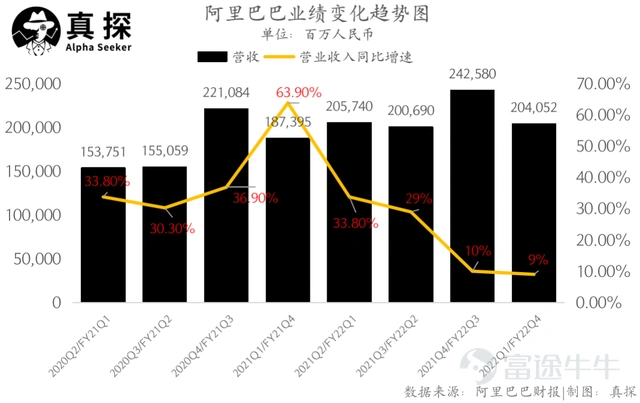
After the financial report was released, Alibaba's management said during the performance conference call,Due to the resurgence of the epidemic in the mainland in March, domestic business has been greatly affected. In view of the risks and uncertainties brought about by the uncontrollable and difficult to predict epidemic, no financial guidance will be provided for this year.
In the past, it was difficult to ignite investors' enthusiasm with such financial performance and expectations, but considering the high pressure on the environment and frequent financial thunderstorms from giants, Alibaba still gave the market some surprises. By the close of trading on May 26, EST, Alibaba's stock price had surged nearly 15%.
The pandemic has dragged down GMV, but the performance of users is impressive
The China Business Division is Alibaba's basic business. In Q4 of FY22, the business growth rate was only 8%, lower than the 9% growth rate of total revenue.
Looking at performance separately, several business segments under China's commercial division are under pressure to grow, but some are growing quite well.
On Taobao's Tmall side, its GMV remained stable in January and February, but declined in March, mainly due to supply chain and logistics disruptions and reduced demand due to the impact of the pandemic; Taobao's order growth from January to March 2022 also slowed down due to the pandemic.An Ali executive said during the earnings call that GMV may drop by more than 10% in April, and with the easing of the Shanghai epidemic, there will be an improvement starting in May.
Maintaining growth are vegetable shopping, direct sales and other businesses, and wholesale trade in China. Among them, Taocai GMV achieved month-on-month growth in January-March, mainly due to an increase in average order prices; direct management and other businesses increased 14% year over year, mainly driven by growth in Gaoxin retail, Tmall and Hema businesses; and China's wholesale business grew by 30%, mainly due to an increase in value-added service revenue.
The management also pointed out during the earnings call that under the influence of the epidemic, users' consumption habits have changed markedly, demand for fashion and consumer electronics products has declined, while demand for fast food, food, and daily necessities has risen markedly, and emerging categories such as fitness and outdoor activities are growing rapidly. At the same time, due to the obvious tendency of users to stock up, Alibaba's “near-field retail” customer unit price has increased significantly.
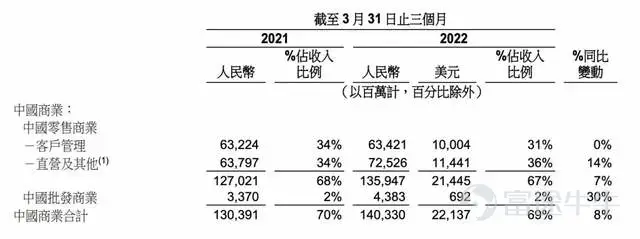
On the user side, throughout FY2022, the China Business Division's performance in attracting new users and maintaining user stickiness is worth watching.
Financial reports show that in the 12 months up to March 31, 2022, there were 903 million annual active commercial consumers in China, with year-on-year net increases of 89 million and 21 million, respectively. Alibaba attributes the robustness of user data to its app matrix to create personalized and immersive interactive experiences for different consumption scenarios and business formats, thereby attracting and retaining user groups with different backgrounds and shopping behaviors.
User data for various business segments also confirms this. In terms of high-net-worth users, on the Taobao Tmall platform in FY2022, more than 124 million annual active consumers spent more than 10,000 yuan per capita on Taobao and Tmall; of the annual active consumers who spent more than 10,000 yuan in the previous fiscal year, 98% remained active this fiscal year. In the sinking market, Aotte's annual active consumers exceeded 300 million. In fiscal year 2022, the proportion of new annual active consumers from underdeveloped regions in the entire Chinese business segment continued to exceed 70% of the total number of new consumers.
Alibaba's approach to the Chinese commercial division mainly revolves around new businesses and consumer/merchant experiences: continuous investment in new businesses such as Taocai and Taote, especially in the fulfillment network; since Dai Shan took office this year, it has also adjusted Taobao Tmall's core strategy — including integrating Taobao Tmall, improving the strategic position of Taobao live streaming and shopping, improving the consumer experience, and the certainty of business operations.
Local life is leading the way in growth, but losses are still the same
In the first three months of 2022, against the backdrop of only single-digit growth in overall revenue, the local lifestyle business, including Are You Hungry, Gaode, Flying Pig, and Taoxenda, grew 29% year over year, ahead of all other businesses.
Among them, the “home delivery business” Hungry increased its average order amount in the second half of FY2022 because it focused on user retention and operational efficiency improvements in key cities; at the same time, the number of orders from non-food (fresh food and medicine) grew significantly due to the benefits of holiday marketing. However, benefiting from the increase in Gaode's user transaction volume and loyalty, the “to the destination” Gaode and Flying Pig businesses have both grown significantly.
In terms of profitability, the adjusted EBITA loss of the local lifestyle services segment narrowed this quarter, from 6.633 billion yuan to 5.483 billion yuan, but the loss rate was still as high as 52%, making it the segment with the worst losses other than innovative businesses.
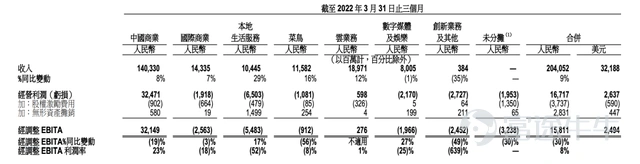
Furthermore, due to the impact of the COVID-19 pandemic in March, the number of orders for Flying Pig and Hungry declined, and the growth rate of Gaode's order volume also slowed.
International business is under pressure from within and outside
In the first three months of 2022, Alibaba's international business division grew by 7%. The growth rate of this business was mainly the international retail business, which slowed down the growth rate of this business.
Financial reports show that the growth rate of the business was only 4% in January-March. The year-on-year growth rate slowdown was partly due to Trendyol's revenue being negatively affected by the depreciation of the Turkish lira against the RMB exchange rate; in the European market, AliExpress orders were continuously affected by changes in EU VAT regulations and the impact of the Russian-Ukrainian conflict on the supply chain. During the earnings call, Alibaba's management also pointed out that offline consumption has recovered due to the easing of the epidemic in Southeast Asia, and Lazada's business in the region has been impacted.
The international wholesale business under the International Business Division increased 13% year-on-year in the first three months of 2022, higher than the overall growth rate of international commerce. This was mainly due to the increase in revenue from value-added services related to cross-border business and the increase in the number of paid members from Alibaba.com.
However, due to the slowdown in China's export growth and the impact of the pandemic on the supply chain, the year-on-year growth rate of the international wholesale business slowed compared to previous quarters.

Cloud business growth slows, achieving annual profit for the first time
Cloud businesses have not escaped the impact of the pandemic.
From January to March, the growth rate of cloud businesses, including Alibaba Cloud and DingTalk, slowed. In the three months ending March 31, 2022, the cloud business revenue after offsetting the impact of cross-segment transactions was 18.971 billion yuan, an increase of only 12% year-on-year, lower than the 20% growth rate in the previous quarter; without considering the impact of losing a single major customer (that is, ByteDance's international business), the cloud business increased 15% year-on-year after offsetting the impact of cross-segment transactions.
Alibaba's cloud business customers come from all walks of life, and whether its growth is strong or not is mainly related to the needs of the customer's industry.For example, from January to March 2022, the growth in cloud business performance was mainly driven by growth in the telecommunications, financial services, and retail industries, while weak customer demand in the Internet industry, particularly the decline in revenue from customers in vertical Internet industries such as online education and entertainment, offset this growth.
Due to economies of scale, the cloud business achieved adjusted EBTIA profit from January to March; at the same time, in fiscal year 2022, the cloud business also achieved its first annual profit in 13 years. The business had an adjusted EBITA loss of 2.51 billion yuan in the previous fiscal year, and a profit of 1,146 billion yuan in fiscal year 2022.
Rookies shook their wings, and revenue from big entertainment and innovation businesses declined
Cainiao Network grew 16% in the first three months of 2022, second only to local life. Cainiao's rapid growth mainly comes from logistics fulfillment solutions and value-added services for retail businesses in China such as Tmall, Taobao, and Taote; in addition, the increase in external revenue is also a driving factor for Cainiao's growth. From January to March 2022, revenue from external merchants increased by more than 30% year-on-year.
The big entertainment sector and “innovation and others” are the only sectors where Alibaba's performance declined.
According to financial reports, the revenue of “Digital Media and Entertainment” for the first three months up to 2022 was $8.05 billion, a year-on-year decrease of 1%. Meanwhile, due to control over content and production investments, the business's adjusted EBITA loss narrowed from $2,698 billion in the same period last year to $1,966 billion.
The revenue of the “Innovation and Others” business, which includes Tmall Genie and Dharma Academy, was 384 million yuan in the quarter, down 35% year on year. Adjusted EBITA losses also increased from 1,648 billion yuan in the same period last year to 2,452 billion yuan, equivalent to nearly 7 times revenue.

At the beginning of 2022, a series of domestic and foreign uncertainties followed one after another, impacting the performance of domestic Internet giants — growth generally slowed and profits were under pressure.
Alibaba is one of them. In fact, Alibaba's performance has been pressured by multiple internal and external factors since last year. In order to cope with successive challenges, Alibaba's internal structure and development strategy adjustments have been ongoing. In December of last year, Alibaba announced that it would redivide its business logic according to domestic and foreign logic. Dai Shan and Jiang Fan took over Ali's domestic business and foreign business respectively.
During the conference call, Ali executives emphasized that the company will continue to reduce costs and increase efficiency over the next year, including shutting down and transferring businesses with no obvious long-term value; setting cost reduction and efficiency targets based on the different nature of the business, such as increasing gross profit in direct business, increasing efficiency in logistics business, and controlling marketing expenses.

Author | Lee Sindi
Risk Disclaimer: The above content only represents the author's view. It does not represent any position or investment advice of Futu. Futu makes no representation or warranty.Read more

Comments
to post a comment
2
16