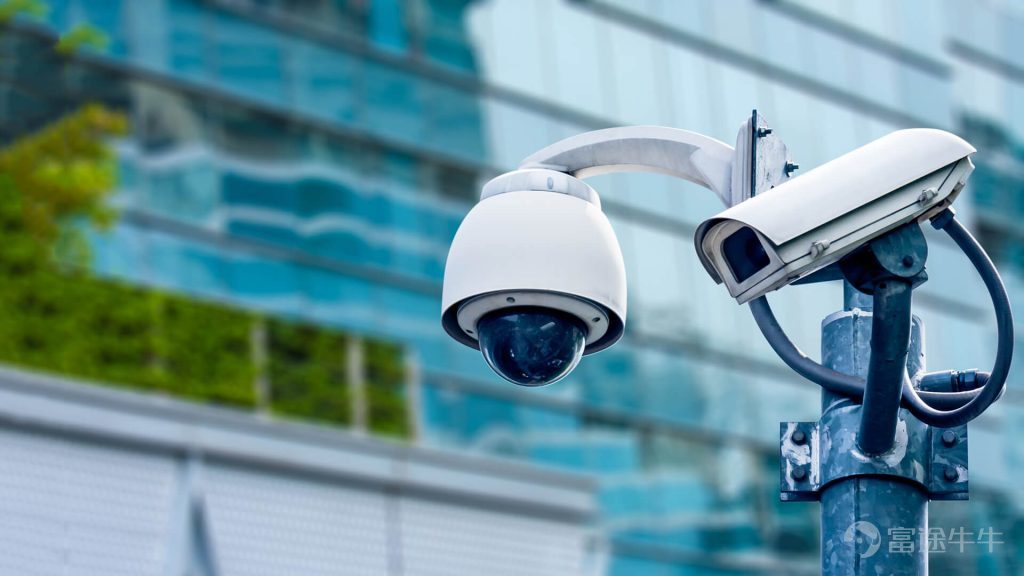

A-share Giant with 300 Billion Market Cap Sees Flash Crash: What Lies Behind the Rumors of US Sanctions and What Other Unspoken Troubles Does Hikvision Face?
*Article by Spades and Longswords
Today is likely not a fortunate day for Hikvision, the leading security company in the A-share market. After opening flat, this well-known stock suddenly plummeted, falling continuously to a low of 31.17 yuan, almost breaching the 30-yuan support level. By the close, Hikvision's share price had recovered somewhat to 32.08 yuan per share, marking a daily decline of 6.05%. However, this was still far from the opening price of the day.
Although Hikvision's stock price has been fluctuating over the past year, today's decline is one of the largest single-day drops since the beginning of the year. At the same time, as a leading security company, Hikvision's downturn also affected the sentiment of other investors. For example, Dahua Technology, another security company, saw its stock price fall by 1.05% at the close.
So, what exactly is wrong with Hikvision that has caused such panic among investors?

This stems from a news report. Recently, the Financial Times cited four informed sources saying that the US is preparing to impose sanctions on Hikvision and has begun informing its allies of its intentions, though no final decision has been made yet.
The report also pointed out that Hikvision is indeed the world’s largest provider of visual IoT solutions and big data services. However, if the US government decides to impose sanctions on Hikvision, any governments and companies cooperating with it would face the risk of violating US sanctions. This might cause a large number of customers and suppliers to distance themselves from Hikvision, similar to what happened with Huawei in the past.
Of course, the situation Hikvision faces is not as severe as Huawei's. As for Hikvision’s core business—visual IoT solutions—components like optical lenses, CMOS sensor chips, codec chips, power management chips, and AI chips are all important parts, and reliable domestic alternatives can be found in these areas.
For instance, regarding optical lenses, eight major domestic manufacturers led by YTOT Optics, Foguang Co., Ltd., and Fordtek occupy 90% of the global security video surveillance lens shipments. In terms of chips, in addition to HiSilicon under Huawei ensuring a certain level of supply, StarFive and Goke Microelectronics can also serve as substitutes for overseas suppliers like Texas Instruments and NXP Semiconductors.

However, the difficulties facing Hikvision are real.
After all, if the sanctions are indeed implemented, they will certainly make many of Hikvision's major overseas clients hesitate, which undoubtedly will deal another blow to its already less-than-optimistic overseas revenue. According to financial reports, in 2020, the gross margin of Hikvision's overseas business increased by 4.78% compared to 2019, but in 2021, this figure fell by 6.71%.
In addition, Hikvision's domestic operations are also facing the dilemma of slowing growth. A review of past financial reports reveals that Hikvision's sales expenses have risen from 2.179 billion yuan in 2015 to 7.378 billion yuan in 2020; R&D investment has also increased from 3.194 billion yuan in 2017 to 6.379 billion yuan in 2020.
At the same time, Hikvision's performance growth rate is gradually declining. Its year-on-year revenue growth rate once reached 60.37% in 2014, and the net profit growth rate was 52.13%, but after that, Hikvision has never been able to break the record again.
Ultimately, this is mainly because the domestic security market has passed its rapid growth phase. Coupled with the continued sluggishness of the real estate market during the pandemic, the overall market situation is much worse than before. According to the '2020 China Security Industry Survey Report' released by CPS Zhongan Network, the total output value of the domestic security industry was 851 billion yuan, with an average annual compound growth rate stabilizing between 10% and 15%. The global security market performed even worse, with an average annual compound growth rate of only 7.3%.
On the other hand, too many new players have entered the security market over the past few years, including heavyweight competitors like Huawei, Alibaba, and Tencent. Previously, Duan Aiguo, President of Huawei Machine Vision, publicly stated that Huawei would not exit the security industry until it reached the top position, aiming to achieve this within five years. Faced with numerous competitors, the pressure on Hikvision is understandable.
Hikvision is not unaware of this. As early as 2015, it launched a series of AI products and made a big push to position 'intelligent IoT solutions' as the company's second growth curve. In addition, Hikvision's product portfolio has gradually expanded over time, and now its hardware SKU exceeds 27,000 types, enough to make any competitor sweat.
Hikvision’s transformation is worth investors’ anticipation, but its new business will likely struggle to counteract the unfavorable conditions of the entire industry in the short term. On one hand, clients in the security industry have varying needs, so Hikvision needs continuous refinement to establish a mature capability for crafting solutions that can scale profitably — which means IoT solutions are inherently a slow business. On the other hand, technologies such as vision and AI are still constrained by the current level of technological development, limiting their application scenarios.

For these reasons, Hikvision’s stock price has been in a prolonged state of volatility in recent years. Most investors remain concerned about its hardware business and lack confidence in its lengthy transformation journey. However, Hikvision’s fundamentals remain solid, and external sanctions along with other shocks have had limited impact. Given this, the security giant still has the opportunity to maintain its leading position until its transformation begins to show results, at which point secondary market investors will naturally recognize its value.
*Image from Yandex
Risk Disclaimer: The above content only represents the author's view. It does not represent any position or investment advice of Futu. Futu makes no representation or warranty.Read more

Comments
to post a comment
2
1