
English
Back
Open Account
雪豹财经社
wrote a column · Apr 21, 2022 10:29

After the trend, the "one-dollar store" of China concept stocks opens.

In the tragic stories of collective downfall, once popular China concept stocks are now lamenting.
On April 18, Tuniu, an online travel platform that has been losing money for 11 consecutive years with a cumulative net loss of 7.8 billion RMB, announced that it has received a delisting warning from the NASDAQ Stock Market due to its closing price being below $1 for 30 consecutive trading days. This is the second time Tuniu has crossed the red line since May 2020.$Tuniu (TOUR.US)$Tuniu's experience is not unique. It is the second time it has crossed the red line since May 2020.
Tuniu's experience is not unique.
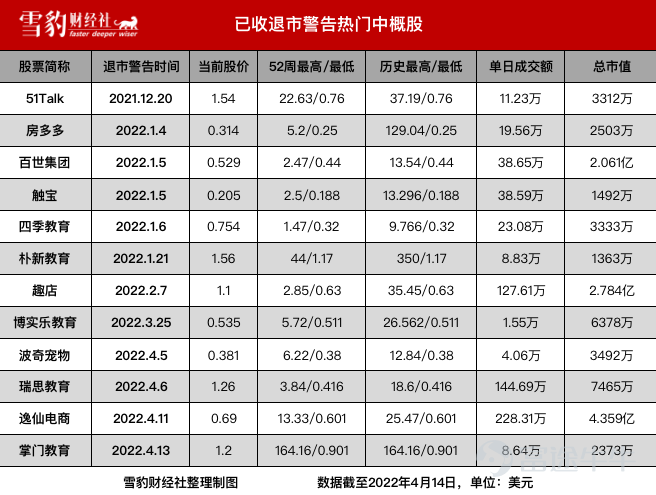
According to incomplete statistics from Snow Leopard Financial News Agency, Fangdd Network, Tuniu, and more than 10 other China concept stocks have received delisting warnings from exchanges due to their stock prices and market values not meeting the continued listing standards of the US stock market.$Fangdd Network (DUO.US)$Best Inc.$BEST Inc (Delisted) (BEST.US)$Four Seasons Education$Four Seasons Education (FEDU.US)$Qudian$High Templar Tech (HTT.US)$Yatsen$Yatsen (YSG.US)$Zhangmen Education$ZHANGMEN EDUCATION INC (ZMENY.US)$Beyond the star halo of the leading companies, there are more waist and tail-end companies struggling on the edge of the red line.
In the tragic stories of collective downfall, once popular China concept stocks are now lamenting. On April 18, Tuniu, an online travel platform that has been losing money for 11 consecutive years with a cumulative net loss of 7.8 billion RMB, announced that it has received a delisting warning from the NASDAQ Stock Market due to its closing price being below $1 for 30 consecutive trading days. This is the second time Tuniu has crossed the red line since May 2020.$Tuniu (TOUR.US)$Tuniu's experience is not unique. It is the second time it has crossed the red line since May 2020. Tuniu's experience is not unique. According to incomplete statistics from Snow Leopard Financial News Agency, Fangdd Network, Tuniu, and more than 10 other China concept stocks have received delisting warnings from exchanges due to their stock prices and market values not meeting the continued listing standards of the US stock market.$Fangdd Network (DUO.US)$, Best Inc.$BEST Inc (Delisted) (BEST.US)$, Four Seasons Education$Four Seasons Education (FEDU.US)$, Qudian$High Templar Tech (HTT.US)$, Yatsen$Yatsen (YSG.US)$, Zhangmen Education$ZHANGMEN EDUCATION INC (ZMENY.US)$Beyond the star halo of the leading companies, there are more waist and tail-end companies struggling on the edge of the red line. Outside the star halo of top companies, there are more struggling companies on the edge of the red line. According to Wind data as of April 14, 2022, there are a total of 280 China concept stocks listed in the United States. Among them, 60 have a stock price below $1, and 68 are between $1 and $2. In terms of market capitalization, there are 79 companies with a market cap below $35 million, and less than 50...
Outside the star halo of top companies, there are more struggling companies on the edge of the red line.
According to Wind data, as of April 14, 2022, there are a total of 280 China concept stocks listed in the US. Among them, there are 60 stocks with a price lower than 1 US dollar, and 68 stocks with a price between 1 and 2 US dollars; in terms of market capitalization, there are 79 stocks with a market capitalization below 35 million US dollars, 101 stocks below 50 million US dollars, and 135 stocks below 0.1 billion US dollars.
According to a report by Ernst & Young, as of March 2022, the total market capitalization of China concept stocks listed on major stock exchanges in the US is approximately 1.1 trillion US dollars, which evaporated over 1 trillion US dollars compared to the peak in 2021, equivalent to a halving.
According to the rules of Nasdaq, delisting procedures will be triggered if the stock price is lower than 1 US dollar for consecutive 30 trading days, the tangible assets of the listed company are less than 2 million US dollars, the market capitalization is less than 35 million US dollars, and the public shareholding is less than 0.5 million shares. NYSE also has similar requirements, where a total market capitalization below 50 million US dollars, shareholders' equity below 50 million US dollars, and stock price below 1 US dollar for consecutive 30 trading days are considered below compliance standards.
In the turbulent capital market, it is inevitable to be influenced by external macro environment. The global spread of the pandemic, escalation of the Russia-Ukraine conflict, black swan events, the delisting risk list released by the U.S. Securities and Exchange Commission, and a series of policies that impact investor confidence have dealt a further blow to China concept stocks in the crisis.
Where should small-cap China concept stocks, which peaked when they went public, go from here?
The disaster area of one-dollar stocks.
The industries such as internet finance, online education, and sharing economy have become the disaster area of one-dollar China concept stocks.
In the tragic stories of collective downfall, once popular China concept stocks are now lamenting. On April 18, Tuniu, an online travel platform that has been losing money for 11 consecutive years with a cumulative net loss of 7.8 billion RMB, announced that it has received a delisting warning from the NASDAQ Stock Market due to its closing price being below $1 for 30 consecutive trading days. This is the second time Tuniu has crossed the red line since May 2020.$Tuniu (TOUR.US)$Tuniu's experience is not unique. It is the second time it has crossed the red line since May 2020. Tuniu's experience is not unique. According to incomplete statistics from Snow Leopard Financial News Agency, Fangdd Network, Tuniu, and more than 10 other China concept stocks have received delisting warnings from exchanges due to their stock prices and market values not meeting the continued listing standards of the US stock market.$Fangdd Network (DUO.US)$, Best Inc.$BEST Inc (Delisted) (BEST.US)$, Four Seasons Education$Four Seasons Education (FEDU.US)$, Qudian$High Templar Tech (HTT.US)$, Yatsen$Yatsen (YSG.US)$, Zhangmen Education$ZHANGMEN EDUCATION INC (ZMENY.US)$Beyond the star halo of the leading companies, there are more waist and tail-end companies struggling on the edge of the red line. Outside the star halo of top companies, there are more struggling companies on the edge of the red line. According to Wind data as of April 14, 2022, there are a total of 280 China concept stocks listed in the United States. Among them, 60 have a stock price below $1, and 68 are between $1 and $2. In terms of market capitalization, there are 79 companies with a market cap below $35 million, and less than 50...
- Internet finance
From 2015 to 2018, the internet finance industry developed rapidly, and institutions also triggered a wave of listings on the USA exchanges, with 13 institutions subsequently listing on the nyse and nasdaq. Among them, 6 institutions went public in the USA in 2017 and 2018 respectively.
However, with increased regulation, the industry continues to clear out, and the number of P2P lending institutions operating nationwide, which peaked at around 5000, completely dropped to zero by mid-November 2020. The listed internet finance institutions, apart from some being delisted, have successively transformed into fintech, assisting in lending, and small lending businesses.
Qudian has successively ventured into the automobile retail project, K-12 education project, luxury goods e-commerce project, and children's education project, but none has shown significant progress. On April 14th this year, Qudian announced the launch of a new instant food business (QD Food) and stated that it might close its credit business.
Online education
The online education industry, which has flourished since 2013 under the impetus of capital, plummeted from being highly sought after to being abandoned child within a few months after the implementation of the 'double reduction' policy.
According to iResearch data, in 2020, the market size of China's online education industry grew by 35.5% year-on-year to 257.3 billion yuan, with a compound annual growth rate of 34.5% over the past 4 years. In March 2020, the user base of online education peaked at 0.423 billion.
In the tragic stories of collective downfall, once popular China concept stocks are now lamenting. On April 18, Tuniu, an online travel platform that has been losing money for 11 consecutive years with a cumulative net loss of 7.8 billion RMB, announced that it has received a delisting warning from the NASDAQ Stock Market due to its closing price being below $1 for 30 consecutive trading days. This is the second time Tuniu has crossed the red line since May 2020.$Tuniu (TOUR.US)$Tuniu's experience is not unique. It is the second time it has crossed the red line since May 2020. Tuniu's experience is not unique. According to incomplete statistics from Snow Leopard Financial News Agency, Fangdd Network, Tuniu, and more than 10 other China concept stocks have received delisting warnings from exchanges due to their stock prices and market values not meeting the continued listing standards of the US stock market.$Fangdd Network (DUO.US)$, Best Inc.$BEST Inc (Delisted) (BEST.US)$, Four Seasons Education$Four Seasons Education (FEDU.US)$, Qudian$High Templar Tech (HTT.US)$, Yatsen$Yatsen (YSG.US)$, Zhangmen Education$ZHANGMEN EDUCATION INC (ZMENY.US)$Beyond the star halo of the leading companies, there are more waist and tail-end companies struggling on the edge of the red line. Outside the star halo of top companies, there are more struggling companies on the edge of the red line. According to Wind data as of April 14, 2022, there are a total of 280 China concept stocks listed in the United States. Among them, 60 have a stock price below $1, and 68 are between $1 and $2. In terms of market capitalization, there are 79 companies with a market cap below $35 million, and less than 50...
However, after the 'double reduction' policy was announced in July 2021, the once prosperous online education industry suffered a severe blow.
New Oriental listed on the U.S. stock market$New Oriental (EDU.US)$, Tal Education$TAL Education (TAL.US)$, Gaotu$Gaotu Techedu (GOTU.US)$, Youdao$Youdao (DAO.US)$Zhangmen Education$ZHANGMEN EDUCATION INC (ZMENY.US)$Later that year, Tal Education, Gaotu, Youdao, and other companies announced that they would stop their K-9 subject-oriented training services by the end of the year. Subsequently, some institutions providing high school education announced that they would stop their K-12 subject-oriented training services by the end of February 2022.
In the tragic stories of collective downfall, once popular China concept stocks are now lamenting. On April 18, Tuniu, an online travel platform that has been losing money for 11 consecutive years with a cumulative net loss of 7.8 billion RMB, announced that it has received a delisting warning from the NASDAQ Stock Market due to its closing price being below $1 for 30 consecutive trading days. This is the second time Tuniu has crossed the red line since May 2020.$Tuniu (TOUR.US)$Tuniu's experience is not unique. It is the second time it has crossed the red line since May 2020. Tuniu's experience is not unique. According to incomplete statistics from Snow Leopard Financial News Agency, Fangdd Network, Tuniu, and more than 10 other China concept stocks have received delisting warnings from exchanges due to their stock prices and market values not meeting the continued listing standards of the US stock market.$Fangdd Network (DUO.US)$, Best Inc.$BEST Inc (Delisted) (BEST.US)$, Four Seasons Education$Four Seasons Education (FEDU.US)$, Qudian$High Templar Tech (HTT.US)$, Yatsen$Yatsen (YSG.US)$, Zhangmen Education$ZHANGMEN EDUCATION INC (ZMENY.US)$Beyond the star halo of the leading companies, there are more waist and tail-end companies struggling on the edge of the red line. Outside the star halo of top companies, there are more struggling companies on the edge of the red line. According to Wind data as of April 14, 2022, there are a total of 280 China concept stocks listed in the United States. Among them, 60 have a stock price below $1, and 68 are between $1 and $2. In terms of market capitalization, there are 79 companies with a market cap below $35 million, and less than 50...
According to data from Qichacha, within 150 days after the implementation of the 'double reduction' policy, nearly 0.07 million education-related companies nationwide have been cancelled or revoked, with an average of more than 465 companies 'disappearing' every day.
While stopping subject-oriented training, some online education institutions have begun actively seeking transformation.
Among them, Tal Education's business focus has shifted to quality education and technology services; Gaotu will focus on professional education services, vocational education services, and digital products; New Oriental has launched the platform 'East Buy' for live-streaming sales of agricultural products, as well as quietly laying out chip-related businesses beyond its main businesses of studying abroad and university education.
In addition, many star companies in the sharing economy and some vertical e-commerce tracks have become "one-dollar shops" in the U.S. stock market, with poor stock performance and trading conditions.
In the tragic stories of collective downfall, once popular China concept stocks are now lamenting. On April 18, Tuniu, an online travel platform that has been losing money for 11 consecutive years with a cumulative net loss of 7.8 billion RMB, announced that it has received a delisting warning from the NASDAQ Stock Market due to its closing price being below $1 for 30 consecutive trading days. This is the second time Tuniu has crossed the red line since May 2020.$Tuniu (TOUR.US)$Tuniu's experience is not unique. It is the second time it has crossed the red line since May 2020. Tuniu's experience is not unique. According to incomplete statistics from Snow Leopard Financial News Agency, Fangdd Network, Tuniu, and more than 10 other China concept stocks have received delisting warnings from exchanges due to their stock prices and market values not meeting the continued listing standards of the US stock market.$Fangdd Network (DUO.US)$, Best Inc.$BEST Inc (Delisted) (BEST.US)$, Four Seasons Education$Four Seasons Education (FEDU.US)$, Qudian$High Templar Tech (HTT.US)$, Yatsen$Yatsen (YSG.US)$, Zhangmen Education$ZHANGMEN EDUCATION INC (ZMENY.US)$Beyond the star halo of the leading companies, there are more waist and tail-end companies struggling on the edge of the red line. Outside the star halo of top companies, there are more struggling companies on the edge of the red line. According to Wind data as of April 14, 2022, there are a total of 280 China concept stocks listed in the United States. Among them, 60 have a stock price below $1, and 68 are between $1 and $2. In terms of market capitalization, there are 79 companies with a market cap below $35 million, and less than 50...
The stock prices of seven stocks, including Seku, the "number one luxury goods e-commerce", Yeti, the "number one Chinese beauty and cosmetics e-commerce", Meiriyouxian, the "number one fresh food e-commerce", Yunji, the "number one members e-commerce", Lantingjishi, the "number one cross-border e-commerce", guaisuochongdian, the "number one shared charging", and Youkegongchang, the "number one co-working space", are hovering around 1 dollar, and four of them have a turnover rate of less than 1%, with a daily trading volume of only about 0.1 million dollars.
Under normal circumstances, a turnover rate of over 10% indicates good stock liquidity and strong investor trading willingness; a turnover rate between 3% and 10% indicates relatively active stock trading; a turnover rate below 1% indicates extreme low stock activity.
Have China concept stocks hit the bottom?
For China concept stocks, larger capital size, stronger liquidity, more diverse investors, and higher international visibility are important factors for them to choose to list on the U.S. stock market. However, due to market conditions, the stock prices and market caps of China concept stocks are generally low.
In the tragic stories of collective downfall, once popular China concept stocks are now lamenting. On April 18, Tuniu, an online travel platform that has been losing money for 11 consecutive years with a cumulative net loss of 7.8 billion RMB, announced that it has received a delisting warning from the NASDAQ Stock Market due to its closing price being below $1 for 30 consecutive trading days. This is the second time Tuniu has crossed the red line since May 2020.$Tuniu (TOUR.US)$Tuniu's experience is not unique. It is the second time it has crossed the red line since May 2020. Tuniu's experience is not unique. According to incomplete statistics from Snow Leopard Financial News Agency, Fangdd Network, Tuniu, and more than 10 other China concept stocks have received delisting warnings from exchanges due to their stock prices and market values not meeting the continued listing standards of the US stock market.$Fangdd Network (DUO.US)$, Best Inc.$BEST Inc (Delisted) (BEST.US)$, Four Seasons Education$Four Seasons Education (FEDU.US)$, Qudian$High Templar Tech (HTT.US)$, Yatsen$Yatsen (YSG.US)$, Zhangmen Education$ZHANGMEN EDUCATION INC (ZMENY.US)$Beyond the star halo of the leading companies, there are more waist and tail-end companies struggling on the edge of the red line. Outside the star halo of top companies, there are more struggling companies on the edge of the red line. According to Wind data as of April 14, 2022, there are a total of 280 China concept stocks listed in the United States. Among them, 60 have a stock price below $1, and 68 are between $1 and $2. In terms of market capitalization, there are 79 companies with a market cap below $35 million, and less than 50...
According to incomplete statistics from Xuebao Finance and Economics, among the 34 popular China concept stocks with stock prices around 1 dollar, only 8 stocks have a positive PE ratio, with a total market cap of only 9.354 billion dollars.
Galaxy Securities research report believes that China concept stocks have experienced significant declines and fast decline speeds this year, and the valuations of some companies are already at historical lows. In the long run, the valuation bubble of China concept stocks has been squeezed, and they are in a relatively high cost-effective position.
Taking the above-mentioned seven China concept stocks in the sharing economy and vertical e-commerce industries as examples, based on the companies' past financial reports, long-term losses and insufficient free cash flow are their common characteristics.
In the tragic stories of collective downfall, once popular China concept stocks are now lamenting. On April 18, Tuniu, an online travel platform that has been losing money for 11 consecutive years with a cumulative net loss of 7.8 billion RMB, announced that it has received a delisting warning from the NASDAQ Stock Market due to its closing price being below $1 for 30 consecutive trading days. This is the second time Tuniu has crossed the red line since May 2020.$Tuniu (TOUR.US)$Tuniu's experience is not unique. It is the second time it has crossed the red line since May 2020. Tuniu's experience is not unique. According to incomplete statistics from Snow Leopard Financial News Agency, Fangdd Network, Tuniu, and more than 10 other China concept stocks have received delisting warnings from exchanges due to their stock prices and market values not meeting the continued listing standards of the US stock market.$Fangdd Network (DUO.US)$, Best Inc.$BEST Inc (Delisted) (BEST.US)$, Four Seasons Education$Four Seasons Education (FEDU.US)$, Qudian$High Templar Tech (HTT.US)$, Yatsen$Yatsen (YSG.US)$, Zhangmen Education$ZHANGMEN EDUCATION INC (ZMENY.US)$Beyond the star halo of the leading companies, there are more waist and tail-end companies struggling on the edge of the red line. Outside the star halo of top companies, there are more struggling companies on the edge of the red line. According to Wind data as of April 14, 2022, there are a total of 280 China concept stocks listed in the United States. Among them, 60 have a stock price below $1, and 68 are between $1 and $2. In terms of market capitalization, there are 79 companies with a market cap below $35 million, and less than 50...
However, the delisted Chinese concept stocks are also trying to escape the crisis or seek new solutions.
In March of this year, New Oriental's stock price fell below $1. In order to avoid receiving a delisting warning, New Oriental conducted a stock combination in advance, adjusting the ratio of its American Depositary Shares (ADS) to ordinary shares from 1 ADS representing 1 share of ordinary stock to 1 ADS representing 10 shares of ordinary stock. After the change took effect, 10 shares of New Oriental's American stock were combined into 1 share, and the price per share increased by 10 times. The above operation is also a common handling measure for Chinese concept stocks in response to exchange delisting warnings, although the specific ratios may vary among companies.
Zhihu, which has fallen to below $2 more than once since its listing on the US stock market for more than a year, and has dropped by 80% from its issuance price, has now decided to dual-list on the Hong Kong stock market on April 22. Can the Hong Kong stock market, which has become a safe haven in the crisis, bear the lost Chinese concept stocks?
Speculation or taking a risk in the midst of a crisis?
From the perspective of institutional hold positions, in the past four quarters, institutions have generally been in a state of slight shareholding reduction for some one-dollar Chinese concept stocks. The number of institutional hold positions has gradually decreased, and the shareholding ratio has correspondingly declined.
However, since the beginning of this year, some Chinese concept stocks have experienced huge declines, attracting institutional funds to buy the dip, including Meicai with a drop of more than 80% and Zuoyebang with a drop of over 76%. Some brokerage research reports believe that institutional funds tend to determine the possibility of oversold stocks with higher decline rates and also have a higher probability of valuation recovery in the future.
In the tragic stories of collective downfall, once popular China concept stocks are now lamenting. On April 18, Tuniu, an online travel platform that has been losing money for 11 consecutive years with a cumulative net loss of 7.8 billion RMB, announced that it has received a delisting warning from the NASDAQ Stock Market due to its closing price being below $1 for 30 consecutive trading days. This is the second time Tuniu has crossed the red line since May 2020.$Tuniu (TOUR.US)$Tuniu's experience is not unique. It is the second time it has crossed the red line since May 2020. Tuniu's experience is not unique. According to incomplete statistics from Snow Leopard Financial News Agency, Fangdd Network, Tuniu, and more than 10 other China concept stocks have received delisting warnings from exchanges due to their stock prices and market values not meeting the continued listing standards of the US stock market.$Fangdd Network (DUO.US)$, Best Inc.$BEST Inc (Delisted) (BEST.US)$, Four Seasons Education$Four Seasons Education (FEDU.US)$, Qudian$High Templar Tech (HTT.US)$, Yatsen$Yatsen (YSG.US)$, Zhangmen Education$ZHANGMEN EDUCATION INC (ZMENY.US)$Beyond the star halo of the leading companies, there are more waist and tail-end companies struggling on the edge of the red line. Outside the star halo of top companies, there are more struggling companies on the edge of the red line. According to Wind data as of April 14, 2022, there are a total of 280 China concept stocks listed in the United States. Among them, 60 have a stock price below $1, and 68 are between $1 and $2. In terms of market capitalization, there are 79 companies with a market cap below $35 million, and less than 50...
In fact, as early as the fourth quarter of 2021, some institutions had already bottom-fished the one-dollar stocks.
Among them, YuanSheng Capital increased its shareholding of Zuoyebang by 3.1044 million shares, increasing its stake by 9.36% to 15.75%; the UK venture capital company Glade Brook Capital Partners LLC established a position in Meicai, with a stake of 1.16%. In the same period, despite the reduction by 23 institutions, Morgan Stanley increased its stake in Highv 6.5825 million shares, increasing its shareholding by 1.48% to 2.57% against the trend of reduction.
Qualcomm Ventures establishes positions in TouchPal, with a shareholding ratio of 1.59%; Hillhouse Capital increases its shareholding in Yatsen Ecommerce by 37.0362 million shares, increasing its shareholding ratio by 5.86% to 19.13%. New Oriental founder and chairman Yu Minhong and his affiliated controlled company (Tigerstep Developments Limited) collectively increase their shareholding in New Oriental Education & Technology Group Inc. by 12.11%.
At least in the eyes of these institutions, after the storms have calmed, there is still a possibility for Chinese concept stocks that have experienced ups and downs to turn the tide and may have the opportunity to bloom in business and performance for the top achievers with solid foundations.
(Author: Lou Jianqi)
Risk Disclaimer: The above content only represents the author's view. It does not represent any position or investment advice of Futu. Futu makes no representation or warranty.Read more
Emm
1
Heart
1
Thumbs Up
8
Sob
1
202K Views
Report
Comments (2)
Write a Comment...
2
11
25