
【有獎】牛友幫幫忙,避開投資路上的坑

[Review of "Fellow Investor Help" Issue 9] Could these be the impacts of the Fed's rate hike on us?
As expected, this thread has brought together experts from all walks of life. A huge thank you to everyone for taking the time to help Cai Xiaoxiong explain the causes and consequences of the Fed's rate hikes—and their broader implications!
[Study Time is Up]
[Study Time is Up]
 1. Click to go to the comments section and see everyone's opinions.→[Help from a Fellow Investor 9] What exactly is the Fed raising when it raises interest rates?
![As expected, this thread has attracted experts from all fields. A big thank you to everyone for taking the time to help Cai Xiaoxiong explain the causes and consequences of the Fed's rate hikes—and their broader implications! [Study Time is Up] [Beckon]1. Click to go to the comments section and see everyone's opinions.→[Help from a Fellow Investor 9] What exactly is the Fed raising when it raises interest rates? [Beckon]2. Tap "Learn" →What exactly are open market operations? And what do "hawkish" and "dovish" mean? [Beckon]3. Tap me to learn→Which US stock sectors have outperformed the most across different rate-hike cycles? [What fellow investors say] [Rose]@天神海海Classmate, you were the first to offer timely help. The meaning of a rate hike is very straightforward:An increase in bank deposit interest ratesOnce everyone is willing to deposit their money in banks, the amount of money circulating in the market decreases, and as a result, the amount of money circulating in the stock market also declines. [Rose]@韭菜嘅夢想係坐上火箭Classmate, I've provided a brief explanation of what QE and Taper mean. Simply put,QE is equivalent to the central bank 'printing money.'This involves purchasing government and corporate bonds and other assets to increase the money supply, thereby stimulating bank lending and reviving the economy. Tapering, by contrast, represents the reverse of QE; literally meaning 'gradual reduction,' it refers to the central bank progressively scaling back its asset-purchase program and gradually phasing out QE. [Rose]@賺番d下午茶錢A classmate pointed out that, logically speaking, Federal Reserve rate hikes constitute a contractionary monetary policy and should, in theory, be bearish for the stock market. However, based on historical data, the Federal Reserve...](https://nnqimage.futunn.com/ee349e3f-e264-480e-b4c5-a272554d255d.png/big?imageMogr2/ignore-error/1/format/webp)
[What fellow investors say]
@天神海海Classmate, you were the first to offer timely help. The meaning of a rate hike is very simple: it meansIncrease in bank deposit interestOnce everyone is willing to deposit their money in banks, the amount of money circulating in the market decreases, and consequently, the amount of money circulating in the stock market also declines.![As expected, this thread has attracted experts from all fields. A big thank you to everyone for taking the time to help Cai Xiaoxiong explain the causes and consequences of the Fed's rate hikes—and their broader implications! [Study Time is Up] [Beckon]1. Click to go to the comments section and see everyone's opinions.→[Help from a Fellow Investor 9] What exactly is the Fed raising when it raises interest rates? [Beckon]2. Tap "Learn" →What exactly are open market operations? And what do "hawkish" and "dovish" mean? [Beckon]3. Tap me to learn→Which US stock sectors have outperformed the most across different rate-hike cycles? [What fellow investors say] [Rose]@天神海海Classmate, you were the first to offer timely help. The meaning of a rate hike is very straightforward:An increase in bank deposit interest ratesOnce everyone is willing to deposit their money in banks, the amount of money circulating in the market decreases, and as a result, the amount of money circulating in the stock market also declines. [Rose]@韭菜嘅夢想係坐上火箭Classmate, I've provided a brief explanation of what QE and Taper mean. Simply put,QE is equivalent to the central bank 'printing money.'This involves purchasing government and corporate bonds and other assets to increase the money supply, thereby stimulating bank lending and reviving the economy. Tapering, by contrast, represents the reverse of QE; literally meaning 'gradual reduction,' it refers to the central bank progressively scaling back its asset-purchase program and gradually phasing out QE. [Rose]@賺番d下午茶錢A classmate pointed out that, logically speaking, Federal Reserve rate hikes constitute a contractionary monetary policy and should, in theory, be bearish for the stock market. However, based on historical data, the Federal Reserve...](https://nnqimage.futunn.com/1589320500227665665.jpg/big?imageMogr2/ignore-error/1/format/webp) @韭菜嘅夢想係坐上火箭Classmate, I've provided a brief explanation of what QE and Taper mean. Simply put,QE is equivalent to the central bank "printing money."This involves purchasing government and corporate bonds and other assets to increase the money supply, thereby stimulating bank lending and reviving the economy. Tapering, by contrast, represents the reverse of QE; literally meaning "gradual reduction," it refers to the central bank progressively scaling back its asset-purchase program and gradually phasing out QE.
@韭菜嘅夢想係坐上火箭Classmate, I've provided a brief explanation of what QE and Taper mean. Simply put,QE is equivalent to the central bank "printing money."This involves purchasing government and corporate bonds and other assets to increase the money supply, thereby stimulating bank lending and reviving the economy. Tapering, by contrast, represents the reverse of QE; literally meaning "gradual reduction," it refers to the central bank progressively scaling back its asset-purchase program and gradually phasing out QE.![As expected, this thread has attracted experts from all fields. A big thank you to everyone for taking the time to help Cai Xiaoxiong explain the causes and consequences of the Fed's rate hikes—and their broader implications! [Study Time is Up] [Beckon]1. Click to go to the comments section and see everyone's opinions.→[Help from a Fellow Investor 9] What exactly is the Fed raising when it raises interest rates? [Beckon]2. Tap "Learn" →What exactly are open market operations? And what do "hawkish" and "dovish" mean? [Beckon]3. Tap me to learn→Which US stock sectors have outperformed the most across different rate-hike cycles? [What fellow investors say] [Rose]@天神海海Classmate, you were the first to offer timely help. The meaning of a rate hike is very straightforward:An increase in bank deposit interest ratesOnce everyone is willing to deposit their money in banks, the amount of money circulating in the market decreases, and as a result, the amount of money circulating in the stock market also declines. [Rose]@韭菜嘅夢想係坐上火箭Classmate, I've provided a brief explanation of what QE and Taper mean. Simply put,QE is equivalent to the central bank 'printing money.'This involves purchasing government and corporate bonds and other assets to increase the money supply, thereby stimulating bank lending and reviving the economy. Tapering, by contrast, represents the reverse of QE; literally meaning 'gradual reduction,' it refers to the central bank progressively scaling back its asset-purchase program and gradually phasing out QE. [Rose]@賺番d下午茶錢A classmate pointed out that, logically speaking, Federal Reserve rate hikes constitute a contractionary monetary policy and should, in theory, be bearish for the stock market. However, based on historical data, the Federal Reserve...](https://nnqimage.futunn.com/1404609058880154506.jpg/big?imageMogr2/ignore-error/1/format/webp) @賺番d下午茶錢A classmate pointed out that, logically speaking, Fed rate hikes constitute a contractionary monetary policy and should, in theory, be bearish for the stock market. However, historical data show that the Fed has undergone six distinct rate-hike cycles; with the exception of the late-2018 hike, U.S. equities have generally responded positively during the other cycles. In fact,The impact of the Federal Reserve's rate hikes on the stock market has not yet become apparent.
@賺番d下午茶錢A classmate pointed out that, logically speaking, Fed rate hikes constitute a contractionary monetary policy and should, in theory, be bearish for the stock market. However, historical data show that the Fed has undergone six distinct rate-hike cycles; with the exception of the late-2018 hike, U.S. equities have generally responded positively during the other cycles. In fact,The impact of the Federal Reserve's rate hikes on the stock market has not yet become apparent.![As expected, this thread has attracted experts from all fields. A big thank you to everyone for taking the time to help Cai Xiaoxiong explain the causes and consequences of the Fed's rate hikes—and their broader implications! [Study Time is Up] [Beckon]1. Click to go to the comments section and see everyone's opinions.→[Help from a Fellow Investor 9] What exactly is the Fed raising when it raises interest rates? [Beckon]2. Tap "Learn" →What exactly are open market operations? And what do "hawkish" and "dovish" mean? [Beckon]3. Tap me to learn→Which US stock sectors have outperformed the most across different rate-hike cycles? [What fellow investors say] [Rose]@天神海海Classmate, you were the first to offer timely help. The meaning of a rate hike is very straightforward:An increase in bank deposit interest ratesOnce everyone is willing to deposit their money in banks, the amount of money circulating in the market decreases, and as a result, the amount of money circulating in the stock market also declines. [Rose]@韭菜嘅夢想係坐上火箭Classmate, I've provided a brief explanation of what QE and Taper mean. Simply put,QE is equivalent to the central bank 'printing money.'This involves purchasing government and corporate bonds and other assets to increase the money supply, thereby stimulating bank lending and reviving the economy. Tapering, by contrast, represents the reverse of QE; literally meaning 'gradual reduction,' it refers to the central bank progressively scaling back its asset-purchase program and gradually phasing out QE. [Rose]@賺番d下午茶錢A classmate pointed out that, logically speaking, Federal Reserve rate hikes constitute a contractionary monetary policy and should, in theory, be bearish for the stock market. However, based on historical data, the Federal Reserve...](https://nnqimage.futunn.com/1552806373793907107.jpg/big?imageMogr2/ignore-error/1/format/webp) @仁慈的卡比牛Classmate,Won the Best Question Award. Beibei has already answered under the post. If fellow investors encounter any other questions they don't understand,Post your question with the hashtag #[Fellow Investor Help],Beibei has brought together fellow investors from all walks of life to help answer your questions!
@仁慈的卡比牛Classmate,Won the Best Question Award. Beibei has already answered under the post. If fellow investors encounter any other questions they don't understand,Post your question with the hashtag #[Fellow Investor Help],Beibei has brought together fellow investors from all walks of life to help answer your questions!![As expected, this thread has attracted experts from all fields. A big thank you to everyone for taking the time to help Cai Xiaoxiong explain the causes and consequences of the Fed's rate hikes—and their broader implications! [Study Time is Up] [Beckon]1. Click to go to the comments section and see everyone's opinions.→[Help from a Fellow Investor 9] What exactly is the Fed raising when it raises interest rates? [Beckon]2. Tap "Learn" →What exactly are open market operations? And what do "hawkish" and "dovish" mean? [Beckon]3. Tap me to learn→Which US stock sectors have outperformed the most across different rate-hike cycles? [What fellow investors say] [Rose]@天神海海Classmate, you were the first to offer timely help. The meaning of a rate hike is very straightforward:An increase in bank deposit interest ratesOnce everyone is willing to deposit their money in banks, the amount of money circulating in the market decreases, and as a result, the amount of money circulating in the stock market also declines. [Rose]@韭菜嘅夢想係坐上火箭Classmate, I've provided a brief explanation of what QE and Taper mean. Simply put,QE is equivalent to the central bank 'printing money.'This involves purchasing government and corporate bonds and other assets to increase the money supply, thereby stimulating bank lending and reviving the economy. Tapering, by contrast, represents the reverse of QE; literally meaning 'gradual reduction,' it refers to the central bank progressively scaling back its asset-purchase program and gradually phasing out QE. [Rose]@賺番d下午茶錢A classmate pointed out that, logically speaking, Federal Reserve rate hikes constitute a contractionary monetary policy and should, in theory, be bearish for the stock market. However, based on historical data, the Federal Reserve...](https://nnqimage.futunn.com/2264360621862783969.jpg/big?imageMogr2/ignore-error/1/format/webp) @愛新覺羅志祥Classmate,Received the Best Contribution AwardHaha, it's because the line "The water of Peach Blossom Pond runs thousands of feet deep, yet it cannot compare to Old Bao's heartfelt concern over interest rate hikes" was "borrowed" by Beibei from Poet Luo., grateful.
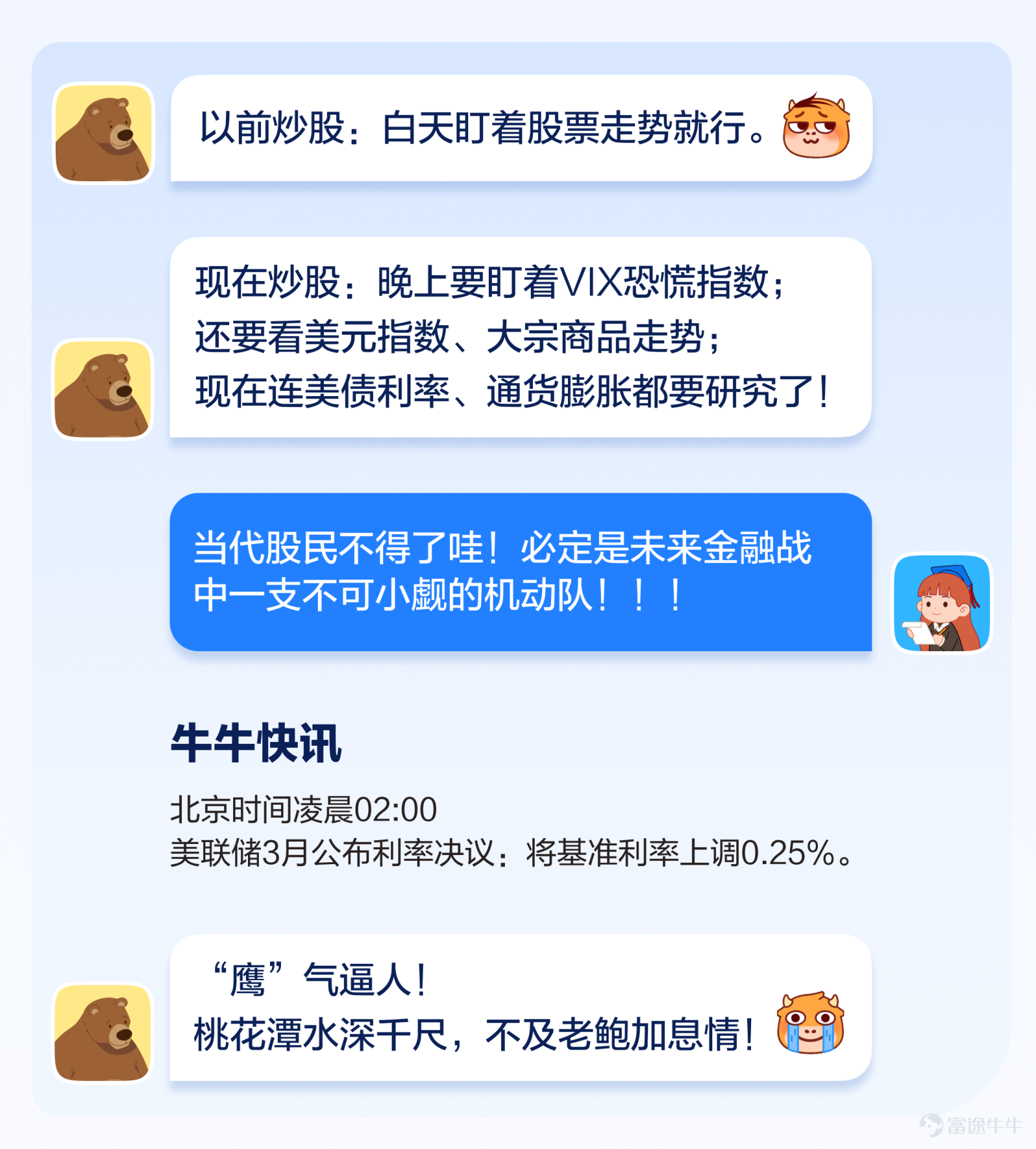
@愛新覺羅志祥Classmate,Received the Best Contribution AwardHaha, it's because the line "The water of Peach Blossom Pond runs thousands of feet deep, yet it cannot compare to Old Bao's heartfelt concern over interest rate hikes" was "borrowed" by Beibei from Poet Luo., grateful.![As expected, this thread has attracted experts from all fields. A big thank you to everyone for taking the time to help Cai Xiaoxiong explain the causes and consequences of the Fed's rate hikes—and their broader implications! [Study Time is Up] [Beckon]1. Click to go to the comments section and see everyone's opinions.→[Help from a Fellow Investor 9] What exactly is the Fed raising when it raises interest rates? [Beckon]2. Tap "Learn" →What exactly are open market operations? And what do "hawkish" and "dovish" mean? [Beckon]3. Tap me to learn→Which US stock sectors have outperformed the most across different rate-hike cycles? [What fellow investors say] [Rose]@天神海海Classmate, you were the first to offer timely help. The meaning of a rate hike is very straightforward:An increase in bank deposit interest ratesOnce everyone is willing to deposit their money in banks, the amount of money circulating in the market decreases, and as a result, the amount of money circulating in the stock market also declines. [Rose]@韭菜嘅夢想係坐上火箭Classmate, I've provided a brief explanation of what QE and Taper mean. Simply put,QE is equivalent to the central bank 'printing money.'This involves purchasing government and corporate bonds and other assets to increase the money supply, thereby stimulating bank lending and reviving the economy. Tapering, by contrast, represents the reverse of QE; literally meaning 'gradual reduction,' it refers to the central bank progressively scaling back its asset-purchase program and gradually phasing out QE. [Rose]@賺番d下午茶錢A classmate pointed out that, logically speaking, Federal Reserve rate hikes constitute a contractionary monetary policy and should, in theory, be bearish for the stock market. However, based on historical data, the Federal Reserve...](https://nnqimage.futunn.com/4416173598384874735.jpg/big?imageMogr2/ignore-error/1/format/webp)
Well, that's all for this episode! Every Friday, tune in to the "Fellow Investor Help" channel, which aims to help fellow investors avoid pitfalls on their investment journey!
[Reward Distribution]Helping Others Award: All participating fellow investors (who meet the requirements) have been awarded 66 points.Best Proposal Award: These 3 students@天神海海@韭菜嘅夢想係坐上火箭@賺番d下午茶錢, and receive a NiuNiu merchandise item.Best Question Award: Congratulations@仁慈的卡比牛Win the Best Question Award, and NiuNiu merchandise will be delivered right to your door!Best Contribution Award: Congratulations!@愛新覺羅志祥Win the Best Contribution Award, and NiuNiu merchandise will be delivered right to your door!
Risk Disclaimer: The above content only represents the author's view. It does not represent any position or investment advice of Futu. Futu makes no representation or warranty.Read more


Comments (4)
to post a comment
7
5