2月非農數據強勁,美股三大股指集體走低

Fed Watch: Can 'Mr. Nice Guy' Powell transform into 'Inflation Fighter' Volcker?
Recently, due to the ongoing escalation of the Russia-Ukraine conflict, crude oil prices surged to over $110 at the fastest pace in four decades. A new round of oil crisis is intensifying, and the soaring oil prices have abruptly increased the already high inflationary pressure in the US. At this point, for Powell, he faces the biggest test of his career as Fed Chair:On one hand, there's persistently high inflation, which even shows signs of accelerating; on the other hand, the increasingly fragile financial market. Entering 2022, volatility in the US stock market has sharply increased, with numerous stocks crashing, including Meta,$Meta Platforms (META.US)$ Netflix,$Netflix (NFLX.US)$ PayPal,$PayPal (PYPL.US)$ Shopify,$Shopify (SHOP.US)$ Snowflake,$Snowflake (SNOW.US)$ and other prominent companies.
For Powell, there are currently two options:
The first option is to prioritize controlling inflation, disregarding other obstacles, by swiftly raising the federal funds rate and subsequently implementing rapid quantitative tightening;
The second option is to continue balancing inflation control with asset prices, as the U.S. stock market remains a primary investment destination for pension funds in wealthy nations, and faces various pressures. If the market experiences a significant downturn, the pressure on Powell would intensify.
At this juncture, how will the affable Powell choose? Will he become another Paul Volcker, the 'inflation fighter' of yesteryears?

Volcker experienced many major events in his lifetime, including the collapse of the Bretton Woods system, the dollar crisis, the stagflation crisis of the 1970s, and the 2008 financial crisis.

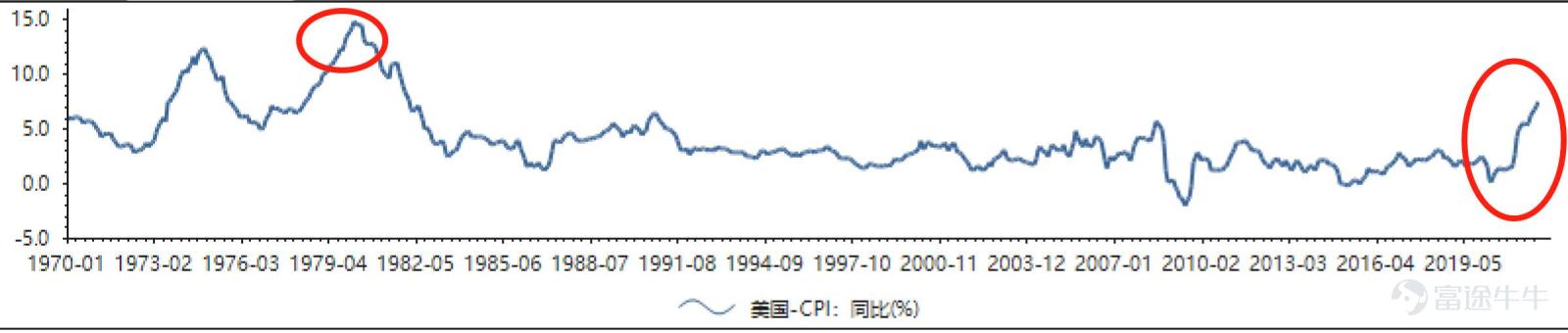
From 1969 to 1974, he served as the Treasury Undersecretary for Monetary Affairs in the Nixon administration, leading the decoupling of the US dollar from gold and the end of the Bretton Woods system. Following the collapse of the Bretton Woods system, factors such as the Cold War between the US and the Soviet Union caused oil prices to soar. After the 1973 oil crisis, inflation became a nightmare for Americans. As can be seen from the chart above, the CPI in the US rose sharply from 5% in 1973, peaking at over 14% in 1980. The sharp rise in inflation led to a loss of public confidence in the economy and the US dollar.

In August 1979, an appointment that changed the course of history occurred when Volcker was appointed as the Chairman of the Federal Reserve. Controlling inflation naturally became the most important task after Volcker took office. He raised interest rates to a high of 22%, which directly tamed inflation. From the chart above, it is evident that the Fed managed to bring down inflation through aggressive rate hikes, allowing the US economy to return to normal and establishing the independence of the Federal Reserve. Volcker's feat in the 1980s was hailed as a 'decisive blow' to save the situation.
Forbes magazine referred to Volcker as a stalwart of the Federal Reserve, while the media called him the 'inflation fighter' who was fearless in the face of political pressure. Bloomberg Weekly wrote in an article, 'Throughout his career spanning more than half a century, Volcker often played the role of a firefighter.' A commentator from the Financial Times stated, 'Volcker is the greatest person I have ever known. He was born with some admirable qualities that ordinary people cannot attain: integrity, wisdom, prudence, and a passion for serving the country.'
Today, Powell faces a situation similar to what Volcker faced back then. Compared to the hyperinflation at that time, the CPI when Powell took over does not seem to be as extreme.
Washington, February 10th, data released by the US Department of Labor showed that the Consumer Price Index (CPI) in January 2022 rose by 0.6% month-over-month and 7.5% year-over-year, creating the largest year-over-year increase since February 1982. The data showed that excluding volatile food and energy prices, core CPI in January rose by 0.6% month-over-month and 6% year-over-year, the largest year-over-year increase since August 1982.Specifically, increases in energy and car prices continued to be the main factors driving price rises in January.Energy prices increased by 0.9% month-over-month and 27% year-over-year.In terms of automobiles,New car prices remained flat compared to the previous month, but increased by 12.2% year-over-year.;Used car prices rose by 1.5% month-over-month and soared by 40.5% year-over-year.Moreover, housing prices increased by 0.3% month-on-month and 4.4% year-on-year; food prices rose by 0.9% month-on-month and 7% year-on-year. In terms of wages, average hourly earnings in January increased by 0.7% month-on-month, but after deducting inflation, real hourly earnings grew only by 0.1%.
For the US CPI, the main drivers are the surging energy and car prices. Energy prices are mainly driven by supply shortages, while car prices are due to disruptions in the global auto industry chain caused by the global chip shortage, leading to a shortage of cars. This is also the core reason why the US President has been urging Tesla$Tesla (TSLA.US)$ and other electric vehicle companies to lower prices. The soaring car prices have been another key driver pushing up the CPI.
For the US CPI, the main drivers are the surging energy and car prices. Energy prices are mainly driven by supply shortages, while car prices are due to disruptions in the global auto industry chain caused by the global chip shortage, leading to a shortage of cars. This is also the core reason why the US President has been urging Tesla$Tesla (TSLA.US)$ and other electric vehicle companies to lower prices. The soaring car prices have been another key driver pushing up the CPI.
The US stock market today is no longer comparable to what it was in the past; most of the assets of the world's major wealthy countries are tied up in US stocks. Therefore, if Powell’s aggressive interest rate hikes lead to a market crash, he will face more resistance. However, if inflation continues to rise beyond expectations, the Fed’s credibility will be at risk. This is the current dilemma for Powell—like trying to perform a ritual in a snail’s shell, with little room to maneuver.

In Yancái Jun's view, Powell cannot act as decisively as Volcker did back then. He is constrained by more factors and cannot act like Volcker, who transformed into a warrior solely focused on controlling inflation, disregarding other impacts.
Moreover, the situation Powell faces is somewhat better than before:
1. America's self-production capacity for crude oil and shale oil has significantly increased, making the US a net exporter of crude oil. Although the US imports large amounts of oil, it also exports crude oil and holds significant oil reserves, making it the world's largest crude oil reserve holder:

In 2019, the US exported an average of 3.8 million barrels of crude oil per day, while daily imports were around 3.5 million barrels.
According to relevant scholars' analysis, the US controls the largest oil circulation process globally. The US exports more than 200 million tons of crude oil annually, while importing around 280 million tons of high-quality crude oil each year. Additionally, the US is the world's largest oil reserve country, with strategic petroleum reserves reaching 1.1 billion barrels.By continuously buying, selling, and storing large quantities of oil, the US can control the largest oil circulation process in the world, gaining first-hand control over global oil prices, thereby consolidating the position of the petrodollar. Another reason is that the oil the US exports is called 'shale oil,' which contains more impurities and is of lower quality, while they import high-quality crude oil from the Middle East and sell lower-grade oil. Americans are very shrewd! With 1.1 billion barrels of massive oil reserves, when there are significant fluctuations in international crude oil prices, the US releases large amounts of reserve oil to stabilize global oil prices. Simply put, Americans won't let anyone else control the fate of global oil, including OPEC and Russia. Only by controlling the lifeline of the global economy can the status of the dollar be solidified, and the US global hegemony maintained!

2. As for the CPI, a potential positive for Powell is that with the peak of Omicron transmission fading, the global semiconductor supply is gradually recovering. The chip shortage in the auto industry is expected to improve quarter by quarter, which is beneficial for inflation recovery.
Therefore, this financial commentator predicts that Mr. Nice Guy Powell will still start with a gentle rate hike and closely monitor the inflation data step by step. If inflation eases, the pace of rate hikes will slow down; if it continues to exceed expectations, the pace will accelerate — after all, market resilience and protection of the economy must both be taken into consideration.
$E-mini S&P 500 Futures (SEP6) (ESmain.US)$$E-mini Dow Futures (SEP6) (YMmain.US)$$E-mini NASDAQ 100 Futures (SEP6) (NQmain.US)$$Brent Last Day Financial Futures (DEC6) (BZmain.US)$$NVIDIA (NVDA.US)$$Apple (AAPL.US)$$Microsoft (MSFT.US)$$Lucid Group (LCID.US)$$Rivian Automotive (RIVN.US)$$Ford Motor (F.US)$
Risk Disclaimer: The above content only represents the author's view. It does not represent any position or investment advice of Futu. Futu makes no representation or warranty.Read more


Comments (11)
to post a comment
35
637