
A Historic Moment! AMD's Market Cap Surpasses Intel: Has Ms. Su's Era Arrived?
Perhaps it's because Intel has long failed to deliver architecture and process improvements that satisfy consumers in the consumer-grade processor segment. Before the launch of the 12th-generation Core and the Alder Lake architecture, AMD's Ryzen processors were the top choice for most cost-conscious gamers, to the point where some AMD users would "live-stream roast" Intel on its Weibo posts promoting new processors, touting AMD's Zen architecture.
Unfortunately, despite AMD's "reputation" among gamers, it has never been Intel's match in terms of market share. Even some seasoned DIY enthusiasts will prioritize Core-based configurations when recommending PC setups to beginners. The same holds true in the graphics card segment: due to A-card's less-than-satisfactory stability in the past, NVIDIA has long dominated the gaming graphics card market. AMD, caught between two fires, is jokingly referred to by gamers as "having better processors than NVIDIA and better graphics cards than Intel," a reality that is starkly reflected in AMD's market capitalization.
However, just a few days ago, a turning point occurred: in 2020, AMD launched an equity-for-equity acquisition of PLD manufacturer Xilinx; on February 14, 2022, AMD successfully completed the acquisition of Xilinx, which in turn drove up the stock prices of both Xilinx and AMD by 80% and 70%, respectively. Indeed, thanks to the post-acquisition stock price surge, AMD's market capitalization surpassed Intel's for the first time, reaching a high of US$199.58 billion.
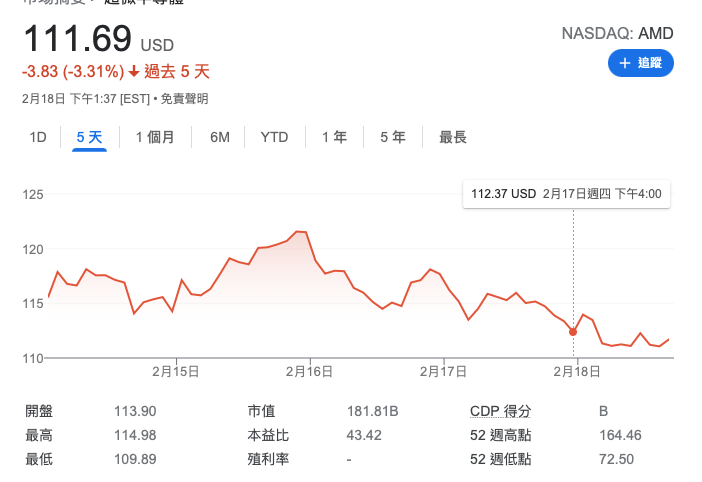
Of course, the boost to stock prices from corporate acquisitions is also time-limited. Within two days, AMD's stock price fell by 7.52%, and its market capitalization dropped back to US$182.87 billion, once again trailing Intel's US$193.66 billion.
This is AMD's era.
Although AMD's market capitalization surpassing Intel's is largely due to its acquisition, from a product perspective, AMD has indeed demonstrated the ability to compete with Intel in recent years. Taking consumer-grade processors as an example, the manufacturing process, as a crucial metric for chips, has a significant impact on chip power consumption. However, while AMD has steadily advanced through 14nm/12nm/7nm nodes, Intel has repeatedly encountered setbacks in this area: the 14nm node was delayed from 2013 to 2014, the 10nm node from 2015 to 2017, and the 10nm node again from 2017 to 2020.
On one side is AMD, with its ever-improving process technology, architecture, and performance; on the other is Intel, "struggling" with its 14nm++ process. Naturally, the vast majority of price-sensitive DIY gamers will opt for products that offer better value. Especially in recent years, as graphics card prices have soared, more and more gamers are choosing to buy gaming laptops. Moreover, the RDNA2-based 6000-series mobile processors have also attracted considerable attention to AMD's gaming laptops.
In other details, it is also easy to see that AMD is trying to break free from Intel's standard restrictions and increase its influence in the DIY field. Last month, the developer of HWiNFO officially confirmed on the forum that AMD RAMP is indeed a new-generation memory standard developed by AMD itself, similar to Intel's XMP, which will be used on the DDR5 platform of Zen4.
For many years, AMD has been using Intel's dominant memory overclocking mechanism, which is in fact a confirmation of Intel's market-leading position. Of course, whether AMD admits it or not, a few years ago no one could deny Intel's status as the market leader. Even under the pressure from Ryzen processors, Intel's current processors still hold the majority of the market share.

Therefore, if AMD wants to continue competing with Intel and seize market influence, it must establish its own standards and build its own ecosystem. In fact, prior to RAMP, AMD had also launched its own memory overclocking protocols based on XMP, namely A-XMP and AMP, but these protocols only received "trial" support from a few manufacturers. This time, surpassing Intel in market capitalization not only confirms AMD's influence from a third-party perspective, but also presents the best opportunity for AMD to establish its own standards.
Has AMD risen from the ashes?
That said, although AMD has performed exceptionally well in recent years—both in terms of product performance and market presence in the consumer segment—if we turn our attention to the commercial market, AMD's performance falls short. In the server and computing unit sectors, where customers place greater emphasis on product stability, Intel's chip solutions tend to win broader user acceptance. For example, according to 2021 data, although AMD's server market share rose from 0% to 10%, it still struggles to compete with Intel.
The same holds true for graphics cards: although AMD launched a number of budget-friendly gaming GPUs amid soaring prices, its efforts to differentiate its products by heavily throttling specifications and performance may have gone too far. From a gamer's perspective, the current 4GB RX 6500 XT is clearly ill-equipped to meet the demands of mid- to high-end gamers. From a video-production standpoint, the absence of dedicated video encoders/decoders severely constrains these cards' performance in video workflows. And this is just one example of how AMD GPUs lag behind in professional applications; their inferior CUDA compute capabilities further limit their suitability for such use cases across the board.
In other words, although AMD's standing has risen among some DIY enthusiasts, it still has room to grow in terms of industry influence when it comes to enterprise and professional applications. This is a key point that AMD fans need to recognize before enthusiastically rallying behind the "AMD YES" slogan.
Of course, we know that AMD needs to break Intel's encirclement, and AMD certainly knows it too. From a business perspective, AMD needs to further decouple from Intel to avoid being constrained in future processor wars; from a user perspective, an effective and stable memory standard is also needed to deliver a better user experience. No matter how you look at it, building an AMD hardware ecosystem must be put on the agenda—only in this way can it counter Intel's long-established ecosystem advantage.
However, some netizens are concerned that if AMD develops its own standards, there may be compatibility issues when running software or games optimized for Intel processors or NVIDIA graphics cards. To be fair, this situation is indeed possible. But with the help of mature general-purpose architectures and algorithm engines, even hardware under the new standard is expected to function normally, just like older hardware in the past.
The aforementioned RAMP memory overclocking protocol is, after all, AMD's challenge to Intel's dominance in the consumer market. In fact, AMD's RAMP is not intended to replace XMP; rather, it provides a targeted memory optimization standard for motherboard and memory manufacturers in addition to XMP, enabling them to offer stronger support for the AMD platform.
At least for AMD users, it's a good thing that AMD's market cap has surpassed Intel's. This means that after years of dominance by a single company in the PC chip market, we're finally seeing a shift toward a more competitive landscape. For consumers, this also means that in the future they can expect to have more diverse options, making it easier to compare products and choose the best one. By then, we believe no one will object to "AMD YES" anymore.
Risk Disclaimer: The above content only represents the author's view. It does not represent any position or investment advice of Futu. Futu makes no representation or warranty.Read more


Comments (5)
to post a comment
13
112