
Options Hub: Oil prices break $100, PPI beats expectations! How to position with options for tonight

When stocks fall, how can we not only leave the market without losing money, but also reduce losses from falling?
The content of this article is valid for a
I've been optimistic about a company for a long time. Those who have just bought their stocks think they'll be shareholders in the future. At this point, the stock starts to fall. Should I take it? sell it? Or add to the warehouse?
![The content of this article is valid for a I've been optimistic about a company for a long time. Those who have just bought their stocks think they'll be shareholders in the future. At this point, the stock starts to fall. Should I take it? sell it? Or add to the warehouse?[Shocked] However, anyone who has bought stocks has had a similar experience. With the dream of increasing wealth, why did you start bothering about this as soon as you arrived?! What can I do? Can we just watch the stock fall and do nothing? If you sell it, the loss becomes a real loss. If you hold it, will it keep falling? Adding warehouses and dilating costs doesn't rise. What should I do? Generally speaking, stock trading is a strategy: buy low, sell high, and have a single direction. If the financial market were just that kind of trick, it would be an underestimation of the strength of our investment forefathers. Market risks are ever-changing. Simply holding stocks seems extremely passive. YesStock optionsWith this risk management tool, investment has become rich and diversified. If you still don't know what options are, you can go to the academy to learn the basics of options: [Share Link: https://www.futuniuniu.com/course/1188] The strategy described next is based on the following context:I'm optimistic about a stock for a long time, and it's currently in a downward channel. I don't want to leave the market, and I also want to hedge against the risk of falling.It does not apply to situations such as intraday option arbitrage, high-frequency stock trading, etc. 1. Bearish Strategy: Pairing Put Options (Pairing Put) Specific practices: Hold underlying stocks, buy puts, and hedge against downside risks. Applicable...](https://nnqimage.futunn.com/16430072481302-999986-web-8f00b204e9800998.jpg/big?imageMogr2/ignore-error/1/format/webp)
However, anyone who has bought stocks has had a similar experience. With the dream of increasing wealth, why did you start bothering about this as soon as you arrived?!
What can I do? Can we just watch the stock fall and do nothing?
If you sell it, the loss becomes a real loss.
If you hold it, will it keep falling?
Adding warehouses and dilating costs doesn't rise. What should I do?
Generally speaking, stock trading is a strategy: buy low, sell high, and have a single direction.
If the financial market were just that kind of trick, it would be an underestimation of the strength of our investment forefathers.
Market risks are ever-changing. Simply holding stocks seems extremely passive. YesStock optionsWith this risk management tool, investment has become rich and diversified.
If you still don't know what options are, you can go to the academy to learn the basics of options:
https://www.futuniuniu.com/course/1188
The strategy described next is based on the following context:I'm optimistic about a stock for a long time, and it's currently in a downward channel. I don't want to leave the market, and I also want to hedge against the risk of falling.It does not apply to situations such as intraday option arbitrage, high-frequency stock trading, etc.
![The content of this article is valid for a I've been optimistic about a company for a long time. Those who have just bought their stocks think they'll be shareholders in the future. At this point, the stock starts to fall. Should I take it? sell it? Or add to the warehouse?[Shocked] However, anyone who has bought stocks has had a similar experience. With the dream of increasing wealth, why did you start bothering about this as soon as you arrived?! What can I do? Can we just watch the stock fall and do nothing? If you sell it, the loss becomes a real loss. If you hold it, will it keep falling? Adding warehouses and dilating costs doesn't rise. What should I do? Generally speaking, stock trading is a strategy: buy low, sell high, and have a single direction. If the financial market were just that kind of trick, it would be an underestimation of the strength of our investment forefathers. Market risks are ever-changing. Simply holding stocks seems extremely passive. YesStock optionsWith this risk management tool, investment has become rich and diversified. If you still don't know what options are, you can go to the academy to learn the basics of options: [Share Link: https://www.futuniuniu.com/course/1188] The strategy described next is based on the following context:I'm optimistic about a stock for a long time, and it's currently in a downward channel. I don't want to leave the market, and I also want to hedge against the risk of falling.It does not apply to situations such as intraday option arbitrage, high-frequency stock trading, etc. 1. Bearish Strategy: Pairing Put Options (Pairing Put) Specific practices: Hold underlying stocks, buy puts, and hedge against downside risks. Applicable...](https://nnqimage.futunn.com/2022012401010842750d09187ea.gif?imageMogr2/ignore-error/1/format/webp)
1. Bearish Strategy: Pairing Put Options (Pairing Put)
Specific practices: Hold underlying stocks, buy puts, and hedge against downside risks.
Applicable scenario: Holding underlying stocks and worrying about subsequent declines.
Some people call this combination:Insure your shareholdings.
Normally, 1 put option can “protect” 100 underlying shares. *
*Note: 1 US stock option corresponds to 100 shares; Hong Kong stock options are not necessarily determined by the option contract size, which may be 100, 500, or 2000, or other quantities(As shown in the red frame in the picture below)
![The content of this article is valid for a I've been optimistic about a company for a long time. Those who have just bought their stocks think they'll be shareholders in the future. At this point, the stock starts to fall. Should I take it? sell it? Or add to the warehouse?[Shocked] However, anyone who has bought stocks has had a similar experience. With the dream of increasing wealth, why did you start bothering about this as soon as you arrived?! What can I do? Can we just watch the stock fall and do nothing? If you sell it, the loss becomes a real loss. If you hold it, will it keep falling? Adding warehouses and dilating costs doesn't rise. What should I do? Generally speaking, stock trading is a strategy: buy low, sell high, and have a single direction. If the financial market were just that kind of trick, it would be an underestimation of the strength of our investment forefathers. Market risks are ever-changing. Simply holding stocks seems extremely passive. YesStock optionsWith this risk management tool, investment has become rich and diversified. If you still don't know what options are, you can go to the academy to learn the basics of options: [Share Link: https://www.futuniuniu.com/course/1188] The strategy described next is based on the following context:I'm optimistic about a stock for a long time, and it's currently in a downward channel. I don't want to leave the market, and I also want to hedge against the risk of falling.It does not apply to situations such as intraday option arbitrage, high-frequency stock trading, etc. 1. Bearish Strategy: Pairing Put Options (Pairing Put) Specific practices: Hold underlying stocks, buy puts, and hedge against downside risks. Applicable...](https://nnqimage.futunn.com/16444628613767-999986-web-8f00b204e9800998.jpg/big?imageMogr2/ignore-error/1/format/webp)
Take PDD stock as an example (the data is pure fiction):
On the 1st of a certain month, I purchased 1,000 shares of Pinduoduo at a price of $100, at a cost of 100,000 US dollars.
By the 15th, Pinduoduo's price had risen to 130 US dollars, making a small profit of 30,000 US dollars. My heart was ecstatic.
At this point, I analyze that there is a downside risk in future stock prices. But I don't have any more money to add to my positions to reduce the cost of holding a position; at the same time, I also hope to keep my profits and at least make some money. So I set a psychological price for myself, $110. If the stock price falls below $110 a week later, I expect to be able to ship it at $110, which guarantees me a yield of around 10%.
So I chose to buy the put that expires on Friday the 20th on the 15th. The exercise price is 110 US dollars. At this point, the price of put is 3 US dollars. If you want to fully cover 1,000 shares, you need to buy 10 cards. The total “premium” is 3,000 US dollars.
So by next week, on the 17th, I discovered that the stock price had already reached 80 US dollars. Oh my gosh,What should I do?
At this point, if you only hold the underlying stock, then the loss = (100-80) *1000 = 20,000 US dollars, and the dry side lost 20,000.Fortunately, I bought insurance for these 1,000 shares.
![The content of this article is valid for a I've been optimistic about a company for a long time. Those who have just bought their stocks think they'll be shareholders in the future. At this point, the stock starts to fall. Should I take it? sell it? Or add to the warehouse?[Shocked] However, anyone who has bought stocks has had a similar experience. With the dream of increasing wealth, why did you start bothering about this as soon as you arrived?! What can I do? Can we just watch the stock fall and do nothing? If you sell it, the loss becomes a real loss. If you hold it, will it keep falling? Adding warehouses and dilating costs doesn't rise. What should I do? Generally speaking, stock trading is a strategy: buy low, sell high, and have a single direction. If the financial market were just that kind of trick, it would be an underestimation of the strength of our investment forefathers. Market risks are ever-changing. Simply holding stocks seems extremely passive. YesStock optionsWith this risk management tool, investment has become rich and diversified. If you still don't know what options are, you can go to the academy to learn the basics of options: [Share Link: https://www.futuniuniu.com/course/1188] The strategy described next is based on the following context:I'm optimistic about a stock for a long time, and it's currently in a downward channel. I don't want to leave the market, and I also want to hedge against the risk of falling.It does not apply to situations such as intraday option arbitrage, high-frequency stock trading, etc. 1. Bearish Strategy: Pairing Put Options (Pairing Put) Specific practices: Hold underlying stocks, buy puts, and hedge against downside risks. Applicable...](https://nnqimage.futunn.com/20220124010108490c6f1823596.jpg?imageMogr2/ignore-error/1/format/webp)
Choice 1
I can choose to exercise my rights, then my stock will be sold at a price of 110 US dollars, I will receive 110,000 US dollars, minus the cost of buying input at 3,000 US dollars, and I will make a profit: 110,000 to 100,000 to 3,000 = 7,000 US dollars. I make money when stocks fall; this is the kind of operation.
In this way, the stock will be sold. If you still want to keep holding the stock, then you can choose the following operation.
![The content of this article is valid for a I've been optimistic about a company for a long time. Those who have just bought their stocks think they'll be shareholders in the future. At this point, the stock starts to fall. Should I take it? sell it? Or add to the warehouse?[Shocked] However, anyone who has bought stocks has had a similar experience. With the dream of increasing wealth, why did you start bothering about this as soon as you arrived?! What can I do? Can we just watch the stock fall and do nothing? If you sell it, the loss becomes a real loss. If you hold it, will it keep falling? Adding warehouses and dilating costs doesn't rise. What should I do? Generally speaking, stock trading is a strategy: buy low, sell high, and have a single direction. If the financial market were just that kind of trick, it would be an underestimation of the strength of our investment forefathers. Market risks are ever-changing. Simply holding stocks seems extremely passive. YesStock optionsWith this risk management tool, investment has become rich and diversified. If you still don't know what options are, you can go to the academy to learn the basics of options: [Share Link: https://www.futuniuniu.com/course/1188] The strategy described next is based on the following context:I'm optimistic about a stock for a long time, and it's currently in a downward channel. I don't want to leave the market, and I also want to hedge against the risk of falling.It does not apply to situations such as intraday option arbitrage, high-frequency stock trading, etc. 1. Bearish Strategy: Pairing Put Options (Pairing Put) Specific practices: Hold underlying stocks, buy puts, and hedge against downside risks. Applicable...](https://nnqimage.futunn.com/2022012401010851b72d59a7fad.gif?imageMogr2/ignore-error/1/format/webp)
Choice 2
Sell your position, close the position, and make some of the difference in the option price.
Before the option expires, a drop in the underlying price may cause the price of the put held to rise. At this point, the put price has reached $20. I can sell the option directly to earn a point difference (because I don't want to sell the underlying stock yet) and earn: (20-3) *1000 = 17,000 US dollars. Of course, the loss of holding the underlying stock at this time (100-80) *1000 = 20,000 US dollars. options,Narrowing the original loss of negative 20,000 to minus 3,000, further falling。
When an option expires, it is also possible to operate according to the above ideas. However, as it nears expiration, option 2 may not work, because the time value of the option is reduced to zero, and almost no one in the market will buy it; they can only choose to exercise their rights and sell stocks.
inIn the case of not cutting meat, profit comparison between holding only the underlying stock and buying input:
![The content of this article is valid for a I've been optimistic about a company for a long time. Those who have just bought their stocks think they'll be shareholders in the future. At this point, the stock starts to fall. Should I take it? sell it? Or add to the warehouse?[Shocked] However, anyone who has bought stocks has had a similar experience. With the dream of increasing wealth, why did you start bothering about this as soon as you arrived?! What can I do? Can we just watch the stock fall and do nothing? If you sell it, the loss becomes a real loss. If you hold it, will it keep falling? Adding warehouses and dilating costs doesn't rise. What should I do? Generally speaking, stock trading is a strategy: buy low, sell high, and have a single direction. If the financial market were just that kind of trick, it would be an underestimation of the strength of our investment forefathers. Market risks are ever-changing. Simply holding stocks seems extremely passive. YesStock optionsWith this risk management tool, investment has become rich and diversified. If you still don't know what options are, you can go to the academy to learn the basics of options: [Share Link: https://www.futuniuniu.com/course/1188] The strategy described next is based on the following context:I'm optimistic about a stock for a long time, and it's currently in a downward channel. I don't want to leave the market, and I also want to hedge against the risk of falling.It does not apply to situations such as intraday option arbitrage, high-frequency stock trading, etc. 1. Bearish Strategy: Pairing Put Options (Pairing Put) Specific practices: Hold underlying stocks, buy puts, and hedge against downside risks. Applicable...](https://nnqimage.futunn.com/16430059787111-999986-web-8f00b204e9800998.png?imageMogr2/ignore-error/1/format/webp)
On the 17th, the stock price fell to $80
![The content of this article is valid for a I've been optimistic about a company for a long time. Those who have just bought their stocks think they'll be shareholders in the future. At this point, the stock starts to fall. Should I take it? sell it? Or add to the warehouse?[Shocked] However, anyone who has bought stocks has had a similar experience. With the dream of increasing wealth, why did you start bothering about this as soon as you arrived?! What can I do? Can we just watch the stock fall and do nothing? If you sell it, the loss becomes a real loss. If you hold it, will it keep falling? Adding warehouses and dilating costs doesn't rise. What should I do? Generally speaking, stock trading is a strategy: buy low, sell high, and have a single direction. If the financial market were just that kind of trick, it would be an underestimation of the strength of our investment forefathers. Market risks are ever-changing. Simply holding stocks seems extremely passive. YesStock optionsWith this risk management tool, investment has become rich and diversified. If you still don't know what options are, you can go to the academy to learn the basics of options: [Share Link: https://www.futuniuniu.com/course/1188] The strategy described next is based on the following context:I'm optimistic about a stock for a long time, and it's currently in a downward channel. I don't want to leave the market, and I also want to hedge against the risk of falling.It does not apply to situations such as intraday option arbitrage, high-frequency stock trading, etc. 1. Bearish Strategy: Pairing Put Options (Pairing Put) Specific practices: Hold underlying stocks, buy puts, and hedge against downside risks. Applicable...](https://nnqimage.futunn.com/16430060080378-999986-web-8f00b204e9800998.png?imageMogr2/ignore-error/1/format/webp)
Risk warning!!!
If I had to say that after I bought PUT, the stock price went up all the way, then I would lose up to 3,000.
However, the underlying stock I hold has a large profit due to price increases, which can also offset the cost of “premium” options.
So-called “The east side is not bright, the west side is bright!”

Feedback from students who participated in the “Practical Options Learning Camp”
The “Options Practice Camp” will open on the morning of May 9 (next Monday). The number of places is limited, and only 500 people will be recruited. clicks@财学堂贝贝, go to the Bebe homepage, and “Add as a friend” will count as a successful registration.
2. Amortize costs: holding+selling underlying shares
Specific practices: Hold the underlying stock, sell it, and amortize the cost of holding a position.
Applicable scenario: Holding underlying stocks, long-term optimism, ready to pick up goods.
Assuming I'm an AMD fan, I think this company is a value stock, and now is a good time to buy it. However, the short-term market is still not very accurate. Use a small number of positions first and buy a few first. The following data is pure fiction.
On the 1st of a certain month, I bought 1,000 shares on a trial basis. The transaction price was 100 US dollars, and the cost was 100,000 US dollars.
After the purchase, it was found that AMD continued to decline.
![The content of this article is valid for a I've been optimistic about a company for a long time. Those who have just bought their stocks think they'll be shareholders in the future. At this point, the stock starts to fall. Should I take it? sell it? Or add to the warehouse?[Shocked] However, anyone who has bought stocks has had a similar experience. With the dream of increasing wealth, why did you start bothering about this as soon as you arrived?! What can I do? Can we just watch the stock fall and do nothing? If you sell it, the loss becomes a real loss. If you hold it, will it keep falling? Adding warehouses and dilating costs doesn't rise. What should I do? Generally speaking, stock trading is a strategy: buy low, sell high, and have a single direction. If the financial market were just that kind of trick, it would be an underestimation of the strength of our investment forefathers. Market risks are ever-changing. Simply holding stocks seems extremely passive. YesStock optionsWith this risk management tool, investment has become rich and diversified. If you still don't know what options are, you can go to the academy to learn the basics of options: [Share Link: https://www.futuniuniu.com/course/1188] The strategy described next is based on the following context:I'm optimistic about a stock for a long time, and it's currently in a downward channel. I don't want to leave the market, and I also want to hedge against the risk of falling.It does not apply to situations such as intraday option arbitrage, high-frequency stock trading, etc. 1. Bearish Strategy: Pairing Put Options (Pairing Put) Specific practices: Hold underlying stocks, buy puts, and hedge against downside risks. Applicable...](https://nnqimage.futunn.com/20220124010108507a47faa5925.gif?imageMogr2/ignore-error/1/format/webp)
I'm not panicking; on the contrary, I think this is an opportunity. If it continues to fall to $90, I'd like to buy another 1,000 shares, so my average holding cost = ($100,000 +$90,000) /2,000 shares = $95 per share.
If I don't have an option instrument, then I'll have to wait until the stock price drops to $90 before I can pick it up. Once I have an option instrument, during this period of waiting, I sell the put, I can receive the premium, which can increase my profit.
![The content of this article is valid for a I've been optimistic about a company for a long time. Those who have just bought their stocks think they'll be shareholders in the future. At this point, the stock starts to fall. Should I take it? sell it? Or add to the warehouse?[Shocked] However, anyone who has bought stocks has had a similar experience. With the dream of increasing wealth, why did you start bothering about this as soon as you arrived?! What can I do? Can we just watch the stock fall and do nothing? If you sell it, the loss becomes a real loss. If you hold it, will it keep falling? Adding warehouses and dilating costs doesn't rise. What should I do? Generally speaking, stock trading is a strategy: buy low, sell high, and have a single direction. If the financial market were just that kind of trick, it would be an underestimation of the strength of our investment forefathers. Market risks are ever-changing. Simply holding stocks seems extremely passive. YesStock optionsWith this risk management tool, investment has become rich and diversified. If you still don't know what options are, you can go to the academy to learn the basics of options: [Share Link: https://www.futuniuniu.com/course/1188] The strategy described next is based on the following context:I'm optimistic about a stock for a long time, and it's currently in a downward channel. I don't want to leave the market, and I also want to hedge against the risk of falling.It does not apply to situations such as intraday option arbitrage, high-frequency stock trading, etc. 1. Bearish Strategy: Pairing Put Options (Pairing Put) Specific practices: Hold underlying stocks, buy puts, and hedge against downside risks. Applicable...](https://nnqimage.futunn.com/2022012401010844fa878dc26c7.png?imageMogr2/ignore-error/1/format/webp)
On the 3rd, AMD's stock price fell. At this time, it expires on the 13th of this month, and the exercise price is 90 US dollars, and the price is 2 US dollars. I'm ready to pick it up and sell 10 copies of this pack.
Selling put is like I'm selling insurance. I promise: if AMD falls to $90 on the 13th, then I'll buy 1,000 shares of AMD for $90. I made this promise not in vain; I need to charge $2*1000 = $2,000 in “insurance premiums”. When someone on the market bought this poop, then this insurance contract came into effect.
1. Within the expiration date, if AMD falls below 90 US dollars, then the buyer of put will exercise his right, and I will need to fulfill my promise, pay 90,000 US dollars, and buy 1,000 shares of AMD (at this point, the “premium” of 2,000 US dollars is already in my pocket).
![The content of this article is valid for a I've been optimistic about a company for a long time. Those who have just bought their stocks think they'll be shareholders in the future. At this point, the stock starts to fall. Should I take it? sell it? Or add to the warehouse?[Shocked] However, anyone who has bought stocks has had a similar experience. With the dream of increasing wealth, why did you start bothering about this as soon as you arrived?! What can I do? Can we just watch the stock fall and do nothing? If you sell it, the loss becomes a real loss. If you hold it, will it keep falling? Adding warehouses and dilating costs doesn't rise. What should I do? Generally speaking, stock trading is a strategy: buy low, sell high, and have a single direction. If the financial market were just that kind of trick, it would be an underestimation of the strength of our investment forefathers. Market risks are ever-changing. Simply holding stocks seems extremely passive. YesStock optionsWith this risk management tool, investment has become rich and diversified. If you still don't know what options are, you can go to the academy to learn the basics of options: [Share Link: https://www.futuniuniu.com/course/1188] The strategy described next is based on the following context:I'm optimistic about a stock for a long time, and it's currently in a downward channel. I don't want to leave the market, and I also want to hedge against the risk of falling.It does not apply to situations such as intraday option arbitrage, high-frequency stock trading, etc. 1. Bearish Strategy: Pairing Put Options (Pairing Put) Specific practices: Hold underlying stocks, buy puts, and hedge against downside risks. Applicable...](https://nnqimage.futunn.com/2022012401010852f39fe484d47.gif?imageMogr2/ignore-error/1/format/webp)
If option income is also included in the cost of holding a position, my current holding cost = 100,000+90,000-2,000 = 186,000.Cost per share is amortized as low as: $93. Good and good!
2. If AMD does not fall to 90 US dollars within the expiration date, then the buyer will not exercise its power.My net income is $2,000 in rotaries. End of collaboration.
![The content of this article is valid for a I've been optimistic about a company for a long time. Those who have just bought their stocks think they'll be shareholders in the future. At this point, the stock starts to fall. Should I take it? sell it? Or add to the warehouse?[Shocked] However, anyone who has bought stocks has had a similar experience. With the dream of increasing wealth, why did you start bothering about this as soon as you arrived?! What can I do? Can we just watch the stock fall and do nothing? If you sell it, the loss becomes a real loss. If you hold it, will it keep falling? Adding warehouses and dilating costs doesn't rise. What should I do? Generally speaking, stock trading is a strategy: buy low, sell high, and have a single direction. If the financial market were just that kind of trick, it would be an underestimation of the strength of our investment forefathers. Market risks are ever-changing. Simply holding stocks seems extremely passive. YesStock optionsWith this risk management tool, investment has become rich and diversified. If you still don't know what options are, you can go to the academy to learn the basics of options: [Share Link: https://www.futuniuniu.com/course/1188] The strategy described next is based on the following context:I'm optimistic about a stock for a long time, and it's currently in a downward channel. I don't want to leave the market, and I also want to hedge against the risk of falling.It does not apply to situations such as intraday option arbitrage, high-frequency stock trading, etc. 1. Bearish Strategy: Pairing Put Options (Pairing Put) Specific practices: Hold underlying stocks, buy puts, and hedge against downside risks. Applicable...](https://nnqimage.futunn.com/20220124010108437d4fcfcff44.jpg?imageMogr2/ignore-error/1/format/webp)
Risk warning!!!
1. Theoretically speaking, options sellers have unlimited risks and limited returns. As an option newbie, use it with caution. Because stocks are likely to keep falling, falling close to zero. The picture below shows the harrowing experience of a fellow cow (left to the end of the article).
2. The seller's risk is high, and future fluctuations are also large. It is generally recommended that option sellers do not choose puts whose expiration date is greater than one month
3. The examples given above are all released under certain probabilistic conditions. As a seller, you need to weigh all the risks and benefits that may occur in the future.
If delivery of goods is not considered, when the buyer exercises its power, the seller will sell its holdings, and the following situations may occur:
The following option prices are estimated based on the option price calculator and are for study reference only
![The content of this article is valid for a I've been optimistic about a company for a long time. Those who have just bought their stocks think they'll be shareholders in the future. At this point, the stock starts to fall. Should I take it? sell it? Or add to the warehouse?[Shocked] However, anyone who has bought stocks has had a similar experience. With the dream of increasing wealth, why did you start bothering about this as soon as you arrived?! What can I do? Can we just watch the stock fall and do nothing? If you sell it, the loss becomes a real loss. If you hold it, will it keep falling? Adding warehouses and dilating costs doesn't rise. What should I do? Generally speaking, stock trading is a strategy: buy low, sell high, and have a single direction. If the financial market were just that kind of trick, it would be an underestimation of the strength of our investment forefathers. Market risks are ever-changing. Simply holding stocks seems extremely passive. YesStock optionsWith this risk management tool, investment has become rich and diversified. If you still don't know what options are, you can go to the academy to learn the basics of options: [Share Link: https://www.futuniuniu.com/course/1188] The strategy described next is based on the following context:I'm optimistic about a stock for a long time, and it's currently in a downward channel. I don't want to leave the market, and I also want to hedge against the risk of falling.It does not apply to situations such as intraday option arbitrage, high-frequency stock trading, etc. 1. Bearish Strategy: Pairing Put Options (Pairing Put) Specific practices: Hold underlying stocks, buy puts, and hedge against downside risks. Applicable...](https://nnqimage.futunn.com/16475723534254-999986-web-8f00b204e9800998.png?imageMogr2/ignore-error/1/format/webp)
In general
If you're not optimistic about a stock for a long time, if you're not ready to pick up the goods, be careful when selling. Options are not only a risk management tool, but also a leverage tool.It can leverage considerable benefits with a small amount of capital, but it can also bring unlimited risks.
![The content of this article is valid for a I've been optimistic about a company for a long time. Those who have just bought their stocks think they'll be shareholders in the future. At this point, the stock starts to fall. Should I take it? sell it? Or add to the warehouse?[Shocked] However, anyone who has bought stocks has had a similar experience. With the dream of increasing wealth, why did you start bothering about this as soon as you arrived?! What can I do? Can we just watch the stock fall and do nothing? If you sell it, the loss becomes a real loss. If you hold it, will it keep falling? Adding warehouses and dilating costs doesn't rise. What should I do? Generally speaking, stock trading is a strategy: buy low, sell high, and have a single direction. If the financial market were just that kind of trick, it would be an underestimation of the strength of our investment forefathers. Market risks are ever-changing. Simply holding stocks seems extremely passive. YesStock optionsWith this risk management tool, investment has become rich and diversified. If you still don't know what options are, you can go to the academy to learn the basics of options: [Share Link: https://www.futuniuniu.com/course/1188] The strategy described next is based on the following context:I'm optimistic about a stock for a long time, and it's currently in a downward channel. I don't want to leave the market, and I also want to hedge against the risk of falling.It does not apply to situations such as intraday option arbitrage, high-frequency stock trading, etc. 1. Bearish Strategy: Pairing Put Options (Pairing Put) Specific practices: Hold underlying stocks, buy puts, and hedge against downside risks. Applicable...](https://nnqimage.futunn.com/202201240101084532ad8dea4ab.jpg?imageMogr2/ignore-error/1/format/webp)
The underlying stock and options markets are changing rapidly. Operate carefully, keep an eye on the market diligently, control positions, and do a good job of risk control.
Otherwise you'll redefineFour dishes and one soup.
![The content of this article is valid for a I've been optimistic about a company for a long time. Those who have just bought their stocks think they'll be shareholders in the future. At this point, the stock starts to fall. Should I take it? sell it? Or add to the warehouse?[Shocked] However, anyone who has bought stocks has had a similar experience. With the dream of increasing wealth, why did you start bothering about this as soon as you arrived?! What can I do? Can we just watch the stock fall and do nothing? If you sell it, the loss becomes a real loss. If you hold it, will it keep falling? Adding warehouses and dilating costs doesn't rise. What should I do? Generally speaking, stock trading is a strategy: buy low, sell high, and have a single direction. If the financial market were just that kind of trick, it would be an underestimation of the strength of our investment forefathers. Market risks are ever-changing. Simply holding stocks seems extremely passive. YesStock optionsWith this risk management tool, investment has become rich and diversified. If you still don't know what options are, you can go to the academy to learn the basics of options: [Share Link: https://www.futuniuniu.com/course/1188] The strategy described next is based on the following context:I'm optimistic about a stock for a long time, and it's currently in a downward channel. I don't want to leave the market, and I also want to hedge against the risk of falling.It does not apply to situations such as intraday option arbitrage, high-frequency stock trading, etc. 1. Bearish Strategy: Pairing Put Options (Pairing Put) Specific practices: Hold underlying stocks, buy puts, and hedge against downside risks. Applicable...](https://nnqimage.futunn.com/20220124010108539d84be1f008.jpg?imageMogr2/ignore-error/1/format/webp)
RELATED READS:
Relevant call:Can the shares issued by the company still be used to collect interest? How do Tencent bosses use options for low-risk arbitrage
Full interpretation of the risks of a risky call:Having a comprehensive understanding of the risks of selling calls, ordinary people can also skillfully use options to “receive interest”
Options operation strategy for the earnings season:How to use options to make money during the earnings season?
Relevant call:Can the shares issued by the company still be used to collect interest? How do Tencent bosses use options for low-risk arbitrage
Full interpretation of the risks of a risky call:Having a comprehensive understanding of the risks of selling calls, ordinary people can also skillfully use options to “receive interest”
Options operation strategy for the earnings season:How to use options to make money during the earnings season?
Attachment 1: The painful lesson of Niuyou selling putty
![The content of this article is valid for a I've been optimistic about a company for a long time. Those who have just bought their stocks think they'll be shareholders in the future. At this point, the stock starts to fall. Should I take it? sell it? Or add to the warehouse?[Shocked] However, anyone who has bought stocks has had a similar experience. With the dream of increasing wealth, why did you start bothering about this as soon as you arrived?! What can I do? Can we just watch the stock fall and do nothing? If you sell it, the loss becomes a real loss. If you hold it, will it keep falling? Adding warehouses and dilating costs doesn't rise. What should I do? Generally speaking, stock trading is a strategy: buy low, sell high, and have a single direction. If the financial market were just that kind of trick, it would be an underestimation of the strength of our investment forefathers. Market risks are ever-changing. Simply holding stocks seems extremely passive. YesStock optionsWith this risk management tool, investment has become rich and diversified. If you still don't know what options are, you can go to the academy to learn the basics of options: [Share Link: https://www.futuniuniu.com/course/1188] The strategy described next is based on the following context:I'm optimistic about a stock for a long time, and it's currently in a downward channel. I don't want to leave the market, and I also want to hedge against the risk of falling.It does not apply to situations such as intraday option arbitrage, high-frequency stock trading, etc. 1. Bearish Strategy: Pairing Put Options (Pairing Put) Specific practices: Hold underlying stocks, buy puts, and hedge against downside risks. Applicable...](https://nnqimage.futunn.com/2022012401010858218bb7bf7d9.png?imageMogr2/ignore-error/1/format/webp)
![The content of this article is valid for a I've been optimistic about a company for a long time. Those who have just bought their stocks think they'll be shareholders in the future. At this point, the stock starts to fall. Should I take it? sell it? Or add to the warehouse?[Shocked] However, anyone who has bought stocks has had a similar experience. With the dream of increasing wealth, why did you start bothering about this as soon as you arrived?! What can I do? Can we just watch the stock fall and do nothing? If you sell it, the loss becomes a real loss. If you hold it, will it keep falling? Adding warehouses and dilating costs doesn't rise. What should I do? Generally speaking, stock trading is a strategy: buy low, sell high, and have a single direction. If the financial market were just that kind of trick, it would be an underestimation of the strength of our investment forefathers. Market risks are ever-changing. Simply holding stocks seems extremely passive. YesStock optionsWith this risk management tool, investment has become rich and diversified. If you still don't know what options are, you can go to the academy to learn the basics of options: [Share Link: https://www.futuniuniu.com/course/1188] The strategy described next is based on the following context:I'm optimistic about a stock for a long time, and it's currently in a downward channel. I don't want to leave the market, and I also want to hedge against the risk of falling.It does not apply to situations such as intraday option arbitrage, high-frequency stock trading, etc. 1. Bearish Strategy: Pairing Put Options (Pairing Put) Specific practices: Hold underlying stocks, buy puts, and hedge against downside risks. Applicable...](https://nnqimage.futunn.com/2022012401010854f3d0b35395c.png?imageMogr2/ignore-error/1/format/webp)
![The content of this article is valid for a I've been optimistic about a company for a long time. Those who have just bought their stocks think they'll be shareholders in the future. At this point, the stock starts to fall. Should I take it? sell it? Or add to the warehouse?[Shocked] However, anyone who has bought stocks has had a similar experience. With the dream of increasing wealth, why did you start bothering about this as soon as you arrived?! What can I do? Can we just watch the stock fall and do nothing? If you sell it, the loss becomes a real loss. If you hold it, will it keep falling? Adding warehouses and dilating costs doesn't rise. What should I do? Generally speaking, stock trading is a strategy: buy low, sell high, and have a single direction. If the financial market were just that kind of trick, it would be an underestimation of the strength of our investment forefathers. Market risks are ever-changing. Simply holding stocks seems extremely passive. YesStock optionsWith this risk management tool, investment has become rich and diversified. If you still don't know what options are, you can go to the academy to learn the basics of options: [Share Link: https://www.futuniuniu.com/course/1188] The strategy described next is based on the following context:I'm optimistic about a stock for a long time, and it's currently in a downward channel. I don't want to leave the market, and I also want to hedge against the risk of falling.It does not apply to situations such as intraday option arbitrage, high-frequency stock trading, etc. 1. Bearish Strategy: Pairing Put Options (Pairing Put) Specific practices: Hold underlying stocks, buy puts, and hedge against downside risks. Applicable...](https://nnqimage.futunn.com/2022012401010861074b6337e65.png?imageMogr2/ignore-error/1/format/webp)

The above picture has been authorized by Niuyou
Attachment 2: Duan Yongping appeared to explain “selling put”
![The content of this article is valid for a I've been optimistic about a company for a long time. Those who have just bought their stocks think they'll be shareholders in the future. At this point, the stock starts to fall. Should I take it? sell it? Or add to the warehouse?[Shocked] However, anyone who has bought stocks has had a similar experience. With the dream of increasing wealth, why did you start bothering about this as soon as you arrived?! What can I do? Can we just watch the stock fall and do nothing? If you sell it, the loss becomes a real loss. If you hold it, will it keep falling? Adding warehouses and dilating costs doesn't rise. What should I do? Generally speaking, stock trading is a strategy: buy low, sell high, and have a single direction. If the financial market were just that kind of trick, it would be an underestimation of the strength of our investment forefathers. Market risks are ever-changing. Simply holding stocks seems extremely passive. YesStock optionsWith this risk management tool, investment has become rich and diversified. If you still don't know what options are, you can go to the academy to learn the basics of options: [Share Link: https://www.futuniuniu.com/course/1188] The strategy described next is based on the following context:I'm optimistic about a stock for a long time, and it's currently in a downward channel. I don't want to leave the market, and I also want to hedge against the risk of falling.It does not apply to situations such as intraday option arbitrage, high-frequency stock trading, etc. 1. Bearish Strategy: Pairing Put Options (Pairing Put) Specific practices: Hold underlying stocks, buy puts, and hedge against downside risks. Applicable...](https://nnqimage.futunn.com/2022012401010856782cd115604.png?imageMogr2/ignore-error/1/format/webp)
![The content of this article is valid for a I've been optimistic about a company for a long time. Those who have just bought their stocks think they'll be shareholders in the future. At this point, the stock starts to fall. Should I take it? sell it? Or add to the warehouse?[Shocked] However, anyone who has bought stocks has had a similar experience. With the dream of increasing wealth, why did you start bothering about this as soon as you arrived?! What can I do? Can we just watch the stock fall and do nothing? If you sell it, the loss becomes a real loss. If you hold it, will it keep falling? Adding warehouses and dilating costs doesn't rise. What should I do? Generally speaking, stock trading is a strategy: buy low, sell high, and have a single direction. If the financial market were just that kind of trick, it would be an underestimation of the strength of our investment forefathers. Market risks are ever-changing. Simply holding stocks seems extremely passive. YesStock optionsWith this risk management tool, investment has become rich and diversified. If you still don't know what options are, you can go to the academy to learn the basics of options: [Share Link: https://www.futuniuniu.com/course/1188] The strategy described next is based on the following context:I'm optimistic about a stock for a long time, and it's currently in a downward channel. I don't want to leave the market, and I also want to hedge against the risk of falling.It does not apply to situations such as intraday option arbitrage, high-frequency stock trading, etc. 1. Bearish Strategy: Pairing Put Options (Pairing Put) Specific practices: Hold underlying stocks, buy puts, and hedge against downside risks. Applicable...](https://nnqimage.futunn.com/20220124010108591b21db3ed61.png?imageMogr2/ignore-error/1/format/webp)
![The content of this article is valid for a I've been optimistic about a company for a long time. Those who have just bought their stocks think they'll be shareholders in the future. At this point, the stock starts to fall. Should I take it? sell it? Or add to the warehouse?[Shocked] However, anyone who has bought stocks has had a similar experience. With the dream of increasing wealth, why did you start bothering about this as soon as you arrived?! What can I do? Can we just watch the stock fall and do nothing? If you sell it, the loss becomes a real loss. If you hold it, will it keep falling? Adding warehouses and dilating costs doesn't rise. What should I do? Generally speaking, stock trading is a strategy: buy low, sell high, and have a single direction. If the financial market were just that kind of trick, it would be an underestimation of the strength of our investment forefathers. Market risks are ever-changing. Simply holding stocks seems extremely passive. YesStock optionsWith this risk management tool, investment has become rich and diversified. If you still don't know what options are, you can go to the academy to learn the basics of options: [Share Link: https://www.futuniuniu.com/course/1188] The strategy described next is based on the following context:I'm optimistic about a stock for a long time, and it's currently in a downward channel. I don't want to leave the market, and I also want to hedge against the risk of falling.It does not apply to situations such as intraday option arbitrage, high-frequency stock trading, etc. 1. Bearish Strategy: Pairing Put Options (Pairing Put) Specific practices: Hold underlying stocks, buy puts, and hedge against downside risks. Applicable...](https://nnqimage.futunn.com/20220124010108551998737c491.png?imageMogr2/ignore-error/1/format/webp)
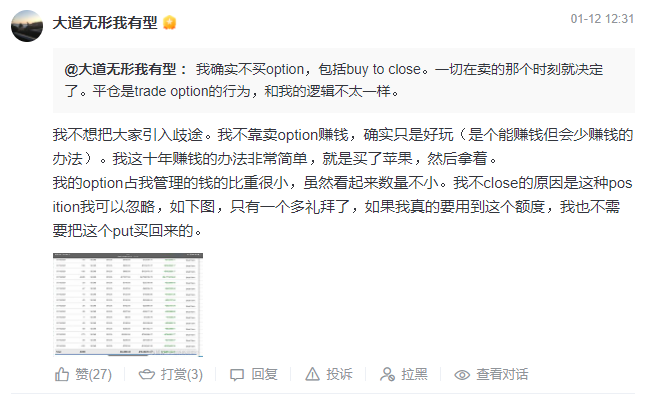
Risk warning: As a veteran trader, Duan Yongping's strategies are not recommended for ordinary people to try easily. You need to fully understand the risks of options trading.
If you want to know more about options, please leave a message to let us know
Risk Disclaimer: The above content only represents the author's view. It does not represent any position or investment advice of Futu. Futu makes no representation or warranty.Read more


Comments (131)
to post a comment
932
2036