
Alibaba is deploying forces to penetrate the sinking markets, with the "trident" taking the lead.
Historian Tanging Bi once analyzed the rise and fall of civilizations using the concept of "challenges and responses," which can also be applied to analyzing companies.
On December 6, Alibaba Group's Chairman and CEO, Zhang Yong, released an internal memo focusing on "diversified governance upgrade," appointing Dai Shan to oversee the group's including Alibaba, Tmall, Ali Mama), B2C Retail Business Group, Taocai, Taotao, and 1688, collectively forming the "China Digital Business Sector."
Ten days later, Dai Shan, who is about to take office, made her first public appearance.
Photon Planet learned that in yesterday's 2021 Alibaba Global Investor Day exchange, Dai Shan disclosed more details, mainly including three key pieces of information:
1. As the foundation, Taobao will integrate with Taocai Cai and Taote Finance to form a 'trident'.
2. The goal is to open up the sinking market through the M2C model and medium-to-high-frequency.
3. Alibaba's two major e-commerce sectors - Taobao system and B system merge for the first time.
This is the most significant organizational adjustment by Alibaba since the launch of the Big Center platform in 2015. In six years, the environment has already changed. At that time, in response to competition, the Big Center formed a 'more agile organization,' with a completely different time background and logic than this time's structural adjustment.
With competition no longer the primary issue, Alibaba's current restructuring actually carries more 'challenges' meaning. On the one hand, the two juniors Taote and Taocai have initially established themselves as pioneers: Taote spent two years entering the sinking market, while Taocai Cai repaired the road and drew troops in less than a year.
On the other hand, integrating into one big 'Tao' and two small 'Tao,' forming a tactical module similar to a 'trident': the increment brought by the two juniors will strengthen the market competitiveness of the big Taobao, with Taote focusing on the sinking market through the M2C model, while Taocai Cai focuses on high-frequency fresh food for three meals a day.
Decrypting the Taobao 'trident' tactics is an important window to understand Alibaba's past and future.
From challenge to challenge
Dai Shan cited three touching numbers at the meeting to illustrate the potential of the sinking market.
In 2020, China's internet user population with a monthly per capita income of 1,000 to 8,000 yuan is nearly 0.6 billion people; the social retail sales in China's third to fifth tier cities and rural areas totaled 15 trillion yuan in 2020; China's rural online retail sales in 2020 were five times that of 2015.

The value of the sinking market is unquestionable.Alibaba once tried to restart Juhuasuan, bringing in over 100 million new users to the Taobao system. However,Relying solely on subsidies is not a long-term solution. To continue providing low stock price good products, one must find ways from the manufacturers.
It took Taotian 2 years and Taocai Cai less than 1 year to establish their respective strongholds.
In 2020, due to the sudden outbreak of the epidemic, a large number of overseas orders were either delayed or canceled, and domestic foreign trade factories faced unprecedented challenges. Some enterprises in Guangdong, Fujian, Zhejiang, Jiangsu and other places had to transform and rely on domestic sales to break through (however, later due to the severe overseas epidemic, overseas orders surged, and China's manufacturing exports hit a new high).
The management gradually realized that most Chinese manufacturing factories are positioned at the top of the industry chain, excelling in production but lacking in sales operations, resulting in a distant connection with consumers. Therefore, the launch of Taote on March 26 actually completed a route adjustment for a sinking battle, transitioning from the previous C-end route to Taote's B-end route.
Three months later, the head of Taote, Wang Hai, has completely reversed his mindset. He mentioned that purely relying on subsidies and traffic pit spots to indirectly pressure prices is difficult to sustain, requiring assistance for factories to reduce costs and increase efficiency. The latest data from Investor Day shows that by the end of 2021, the M2C annual trade volume from factories reached 1.1 billion orders; over 6,800 factories and 1,700 types of commodities were integrated into the factory's flagship stores.
The increase in manufacturing activity has boosted efficiency, ensuring that the platform can offer attractive prices without subsidies. After 18 months online, Taote App's monthly active consumers reached 0.24 billion.
Earlier views suggested that Taote was benchmarking against PDD Holdings. Regarding this, Light Planet once asked Taote about the above view, with the official repeatedly denying benchmarking and stating that it was a lack of understanding from external parties.
Taote's success led Alibaba to replicate its experience in the community e-commerce platform in March this year. Previously, Alibaba's grocery business had diversified, integrating Retail Pass and Hema Market businesses, forming the brands 'Hema Market' and 'Taobao Grocery,' which were unified into 'Taocai Cai' six months later.
The SKUs of Taocai Cai are different from Taote, with the key commonality being the ability to achieve low prices through efficiency, providing two completely different models for Alibaba, forming a 'trident.'
A csi commodity equity index manager told Light Planet that similar to cost reduction and efficiency improvement with factories, if non-standard agricultural products can improve inventory turnover rate, it would effectively reduce losses caused by overstocking— which accounts for a considerable proportion of the costs. "If it is a direct connection to volume, it can indeed provide competitive prices while allowing producers to make money."
Taocai Cai's performance is similar to Taote's, enhancing upstream efficiency: in non-perishable categories, it has achieved brand joint procurement with over 1,600 well-known brands, and provided goods from over 3,500 high Xin's own brand. In the fresh category, there are over 700 agricultural direct procurement bases and SunArt Retail's fresh processing centers. More importantly, under the new model, the inventory turnover only takes 1.5-2 days, contrasting sharply with the traditional supply chain's circulation efficiency of more than ten days.
With the operation of two small platforms, expanding upstream in the industry chain and original source locations, providing the market with customized cost-effective products and next-day self-pickup services, they have found a foothold in the sinking market. This M2C model was mentioned by Dai Shan at least 10 times during the conference.
As a factory-customized integrated dual-sided entity, previously the official frequently mentioned C2M (producers provide goods and services based on user needs), while Dai Shan repeatedly mentioned it at the investor conference.M2C (producers directly sell goods and services to consumers). This subtle change seems to indicate that another key point of the '12.16' reform is to consolidate the B-side. In fact, it is understood that Alibaba's internal shift from C2M to M2C has been ongoing for a year.
This may explain why Dai Shan took the helm of the 'China Digital Business Sector' after the integration of the three platforms. From the resume, Dai Shan is not only a founder but also has many years of experience in the supply chain, making her the suitable leader for the transition towards BC integration.
The 'trident' tactic
The reason for summarizing the Alibaba China Digital Business Sector after the integration of the three platforms as 'trident' mainly has three reasons.
The '12.16' adjustment focuses on sinking, but as the cornerstone, Taobao, without a doubt in terms of volume and importance, is the main force of the trident. Taote and Taocai each focus on specific areas similar to the two wings of a trident, and can currently share and supplement part of the responsibilities of Taobao.
In addition, the two small Taos provide greater flexibility and differentiation for Taobao, bringing at least three increments, including the sinking market, new SKUs, and a high-frequency scenario—a community e-commerce that satisfies three meals a day.
The background of Alitao's launch of Taote when the monthly active users of Mobile Taobao slowed down.
In March 2020, the monthly active users of Mobile Taobao/ Mobile Tmall reached 0.846 billion, compared to a net increase from 39 million to 22 million from December 2019. As it approaches the milestone of 1 billion users, Alibaba's big Taobao is showing signs of a 'plateau effect' - the higher the number goes, the thinner the air, and the weaker the growth.
It should be pointed out that for an application with a user base of over 0.7 billion, even the slightest change is a high-risk endeavor. To give an inappropriate analogy, it's impossible to compete for socializing with strangers by risking turning WeChat into Momo, as any slight mistake could lead to a total loss.
Therefore, Alibaba chose a 'multi-end strategy' and separately launched Taote. Compared to the Mobile Taobao app, Taote currently has a nearly 50% exclusive membership DAU ratio, and Taote has firmly established itself in the sinking market, bringing one of the incremental markets to the Taobao e-commerce ecosystem.
The other two increments all come from Taocai, which are incremental scenes and new SKU to meet new demands.
As a community e-commerce platform targeting the sinking market, Taocai has provided a new and high-frequency scenario for Taobao and Taote: three meals a day. Data disclosed by investors shows that consumers who have used 'Taobao, Taote, and Taocai' at the same time purchase 1.8 times more frequently annually than those who only use Taobao.
Fresh produce has always had a very low rate of e-commerce due to its non-standard attributes. While Taote's M2C challenges enterprise flexible manufacturing and platform big data capabilities, Taocai's M2C, due to the characteristic of short-circuit transaction, can effectively improve the turnover speed of fresh produce.
We note that in July, Taocai experienced explosive growth in ice cream and fresh pork sales, but the complaint and return rates for frozen and chilled products did not increase but instead decreased, indicating that the cold chain solution has gradually matured.
Another report mentioned that Yunnan Xinping iced orange pick within 8 hours to complete the cleaning, sterilization, preservation in the local warehouse, then sorted by photoelectric separation, and can reach communities and small stores across the country within 48 hours to enter the market. Both cases indicate that the business has initially succeeded.
Alibaba's integration of three 'Taobao' platforms may also hope to ensure the growth of Taobao while providing development space for Taocai Cai and Taotopia, in order to capture more market share in the sinking market and fresh e-commerce.
From public information, Taotee initially relied on Taobao for its launch, gradually developing independently. In May this year, it was renamed from Taobao Special Edition to Taotee, further highlighting its differentiation from Taobao, forming a complementary relationship. Taotee focuses more on serving the sinking market, while Taobao also has a large number of sinking market users. Taotee has opened direct-operated factory stores on Taobao.
Taocai Cai plays a rather special role. On September 20, Hema Market upgraded to Taocai Cai, providing entrances on the home pages of Taobao App and Taotee App, expanding scenes and categories for both, and also bringing market opportunities for itself. It can be anticipated that through Taocai Cai, more sinking market users will gradually enter the massive market of Taobao.
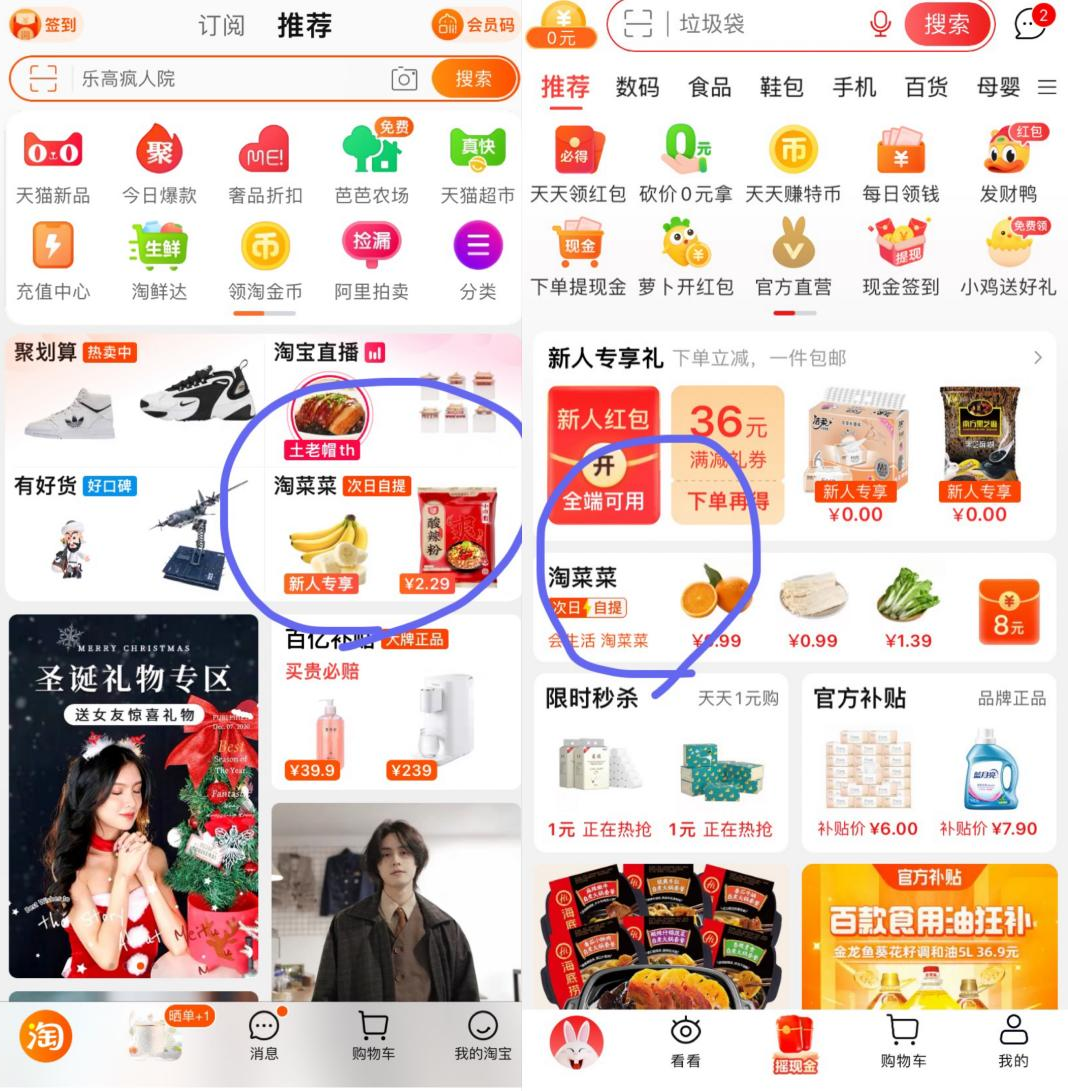
Left: Taobao App screenshot, Right: Taotee App screenshot
Taocai Cai and Taotee both originate from Alibaba's B-series. The organizational restructuring on December 26 and the integration with Taobao actually also involve B-C integration, which macroscopically conforms to the trend of accelerated integration of consumer internet and industrial internet.
Conclusion
Unlike other integration cases, Alibaba's clear 'trident' tactic of 'three Taos' is the result of multiple reasons coming together.
Internally, Alibaba is undergoing a process of "connecting and self-connection" - integrating blockchain; externally, WeChat external links are gradually opening up, and Alibaba is also seeking guidance from PDD. In short, in the context of internet interconnection, the internet industry will all open up and enter a relatively fair competitive situation.
With PDD and Taocai's return from exploring the sinking market, forming a trident pointing to the sinking market with Taobao, the three will become a new form of Alibaba's "China Digital Commerce Sector", continuing the "swift organization" formed by Alibaba's large and middle platform.
In the words of Dai Shan, "Only through innovation in technology and mode, creating resonance and win-win situations of business value and social value, can we open up greater imagination space for the future of the sinking market".
Article by Wen Yehao Wang Pan
Editor | Wang Yan | Wu Xianzhi
$Alibaba (BABA.US)$$BABA-W (09988.HK)$$Alibaba Ecosystem (LIST2118.US)$
$Alibaba (BABA.US)$$BABA-W (09988.HK)$$Alibaba Ecosystem (LIST2118.US)$
Risk Disclaimer: The above content only represents the author's view. It does not represent any position or investment advice of Futu. Futu makes no representation or warranty.Read more

Comments
to post a comment
1
8