
Overseas Major Real Estate Sector Weekly Report: How Should We View the Current Moment in the Real Estate Development Industry and Its Related Sub-Sectors?
Vanke A and Binjiang Group have disclosed their third-quarter reports. Vanke has seen revenue growth without corresponding profit growth, with a sharp decline in gross margin; by contrast, Binjiang has benefited from rapid sales expansion and effective cost-control measures, sustaining robust earnings growth. On October 29, Vanke A released its third-quarter financial results, reporting revenue of RMB 104.37 billion for the period, up 9.7% year on year, but net profit attributable to shareholders of RMB 5.64 billion, down 23.3% year on year. In the first three quarters of this year, Vanke's cumulative revenue reached RMB 271.49 billion, up 12.4% year on year, while net profit attributable to shareholders totaled RMB 16.69 billion, a 16% decline from the same period last year. On the same day, Binjiang Group also released its third-quarter report, showing revenue of RMB 5.05 billion for the period, up 94.8% year on year, and net profit attributable to shareholders of RMB 60 million, up 144.7% year on year. For the first three quarters of this year, Binjiang's cumulative revenue stood at RMB 24.44 billion, up 89.4% year on year, with net profit attributable to shareholders totaling RMB 1.32 billion, a 49% increase over the same period last year.
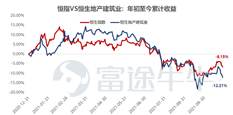
Affected by the anticipated large-scale pilot program for the property tax and the continued deterioration of the fundamentals in the development sector, nearly all major real estate–related sectors plunged. On the policy front, on October 23, the Standing Committee of the 13th National People's Congress adopted a decision authorizing the State Council to conduct pilot reforms of the property tax in selected regions. On the fundamental front, industry sales have declined sharply at the margin, the land market continues to cool, and the growth rate of nationwide real estate investment and development has been declining for seven consecutive months. As a result of these factors, major real estate–related sectors mostly fell this week: the SW Real Estate Index and the Hang Seng Property & Construction Index dropped 8.1% and 6.1% week-on-week, respectively; leading A-share developers such as Vanke A and Poly Development plunged 14.6% and 8.4% week-on-week, respectively; while leading Hong Kong-listed developers—including Sunac China, China Overseas Land & Investment, Country Garden, Longfor Group, and China Resources Land—saw week-on-week declines of 14.8%, 7.8%, 10.4%, 5.1%, and 10.2%, respectively. The real estate brokerage sector, as measured by Beike, Wo Ai Wo Jia, and E-House Enterprise Holdings, plummeted 27.1%, 9.7%, and 16% this week, respectively. The Hang Seng Property Services & Management Index, which tracks the performance of the property management sector, also fell by 10.6%. In addition, Greentown Management Holdings, a leader in the project-construction-management sector, posted a modest gain of 2.1% this week.
This Week's View
Industry regulatory policies are the main driver of the large-cap property sector, and the alpha of listed companies in this sector is significantly constrained by the sector's beta.Therefore, although valuations in the real estate development sector are already at historic lows, without a significant easing of regulatory policies, valuation recovery will remain elusive, and the sector is unlikely to stage a genuine rebound. Moreover, driven by factors such as company-specific credit risk levels, financing capabilities, the degree of business diversification, and the share of recurring earnings, divergence in future prospects and stock performance among developers will continue to widen. We believe that property companies with strong financing advantages, low credit risk, a solid core development business, and well-developed diversified operations will increasingly attract market favor. By contrast, firms facing credit risks or potential liquidity crises, as well as those focused solely on real estate development, are likely to remain out of favor with the market.In summary, for the real estate development sector, we believe that in the era of existing stock, large opportunities are unlikely to emerge for pure-play developers. Only a small number of well-managed, financially resilient, diversified, and high-recurring-margin integrated developers—such as Longfor Group and China Resources Land—are likely to present structural investment opportunities.As for the vast majority of property developers that focus on their core real estate development business, their stock prices will be difficult to recover in the short term unless regulatory policies ease significantly.
From a sector perspective, we remain firmly bullish on property management and construction-on-behalf-of others, while continuing to be bearish on the real estate brokerage sector.The core rationale is that the property management industry remains in a phase of rapid growth and exhibits low industry concentration, affording high-quality property management firms substantial room for expansion. Moreover, with respect to the key metric of pipeline versus assets under management, most property management companies are still expected to deliver robust earnings growth over the next three years. As for the project-construction-management (PCM) sector, it stands to benefit markedly from its counter-cyclical nature—namely, the broad demand for PCM services driven by the downturn in the real estate development industry. Finally, the primary bearish thesis on the real estate brokerage segment hinges on the near-certainty that the industry's future growth potential will be constrained, coupled with the likelihood that regulatory policies targeting the existing housing stock will remain tight.
Investment Recommendation
We are structurally bullish on a small number of well-managed, diversified, and high-performing integrated property developers.In addition, we recommend that investors continue to monitor high-quality property management firms with strong external expansion capabilities, as well as leading project-construction-management companies that benefit from their counter-cyclical characteristics.
Risk Warning
Real estate regulatory policies continue to tighten beyond expectations


Risk Disclaimer: The above content only represents the author's view. It does not represent any position or investment advice of Futu. Futu makes no representation or warranty.Read more

Comments
to post a comment
6
10