

Start a new paradigm! Digital Life Systems: The Path to Future Healthcare
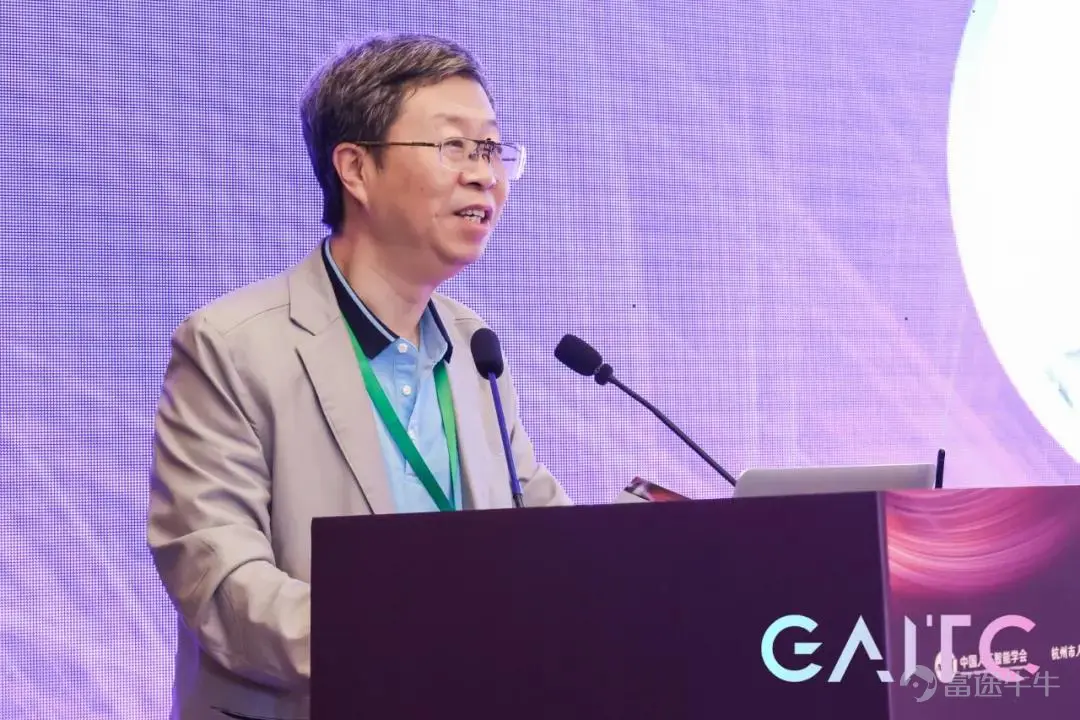
Recently, the 2021 Global Artificial Intelligence Technology Conference (GAITC 2021) was held in Hangzhou. At the “Digital Life and Smart Health Forum” co-chaired with Mr. Xu Jiming, co-founder of Yidu Technology Group and CEO of Happy Life Technology,duringDirector of the National Artificial Intelligence Society (CAAI) Bioinformatics and Artificial Life Special Committee、Department of Automation, Tsinghua UniversityProfessor Zhang XuegongHe said that building a mathematical model of life on the basis of data knowledge is a new paradigm for future life science research and healthcare practice, and can provide solutions for future intelligent healthcare. “Digital life systems will become a new paradigm for future research and healthcare practices. This new paradigm will facilitate upstream and downstream cooperation and organic connections in the smart medical industry, and form a medical ecological industry chain with deep integration of government, industry, academia, research, and medicine.” Seo Ji-ming Observation Trail。
Build a digital-based life system to advance life cognition through numbers and mathematics
With the development of information technology and science, most industries use informatization and intelligent technology in decision-making, from virtual deduction, experiments, and model construction to actual production, making decisions more efficient and accurate. However, in the medical industry, due to problems such as insufficient acquisition of human information, insufficient quantitative understanding of human mechanisms, and inadequate methods for presenting life knowledge, medicine cannot effectively combine information science, intelligence science, and life science in clinical decision-making, and still mainly relies on doctors' “naked intelligence.”
What is the reason for the problem of not being able to make effective use of it? Professor Zhang Xuegong said that from the perspective of life mechanisms, in life science research and health care practice, from scientific discovery, to the transformation and application of usable technology, to the clinical popularization and implementation of usable technology, to the effective benefit of patients, the transformation and application of accessibility between every link has been drastically reduced to varying degrees. The current situation where this healthcare model is unsustainable needs to be addressed urgently. At the same time, it will also face three core challenges in practice: 1) accurate, comprehensive, and easily popularized life observation; 2) understanding life through cross-level relationships and quantitative mathematical models; and 3) effectively presenting life and health knowledge to patients.

Therefore, in the medical field, it is necessary to improve the quantitative understanding of complex life phenomena and laws in order to further establish a mathematical model of life, that is, a digital-based life system. Digital-based life systems are artificial life in digital and mathematical spaces. They can reproduce various physiological and pathological processes and phenomena in human tissues, organs, and the whole body from the micro to the macro level. Through data sensing and digital representation of life, digital-based life systems achieve digital understanding of life mechanisms from micro to macro, construct digital models of all dimensions of “living” human systems, simulate individual health and disease occurrence and development processes, and achieve accurate and intelligent medical care on the basis of individualized digital twins.
Of course, modern clinical medical testing technology, understanding of life mechanisms, the degree of medical big data development and application, and the degree of medical intelligence all have a long development process, and digital-based life systems cannot be achieved overnight. Although the establishment of a complete digital-based life system is still a long-term goal and plan, this path will effectively bring together advanced technologies, ideas and achievements in various fields of clinical, industrial, and scientific research to lay the foundation for the high-quality development of a new ecological smart medical industry.
Digital-based smart healthcare promotes the development of the smart healthcare industry
The only standard for testing truth is practice. The digital life industry, based on the theory of digital life systems, is a further upgrade from traditional digital medicine, smart health, etc. It is also a new industrial ecosystem created by organically connecting many industrial elements such as life information sensing, data collection and management, basic life science research, mathematical modeling and simulation, medical knowledge maps, medical health data machine learning, artificial intelligence assisted medicine, etc. through digital life systems.
Professor Zhang Xuegong believes that by constructing digital virtual life models that reproduce and deduce various physiopathological processes from micro to macro, establishing individualized digital twins for each person and a new healthcare paradigm based on digital twin deduction, and realizing digital-carbon-based coupling R&D and virtual population testing of personalized drugs and treatment plans, it will lead the future development of intelligent medical health management, intelligent precision medicine, and intelligent healthcare industries.

Speaking about the development blueprint, during the round table on “The Opportunities and Challenges of Data Intelligence in Healthcare”, Yan Jun, the chief artificial intelligence scientist of Yiduyun, said that in the next ten years, he shared the expectations of Professor Zhang Xuegong, and they all hoped that the relationship between humans and diseases could be effectively improved. This was also the mission Yiduyun upheld at the beginning of its establishment — to make precision medicine more accessible and valuable. Starting with thousands of high-rise buildings on the ground, we still need to get down to earth and help medical institutions solve problems such as data governance, joint security modeling, and implementation application scenarios through AI technology. We need to gradually form a setA relatively complete system process.

In the future, Yiduyun will also actively explore breakthroughs in core artificial intelligence technology in a new paradigm of research and healthcare practice, empower the medical industry with numerical intelligence, help transform clinical diagnosis and treatment and scientific research results, adhere to the mission of “making value-oriented precision medicine benefit everyone”, and further help promote the construction of a healthy China 2030.
Risk Disclaimer: The above content only represents the author's view. It does not represent any position or investment advice of Futu. Futu makes no representation or warranty.Read more

Comments
to post a comment
2