
The national standard for micro low-speed electric vehicles is about to be implemented—could the Wuling Hongguang MINI become the new way forward for "senior mobility vehicles"?
In recent years, in addition to bicycles and two-wheeled electric scooters, it has become increasingly common to see elderly people driving four-wheeled electric vehicles with their grandchildren in tow. Because the drivers are generally quite elderly, these vehicles are often referred to by other names—such as "old man's fun" or "senior mobility scooter."
These senior mobility scooters do not require a driver's license and are easy to operate, making them a favorite among many older adults. However, improper driving by operators has earned them widespread disapproval. With the growing popularity of electric vehicles and the increasing number of senior mobility scooters on the road, the unregulated market for these vehicles has now drawn the attention of regulatory authorities.
On June 21, the Ministry of Industry and Information Technology officially launched a public consultation on the draft recommended national standard "Technical Requirements for Pure Electric Passenger Vehicles" (hereinafter referred to as the "Requirements"), which, for the first time, classifies elderly mobility vehicles as a subcategory of pure electric passenger vehicles and sets out corresponding technical requirements.
"Road Killer" Old-Electric-Go-Kart
Until the relevant standards and regulations were issued by the regulatory authorities, the legal status of senior mobility scooters remained highly ambiguous. Many owners of such vehicles believe that allowing them on the road only adds to traffic congestion—a view that is not entirely unfounded. Although many children purchase these scooters for their elderly parents with the intention of making their daily commutes easier, in practice, once these vehicles are on the road, they often cause considerable inconvenience for both drivers and other road users.
These elderly mobility scooters look much like cars, but they have long been plagued by numerous problems. First, they don't require license plates; second, most seniors neither hold a driver's license nor are able to obtain one; and third, these vehicles aren't particularly fast. As a result, many older adults frequently cruise along the roads in such vehicles at a leisurely pace, virtually ignoring traffic rules—especially on narrow streets—often driving car owners who follow behind them to sheer exasperation.
Moreover, because there are no established standards for senior mobility scooters and the primary users are elderly people, manufacturers often prioritize price over quality, resulting in subpar product safety. Many models are essentially converted electric tricycles—four wheels added to an existing frame with a new body shell. As one netizen put it: "The metal outer shell on these 'old-man cars' has nothing to do with safety; its sole purpose is aesthetics."

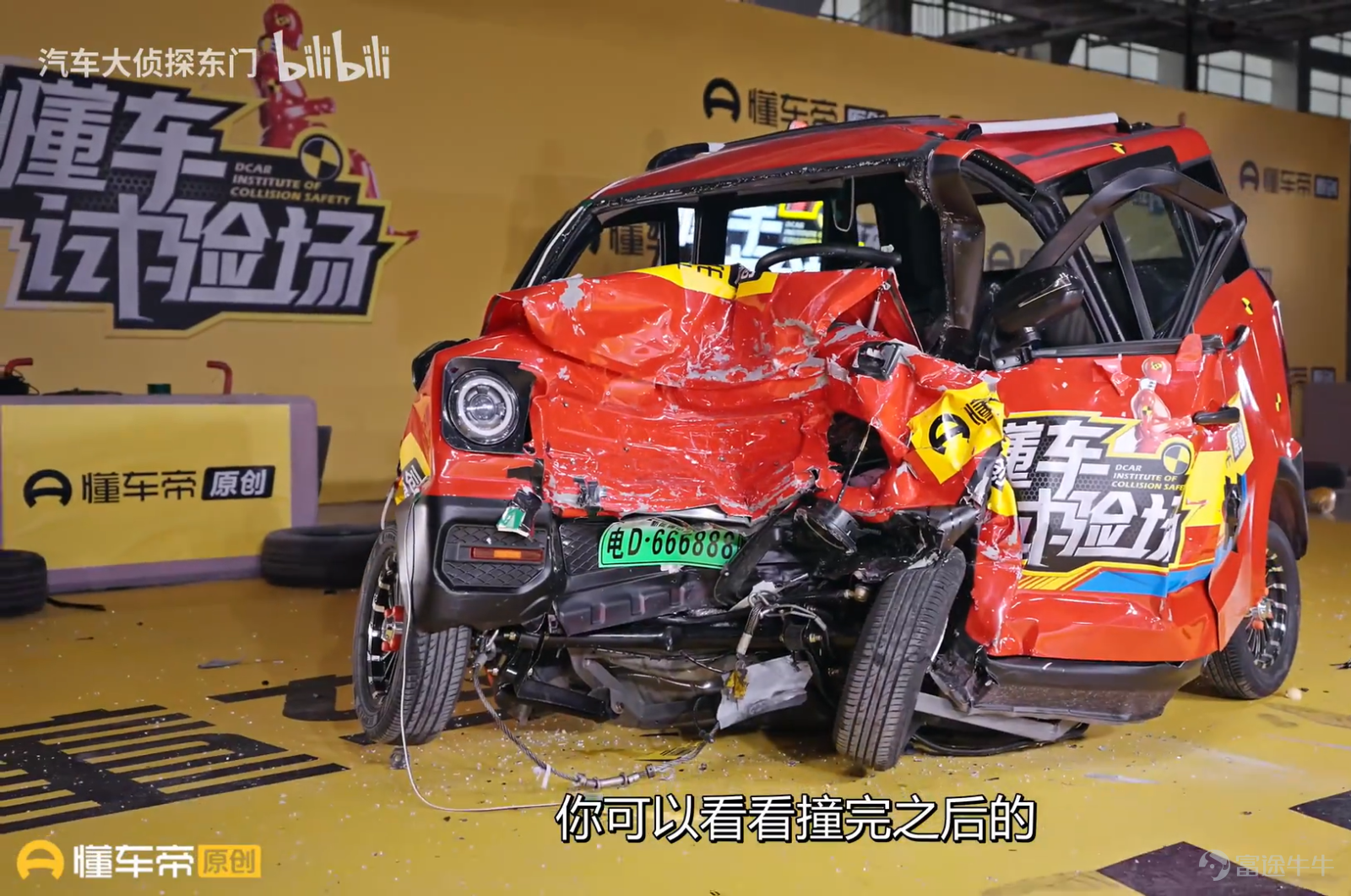
According to crash tests on elderly mobility vehicles released by Autohome, the collision between the "Lao Tou Le" and the Wuling Hongguang MINI EV resulted in the entire front end of the vehicle being completely crushed, leaving the wooden dummy in a total wreck. "It doesn't have any real vehicle structure—no longitudinal beams, no anti-collision beams, no energy-absorbing boxes. It's simply not a car at all," an Autohome tester commented on the structural design of such vehicles.
Cui Dongshu, Secretary-General of the Automotive Market Research Branch of the China Automobile Dealers Association, stated in a media interview that, based on incomplete statistics, there are currently nearly 300 manufacturers of low-speed electric vehicles in China, with an annual production capacity of around 2.6 million units. "Many people choose low-speed electric vehicles precisely because they are convenient to use and do not require license plates; however, this also poses certain safety risks for quality control in the market."
As the new regulations governing senior mobility scooters are gradually implemented, these vehicles will soon be subject to national standards.
Can national standards address the "time bombs" on the roads?
In the "Regulations," senior citizen mobility vehicles are classified as micro low-speed electric vehicles under the category of all-electric passenger cars. By definition, only all-electric vehicles with four seats or fewer and a maximum speed of less than 70 km/h qualify as this type. However, popular models on the market such as the Wuling Hongguang MINI and the ORA Black Cat, which are both micro electric vehicles, have maximum speeds exceeding 100 km/h, clearly failing to meet this criterion. In contrast, senior citizen mobility vehicles generally have maximum speeds no higher than 50 km/h and thus mostly fall into this category.
The "Requirements" also, for the first time, set production standards for "old-man cars." Although these standards are considerably more lenient than those for other types of battery electric vehicles, they nonetheless cover every essential requirement. In terms of specifics, the "Requirements" not only stipulate limits on the vehicle's dimensions, weight, and tires, but also impose requirements on battery safety, braking performance, stability, and overall reliability.

The "Requirements" explicitly stipulate that vehicles must be manufactured in accordance with approved drawings and design documents following the prescribed procedures, and that their batteries, like those of other all-electric models, must comply with national mandatory standards. In terms of crash safety, vehicles are required not only to be equipped with three-point seat belts but also to undergo corresponding crash tests.
From development to production, this regulation covers most of the problems associated with "laotoule" vehicles. Although the standard is still in the public-comment stage, its successful implementation would undoubtedly rectify the current disorder in the laotoule market, significantly reduce the prevalence of illegal, unlicensed workshops, and ensure that laotoule vehicles no longer pose a major headache for regulatory authorities.
Industry insiders believe that the upcoming national standard for micro low-speed electric vehicles will formally bring these vehicles under standardized regulatory oversight, providing a solid legal basis for relevant authorities at all levels and local governments to carry out their respective responsibilities. This will foster the industry's orderly and compliant development.
However, at present, while issues related to products can be resolved, problems associated with drivers persist. The core issues remain: these vehicles do not require registration or a driver's license, and drivers often disregard traffic laws, acting as they please on the road. Unless the driver problem is addressed, "old-man cars" will continue to pose significant risks on the streets. That said, with the implementation of national standards, it may eventually become inevitable for these vehicles to be registered and insured.
The Transformation Journey of "Old Man Fun"
If the "old man fun" vehicle sector aims to transform, the outlook appears promising, as there are already precedents in the market.
Recently, the automotive industry has been abuzz with news that the Wuling Hongguang MINI has clinched the title of the world's best-selling new-energy passenger car for April. According to the latest data from market research firm EV Sales, the Wuling Hongguang MINIEV secured the top spot with sales of 29,251 units in April this year.
In fact, the explosive popularity of both "old-man cars" and the Wuling Hongguang MINI highlights the booming domestic micro-vehicle market. From a product perspective, both share similar characteristics: affordability and convenience.
From a practical standpoint, both the "old man's car" and the Wuling Hongguang perfectly meet the needs of urban residents. As family commuter vehicles, they handle everyday travel with ease, catering to users' commuting, picking up and dropping off children, and leisure outings in and around the city—plus, they're ready to go with just a charge, and their routine maintenance costs are low.

In terms of price, "old-man cars" generally cost no more than 30,000 yuan, and the Wuling Hongguang MINI's official suggested retail price falls within roughly the same range, at 28,800 yuan to 43,600 yuan—with the most expensive model not exceeding 100,000 yuan.
With its affordability and ease of use, it's only natural that the "old man's joy" and the Wuling Hongguang MINI have enjoyed strong sales. However, compared with the "old man's joy," the Wuling Hongguang MINI offers clear advantages in terms of safety and compliance with regulatory standards. That said, the downward pressure on prices has also created a challenge: the Wuling Hongguang MINI still falls slightly short when it comes to safety.
In the vehicle tests conducted by Dongchedi mentioned earlier, although the Wuling Hongguang MINI performed better than the "old-man car" in terms of overall structural integrity, it still suffered multiple damages. After all, safety is only relative: while the Wuling Hongguang MINI can meet national standards, its performance is largely constrained by cost, making further improvements difficult.
Overall, affordability and ease of use are the hallmarks of this type of micro electric vehicle. However, precisely because of the emphasis on low cost, the vehicles' reliability tends to lag slightly behind other models. That said, given the current state of the "old-man's bike" market, following Wuling Hongguang MINI's lead may well be a smart move. After all, the price tag speaks for itself: as the saying goes, "At this price, who needs a bicycle anymore?"
Risk Disclaimer: The above content only represents the author's view. It does not represent any position or investment advice of Futu. Futu makes no representation or warranty.Read more
Comments
to post a comment
2