Share the A-Share stocks you're optimistic about

The Time to Position in A-Shares is Now: Dual Benefits from Strong RMB Appreciation and Asset Revaluation
In the past week, the A-share market has been very active. On May 25, the Shanghai Composite Index surged by 2.4%, marking the largest single-day increase in the past seven months. In the following three trading days, it strongly broke through the 3,600-point mark.
$CSI 300 Index (000300.SH)$The index also showed strong performance, with a weekly gain of 3.64%. It has rebounded significantly from the post-Chinese New Year adjustment and is approaching the historical highs seen during the major bull markets of 2007 and 2015.
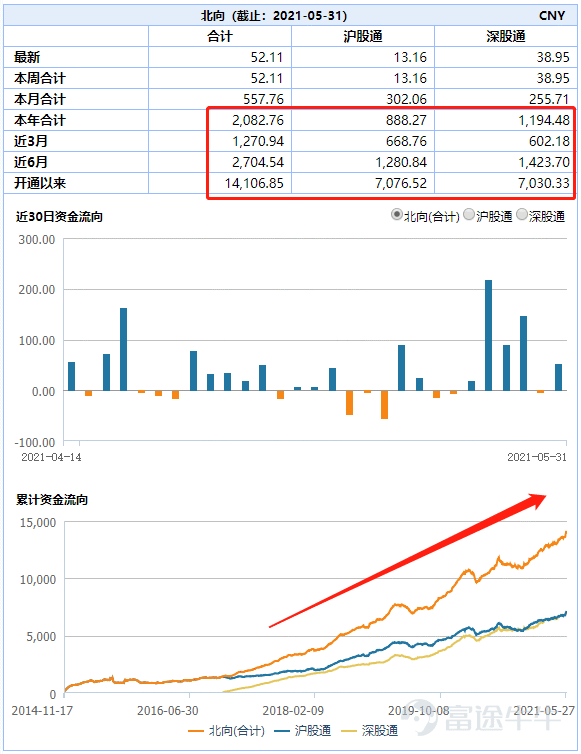
The surge in A-shares is closely related to the significant increase in positions by northbound funds. According to Wind data, during the week from May 24 to May 29, northbound funds had a total net inflow of 46.8 billion yuan, including a single-day net inflow of 21.7 billion yuan on May 25 when A-shares surged, setting a new record for the highest single-day net inflow since the launch of the Stock Connect program.

Strong appreciation of the RMB may help rebuild a bull market for A-shares
The most direct factor driving the substantial increase in positions by northbound funds, which represent foreign capital, is the appreciation of the RMB.
On May 25, the offshore RMB exchange rate against the US dollar broke through 6.4, hitting a new high since June 2018. The integer thresholds in the foreign exchange market are particularly important. Attempts were made to challenge the 6.4 threshold at the beginning of 2021 and in February, but they failed to break through.
Under the combined influence of internal and external factors such as the decline of the US Dollar Index and China’s high trade surplus, the RMB exhibited a phase of strength this time, breaking through 6.4 and subsequently touching 6.3525.
From a slightly longer-term perspective, the appreciation of the RMB is a result of China's macroeconomic fundamentals. The upward trend in the RMB exchange rate against the US dollar started at 7.19 in May 2020.

Due to China’s rapid and effective control of the pandemic outbreak, domestic economic recovery was relatively quick. Meanwhile, the outbreak abroad stimulated a rapid increase in China’s export scale, leading to a significant expansion in the current account balance, supporting the continuous appreciation of the RMB.
In sync with the nearly year-long appreciation of the RMB, foreign capital represented by northbound funds has been continuously flowing into the A-share market over the long term. As of June 1, northbound funds have cumulatively net purchased 209.379 billion yuan this year, surpassing the net purchase amount of last year.
Regarding the future trend of the RMB exchange rate and its impact on China's economy, Ling Peng from Prairie Asset Management believes:
The current appreciation of the RMB may be somewhat different from what it was fifteen years ago. This time, it is likely to appreciate against all major currencies worldwide because China’s economy is in the best shape and has been least affected by the pandemic.
Appreciation is currently the best choice. On one hand, there is no need for domestic tightening to suppress aggregate demand, and on the other hand, it can temporarily cut off imported inflation.
Moreover, the biggest fear of appreciation—harming export competitiveness—is temporarily not an issue, as the demand from first-world countries has gradually recovered, while the supply from third-world countries still lags behind, giving China a unique opportunity.
According to a Guotai Junan report, the RMB appreciation alleviates cost pressures from raw materials, weakening market concerns about inflationary pressures, while the upward trend in corporate earnings remains unchanged. The market adjustment after the Spring Festival, whether in terms of magnitude or duration, has already been fairly sufficient, and the A-share market will welcome a 'bull market reconstruction.'
Foreign capital inflows in the next three to five years may exceed one trillion yuan.
Regarding the future trend of foreign capital inflows, Industrial Securities stated that, amid global liquidity easing, China, having recovered earliest from the economic downturn, boasts overall fundamentals and allocation proportions that are more attractive to foreign capital, supporting our long-held view that the world's best assets are in China's stock market. This year, foreign capital inflows are expected to reach 200-300 billion yuan—a view that has been validated by the market—and over the next three to five years, we expect foreign capital inflows to continue at a scale of one trillion yuan.
Wang Ying, Chief Market Strategist at Morgan Stanley China, stated:
Even during the significant market adjustments in February and March this year, northbound funds maintained a positive inflow trend. In fact, since last year until now, northbound funds have maintained an inflow trend for quite some time, although this trend has recently become particularly strong.
Since the launch of the Stock Connect mechanism in 2014, northbound funds have mostly remained in an inflow state. From a long-term momentum perspective, we are very confident in the continued inflow of northbound funds, and the proportion of foreign holdings in the A-share market will continue to increase.
Looking ahead, A-shares also attract foreign capital inflows in terms of relatively lower valuations and being less impacted by anti-monopoly measures. Morgan Stanley's recent research report highlighted a more positive view on the A-share market for three main reasons:
First, relative valuation attractiveness. The current 12-month forward P/E ratio for A-shares is 14.7x, which is 5% lower than that of the MSCI China Index, which includes US-listed Chinese stocks and Hong Kong stocks.
Second, minimal exposure to sectors affected by regulatory uncertainties (Internet, fintech, and education account for less than 2% of the CSI 300 Index but represent 46% of the MSCI China Index), meaning the impact of anti-monopoly measures on A-shares is almost negligible.
Third, it is expected that more market reforms will be carried out in the coming years to improve the accessibility and investability of A-shares, especially for institutional investors.
Moreover, international indices continue to increase the weighting of A-shares. Prominent global indices like MSCI and FTSE Russell have been progressively raising the weight of A-shares, demonstrating the growing attractiveness of China’s core assets to foreign capital.
The CSI 300 Index continues to climb as asset revaluation is underway.
In recent years, continuous foreign capital inflows have led to significant gains. The CSI 300 Index, which best represents the overall performance of the A-share market, has had two consecutive bullish years: rising 36% in 2019 and 27% in 2020, outperforming the Hang Seng Index in recent years.

The yellow line represents the CSI 300, and the purple line represents the Hang Seng Index.
Regarding this year’s A-share market trend, Guotai Junan recently made a clear statement, predicting a "challenge to reach 4,000 points." Huang Yanming, head of Guotai Junan Research Institute, pointed out that volatility won’t last long, and the market will rise. After six years of dormancy, the Shanghai Composite Index will challenge the 4,000-point level, driven primarily by a decline in 'risk evaluation.'
Guotai Junan stated that within the 'waterfall' structure of global liquidity stratification, the United States and China are upstream and downstream, respectively. If the Fed continues to inject liquidity into the global economy while international capital expects the renminbi to appreciate, there will be more incremental inflows of foreign capital into the domestic market. Once renminbi-denominated assets such as A-shares and Chinese bonds form a 'profit effect,' it will further strengthen the inflow of foreign capital, thereby driving the revaluation of renminbi assets.
At the individual stock level, the revaluation of RMB assets is also evident. The core assets represented by the 'Mao Index' experienced a significant adjustment after the Lunar New Year this year, but have now rebounded to their early January levels, with some stocks hitting new highs.
For example, "battery straw"$Contemporary Amperex Technology (300750.SZ)$"Banking Mao"$China Merchants Bank (600036.SH)$For instance, recent record highs were set by 'Battery Mao', 'Banking Mao', and 'Waterproofing Mao' Dongfang Yuhong, while MGI Tech, Hikvision, Wuxi Apptec, East Money, and Aier Eye Hospital have all rebounded close to historical highs.

“True Mokushin”$Kweichow Moutai (600519.SH)$'True Mao' itself is only about 15% away from its historical high. Listed companies in the globally scarce liquor industry are also highly favored by northbound funds, such as Wuliangye Yibin, Luzhou Laojiao, and Shanxi Xinghuacun Fen Wine.
For investors in US and Hong Kong stocks, gaining exposure to A-share assets via Stock Connect is an attractive investment strategy, as it not only offers forex gains from the appreciation of the RMB, but also provides returns from the assets themselves.
Risk Disclaimer: The above content only represents the author's view. It does not represent any position or investment advice of Futu. Futu makes no representation or warranty.Read more


Comments (4)
to post a comment
6
1