
[Focus] Huawei HarmonyOS Press Conference[Focus] Huawei Harmony Press Conference
Can this Hong Meng's arrow that pierces the clouds call upon thousands of troops to help?

Produced by Pai Finance
Author: Wang Feishu Editor: Pai Gongzi
On June 2, 2021, Huawei's history was divided in two. Previously, Huawei was a communications equipment manufacturer and a smart terminal producer; after this day, Hongmong officially ushered Huawei into a new era as a system supplier and software service provider.
A new era is approaching, success or failure hinges on this move. Previously, Huawei has been facing severe crackdowns from the USA, including chip bans, Google suspending Android updates, ARM ceasing all cooperation... with the smartphone business bearing the brunt. In the first quarter of 2021, Huawei's global smartphone shipments fell out of the top five, landing in Others category, a year ago, Huawei's phones were ranked second globally. Recently, Yu Chengdong admitted that the four rounds of U.S. sanctions have made Huawei's consumer business very challenging.
Fortunately, with its solid foundation, Huawei's 'copper peas' weathered the storm when Google halted Android updates, unfurling the Hongmong flag, and continuously improving it over the next two years, finally officially launching it to the world today.
开创者?引领者?终结者?无论结果为何,华为在安卓、iOS湖面上投下的这枚石子,都将荡开移动互联网历史上最波澜壮阔的一章。
鸿蒙与安卓同源而出,各得其所
“鸿蒙到底是不是国产自主研发?”
这应该是鸿蒙历次消息后,好事者最为关心的话题。质疑者认为,鸿蒙OS就是安卓系统套了个皮肤;支持者认为,谷歌至今都没有指控鸿蒙OS抄袭,自主无疑。其中,持第二种观点的就包括魅族前CEO李楠,他表示鸿蒙被黑得莫名其妙,没有哪个系统生来就该是凭空出世,实力为鸿蒙OS站台。
鸿蒙第一次出现在公众视野应追溯到2019年5月美国将华为列入“实体清单”之后,谷歌开始逐步缩减对于华为的服务范围。当年8月9日,华为正式发布HarmonyOS,同时余承东宣布,HarmonyOS实行开源。
实际上,鸿蒙真正发端却是在2016年5月。美国对华为的制裁,加速了华为鸿蒙的研发迭代速度,2020年9月10日,华为HarmonyOS升级至HarmonyOS 2.0版本;今年3月31日,华为正式发布了鸿蒙Beta3.0版本,在随后20天宣布增加Mate X2、Mate 40等其他型号的HarmonyOS 2.0开发者Beta招募;6月2日,华为所有手机用户可以升级鸿蒙系统。
华为加速鸿蒙系统迭代研发,当然有受现实所困的因素,另一方面,相信华为也是对鸿蒙有着相当的自信。那么,与安卓相比,鸿蒙究竟有何不同?与当下的手机操作系统霸主叫阵,鸿蒙又有何优势?
首先从底层架构来看,鸿蒙在底层架构上采用了谷歌开源技术(AOSP),但又有独立之处。安卓系统是基于linux的宏内核设计,宏内核包含了操作系统绝大多数的功能和模块,而且这些功能和模块都具有最高的权限,采用Java语言编写,系统开发难度低。但这一方案的缺点也很明显:与系统底层通信需要虚拟机来实现,虚拟机是传递者,一旦出现问题系统就会卡住。
The kernel subsystem of the Hongmeng operating system is a design that mixes multiple kernels such as the Linux macro kernel, LiteOS kernel, and Hongmeng microkernel. It only includes necessary functional modules of the operating system (task management, memory allocation, etc.) in a core position with the highest authority. If other modules encounter problems, it will not affect the overall system operation, significantly improving system stability. The role of the Ark compiler in the Hongmeng system is to compile Android software, thereby communicating with the underlying system, meaning that the Hongmeng system, with the compiler, will replace the virtual machine.
These changes are reflected in the differences in compatibility and speed at the effect level. Harmony OS accesses at the operating system level, somewhat like traveling on the "main road," ensuring the reach rate and timely effectiveness of services; whereas Android accesses at the application level, which weakens the reach rate and efficiency. No wonder Yu Chengdong once "bragged" about Harmony OS: firstly, Harmony OS is compatible with all Android applications, and secondly, Harmony OS is 60% faster than Android. Recently, this statement has also been validated by users. Some netizens found in testing that the CPU and GPU performance of the MatePad Pro equipped with Harmony OS both surpass the same model equipped with EMUI 11 (Huawei's Android-based operating system).
In addition to compatibility with Android and responsiveness, Harmony OS 2.0 has also added a "super hardware" function. Through this function, rapid deep connections can be made with other Harmony devices to share hardware resources. Yang Haisong, the head of the Harmony ecosystem, previously stated that the "card" (interface) pulled up by a phone with Harmony OS is atomic-level, from the end side to the operation system's native functions. On the other hand, when an Android phone connects to a device, it is at the application level, achieved through continuous patch upgrades in a compatibility mode.
Such differences have turned the Hongmeng system into a distributed OS for all scenarios, capable of simultaneously supporting smart phones, smart wearable devices, computers, televisions, and other smart home devices, forming a seamless and unified operating system that is also compatible with all Android applications.Furthermore, leveraging deterministic engines and high-performance IPC technology can achieve inherently smooth system operation; reshape terminal device trustworthy security; support one-time development through unified IDs for multi-terminal deployment, promoting cross-terminal ecosystem sharing.
From the perspective of consumer user experience, the actual projection latency of Huawei smartphones and smart screens running EMUI 11 can be controlled to 30-90 ms, providing a nearly imperceptible experience.
It can be said that Hongmeng is a system truly adapted to the current 5G and Internet of Things era. Taking various IoT products commonly seen in daily life, such as smart screens, Bluetooth speakers, robotic vacuum cleaners, smart watches, as examples, under the Hongmeng system, all you need is a single Huawei ID account to quickly pair them. Even if disconnected, there is no need to re-pair. You can even directly drag and drop on the device center card page to complete the pairing. Control a microwave or refrigerator with a smartwatch, continue watching unfinished TV shows from a smart screen in the car, play mobile games on the smart screen... These highly futuristic scenes, under the Hongmeng distributed OS, can be easily achieved with a simple touch of IoT devices.
From this perspective, Hongmeng and Android are not just simple competitors but two application systems with intergenerational differences, originating from the same source but ultimately taking different paths.
Hongmeng has opened the window to the future for Huawei.
At the time when Google cut off the supply, Huawei's self-developed Hongmeng system undoubtedly bears a special important responsibility, which is also the most important significance of Hongmeng for Huawei smartphones at present.
Relying on strong product capabilities, Huawei has already become the world's second largest mobile phone manufacturer in 2020. Recently, Yang Haisong stated that Huawei currently has over 0.73 billion Huawei mobile devices worldwide. Combining research data such as the continuous extension of the phone replacement cycle, he believes that Huawei phones will not disappear in the short term. Although phones will not disappear in the short term, the shadow of Google GMS (the developer service package on which most Android applications are based) always exists - Huawei's operating system and ecosystem face huge threats. Therefore, in order to ensure the normal use of mobile phone users and minimize system risks, Huawei has successively launched HMS and Hongmeng system.
From the current perspective, in terms of the HMS ecosystem, in early 2020, Huawei implemented the Shining Star program with a value of 1 billion US dollars globally to encourage partners to join the HMS ecosystem for innovation. As of September 2020, there were over 1.8 million developers, 0.096 million applications, and over 0.49 billion active users. HMS has successfully entered the market. The Hongmeng system has undergone several iterations over the course of 2 years and was officially launched on June 2nd.
The significance of Hongmeng for Huawei goes far beyond independent system and user experience. The software services business derived from the Hongmeng system will also bring new growth opportunities for Huawei. Taking Apple's software service business as an example, this business includes App Store, Mac App Store, Apple Music, Apple Pay, AppleCare, Apple TV+, iCloud, and other subscription services, with a user base of 0.62 billion. This business generated 15.8 billion US dollars in revenue for Apple's services market in Q1 2021, compared to 12.7 billion US dollars in the same period last year.
More importantly, software service revenue does not fluctuate with changes in hardware sales. Huawei can obtain continuous revenue through deeply customized software licensing and channel commissions, making it the best breakthrough for Huawei's current business growth.
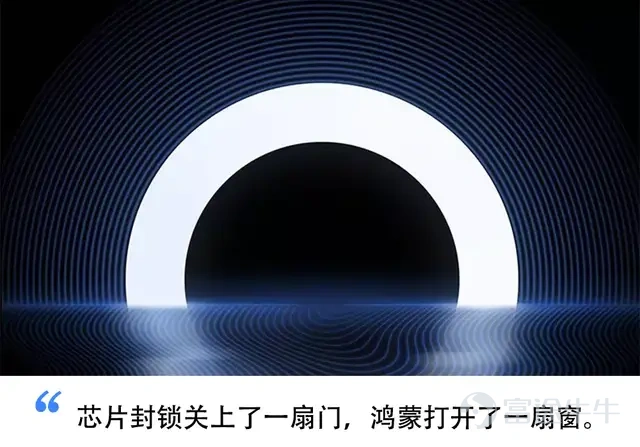
The chip blockade closes a door, while Hongmeng opens a window.
On May 30th, Ren Zhengfei called on company employees to "dare to lead the world in the field of software," which has "greater independence and autonomy," as the company seeks growth beyond hardware business. He stated that due to external restrictions, it is difficult for Huawei to produce advanced hardware in the short term, so the focus should be on building software ecosystem like the Hongmeng operating system, the all-scenario AI computing framework Mindspore, and other IT products.
In this way, Huawei will be able to overcome the business risks caused by chip blockade, invest more efforts in basic software layers such as databases, compilers, and even programming languages, continue its business through Hongmeng OS, and become a crucial participant in the process of China's national software and service industry.
Lastly, and most importantly, although Hongmeng system was launched to solve immediate system needs, its ultimate mission is to become an operating system for the interconnected future era.Hongmeng system was officially launched in 2016. At that time, key indicators such as monthly active users of mobile internet, growth of mobile devices, usage time of mobile apps, and user experience of single devices had peaked. The future communication form required a new operating system to address the needs. Therefore, Google and Apple also initiated the next-generation operating system projects around that time, although the progress of both slightly lagged behind.
Of course, Huawei also has another consideration, 'When Huawei's terminal achieves $100 billion in revenue, we realize that the roots of our ecosystem are not in our hands, and the risk is too great.' Huawei's senior management revealed.
Based on this, Huawei positioned Hongmeng as an operating system for the Internet of Things. 'We hope to solve the problem of all IoT hardware devices running on a single operating system. Hardware manufacturers do not need to cut or find a new system installation when producing different hardware.' According to Wang Chenglu, President of Huawei's Consumer Business Software Department, HarmonyOS provides a distributed programming framework for all developers, allowing everyone to write business logic in their familiar high-level language and run it on all devices with just one write, thus maximizing the sharing of the ecosystem on isolated devices.
Wang Yunhou, Deputy General Manager of CCID Consulting's Software and Information Services Industry Research Center, believes that the distributed characteristics of Hongmeng system have a clear direction - the Internet of Things. In theory, Hongmeng can naturally distribute applications on smartphones to all terminals, which indeed addresses some pain points of current IoT devices.
Currently, some of Huawei's smartwatches, smart screens, and smart automobile products have already adopted HarmonyOS. Now with the addition of mobile devices, the rapid deployment of Hongmeng across all terminal devices is accelerating. This comprehensive deployment of Hongmeng to mobile devices will undoubtedly bring new and critical opportunities to Huawei's IoT strategy, considering that almost all application ecosystems are currently based on the extension of the smartphone platform.
Ecology and time, Hongmeng needs to cross the line between life and death.
Despite its forward-looking and quite good system performance, it is difficult to be optimistic about whether Huawei Hongmeng can carve out a path in the current operating system landscape.
In history, many manufacturers have launched their self-developed mobile operating systems, including Nokia, Microsoft, Blackberry, Samsung, LG, as well as domestic BAT, all have dabbled in this field. However, it can be seen from the results that the successful ones are only Google's Android and Apple's iOS. The other systems have not escaped the fate of failure, and the word 'ecosystem' is the primary reason.
Huawei's Consumer Business AI and Smart All-Scenario Business Deputy General Manager Yang Haisong expressed, 'Developing an operating system is just a drop in the bucket, with completion being only 1%; the remaining 99% depends on how many industry partners are willing to adopt your platform.' He believes that the biggest challenge of the Hongmeng system is the time and scale gap, giving only one to two years for the construction of the China Internet-of-Everything software platform or ecosystem.
After years of development, Huawei has accumulated a sufficient number of user cohorts and device ownership. Huawei previously estimated that by the end of 2021, the number of devices equipped with the Hongmeng operating system would reach 0.3 billion, with Huawei devices exceeding 0.2 billion.
However, this is still far from enough. To achieve the promotion of the Hongmeng Internet of Things system, it is necessary to collaborate with as many external manufacturers as possible to build the ecosystem. In September 2020, Huawei stated that products related to the 1+8+N full-scenario strategy have plans to start deploying the Hongmeng system. Among them, 1 stands for smartphones, 8 for Huawei large-screen devices, and N for third-party partners' IoT devices. According to the plan, in 2021, Huawei will cooperate with more than 40 mainstream brands such as Midea, Joyoung, Hangzhou Robam Appliances, and Haier Smart Home to cover over 0.1 billion third-party devices with the Hongmeng system.
However, Huawei still faces a great challenge to ensure the survival of the Hongmeng system, especially in the highly valued smartphone sector. Wang Chenglu stated in a media interview in January of this year, 'We have analyzed the ecological development of the PC and mobile industries over the past twenty years and found that 16% market share is a watershed, where ecological success is basically achieved if it exceeds 16%.' 'So my goal for this year is to increase the market share of the Hongmeng ecosystem to 16%. We must cross this watershed for the ecosystem to thrive.'
The real difficulty lies in the fact that currently, Huawei's smartphone ownership globally accounts for about 15%, and smart wearable devices of 92 million account for approximately 8.69%. Considering that some older models cannot be upgraded to the Hongmeng system, Huawei currently faces immense pressure to achieve the goal of a 16% market penetration globally with its own devices.
Especially for the overseas market, after Google and Apple isolated Huawei, due to the heavy reliance of overseas consumers on the two companies, the internationalization of the Hongmeng system is unlikely to perform outstandingly in the short term. Moreover, the challenge for Huawei to complete the 5-7 year journey of other systems and rapidly increase ecosystem adoption within the 1-2 year window after 2021 is even greater.
To achieve this goal, huawei's own smartphones are obviously not enough. In order to accelerate ecosystem development, in addition to opening up battlefields for IoT manufacturers, huawei issued invitations to other smartphone manufacturers at the beginning of hongmong's announcement, hoping to participate in ecosystem co-creation. However, this wish is not easy to achieve. A major domestic small and medium-sized smartphone manufacturer mainly engaged in overseas markets stated that smartphone manufacturers are seeing some potential risks. They are adopting a wait-and-see attitude, and some are even resistant.
The above-mentioned manufacturers stated that usually, OS, chips, and smartphones need to be adapted. Over the years, the default cooperation relationship between Android, chip manufacturers, and smartphones through adaptation has kept the cost of OS on smartphones relatively low. In addition, increasing the corresponding software R&D team, overseas user acceptance of hongmong, and the damage caused to their own brands by using competitor systems are also important concerns. Born out of huawei, its CEO, Zhao Ming, recently stated that currently Android is still the first choice for honor, but the possibility of using hongmong in the future is not ruled out.
On the other hand, the number of applications in the hongmong system is also a decisive difficulty. Compared to Android and iOS, which both have millions of applications, the number of applications in huawei HMS services is only 0.1 million. This is a huge gap compared to the former two. Take apple as an example, as of now, the number of registered developers in the apple developer community in Greater China alone has reached 4.4 million, with over 24 million globally. Android also has nearly 20 million developers. In comparison, the total number of global developers for huawei HMS has just exceeded 1.8 million.
"Many small app development companies may not be willing to join hongmong and develop hongmong version apps, as it would mean increasing development costs. Small businesses may find it difficult to afford, so they may directly give up that small market share." Internet scholar and Director of DCCI Internet Research Institute, Liu Xingliang, believes that even if the huawei hongmong system crosses the life-and-death line of a 16% market share in the short term, it will still face a severe survival test.
Despite the hongmong system relying on its distributed features that are closer to the real needs of the Internet of Things and receiving enthusiastic support from most domestic users, real difficulties still need to be resolved. Especially in terms of ecosystem development, if there is no active participation from other smartphone manufacturers and app developers, how hongmong will cross the life-and-death line and continue to thrive will be the most difficult challenge.
The road is long and full of obstacles, yet hongmong still shoulders heavy responsibilities.(End)$Alphabet-C (GOOG.US)$ $Apple (AAPL.US)$
Risk Disclaimer: The above content only represents the author's view. It does not represent any position or investment advice of Futu. Futu makes no representation or warranty.Read more


Comments (7)
to post a comment
11
9