

What is the impact of Huawei's entry into the autonomous driving field on the industry?
Big manufacturers build cars | Huawei automotive concept stocks: Will Huayang Group welcome new opportunities?
There are two major camps in the Huawei automobile concept stock. One is the automobile segment, such as Xiaokang Co., BAIC Blue Valley, Changan Automobile, and Guangzhou Automobile Group, which have recently performed well in the secondary market; the second is the parts section, which has many children with many parts and components. Each has excellent skills, and is also flourishing in the capital market.
With the spread of the “software-defined automobile” consensus in the automotive industry, the position of automotive electronics in the entire upstream component of automobiles has improved, and its vital role has been revealed.
Although Huawei's accumulation of core technologies for intelligent cockpits and autonomous driving is second to none, there are certain blind spots in the transition between software and OEMs. Therefore, it is necessary to bring in external strategic partners.
01 The significance of Huayang Group and Huawei holding hands
The key technology for new energy vehicles is chip+operating system+middleware+application algorithm software+data. It is very difficult to grasp one link. It is almost difficult to achieve it all in one fell swoop. More scenarios are collaborative combat.
The reason why Huawei is able to lead upstream components and downstream car companies in smart cars is due to its strong technical reserves of basic hardware platforms (chip/MDC) + basic software platforms (HOS, VOS, AOS) + big data algorithms. In addition, it has also deployed cloud platforms, sensors, and three electric power fields, etc., achieving a two-legged path of “intelligence” and “electrification” in the true sense of the word.
However, after all, Huawei is not omnipotent. Some non-core technologies that it has no reserves of, still have to be made up for by the outside. For example, when it comes to connecting intelligent systems, software, and hardware with OEMs, Huawei is a little weak, so it brought in the strategic partner Huayang Group.
Currently, the cooperation between Huayang and Huawei mainly focuses on the research and development of in-vehicle intelligent cockpits. Huayang's integrated HUAWEI HiCar engine products have been launched. Automated Parking (APA) based on HUAWEI Hisilicon chips already has a targeted project, and other collaborations are in progress. Huayang officially claims that there is still a lot of room for cooperation with Huawei.
On September 28, 2020, at the Beijing International Automobile Exhibition, Huawei Hisilicon and Huayang jointly released the 360° AVM intelligent surround view system. The system can synthesize and splice videos taken in the surrounding environment and monitor and classify moving objects. This technology is playing a role in autonomous driving.
In addition, Huayang also showcased the HUAWEI HiCar, HUD, and Wechat connected systems, automatic parking systems, “Yuyan” technology, and in-vehicle wireless charging products.
It is worth mentioning that “Yueyan” technology has also been recognized by Baidu and will help Weimar implement L4 AVP technology.
In other words, Huayang has not only entered the Huawei ecosystem, but has also been recognized by Baidu and other autonomous driving companies.
With the endorsement of big names such as Huawei and Baidu, Huayang's market expansion path is smoother, and the chances of getting orders from downstream car companies are increasing.
02 Huayang Group's core competitiveness
For most technology companies, core competitiveness often depends on the barriers built up by R&D strength.
The so-called barrier, in layman's terms, means you will; you will have what no one else has; you only need half a month to do what others can complete in a month.
According to the 2020 report of Huayang Group, the company's four major businesses are — automotive electronics business, precision die-casting business, precision electronic components business, and LED lighting business; the revenue of these four major businesses in 2020 was 2.106 billion yuan, 636 million yuan, 392 million yuan, 142 million yuan, and 142 million yuan, with automotive electronics accounting for 62%, with a clear core position.
In fact, automotive electronics is also a large field. There are many branches below. Huayang Group's core products in the automotive electronics field are smart cockpins+advanced driver assistance systems.
As mentioned earlier, Huayang Group plays a middle level role in connecting the demand between pure software (such as Huawei and Baidu) and OEMs (such as GAC and Weimar), empowering the integration of software and hardware.
Huayang Group's core competitiveness mainly has the following three aspects:
First, investment in R&D continues to be high. Even in the face of declining industry demand in 2017-2019 and the difficult business situation of end customers, the balance ratio remained low and continued to invest 300 million yuan or more in R&D every year.
In addition, Huayang has also established its own research center, Huayang Industrial Research Institute, and established cooperative relationships with famous domestic institutions of higher learning and internationally renowned companies; it has also established subsidiaries in Germany to ingest technical nutrition from abroad.
Second, playing a leading role in the smart car field has not only accumulated resources from software manufacturers such as Huawei and Baidu, but also accumulated resources from downstream car companies.
The cooperation between Huayang and Huawei includes HiCar and 360° surround view systems. As the cooperation between the two sides gradually deepens and the large-scale mass production of more cars equipped with Huawei products, Huayang will directly benefit as a Tier 1 supplier connecting with Huawei and car companies.
The customer structure continues to be optimized. On the basis of old customers such as Great Wall, Changan, GAC, and Geely, new customers such as Changan Ford and Xiaopeng were added in the first half of the year; HUD products supporting Dongfeng Nissan and Great Wall have been mass-produced one after another since June. The order growth rate is obvious, and the AR-HUD program developed independently by the company has received targeted projects from customers.
After all, customers are the most compelling proof.
Third, it started early and entered the automotive electronics field in 2002. At the time, it targeted in-vehicle infotainment systems, in-vehicle interconnection systems, air conditioning control systems, driver assistance systems (panoramic surround view, reversing images), etc. After 20 years of hard work, the barrier effect was quite obvious.
03 The lifeblood of smart cars - domain controllers
Looking at Huayang's 2020 report, its main product lines for smart cockpits include products such as cockpit domain controllers, digital instruments, streaming rearview mirrors, advanced assisted driving, HUD, wireless charging, and automatic parking. Among them, cockpit domain controllers are an important source of revenue.
Although autonomous driving is the status of an upstream component of an automobile, it actually has many product lines, mainly including cockpit controllers, lidar, image processors, chips, digital instruments, streaming media rearview mirrors, HUDs, etc. Among them, the most important is the domain controller, similar to the human brain, which plays a role in decision-making.
A domain controller combines sensor data from cameras, ultrasound, millimeter wave radar, lidar, GPS/inertial guidance (IMUs), and maps for perception and decision making.
Currently, there are two main types of domain controllers for intelligent driving. One is an ADAS ECU, which mainly satisfies the implementation of L2/L2+ functions; the other is an AD ECU, which mainly satisfies L3 level and above requirements.
According to the list of candidate companies for the domain controller ranking published by Zosi Automotive Research, Huayang is ranked among them. There are also Huawei, Baidu, Desai Seaway, etc.
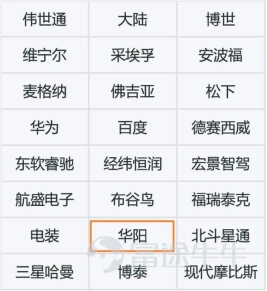
However, Desai Seaway is also in the Huawei camp and has established a cooperative relationship with Huawei in terms of domain controllers.
At present, Huawei should be the only company that has independently developed a domain controller core chip and OS. In the Huawei MDC intelligent driving computing platform solution that has already been unveiled, a self-developed host CPU chip, AI chip, ISP chip, and SSD control chip are integrated.
At present, MDC has established cooperative relationships with nearly 50 partners, including more than a dozen car companies, as well as parts companies such as Huayang Group and Desai Seaway.
Currently, Huawei has promoted two products, one is the MDC210, which can provide computing power for L2+ level autonomous driving. The other is the MDC 610, which can provide computing power for L3 and L4 autonomous vehicles.
There are two ways for domestic domain controllers and other manufacturers to break through. One is to set up joint ventures with car companies to establish binding relationships; the other is to establish cooperative relationships with companies like Huawei and participate.
For example, Yingbo Super Computing and Chery New Energy have set up a joint venture. The @Pilot自动辅助驾驶系统 carried by Chery Ant is equipped with China's first intelligent driving domain controller with independent intellectual property rights.
Hongjing Smart Driving, on the other hand, established Anhui Yuchi Intelligent Technology Co., Ltd. as a joint venture with Jianghuai Automobile to develop a full-stack solution for automotive-grade intelligent domain controllers integrating software and hardware, covering L1 to L4 levels, and providing a highly scalable solution.
Huayang is an automobile manufacturer or a first-tier supplier to an automobile manufacturer (such as Huawei), and has established cooperative relationships with both.
In addition, some car companies are also aware of the importance of domain controllers. For example, many automobile manufacturers such as BYD, Ideal Auto, and NIO are also developing domain controllers independently, with the intention of seizing the underlying hardware autonomy of future software-defined vehicles.
Whoever holds the domain controller has basically held the future of autonomous driving and the future of smart cars.
Author Hye-taek Lee
Risk Disclaimer: The above content only represents the author's view. It does not represent any position or investment advice of Futu. Futu makes no representation or warranty.Read more
Comments
to post a comment
1