

Education stocks continue to fall sharply, or due to the new regulations on the supervision of online extracurricular tutoring

[Frontline Industry] Flood of Advertising Amid Fines: The Right Moment to Address the Chaos in Online Education

Twenty years ago, Shi Yuzhu made billions by leveraging Brain Platinum's straightforward, brainwashing-style advertising.
The brainwashing-style advertising campaign for 'Brain Platinum' can be said to have ushered in a new era, demonstrating to entrepreneurs the power of mind-control marketing.
Today's online education market has taken marketing to a whole new level through relentless, barrage-style advertising. On bus-stop signs, in subway corridors, inside elevators, and across countless mobile apps, ads promoting 'one-on-one synchronous tutoring' and 'all the world's top foreign teachers are right here' relentlessly stoke parents' anxieties, leaving them thoroughly fed up.
Unlike the Brain Platinum ad campaign, many online education companies today are failing to treat consumers with honesty and integrity—so much so that while they are busy launching aggressive, barrage-style marketing campaigns, they simultaneously find themselves on the receiving end of fines issued by the relevant authorities.
How can one educate others while deceiving oneself and others?
Over the past two years, the online education sector has been plagued by widespread irregularities, with market regulatory authorities in numerous provinces and cities imposing administrative penalties on a number of off-campus education and training institutions in accordance with the law. The companies involved have been fined for such violations as alleged false advertising and the use of deceptive pricing practices designed to mislead consumers into making purchases.
Notably, well-known firms such as New Oriental, Gaotu (formerly known as 'GOTU'), TAL Education Group, Yuanfudao, and Zuoyebang are among the off-campus education and training institutions that have been fined.
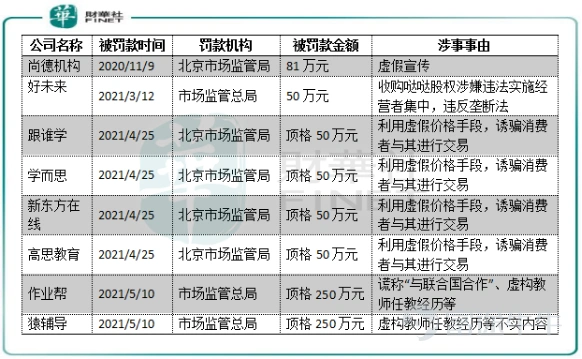
Since November 2020, the Beijing Municipal Government has intensified its oversight and enforcement against off-campus education and training institutions, with several leading companies in the sector squarely in the crosshairs. On May 10, Zuoyebang and Yuanfudao were each slapped with the maximum fine of RMB 2.5 million by the State Administration for Market Regulation for fabricating false and misleading content. Notably, Zuoyebang's deceptive advertising was particularly egregious: on its official website, it falsely claimed to be 'in partnership with the United Nations,' fabricated teachers' teaching credentials, and cited unverified user reviews.
It's rather awkward to see that Homework Help's advertising has seized on the 'United Nations' as a talking point. Two months ago, another domestic online education company, NetDragon, teamed up with UNESCO's Institute for Information Technologies in Education to launch a digital education resource platform available to teachers worldwide. While this achievement garnered considerable attention within the industry, NetDragon remained remarkably low-key and did not let success go to its head.
According to Caihua News Agency, following the release of a notice by the State Administration for Market Regulation, the wording on the official website of Zuoyebang referring to 'cooperation with the United Nations' has been removed and replaced with a statement that the company 'collaborates with institutions such as Beijing Normal University and the All-China Women's Federation to provide high-quality educational resource services.'
While the repetitive and exaggerated slogans from the old 'Brain Platinum' advertisements were undoubtedly irritating, they were honest and transparent—free of tricks. In contrast, some online education firms today claim to uphold high teaching standards, but prioritize profits over nurturing students, compromising the very essence of what defines a reputable organization for quick financial gains. Worse still, in an attempt to project an image of 'renowned teachers' and premium education, four major online education platforms—Xueersi Online School, Qingbei Online School, Yuanfudao, and Gaotu Classroom—have been embroiled in scandalous reports of 'teacher impersonation': all four hired the same individual to pose as a 'teacher' in their advertisements, with the extent of their deceptive marketing leaving observers utterly shocked.
In addition to misleading and exaggerated advertising, the online education industry is plagued by numerous other issues, such as problems with teaching staff qualifications, overpromising results, and difficulties in securing refunds, all of which have sidelined the core mission of education itself.
Fines amounting to hundreds of thousands or even millions are mere peanuts for these large online education companies. However, public exposure coupled with enforcement actions serves as a strong deterrent, and regulators may adopt a multi-faceted approach to further crack down on industry malpractices in the future.
Under strict regulatory scrutiny, online education stocks have all experienced steep declines without exception; among them, New Oriental Online, Youdao, and TAL Education Group saw their share prices cumulatively drop by more than 10% from April 25 to May 11.
What are the root causes behind these overlapping irregularities?
Marketing is a key channel for internet companies to acquire customers and a standard business practice for enhancing brand awareness in a competitive market. In the online education sector in particular, customer acquisition poses a significant challenge and pain point; thus, multi-channel promotion is essential to secure more student enrollments.
However, when the entire industry repeatedly resorts to misleading advertising and excessive marketing to attract customers, it indicates that the healthy development of the sector has been fundamentally distorted.
Behind the growing chaos in the online education industry, two major factors are at play.
I. Competition Has Reached a Frenzied Level, with Massive Industry Funding Fueling DisorderThe COVID-19 pandemic in 2020 accelerated the growth of the online education industry, pushing its competitive landscape into overdrive. This can be observed in the data regarding newly established companies.
According to data from Tianyancha, as of the end of 2020, nearly 97,000 online education companies were newly established, accounting for 16% of all new educational enterprises.
As new entrants continue to join the market, the industry is also seeing massive capital inflows. In 2020, more than RMB 10 billion in funding poured into the education sector, with online education as its core focus—and Yuanfudao and Zuoyebang, recently fined by the State Administration for Market Regulation, were the two companies that secured the largest rounds of financing in the industry.
According to statistics, Yuanfudao raised more than US$3.5 billion in funding in 2020, while Zuoyebang completed two rounds of financing that year, bringing its total fundraising to US$2.35 billion. Both companies have secured over RMB 10 billion in funding—enough to launch aggressive, multi-year marketing campaigns aimed at attracting customers. Moreover, Zuoyebang is not content with this; it plans to list on the U.S. stock market in the second half of this year, aiming to raise at least US$500 million.
Product homogenization in the online education industry is becoming increasingly severe, forcing leading players to rely heavily on aggressive advertising and marketing to acquire customers. Before regulatory crackdowns were imposed, many of these companies harbored a sense of complacency and even incorporated "false elements" into their advertising campaigns—all in an effort to maximize customer acquisition and seize the top spot in the industry.
After all, these companies can't just sit on a mountain of cash and do nothing—burning through the funds in the name of "strategic losses" is one thing. What really matters is that student enrollment and revenue growth convince investors that the investment is worthwhile.
The frenzied marketing driven by cutthroat competition among industry leaders is also reflected in corporate financial statements. Consistent with industry investment and financing trends, the sales expenses of leading online education companies all surged in 2020.
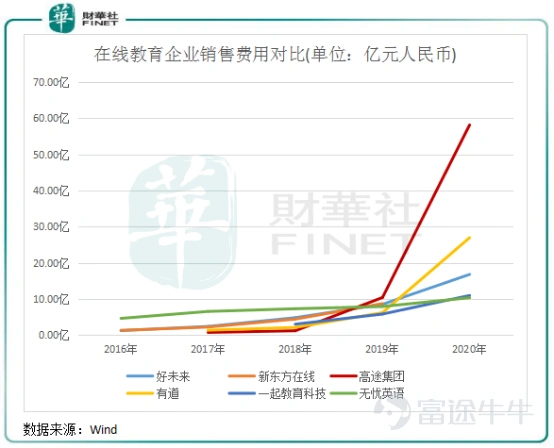
Among them,Genshuixue is by far the most lavish spender on advertising, with sales expenses reaching RMB 5.8 billion in 2020. At this rate, the company could fund the construction of a domestically built aircraft carrier in just 3.3 years—a testament to how aggressively it is pursuing customer acquisition.According to military experts, the construction cost of China's first domestically built aircraft carrier, the Shandong, is estimated at approximately US$3 billion, equivalent to about RMB 19.3 billion.
In addition to Gaotu, other well-known online education companies such as TAL Education Group, New Oriental Online, and Youdao also saw a substantial increase in sales expenses in 2020, with each company's spending exceeding RMB 1 billion.
II. Under the pressure of academic advancement, market demand remains robust.The reason online education companies are willing to invest heavily in the market is closely tied to market demand.
On the one hand, China's education market is vast, yet online education penetration stood at only 33% in 2020, suggesting significant growth potential ahead. On the other hand, the pressure on children to advance academically has fueled parental anxiety, which in turn has become the "spark" that drives both the very existence of online education companies and intense competition within the sector.
China's education system is heavily exam-oriented, and the country's large population has further entrenched the belief that "knowledge changes one's destiny" in parents' minds. Against this backdrop, online education companies must not only refine their products and tailor their services to enhance competitiveness but also invest in market promotion to meet users' needs for score improvement and academic advancement.
In 2021, the domestic COVID-19 epidemic was brought under effective control; however, pressure to advance to higher education and secure employment remained unabated. The trend of students competing based on their performance in the high school entrance and college entrance examinations continued to hold, with ample room for industry growth and steadily strengthening rigid demand.
Outcomes and Consequences of Madness
The profit-driven competition in the online education market has, to a large extent, propelled schools and educational institutions to shift their development strategies from offline to online, thereby outlining a vibrant blueprint for the modernization of education under the banner of information technology.
The development of online education is an inevitable trend in social progress. Beyond mere after-school tutoring, the 2020 initiative to "suspend classes without suspending learning" demonstrated that online education technologies can be effectively integrated into virtual classroom settings, thereby enriching and enhancing the development of quality education, higher education, vocational education, and other educational domains, and ultimately supporting students' growth and advancement.
At the corporate level, the fierce competition among leading online education providers has steadily increased industry concentration, significantly enhancing educational quality and service convenience. Driven by aggressive marketing campaigns, these top players' financial performance has indeed impressed investment firms.
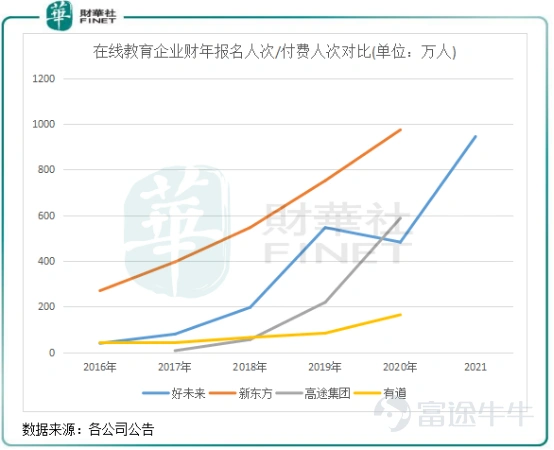
Judging by the number of registrations or paid enrollments, driven by aggressive market expansion, online education companies such as TAL Education Group, New Oriental, and Gaotu have all posted substantial growth since 2019, thereby boosting industry penetration. Notably, Xueersi Online School, a subsidiary of TAL Education Group, saw its number of enrolled students nearly double year on year in fiscal year 2021, reaching 9.445 million, underscoring a remarkably strong growth trend.
The surge in the number of students registering has also fueled rapid revenue growth for online education companies. Notably, in 2020, several publicly listed online education firms reported a sharp increase in revenue. In addition, substantial marketing expenditures—particularly those by Gaotu—played a significant role: Gaotu's revenue reached RMB 7.125 billion in 2020, a year-on-year jump of 240%.
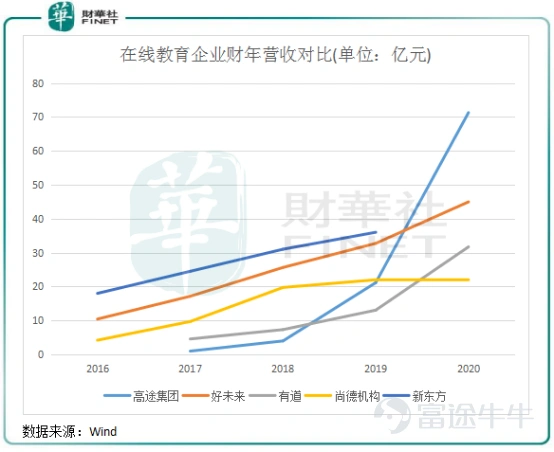
However, in an environment of excessive competition, there are no winners. High customer acquisition costs have made losses the norm across the industry. According to Wind data, U.S. stocks represent the primary market for Chinese online education companies listed in the U.S. Among the more than 30 education firms in this sector, nearly 20 reported losses in 2020, with Dao and Gaotu ranking among the top three in terms of loss magnitude.
These companies are eager to wage a blitzkrieg-style battle for market share, sacrificing profitability in exchange for growth. However, this low-price dumping model ultimately disrupts the industry’s ecosystem, leaving many small and medium-sized firms unable to survive and resulting in significant waste of societal resources.
Two months ago, Yu Minhong, founder of New Oriental, stated that online education would not fail; however, he now believes that China's online education sector has gone off track and that the internet-based 'burn-money' model is unsustainable.
Author: Yuan Yao
Risk Disclaimer: The above content only represents the author's view. It does not represent any position or investment advice of Futu. Futu makes no representation or warranty.Read more

Comments
to post a comment
1
2