
【Awarded】Tencent Holdings' Q4 and full-year financial reports have been released. What's your comment?

Commentary on Tencent's 2020 Financial Report: A Consensus on Seeking New Growth Drivers and the Evolution of Tencent's Core Competitiveness
In Q4 2020, Tencent reported revenue of RMB 133.669 billion, up 26% year on year, and non-IFRS net profit of RMB 33.207 billion, up 30% year on year. For the full year, revenue totaled RMB 482.064 billion, up 28% year on year, and non-IFRS net profit reached RMB 122.742 billion, up 30% year on year.
Overall, the financial results once again met market expectations: "stable." Tencent's core businesses—communication and social networking, online gaming, digital content, and online advertising—remain firmly established.
According to fourth-quarter data, its value-added services revenue reached RMB 67 billion, up 28% year on year;
Fintech and enterprise services revenue reached RMB 38.5 billion, up 29% year on year;
Online advertising revenue reached RMB 24.7 billion, up 22% year on year, with social advertising accounting for RMB 20.4 billion, a 25% increase. Media advertising, after seven consecutive quarters of year-on-year decline, finally posted an 8% year-on-year gain, driven by the macroeconomic recovery that has also spurred a broader rebound in the advertising market.
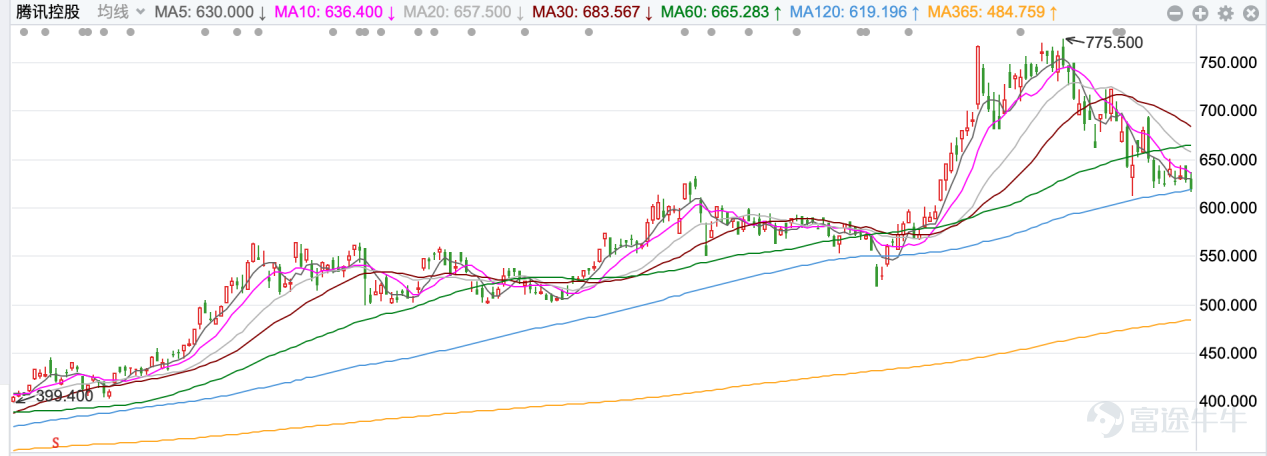
Based on the current position and the latest financial results, several questions arise:Is Tencent's current valuation high? Beyond its solid, well-established business foundation, has the market reached a consensus on Tencent's new growth drivers?
We believe that:
1. Currently, Tencent's trailing price-to-earnings ratio stands at approximately 40 times, near its historical median, reflecting broad market consensus on the company's high-conviction growth prospects in its core consumer-internet segments, including social networking and gaming.
From a dynamic perspective, assuming Tencent's core businesses—digital content, advertising, and financial technology—continue to grow steadily and no black-swan events occur, analysts at CITIC Securities and other brokerage firms project Tencent's revenue for 2021–2022 at RMB 599 billion and RMB 715.9 billion, respectively, with Non-GAAP net profit forecast at RMB 152.8 billion and RMB 183.7 billion, respectively, representing an annual growth rate of about 22%. Based on a price-to-earnings multiple of 45, Tencent's market capitalization could range from RMB 6.8 trillion to RMB 8 trillion.
Stock price = Earnings per share (EPS) × Price-to-earnings ratio (PE); the consumer internet sector provides high certainty for Tencent's steady EPS growth.
2. The market is focusing on Tencent's new long-term profit growth drivers—primarily the industrial internet and the WeChat ecosystem, led by WeChat Video Accounts. In 2020, a series of new developments in these two segments continuously boosted Tencent's valuation ahead of the Spring Festival, positioning them as key sources of future profit expansion.
These two major segments will be discussed in detail below, suggesting that Tencent's core competitive advantages may be undergoing a significant shift—from a social-gaming company and traffic powerhouse to a technology firm and leader in the digital industry. Tencent is increasingly aligning with—and becoming virtually inseparable from—the real economy.
3. The greatest source of uncertainty for Tencent, aside from its fundamental business prospects, is the unpredictability of external regulatory policies—this is precisely what the market is currently concerned about. While internet regulation is an industry-wide issue, Tencent's various businesses are not the primary focus of such oversight; moreover, given Tencent's long-standing commitment to aligning with government priorities, there is no need to overstate the risks posed by regulatory scrutiny.
We won't delve further into the stability of Tencent's core business. However, several figures in the earnings report are worth paying attention to:
Tencent's paid value-added service user base expanded to 219 million, up 21.9% year on year, with Tencent Video's paid subscribers reaching 123 million and Tencent Music's paid users totaling 56 million, a 40.4% increase from the previous year.
In the post-pandemic era, consumers have already developed established habits of consuming digital content, and competition in the consumer internet space will increasingly hinge on content. Tencent's "New Cultural Creativity" strategy—integrating reading, film and television, animation, and gaming—enables it to secure high-quality content at the source and drive its production toward industrial-scale, standardized workflows, giving it a clear competitive edge.
In its core gaming business, Tencent Online Games continued to post a year-on-year growth rate of 36%, with several top titles maintaining robust lifecycles and consistently contributing revenue. Over the past few years, Tencent has placed particular emphasis on continuously upgrading its anti-addiction system, imposing increasingly stringent restrictions on underage players, especially primary school students. In its latest earnings report, Tencent unusually disclosed that in Q4 2020, revenue generated by users under the age of 16 accounted for 3.2% of total domestic game revenue—lower than external estimates.

Image source: Internet
Let's take a close look at Tencent's industrial internet and WeChat—
(1) After more than two years of talk, Tencent's industrial internet initiative has fully blossomed in 2020, and the "fruits" are just around the corner.
First, both Alibaba Cloud and Tencent Cloud are currently in the investment phase. According to Alibaba's fiscal third quarter of 2021, Alibaba Cloud posted its first quarterly profit since its inception. Meanwhile, Tencent Cloud's new infrastructure initiatives remain in an acceleration phase, suggesting promising medium- to long-term profitability.
Some securities firms have also taken note of this trend. According to an analysis by Guotai Junan, Tencent's capital expenditures have exceeded those of Alibaba in recent years, with the company heavily investing in emerging sectors such as cloud computing and big data—a clear indication of its strategic focus on R&D.
In 2020, Tencent announced an investment of RMB 500 billion to further advance its new infrastructure initiatives and industrial internet strategy. In the data center sector, Tencent has progressively built several large-scale data centers in South and East China, each with a server capacity of over one million.
Data show that, to date, Tencent Cloud has launched 60 availability zones across 27 geographic regions worldwide. As early as 2019, Tencent became China's first company to operate a server fleet exceeding one million units and one of only five global companies with a server count surpassing one million. With the rollout of new infrastructure initiatives, its cloud capacity advantage within China has been further strengthened.
As cloud capacity continues to expand at an accelerated pace, Tencent Cloud also leads the domestic market in key technical metrics, even surpassing its competitors.
Tencent has revealed that the elastic resource pool of its cloud-based big-data platform now encompasses 5 million CPU cores, handles 15 million analytical tasks daily, executes over 40 trillion real-time computations per day, and supports model training on datasets with more than one trillion dimensions. This signifies that Tencent Cloud has not only become the domestic cloud provider with the most robust computing power but also the company with the highest daily volume of real-time computations.
Secondly, propelled by the development of cloud infrastructure, Tencent Cloud has consistently secured major contracts across various industries, which is anticipated to expedite revenue growth.
Publicly accessible information indicates that Tencent Cloud has clinched multiple large-scale deals spanning numerous sectors, including smart manufacturing, intelligent transportation, smart cities, smart healthcare, as well as finance, education, and public services. For example, in the manufacturing sector, Tencent Cloud has forged strategic partnerships with leading firms like Sany Heavy Industry and Foxconn Industrial Internet; in the financial sector, Tencent Cloud's distributed database TDSQL currently serves nearly half of the top 20 banks in China, with a penetration rate as high as 60% among the top 10 banks; and in the smart city domain, Tencent WeCity has been implemented in more than 10 cities, including Shenzhen, Guangzhou, Shanghai, Guiyang, Changsha, Wuhan, Chongqing, and Suzhou.
"Open collaboration and co-creation" is Tencent's strategy for constructing the industrial internet. By the end of 2020, Tencent Cloud had already partnered with over 8,000 collaborators to jointly develop more than 300 integrated solutions, serving 300,000 enterprise clients across more than 20 industries—including healthcare, education, mobility, finance, manufacturing, and retail—and generating revenue of 10 billion yuan.
Third, and most importantly, the unique conditions during the pandemic response and recovery period in 2020 validated Tencent's C2B value proposition.
According to the financial report, the user base of Tencent Meeting continues to expand rapidly. Tencent Meeting has emerged as China's largest standalone cloud conferencing application, while WeCom serves more than 5.5 million enterprise clients and is connected to over 400 million WeChat users.
With the ongoing advancement of WeCom and Tencent Meeting, Tencent's B2B business is set for sustained expansion and deeper market penetration.

Image source: Internet
(2) The WeChat Ecosystem: The New Connection Value Behind Product Strength.
At the 2021 WeChat Open Class, Zhang Xiaolong dedicated more than half of the session to outlining the positioning of Video Accounts, their recommendation algorithm, and the future direction of cloud integration—following which WeChat experienced a renewed surge in user growth.
In addition to Video Accounts, the 'Search' feature that integrates with service search has also become more familiar to users, largely due to the surge in popularity of WeChat red-envelope covers during the Spring Festival.
If we say that the primary driver of Tencent's valuation surge in 2020 was the rise of the industrial internet, then the rally at the start of this year likely owes much of its valuation uplift to the new developments within WeChat—most notably Video Accounts and the 'Search' feature.
We believe that Video Accounts further extend WeChat's traffic reach, fostering new connections and enabling the platform to move beyond social networking into the realm of public information. At the same time, Video Accounts will further increase the amount of time users spend on WeChat. Beyond simply meeting users' growing demand for video content, Video Accounts will also become a vital component of Tencent's broader digital content ecosystem.
Currently, WeChat's 'Search' feature has surpassed 500 million monthly active users. Although Tencent did not disclose the daily active users of Video Accounts in either the WeChat Open Class or this earnings report, based on the prominent first-level entry point that WeChat has provided for it, Video Accounts likely commands substantial traffic.
WeChat is encouraging users across various sectors to create original content for Video Accounts; only with such content can both social and algorithmic recommendations generate a steady flow of fresh, engaging material.
As everyone knows, WeChat has long pursued a highly restrained and gradual approach to monetization. The market is eager to see how Video Accounts can be further integrated into the WeChat ecosystem to unlock additional revenue streams—such as revenue sharing from live-stream tipping, advertising, technology service fees and commissions on livestream e-commerce, and new revenue from integrated cloud-based technical solutions.
The financial report reveals that Video Accounts has been integrated with Mini Programs, enabling brands and enterprises to expand their audience reach and drive transactions, with particularly notable results.
The connectivity features of Mini Programs are now widely recognized by both merchants and users, further energizing the transaction ecosystem in 2020. Currently, Mini Programs can integrate with a range of WeChat platform capabilities, including WeChat Pay, Enterprise WeChat, WeChat Search, WeChat AI, and Video Accounts.
According to the financial report, daily active users of Mini Programs have exceeded 400 million, and in 2020, transaction volume generated through Mini Programs more than doubled.
We believe that any monetization of WeChat will remain a gradual process. Over the past year, however, WeChat has evolved far beyond a mere messaging and payment platform; it has become an indispensable 'code-based' lifestyle tool, a new e-commerce trading platform, and even a video-enabled digital identity accessible to everyone. In short, WeChat has become an integral part of our digital lives and is increasingly intertwined with the real economy, generating immeasurable social and commercial value in the process.

Image source: Internet
(3) The core competitive advantages of Tencent are undergoing new changes.
In the past, investors viewed Tencent through the lens of its social networking, gaming, and entertainment value-added services; today, the focus has shifted to its B2B business and the WeChat digital ecosystem.
Even in the previous consumer internet space, the era of pure traffic competition has already passed; today, the core of the battle for digital content lies in the quality and value of the content itself. As the growth of the mobile user base slows, we have entered an era of stock-based competition, where simply chasing traffic for quick profits is a thing of the past.
Whether it's the fruitful outcomes of the industrial internet or WeChat's evolution into a digital ecosystem, Tencent has grown increasingly intertwined with various industries and the real economy.This is driven by technological investment and innovation, rather than mere traffic-driven growth.
In addition to the capital investment figures mentioned above, there is another recent piece of data that highlights Tencent's commitment to technology:
In 2020, Tencent's R&D workforce accounted for 68% of the company's total headcount, a year-on-year increase of 16%, placing the company among the leaders in the tech industry. On average, Tencent's R&D team completed 5,242 requirements per day.
In 2020, Tencent launched more than 4,000 new R&D projects, a year-on-year increase of 22%, and added over 2 billion lines of code, up 67% from the previous year.
As of September last year, Tencent had filed more than 5,600 AI-related patent applications in China and been granted over 1,200, ranking first among domestic internet companies in total AI patent filings.
By analyzing Tencent through the perspectives of evolving business dynamics and improved product capabilities, while adopting a dual focus on technology and content, we can gain insight into the company's core competitive advantages.

Image source: Internet
(4) Finally, let’s discuss the FLD regulation that the market is closely monitoring.
Recently, due to issues related to the declaration process, ten internet companies including Tencent, ByteDance, and Baidu have been fined again by the State Administration for Market Regulation. However, the amount remains at RMB 500,000. Moreover, the State Administration for Market Regulation clarified that the 'prior declaration' procedural issue constitutes an administrative penalty imposed on relevant operators for violating statutory declaration procedures and does not involve substantive antitrust violations.
Overall, we believe that antitrust enforcement will become the new normal and a challenge facing the entire internet industry. Specifically, issues such as 'choose one of two' practices, consumer interest protection, and safeguarding user privacy against 'big data price discrimination' will be subject to strict regulatory scrutiny to prevent harm to users and curb unfair competition. However, these areas have only a weak connection to Tencent.
There is now broad consensus in both domestic and international industries that market share should not be used as the criterion for determining 'dominant market position' or 'monopolistic status.' The 3Q War of those years serves as a valuable case study: despite WeChat's substantial market share, the Supreme People's Court did not find that WeChat held a monopolistic position based solely on that fact.
As for the repeated allegations of anti-competitive practices against Douyin ahead of the Spring Festival, investors familiar with Tencent are well aware that intense competition has long characterized the company's internet businesses—whether in the social space, with DingTalk and Feishu, or in the video space, with Douyin and iQIYI.
In this earnings report, Tencent once again emphasized that the strategic priority for its fintech business is to proactively collaborate with regulators and industry partners to launch compliant and inclusive fintech solutions, while prioritizing risk management over scale expansion.
Tencent Investment has occasionally drawn public scrutiny due to its large scale and high profile. Nevertheless, it enjoys a strong reputation within the industry, largely because most of its investments are minority equity stakes held over the long term, with a significant focus on emerging industries and early-stage technology startups. The firm typically refrains from interfering in or exerting control over the management teams of these ventures, adopting a supportive and non-intrusive approach. As such, it serves as an important source of private capital that helps nurture and develop cutting-edge technology sectors, consistently positioning itself as a model of 'good industrial capital.'
Furthermore, given Tencent's longstanding commitment to 'political sensitivity' and its non-radical approach, its senior executives have repeatedly stated that they will 'embrace regulation.'
Therefore, when viewed as a whole, concerns about antitrust enforcement should not be overstated; acceptance of regulatory oversight has become the new norm, and the final decision will naturally follow.
Risk Disclaimer: The above content only represents the author's view. It does not represent any position or investment advice of Futu. Futu makes no representation or warranty.Read more


Comments (9)
to post a comment
5
14