

【Awarded]】Technology stocks have risen and fallen sharply. Is it crisis or opportunity?

Elephant Wealth Daily | Goldman Sachs: Advises Hedging Against Election Uncertainty
Hot News
The U.S. stock market's earnings season kicks off this week as Goldman Sachs and JPMorgan raised their forecasts for the S&P 500 Index.
The U.S. stock market’s earnings season is about to begin. Companies scheduled to report earnings this week include JPMorgan, Wells Fargo & Co, Citi, Netflix, and Johnson & Johnson.
Goldman Sachs Group Inc. has become more optimistic about the profit outlook for the S&P 500 Index this year. However, Goldman Sachs emphasized that corporate earnings guidance will be crucial in assessing profit prospects.
The number of COVID-19 cases in the United States has surpassed 10 million, with the pandemic now in its 'worst' phase.
Data from Johns Hopkins University shows that as of noon Eastern Time on November 9, the cumulative number of confirmed COVID-19 cases in the United States exceeded 10 million, accounting for approximately one-fifth of the global total; cumulative deaths surpassed 237,000. The increase from 9 million cases on October 30 to over 10 million on November 9 took only 10 days, marking the fastest growth rate since the outbreak began.
Prominent U.S. epidemiologists have stated that the country is currently in the 'worst' phase of the pandemic; the surge in cases may persist for several weeks; without large-scale containment measures, the situation is unlikely to improve in the short term.
A rebound in technology stocks pushed the Nasdaq up more than 2%.
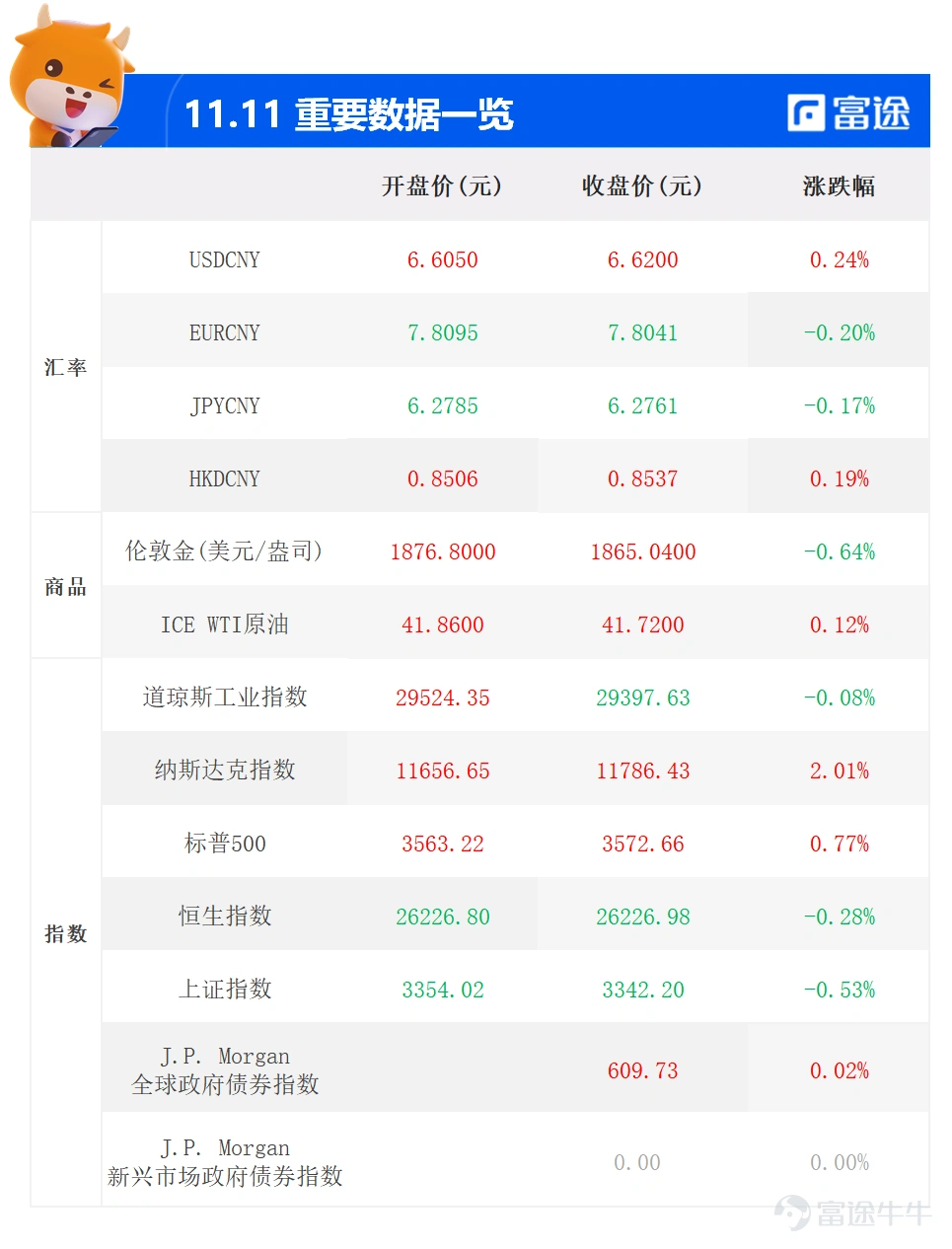
On Wednesday Eastern Time, the three major U.S. stock indexes closed mixed. A rebound in technology stocks pushed the Nasdaq up more than 2%, while the Dow fluctuated widely and closed slightly lower. At the close, the Nasdaq was up 2.01%; the Dow fell 0.08%; and the S&P 500 Index rose 27.13 points, or 0.77%. Large-cap tech stocks rebounded collectively, with chip stocks leading the gains.
Powell is approaching his 'contract year,' and the prospect of his reappointment could lead to significant fluctuations in the U.S. dollar.
As Biden prepares to take office as U.S. President in January next year, the Federal Reserve has taken various measures to address the economic recession, and decisions regarding federal spending have become more urgent for the incoming administration.
If the Republican Party controls the Senate, the likelihood of changes to the Federal Reserve Act would be smaller, potentially limiting many of Biden’s ambitions. The larger fiscal stimulus package supported by Biden would face obstacles, its scale might be reduced, and the U.S. dollar could remain on an upward trend. Conversely, if the Republicans fail to retain control of the Senate, the larger fiscal stimulus previously supported by Biden could be successfully implemented, leading to further depreciation of the U.S. dollar.
Moreover, Trump has so far refused to acknowledge Biden's victory in the U.S. presidential election, claiming that evidence of voter fraud will be revealed, which increases uncertainty over whether the Federal Reserve's emergency measures can be extended smoothly and could result in greater volatility in the U.S. dollar in the near term.
Insights from Major Banks
Refinitiv: Predicts Lower Q2 Earnings for S&P 500 Companies
A survey by Refinitiv shows that analysts predict a 43.9% year-over-year decline in Q2 profits for S&P 500 companies, much worse than the 11.7% drop initially forecast at the start of the quarter. This would mark the worst performance since 2008.
Goldman Sachs:Recommends hedging risks associated with election uncertainty.
Global stock markets are currently trading near their highest levels since February, with market focus on whether profit prospects will support the bullish sentiment driven by central bank and fiscal policy. Many U.S. companies have yet to provide specific guidance on the impact of the pandemic.
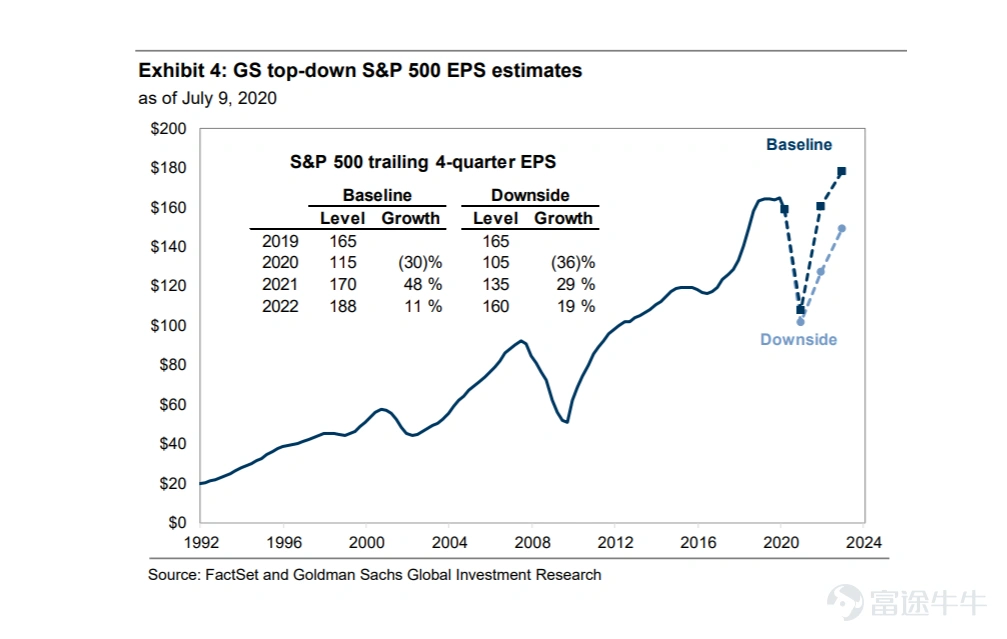
Goldman Sachs noted that overall performance in the second quarter may obscure significant variations across industries. Analysts expect the energy and non-essential consumer goods sectors to report losses for Q2, with weak performance in the financial sector. They anticipate stronger results from utilities and technology firms.
Strategists also mentioned that risks to forecasts include regulation, infrastructure, and trade policies, recommending hedging against the possibility of delayed election results. The U.S. election in November could introduce additional uncertainties for corporate earnings.
State Street Global Advisors: investors'sPortfolio adjustments are healthy for the overall market.'s
Tech stocks, which led the market during the pandemic, have recently faced consecutive sell-offs, causing the Nasdaq to decline more than 1% over Monday and Tuesday sessions. Meanwhile, the energy, financial, and industrial sectors outperformed the broader market in the past two days.
State Street Global Advisors' investment strategist said this appears to be a case of investors adjusting their portfolios. Investors seem content with the election outcome, progress on coronavirus vaccines and treatments, and stable corporate earnings this quarter. He believes they are looking ahead to 2021, anticipating improved economic growth and corporate profitability. As a result, they are increasing positions in more cyclical value-oriented companies while reducing exposure to tech stocks.
Strategists also believe that this adjustment of positions is healthy. We have all been concerned about the concentration of the market — only a few technology stocks were driving the entire market higher. Now, we see more companies participating in the current stock market rally, and he believes this is healthy for the overall market.
Institutional Allocation Insights
JPMorgan:The US stock market is facing one of the best backdrops for sustained growth in many years.
JPMorgan equity strategists expect the S&P 500 Index to surpass its previous target price of 3600 points by the end of the year, reaching 4000 points early next year, and potentially climbing further to 4500 points by the end of 2021. The strategists also noted that the US stock market is facing one of the best environments for sustained growth in many years. After enduring prolonged high-risk factors such as the global trade war, the coronavirus pandemic, and uncertainties surrounding the US election, the outlook for the stock market has significantly improved.
Editor/Echo
Risk Disclaimer: The above content only represents the author's view. It does not represent any position or investment advice of Futu. Futu makes no representation or warranty.Read more


Comments
to post a comment
8