
【Awarded]】Technology stocks have risen and fallen sharply. Is it crisis or opportunity?

Elephant Wealth Daily | Global markets surged overnight, BlackRock: favors growth stocks

Hot News
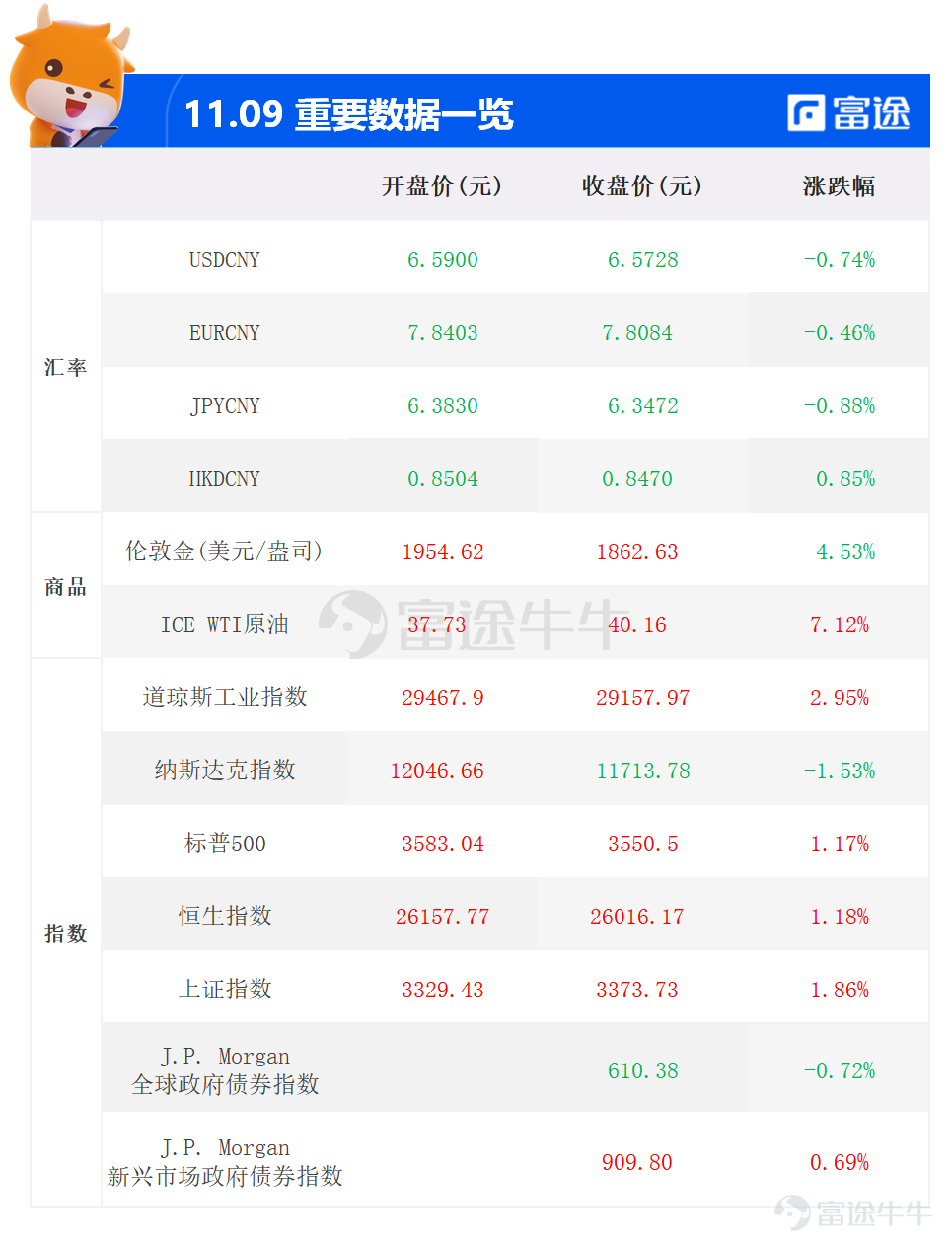
The onshore RMB exchange rate against the US dollar opened sharply lower.
On November 10, the onshore RMB exchange rate against the US dollar opened lower, falling more than 400 points, breaking below 6.62, while at the same time, the offshore RMB exchange rate against the US dollar rose in the short term, recovering above 6.61. As of 9:35 am, the onshore and offshore RMB exchange rates against the US dollar were 6.6242 and 6.6088 respectively. On the same day, the central parity rate of the RMB against the US dollar was raised by 226 basis points compared to the previous trading day, reaching 6.5897, the highest since June 2018.
Since October 12, the central parity rate of the RMB against the US dollar has frequently shown a weak bias, with an average daily weakening of 20 basis points, and last Friday it weakened by 75 basis points, the highest since August 2019.
China's foreign trade import and export growth may reach 2% for the whole year.
According to data from the General Administration of Customs, in the first 10 months of this year, China's total import and export value of goods amounted to 25.95 trillion yuan, a 1.1% increase compared to the same period last year. Among them, exports increased by 2.4%; imports decreased by 0.5%; and the trade surplus was 2.71 trillion yuan, an increase of 16.9%. In October, China's foreign trade imports and exports increased by 4.6%. Among them, exports increased by 7.6%; imports increased by 0.9%; and the trade surplus was 401.75 billion yuan, an increase of 34.9%.
The spokesperson for the General Administration of Customs stated that since June, foreign trade imports and exports have achieved positive growth for 5 consecutive months, and China's share in the global export market has continued to increase. This highlights the strong resilience and quality improvement of China's development in the face of the severe global economic recession and significant shrinkage of external demand.
Global markets rejoice as good news about the development of the COVID-19 vaccine emerges.
During yesterday's Asia-Pacific trading session, the Nikkei 225 index opened higher and closed up 2.12% at 24,839.84 points, reaching a new high since November 1991. Most other Asia-Pacific markets also ended in the green. The European markets followed suit, with benchmark stock indexes in the UK, France, and Germany all opening more than 1% higher and experiencing a straight-line upward trend. At one point, the France CAC40 index rose by as much as 7.73%. The three major US stock indexes also opened significantly higher, with the Dow Jones Industrial Average up 5.51%; the S&P 500 index also showed an upward trend, rising 3.87%; and the Nasdaq Composite index rose 1.31%.
According to reports, the COVID-19 vaccine jointly developed by Pfizer and the German biotech company BioNTech can prevent 90% of infections in large-scale trials, exceeding market expectations. Wall Street consulting firms said that the efficacy of the Pfizer-produced vaccine is surprising, and the turning point in the fight against the virus may have arrived.
Banks' view of the market
GTJA: Facing hesitation with profitability, grasp three main lines of profit improvement.
Shifting focus from short-term certainty to long-term profitability. Different from the market focus on cyclical sectors in August and September, there has been a marked change in the style and industry structure of the A-share market since October: differentiation within the cyclical sector, with the market spreading to consumer and technology sectors. However, the direction of diffusion is consistent, all in industries where profitability is expected to improve (such as autos, home appliances, textiles and apparel, new energy, etc.).
The market structural changes reflect a shift in investor focus from short-term performance certainty to long-term profit improvement and industry prosperity, driven by the switch in expectations for domestic economic recovery momentum from government-stimulated investment to consumption recovery and corporate restocking. We believe that the switch in domestic economic momentum will continue to expand in the fourth quarter and 2021, and future overseas economic recovery and corporate restocking will resonate with improved domestic economy, which is expected to further accelerate the recovery of export chains. Compared with the global trade and domestic export structure of the past decade, the chemical industry, transportation equipment, machinery and electronics, and mineral products have high consistency, and future marginal improvement is expected under global recovery.
Goldman Sachs: A-shares are an asset that global investors must hold.
Goldman Sachs stated that 2020 was an unpredictable, unforgettable, and extremely difficult year: with over 43 million new confirmed cases of COVID-19 worldwide, the global GDP is expected to decline by 4.1% year-on-year, the most severe contraction since the 1930s. From February to March, the global stock market also experienced a historically brutal plunge. Despite this background, China's A-shares have risen by 15% year-to-date, outperforming almost all major global markets, making it a bright spot in the global stock market. This is mainly due to the decisive and effective virus containment measures taken by the Chinese government, along with policy support, leading to a strong rebound in total demand.
It is expected that in 2020, China's GDP will grow by 2.0%, very likely to be the only one among the 47 large economies covered by Goldman Sachs research to achieve positive growth this year. The resilient performance of the Chinese economy and stock market highlights the value of A-shares for global equity investors. As the world's second-largest and most rapidly growing stock market with the greatest depth, A-shares have brought profits to many global equity investment portfolios, but have not been fully reflected in global benchmark indices, resulting in insufficient holdings by both domestic and foreign investors, as well as a general lack of research by sell-side brokers.
Institutional investment allocation views
BlackRock: After the 'Blue Wave' Expectations Fall Through, BlackRock Favors Growth Stocks
Before the election, BlackRock expected a 'blue wave,' which meant that the Democratic Party would dominate the White House, the House, and the Senate, making it easy for them to advance large-scale fiscal stimulus, tax increases, and other measures. BlackRock Investment Research Institute released a report last Saturday (7th) stating that the Democratic Party may not be able to fully control Congress, which could limit the scale of fiscal stimulus and the growth in bond yields, suppress inflation expectations, but at the same time, risk assets will be boosted.
BlackRock wrote in the report that although some fiscal stimulus measures may still be introduced in the short term, the scale and scope will be much smaller compared to a unified Democratic government. The development of the situation indicates that the short-term market environment will return to a state dominated by "low interest rates, the pursuit of high returns and growth stocks".
While investors are waiting for the results of the US election, global financial markets have also experienced a turbulent week. Last week, US tech stocks and healthcare stocks drove the S&P 500 index up 7.3%, while the yield on 10-year US Treasuries fell by about 5 basis points. At the same time, the US dollar continued to weaken. BlackRock Investment Research Institute predicts that in the background of Biden winning the White House, but without the "blue wave sweeping everything" scenario, technology and healthcare companies, as well as high-quality and large-cap stocks, will perform well.
Editor/Echo
Risk Disclaimer: The above content only represents the author's view. It does not represent any position or investment advice of Futu. Futu makes no representation or warranty.Read more


Comments (5)
to post a comment
17