Pause or Expand Data Centers? Democrats Split on AI Regulation

Democratic Victory Shakes AI Infrastructure? Bernstein: Keep a Close Eye on Policy Shifts in Three Key States
As the U.S. midterm elections concluded, the Democrats' sweeping victory sparked market concerns over tighter AI regulation and slower data center construction, leading to heavy selling of AI infrastructure-related stocks in the U.S. market.
However, Bernstein believes thatthe actual impact of this political storm on AI infrastructure may not be as severe as implied by the stock price reaction.The firm stated that although the election results have increased regulatory risks for data center projects in certain states, the market may have overstated the impact of these policy changes, given the progress of existing projects, the difficulty of policy implementation, and the contribution of data centers to local economies.
The firm estimates that, under a more realistic scenario, the impact on the U.S. national pipeline of reliable data center projects may be only 2% to 4%.
Policy risks are heating up, but how many projects are actually affected?
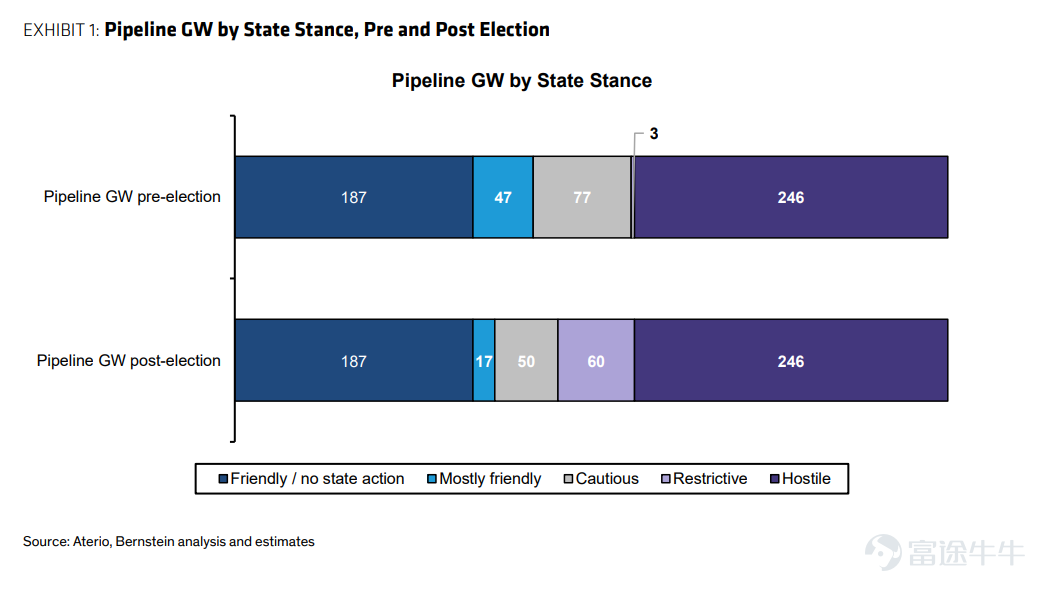
According to Bernstein's statistics, the capacity of project pipelines in U.S. regions with policies opposing or restricting data center construction increased from 249 GW to 306 GW around the election period.
Source: Bernstein
However, not all of these projects will actually be built. According to Bernstein's assessment of project feasibility, the related "credible capacity" has increased from 78 GW to 105 GW, an addition of approximately 27 GW.
More importantly, of the additional 27 GW, about 10 GW have already started construction and are protected by existing project exemption arrangements. The capacity that may truly face stricter regulation is approximately 17 GW.
Bernstein calculates that even if all 17 GW ultimately fail to materialize, the impact on the national viable project pipeline would be around 9%. In a more likely scenario where only some projects are cancelled or delayed, the actual impact could shrink to 2% to 4%.
Therefore,Going forward, the market needs to focus not only on which states are tightening data center policies, but also on whether these policies can truly halt project construction.
Policy changes in three major states: Texas, Georgia, and Ohio
Bernstein provided a detailed analysis of three states worth watching: Texas, Georgia, and Ohio. Their policy risks differ, involving gubernatorial executive power, public utility regulatory authority, and local government approval rights, respectively.
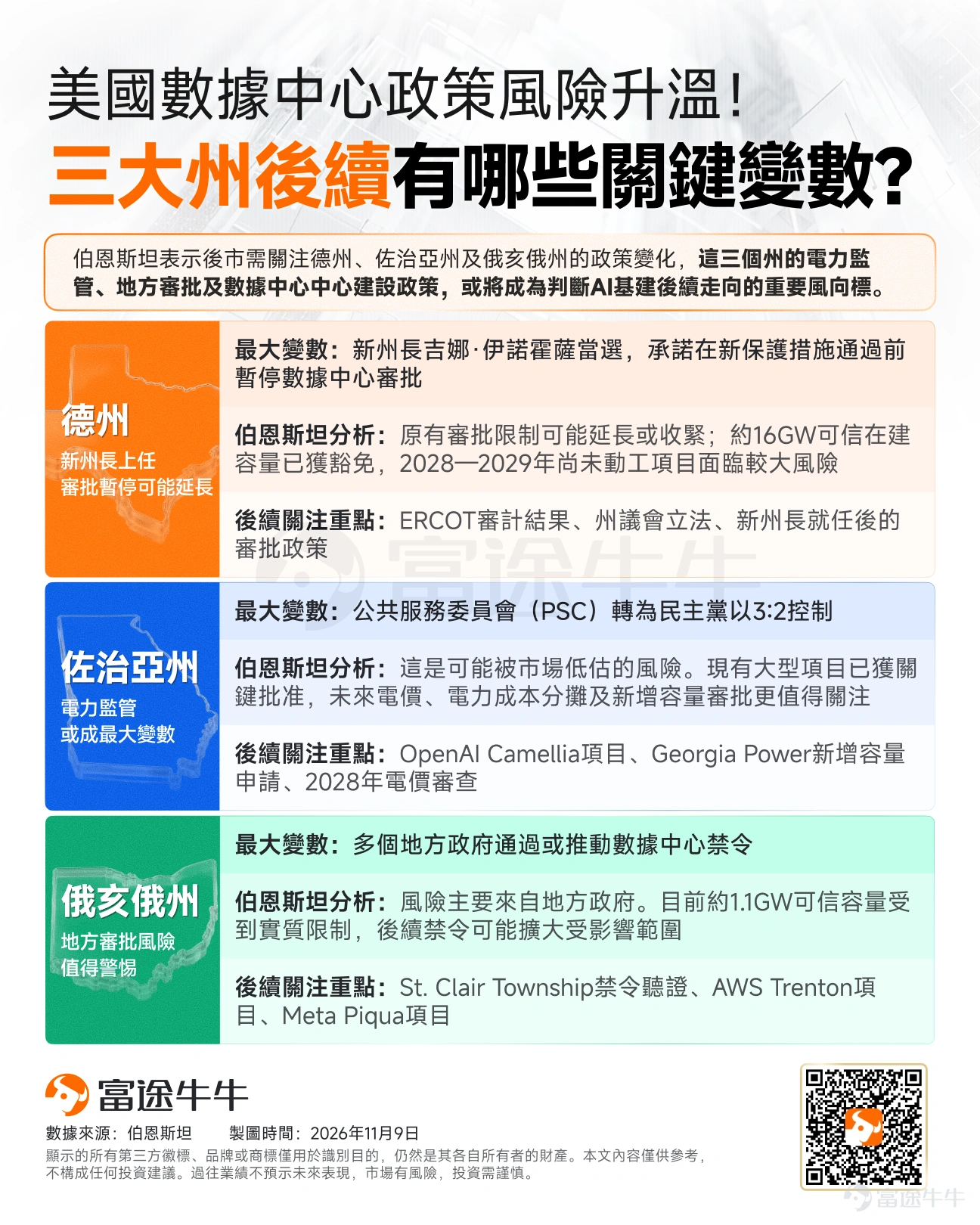
1. Texas: New Governor Pledges Moratorium on Approvals, Projects Targeting 2028 Face Significant Risks
Texas is one of the most important markets for data center construction in the U.S. and a region where policy uncertainty has drawn significant attention following the election.
Democratic candidate Gina Hinojosa defeated incumbent Republican Governor Greg Abbott, pledging to formally suspend approvals for related projects until the state legislature passes new data center protection measures.
However, Bernstein points out thatdata center approvals in Texas were already restricted before the election. The change in administration does not imply a sudden shift from a lax to a strict regulatory stance; rather, existing moratoriums may be prolonged, and their scope further expanded.
Currently, Texas has approximately 150 GW of forward-looking nominal project capacity, of which Bernstein believes about 50 GW has a realistic chance of being built.
Among these projects, 21 GW of nominal capacity is already under construction, with 16 GW considered credible capacity that will largely remain unaffected by the new suspension measures.
The real focus should be on projects that have not yet started construction, particularly the approximately 18 GW of nominal capacity originally scheduled to come online in 2028. Of this, about 5 GW is viewed as credible capacity and may face significant delay risks.
Furthermore, the Texas Legislature will convene on January 12, 2027, and the new governor will officially take office on January 19. With the State House controlled by Democrats and the State Senate still controlled by Republicans, there remains uncertainty over whether relevant regulatory bills will pass smoothly.
Bernstein believes the biggest risk in Texas is not the cancellation of all projects, but rather a further extension of the approval moratorium, leading to delays in new construction projects.
2. Georgia: Shift in regulatory power could become the most underestimated risk
Compared to Texas, Bernstein believes that policy changes in Georgia warrant greater caution from investors.
Following this election, control of the Georgia Public Service Commission (PSC) has shifted from Republican dominance to a 3-2 Democratic majority.
This shift is significant because the PSC holds key regulatory authority over electricity cost allocation, tariff rates, and new supply capacity approvals, which directly impact the economic viability of data center projects.
According to Bernstein's analysis,Georgia is one of the states with the most pronounced deterioration in its regulatory environment following this election, with its policy classification downgraded from "relatively friendly" to "restrictive."The project development adjustment factor has also been reduced from 0.95x to 0.80x.
However, existing large-scale projects still retain a certain level of protection.
Georgia had previously approved approximately 10 GW of power supply capacity, and OpenAI's 3.2 GW power supply contract was also approved in August.
Therefore, it will be difficult for the new PSC to directly overturn major approvals already granted; the real impact is likely to be reflected in future electricity tariffs and approvals for new power supply capacity.
Notably, Georgia Power is expected to file its application for additional power supply capacity for 2032–2033 in mid-2027, alongside a rate review scheduled for 2028.
Furthermore, the majority of credible projects in Georgia that have not yet commenced construction are concentrated in the longer term:Approximately 87% of the relevant capacity is scheduled to come online in 2029 or later.
This implies that policy changes in Georgia may not immediately halt data center operations, but could increase electricity costs for future projects, thereby impacting the ROI of new developments.
Bernstein’s assessment is as follows:The primary risk in Georgia is not an abrupt halt to current construction, but rather the potential for future data center projects to become more expensive.
3. Ohio: Rising local bans make project relocation a key factor
Unlike Texas and Georgia, the risks in Ohio primarily stem from local governments.
Bernstein points out that at least 10 towns in Ohio have passed measures prohibiting data center construction.
Preliminary statistics indicate that approximately 3 GW of credible capacity is located in areas that have either passed or are considering restrictive measures, involving about 5.4 GW of nominal capacity.
However, after further consideration of municipal boundaries, project siting, and existing approvals, Bernstein estimates that the current credible capacity directly constrained is approximately 1.1 GW.
Among these, Meta’s 1.1 GW campus in Piqua has been affected by local regulatory amendments, but since relevant agreements were previously secured, it may subsequently enter into legal dispute proceedings.
Another significant project is Amazon AWS’s data center in Trenton. With a nominal capacity of approximately 1.5 GW, its continuation depends on the local hearing and injunction decision in St. Clair Township on November 10.
Bernstein points out that while local bans typically take effect faster than state-level policies, developers may relocate projects to neighboring towns rather than completely abandoning their investments.
Therefore,The most noteworthy aspect in Ohio is not just the increase in the number of bans, but whether affected projects can continue construction by changing locations.
How will the AI industry chain be affected?
The impact of policy changes is uneven. Bernstein found that the market’s pricing of data center-related stocks has a relatively limited correlation with the number of projects companies have in restrictive states,but instead depends more on whether a company’s future growth is highly reliant on new projects that have not yet obtained approval.
During the period from the beginning of the election cycle tracked in the research report to the close on November 4, shares of major cloud service providers rose by an average of 3.6%, and major data center REITs rose by an average of 3.9%. In contrast, emerging AI infrastructure developers fell by an average of 5.7%, and Neocloud companies fell by an average of 7.1%.
This reflects that the market may be distinguishing between two types of assets: one comprising companies with mature facilities, power access, and existing operational capacity; and the other comprising companies whose future revenue is highly dependent on the construction and approval progress of new projects.
As regulatory barriers rise, facilities that have already secured power resources and necessary approvals may become scarcer, potentially enhancing the value of existing assets. Conversely, projects that have not yet started construction, require new power supply connections, or are awaiting local approvals may face higher construction costs and delays.
Bernstein also pointed out that it is worth noting that Fermi, Galaxy, and Cipher Mining have 96%, 91%, and 88% of their announced project pipelines located in regions with restrictive or anti-data center policies, respectively.
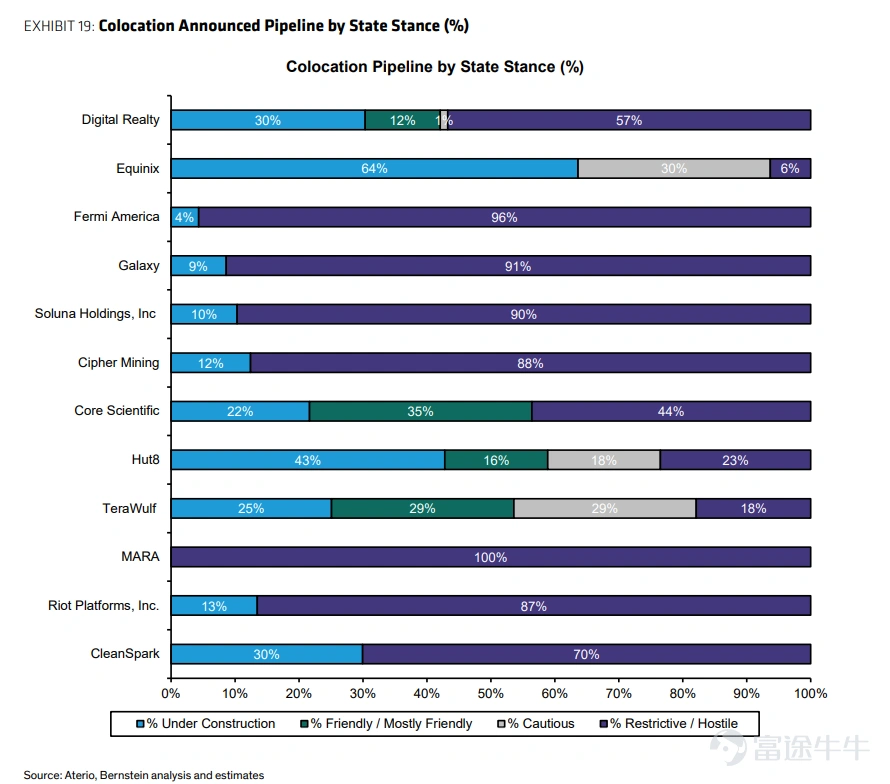
Source: Bernstein
What key timelines should we monitor going forward?
Whether policy risks will truly translate into a slowdown in construction remains to be confirmed by subsequent approval and legislative outcomes. According to Bernstein's analysis, investors should focus on the following events:
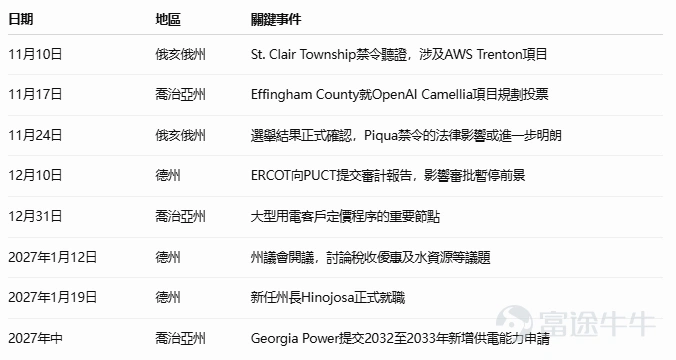
Source: Bernstein
Overall, Bernstein believes that data center construction in the US remains a significant driver of local economic growth and employment, which will limit the willingness of local governments to completely block investments.
Past cases also show that tough policies proposed during election campaigns do not necessarily materialize fully as originally promised.Future policy changes are more likely to manifest in the allocation of electricity costs, reduction of tax incentives, and stricter approval requirements, rather than large-scale cancellations of data center projects.
For the AI industry chain, this also means the market may need to reassess the risks associated with different companies. Rather than simply comparing planned future capacity in GW, whether projects have commenced construction and secured power access and necessary approvals will become more critical criteria for evaluation.
Risk Disclaimer: The above content only represents the author's view. It does not represent any position or investment advice of Futu. Futu makes no representation or warranty.Read more


Comments (3)
to post a comment
30
43