Palantir and others hit new highs; which software stocks are worth watching?

AI software stocks stage a comeback! Palantir, Okta, and others hit new highs. Which of these six sectors stands to benefit the most?
Recently, the U.S. software sector has seen a strong rebound.
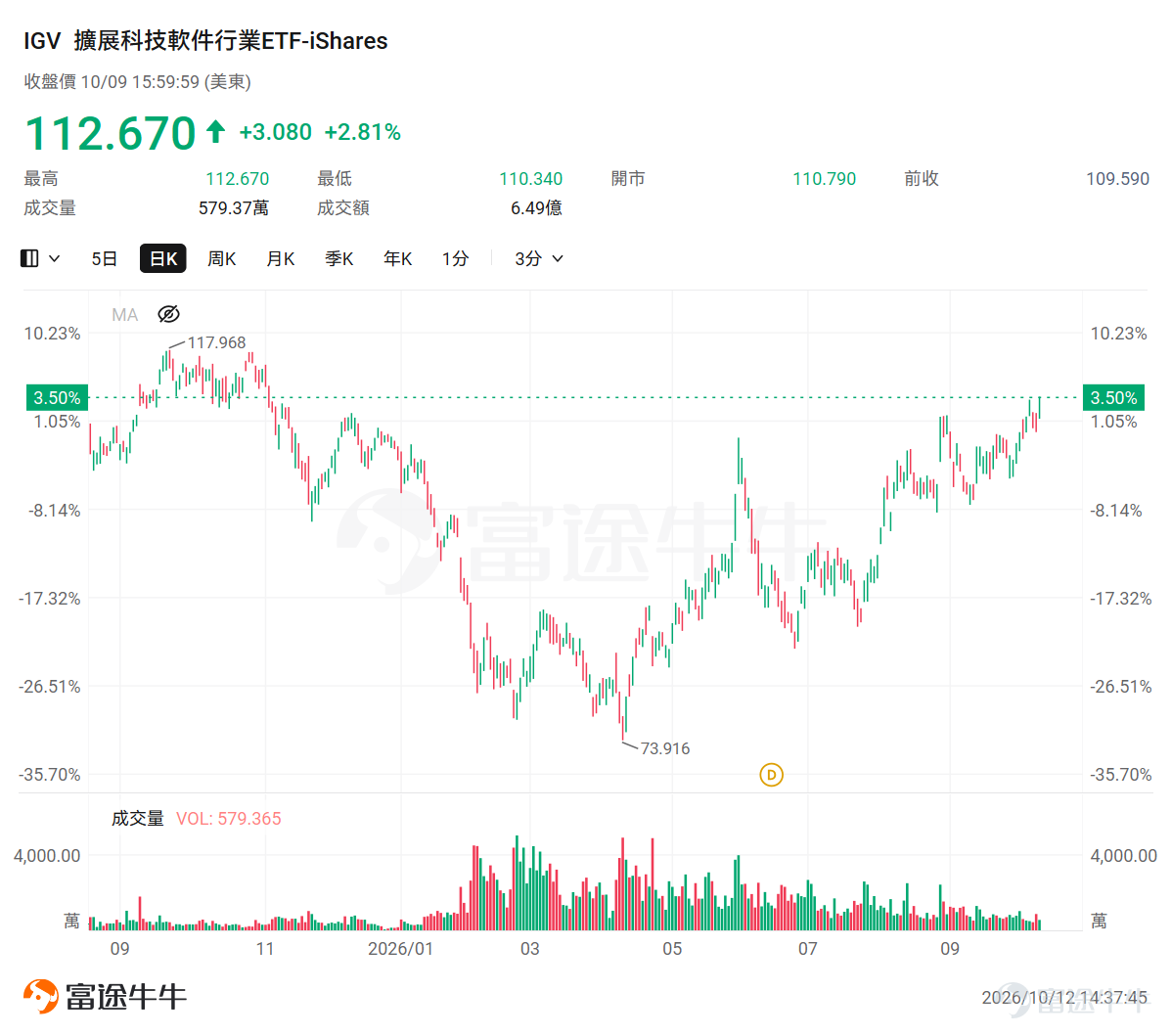
As of last Friday, the software industry ETF $iShares Expanded Tech-Software Sector ETF (IGV.US)$ rose to its highest level since November 2025, setting a new year-to-date high.
![Recently, the U.S. software sector has seen a strong rebound. As of last Friday, the software industry ETF $iShares Expanded Tech-Software Sector ETF (IGV.US)$ rose to its highest level since November 2025, setting a new year-to-date high. Regarding individual stocks, $Palantir (PLTR.US)$ 、 $Fortinet (FTNT.US)$ 、 $Datadog (DDOG.US)$ 、 $Okta (OKTA.US)$ Software stocks such as [tickers] all hit new highs last week; in terms of year-to-date gains, $DigitalOcean (DOCN.US)$ 、 $Okta (OKTA.US)$ 、 $Fortinet (FTNT.US)$ [tickers] have recorded gains of over 140%. Behind this rebound, market sentiment regarding the relationship between AI and the software industry is quietly shifting. Early this year, as AI Agent capabilities continued to improve, the market worried that traditional SaaS software would be replaced, leading to a collective sell-off in software stocks. However, as enterprise AI applications are gradually being implemented, investors are beginning to reassess the actual impact of AI on software companies. Market focus is shifting from 'Will AI replace software?' to 'Which software companies can benefit from AI development?' According to LSEG data cited by Reuters, market expectations for the software sector's earnings growth rate in 2026 have risen from late March...](https://nnqimage.futunn.com/sns_client_feed/900080/20261012/web-1791795424220-jGrxFYDP5I.png/big?area=1&is_public=true&imageMogr2/ignore-error/1/format/webp)
--
--
--
Regarding individual stocks, $Palantir (PLTR.US)$ 、 $Fortinet (FTNT.US)$ 、 $Datadog (DDOG.US)$ 、 $Okta (OKTA.US)$ Software stocks such as [tickers] all hit new highs last week; in terms of year-to-date gains, $DigitalOcean (DOCN.US)$ 、 $Okta (OKTA.US)$ 、 $Fortinet (FTNT.US)$ [tickers] have recorded gains of over 140%.
![Recently, the U.S. software sector has seen a strong rebound. As of last Friday, the software industry ETF $iShares Expanded Tech-Software Sector ETF (IGV.US)$ rose to its highest level since November 2025, setting a new year-to-date high. Regarding individual stocks, $Palantir (PLTR.US)$ 、 $Fortinet (FTNT.US)$ 、 $Datadog (DDOG.US)$ 、 $Okta (OKTA.US)$ Software stocks such as [tickers] all hit new highs last week; in terms of year-to-date gains, $DigitalOcean (DOCN.US)$ 、 $Okta (OKTA.US)$ 、 $Fortinet (FTNT.US)$ [tickers] have recorded gains of over 140%. Behind this rebound, market sentiment regarding the relationship between AI and the software industry is quietly shifting. Early this year, as AI Agent capabilities continued to improve, the market worried that traditional SaaS software would be replaced, leading to a collective sell-off in software stocks. However, as enterprise AI applications are gradually being implemented, investors are beginning to reassess the actual impact of AI on software companies. Market focus is shifting from 'Will AI replace software?' to 'Which software companies can benefit from AI development?' According to LSEG data cited by Reuters, market expectations for the software sector's earnings growth rate in 2026 have risen from late March...](https://nnqimage.futunn.com/sns_client_feed/900080/20261012/web-1791799376442-qn37m2eNKd.png/big?area=1&is_public=true&imageMogr2/ignore-error/1/format/webp)
--
--
--
Behind this rebound, market sentiment regarding the relationship between AI and the software industry is quietly shifting.
Early this year, as AI Agent capabilities continued to improve, the market worried that traditional SaaS software would be replaced, leading to a collective sell-off in software stocks. However, as enterprise AI applications are gradually being implemented, investors are beginning to reassess the actual impact of AI on software companies.
Market focus is shifting from 'Will AI replace software?' to 'Which software companies can benefit from AI development?'
According to LSEG data cited by Reuters, market expectations for the software sector's earnings growth rate in 2026 have been revised up from 13.8% in late March to 20.6%. Meanwhile, after AI hardware stocks such as semiconductors accumulated significant gains, some market participants are beginning to focus on the possibility of capital rotating into the software sector.
So, how does Wall Street view this round of rebound? Which sub-sectors are worth watching?
How does Wall Street view the rebound in software stocks?
Recently, Wall Street institutions such as Goldman Sachs and JPMorgan have analyzed the impact of AI on the software industry. Contrary to the previous market consensus that AI would disrupt traditional SaaS, major banks are now placing greater emphasis on the business differences among various software companies.
Goldman Sachs: The market is overly concerned about the AI shock; corporate core data and business processes remain valuable
Goldman Sachs pointed out that the recent decline in software stocks primarily reflected investors' concerns about the industry's long-term prospects, rather than a sudden deterioration in corporate fundamentals.
The bank believes that the impact of AI on software companies cannot be generalized. While software relying on simple user interfaces and standardized functions may indeed face replacement risks from AI, software platforms that hold core enterprise data and support critical business processes still maintain strong competitive advantages.
In particular, demand in areas such as data management, workload orchestration, cybersecurity, and system recovery may further increase as enterprises deploy more AI applications.
JPMorgan: Divergence in the software industry is intensifying; bullish on cloud infrastructure, cybersecurity, and data platforms
JPMorgan believes that AI is changing the business models, pricing strategies, and competitive landscape of the SaaS industry. Although the fundamentals of software companies are expected to improve in the first half of 2026, the market is no longer willing to assign the same valuations to all software companies. Investors are focusing more on whether companies can translate AI demand into revenue growth.
In terms of specific segments, JPMorgan is relatively bullish on cloud infrastructure, cybersecurity, and data platforms. These businesses are closely tied to the operation of enterprise IT systems, and as the scale of AI applications expands, demand for related products is expected to grow in tandem.
Synthesizing the views of both institutions, the software industry is not benefiting uniformly from AI; instead, it may face a new round of divergence. Companies with strong control over core enterprise data, critical workflows, and underlying IT systems are relatively more likely to benefit, while software with functions easily replaced by AI may still face competitive pressure.
Six major software tracks have emerged. Which companies are worth watching?
Based on practical enterprise AI applications, the software industry can be broadly categorized into six directions: AI data management, AI networking and deployment, enterprise AI applications, AI development and operations (DevOps), AI cybersecurity, and AI content creation and commercialization.
The growth logic in these areas varies; some benefit directly from increased data and network traffic driven by AI adoption, while others rely on existing enterprise customers and business processes to convert AI capabilities into new revenue streams.
![Recently, the U.S. software sector has seen a strong rebound. As of last Friday, the software industry ETF $iShares Expanded Tech-Software Sector ETF (IGV.US)$ rose to its highest level since November 2025, setting a new year-to-date high. Regarding individual stocks, $Palantir (PLTR.US)$ 、 $Fortinet (FTNT.US)$ 、 $Datadog (DDOG.US)$ 、 $Okta (OKTA.US)$ Software stocks such as [tickers] all hit new highs last week; in terms of year-to-date gains, $DigitalOcean (DOCN.US)$ 、 $Okta (OKTA.US)$ 、 $Fortinet (FTNT.US)$ [tickers] have recorded gains of over 140%. Behind this rebound, market sentiment regarding the relationship between AI and the software industry is quietly shifting. Early this year, as AI Agent capabilities continued to improve, the market worried that traditional SaaS software would be replaced, leading to a collective sell-off in software stocks. However, as enterprise AI applications are gradually being implemented, investors are beginning to reassess the actual impact of AI on software companies. Market focus is shifting from 'Will AI replace software?' to 'Which software companies can benefit from AI development?' According to LSEG data cited by Reuters, market expectations for the software sector's earnings growth rate in 2026 have risen from late March...](https://nnqimage.futunn.com/sns_client_feed/900080/20261012/web-1791798869828-qrCOFl4eR6.png/big?area=1&is_public=true&imageMogr2/ignore-error/1/format/webp)
--
--
--
1. Cybersecurity: Increased AI adoption drives a simultaneous rise in enterprise security demands.
Cybersecurity has been one of the stronger-performing sectors in the recent rebound of software stocks. As enterprises deploy more AI agents, the scope of cybersecurity protection is expanding. Beyond employee accounts and traditional applications, companies now need to manage the identities, operational permissions, and data access behaviors of AI agents. Meanwhile, AI may also be used for cyberattacks, further increasing the demand for enterprise security protections.
Goldman Sachs previously pointed out that cybersecurity firms, having accumulated technology over the long term, are now equipped to handle new types of threats. Relevant companies include $CrowdStrike (CRWD.US)$ 、 $Palo Alto Networks (PANW.US)$ 、 $Fortinet (FTNT.US)$ and $Okta (OKTA.US)$ 。
Among them, CrowdStrike primarily provides endpoint security and threat detection services; Palo Alto Networks' business covers networking, cloud, and security operations; Fortinet focuses on cybersecurity hardware and software; and Okta specializes in identity authentication and access management.
Going forward, it will be worth watching whether increased enterprise spending on AI security can drive sustained growth in orders, customer expenditure, and profits for these companies.
2. AI Data Management: Enterprise AI implementation relies on underlying data support
AI models can assist enterprises in analyzing information, generating content, and executing tasks. However, to truly apply them in business scenarios such as finance, sales, and supply chain management, access to accurate, complete, and secure enterprise data is still required. Therefore, as AI applications become more deeply integrated into daily enterprise operations, the importance of data storage, management, and retrieval is increasing.
Relevant companies include $Oracle (ORCL.US)$ 、 $Snowflake (SNOW.US)$ 、 $MongoDB (MDB.US)$ and $NetApp (NTAP.US)$ , covering enterprise databases, cloud data platforms, developer databases, and data storage infrastructure.
Unlike some SaaS products aimed at end-users, data management systems are typically tightly integrated with an enterprise's existing IT architecture, resulting in relatively high replacement costs. Even if employees increasingly use AI Agents to handle work in the future, these AI systems will still need to access and manage the enterprise's legacy data.
However, increased data demand does not necessarily lead to proportional profit growth. Investors should still focus on whether related companies can effectively increase customer usage, product pricing, and profitability.
3. AI Development and Operations (DevOps): As AI application scale expands, monitoring and management needs increase
As enterprises integrate AI into more application scenarios, ensuring stable system operation has become a new technical challenge. Especially when enterprises run multiple AI Agents simultaneously, it is necessary not only to monitor system performance but also to track model response times, error rates, resource consumption, and operating costs.
This creates new demand for software development and operations tools, with relevant companies including $Datadog (DDOG.US)$ 、 $Dynatrace (DT.US)$ 、 $Elastic (ESTC.US)$ and $Gitlab (GTLB.US)$ 。
Among them, Datadog and Dynatrace primarily provide cloud monitoring and observability services; Elastic is involved in search and data analytics; and GitLab provides software development and delivery management tools.
The growth of such companies is closely linked to enterprise cloud workloads. If AI applications continue to expand in the future, it is expected to drive increased usage of monitoring, analytics, and development tools.
However, whether related companies can benefit still depends on whether the incremental demand generated by AI businesses is sufficient to accelerate overall revenue and earnings growth.
4. Three other key directions: network deployment, enterprise applications, and AI commercialization
In addition to the three areas mentioned above, AI networking and deployment, enterprise applications, and the commercialization of AI-generated content are also worth watching.
Regarding AI networking and deployment, $Cloudflare (NET.US)$ 、 $F5 Inc (FFIV.US)$ Companies such as Palo Alto Networks, CrowdStrike, Fortinet, and Datadog primarily provide network connectivity, application delivery, and security services. As AI applications drive increased network traffic, corporate demands for network performance, security, and service stability are expected to rise.
Regarding enterprise AI applications, $Salesforce (CRM.US)$ 、 $ServiceNow (NOW.US)$ and $Palantir (PLTR.US)$ Companies like Palantir, Okta, and Gitlab are integrating AI capabilities into existing enterprise software and workflows. For example, using AI to assist enterprises with tasks such as customer service, IT management, and data analysis. The key investment thesis for these companies is whether AI features can drive increased spending from existing customers and attract new ones.
Regarding AI content creation and commercialization, $Adobe (ADBE.US)$ 、 $Shopify (SHOP.US)$ and $Applovin (APP.US)$ Companies in this space are introducing AI into content creation, e-commerce operations, and advertising technology to enhance product functionality or business efficiency.
It is important to note that competition in application software may be more intense than in underlying infrastructure. While AI enhances enterprise software capabilities, it may also lower the barriers to development and usage for certain software, putting pressure on existing products and pricing models.
Therefore,The ability to launch AI features is not the only focus; more importantly, it depends on whether customers are willing to pay for these features.
Can the rebound in software stocks be sustained? Watch for three key signals next.
Following the recent rebound, some software stocks have gained over 100% year-to-date. As valuations recover, the market may increasingly focus on whether corporate earnings can keep pace with stock price performance.
First, whether Q3 earnings reports can validate revenue growth driven by AI.
As the U.S. Q3 earnings season kicks off, the market will focus on software companies' AI-related revenue, order growth, customer spending, and full-year performance guidance.
If companies can demonstrate that AI demand is driving actual revenue and earnings growth, it will help support stock prices. Conversely, if results fail to meet market expectations, stocks with significant prior gains may face correction pressure.
Second, whether capital continues to rotate from AI hardware to the software sector.
According to a Reuters report on October 6, the S&P 500 Software & Services Index had risen only about 5% year-to-date at that time, significantly lagging behind the Philadelphia Semiconductor Index.
Adam Turnquist, Chief Cross-Asset Strategist at LPL Financial, believes that the software sector is regaining its leadership momentum and has the potential to outperform semiconductors in the future.
After previous sharp rallies, AI hardware stocks such as semiconductors have accumulated high market expectations. In contrast, the software sector was previously suppressed by concerns over AI substitution risks, leaving room for valuation repair in some companies.
However, whether software stocks can continue to outperform depends on the extent of improvement in earnings expectations, not just capital rotation.
Finally, the impact of AI on traditional SaaS business models still needs to be observed.
Goldman Sachs believes that the impact of AI on software companies varies significantly. Platforms that hold core enterprise data and are deeply integrated into critical business processes are relatively harder to replace; however, products with simple functionalities that primarily rely on per-seat licensing may face greater competitive pressure.
Brian Mulberry, a strategist at Zacks Investment Management, also warned that the second half of 2027 could become a crucial testing period for the software industry. As more data center computing power comes online, the capabilities of AI programming and automation tools are expected to further improve, potentially increasing competitive pressure on traditional software companies.
In other words,The current rebound in software stocks does not mean that the disruption risk posed by AI to the traditional software industry has disappeared.
In the short term, upward revisions to earnings expectations and sector valuation repair are likely to continue providing support; but in the medium to long term, whether software companies can translate AI demand into sustained revenue and profit growth remains the key determinant of stock performance.
For investors, in addition to monitoring the overall trend of the software sector, it is even more important to pay attention to performance changes in different sub-sectors, and to identify which companies can truly expand market share and enhance profitability during the widespread adoption of AI.
Risk Disclaimer: The above content only represents the author's view. It does not represent any position or investment advice of Futu. Futu makes no representation or warranty.Read more


Comments (4)
to post a comment
24
28