Micron expands share buybacks! Will the memory chip rebound gain momentum?

Earnings Options Strategy | Micron's earnings report is imminent! How should we interpret the massive options bets placed by large capital?
$Micron Technology (MU.US)$The latest earnings results are expected to be released after the market close on Wednesday, September 30 (Eastern Time).As the continuous build-out of AI infrastructure drives up demand for High Bandwidth Memory (HBM), server DRAM, and data center SSDs, the market generally expects Micron to deliver strong earnings. Beyond "how much profit was made this quarter" and "whether earnings beat expectations," investors may be more concerned with these three questions:How long can the supply shortage in memory chips last? Can Micron maintain its competitiveness in the HBM4 era? After significantly increasing capital expenditures, will Micron fall back into the old trap of oversupply common in the traditional storage industry?

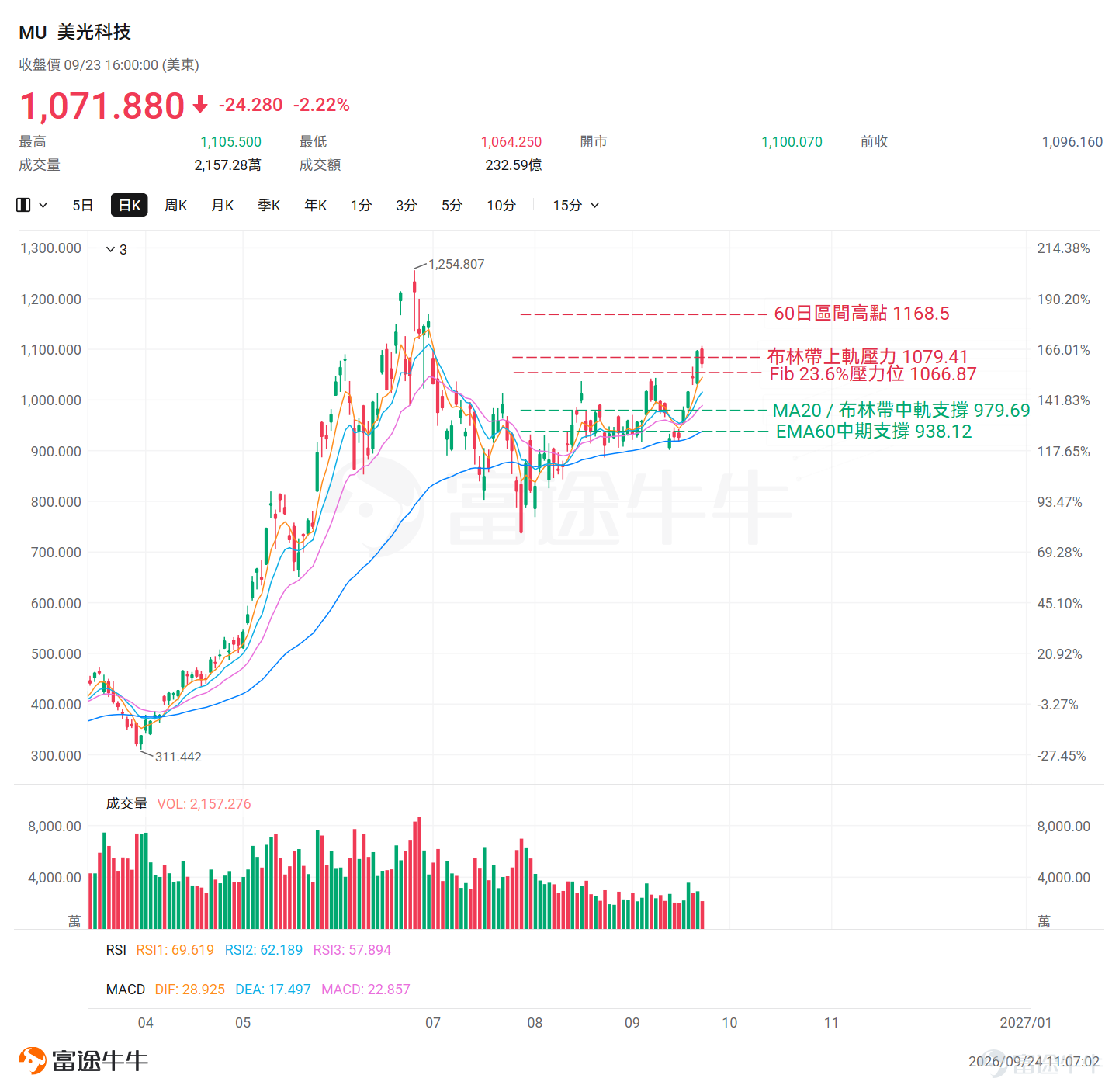
Micron closed down 2.22% on September 23, with a closing price of $107.88. From a technical perspective, the EMA moving averages show a perfect bullish alignment,indicating a clear upward trend. Regarding key price levels,the core support levels below the current stock price are located at $97.97, where the 20-day Moving Average (MA20) coincides with the middle Bollinger Band, and at $93.81, corresponding to the 60-day Exponential Moving Average (EMA60).Resistance above is concentrated at$1,066.87 at the 23.6% Fibonacci retracement level, $1,079.41 at the upper Bollinger Band, and $1,168.50 at the 60-day range high.
Key Earnings Focus Areas
1) Guidance for next quarter's earnings
For companies in an upcycle, historical results typically only reflect supply and demand conditions from the previous quarter, whereas guidance for the next quarter is more decisive for stock price direction. Regarding Micron's latest earnings,in addition to management's guidance on next quarter's revenue, EPS, and gross margin, investors should also pay close attention to the company's initial outlook on product demand for fiscal year 2027.
Previously, Micron had forecast that the chip shortage would persist. If management maintains or even strengthens this view, it will help convince the market that the current supercycle in memory chips has not yet peaked; conversely, if their tone shifts toward caution, it could signal a market re-evaluation of memory pricing and profit expectations.
2) How long can ultra-high gross margins be sustained?
Micron reported a striking non-GAAP gross margin of 84.9% in its FY2026 Q3 results, a level rarely seen in the semiconductor industry. However, once gross margins reach such elevated levels, market focus shifts from "can it increase by a few more percentage points" to "is this margin level sustainable."
Investors should monitor management's comments—if the margin is primarily driven by the HBM product mix, cost advantages, and long-term customer agreements, its sustainability is relatively stronger; if it relies mainly on short-term price hikes for traditional DRAM and NAND, once $Samsung Electronics (005930.KR)$$SK Hynix (000660.KR)$ synchronous capacity expansion begins to exert marginal pressure on pricing, gross margins could decline rapidly.
3) HBM4 mass production progress and scheduled capacity for 2027
HBM is key to Micron's transition from a traditional cyclical memory stock to a core supplier of AI infrastructure. Previous information indicated that Micron's HBM capacity for the full year of 2026 and even early 2027 has been largely booked by customers.
Therefore, this conference call requires a focus on Micronspecifically, whether it can provide more committed figures for supply allocation in 2027, and whether it can narrow the gap with SK Hynix in terms of share within Nvidia's supply chain.
4) Capital expenditure pace
Micron previously projected that capital expenditure would continue to increase in FY2027. The market's concern is that the capacity being built today to meet AI demand could evolve into oversupply in the future.
If management can demonstrate that new investments are primarily directed toward HBM and advanced process nodes, supported by long-term orders from major clients, then high capital expenditure can be understood as a long-term commitment to certain demand. Otherwise, the market may worry that Micron is re-entering the traditional cycle of 'price hikes—capacity expansion—oversupply—price cuts'.
Options Market Analysis

Sentiment in Micron's options market has shifted—the Put/Call open interest ratiohas fallen from a June high of approximately 1.5 to 1.03; total open interest reached 3.1735 million contracts, indicating growing market optimism regarding the earnings outlook for September 30.

Meanwhile, significant capital inflows were observed during the trading session on September 22Purchased multiple Micron call options with a strike price of $1,060 and an expiration date of October 2 for $11.78 million. With only 10 days remaining until expiration, this represents a strong bet on earnings-driven momentum.

From the perspective of Gamma distribution,There is a call wall at $1,100 on the upside and a put wall at $1,040 on the downside.If the stock price breaks above the upper call wall, it will force market makers to chase the rally, potentially triggering a short squeeze; if it falls below, selling pressure will accelerate. The options market is pricing in an expected volatility range of approximately ±10% for Micron's earnings day.
Option Strategy Reference 1: Covered Call

(The option strategies displayed on screen do not constitute any investment advice or guarantee; market conditions change frequently, and option prices may not reflect real-time situations.)
Suitable for: For investors who currently hold Micron shares, have limited expectations for post-earnings upside, and wish to exchange some of that limited upside potential for 'protection'.
Reference Strike Price:$1200
Reference Expiration Date:2026-10-09
Reference Premium:Approx. $2,325 per contract, equivalent to a reduction in holding cost of $23 per share
Strategy Logic:If the stock price rises moderately or consolidates after the earnings release, the full premium is retained. If the stock price exceeds the strike price, the underlying shares are sold for profit at the corresponding level, with the premium serving as additional compensation; the effective selling price will be higher than the stock price alone. The only trade-off is forfeiting any further upside potential above the strike price.
Options Reference Strategy 2: Cash-Secured Put

(The option strategies displayed on screen do not constitute any investment advice or guarantee; market conditions change frequently, and option prices may not reflect real-time situations.)
Suitable for:Suitable for investors who are confident that Micron's stock will rise after earnings, or who are willing to buy shares at a lower price if the stock falls after earnings.
Reference Strike Price:$1000
Reference Expiration Date:2026-10-16
Reference Premium:Approx. $3,615 per contract, equivalent to a reduction in holding cost of $36 per share
Strategy Logic:If earnings exceed expectations, the PUT will likely expire worthless; if earnings meet expectations or miss slightly but the stock price decline is limited, the PUT will also likely expire worthless due to IV normalization and time decay; if earnings significantly miss expectations and the stock price falls below $1,000, you may choose to close the position early to cut losses, avoiding forced assignment of the underlying stock.
Risk Management Reminder
Although short-option strategies generally have a high probability of profit, investors must still implement sound risk management:
Position management is core:The biggest risk for option sellers lies in black swan events. It is recommended that margin usage for a single underlying asset does not exceed 20% of total capital. Do not sell options beyond your capacity to take delivery just to chase premiums.
Covered calls require attention to rolling positions:When a Covered Call is deep in-the-money, if you remain bullish on the underlying stock, consider buying back the current option to close the position and simultaneously selling an option with a further expiration date and a higher strike price. This avoids having your shares forcibly sold at a low price.
Cash-secured puts require vigilance against left-tail risk:If the stock price drops significantly due to deteriorating fundamentals, do not mechanically hold on. Instead, cut losses or roll down the position based on your risk tolerance.
Finally, we’ve got a little perk for our fellow investors—feel free to claim it!Options Starter Pack
*This event is exclusively for invited HK users. Click to learn more.Detailed terms and conditions of the promotion >>
Market conditions are complex and ever-changing,Options strategiesToo many choices and unsure how to proceed? Let Futubull help you build a strategy in three simple stepsOptions strategies, making investing simple and efficient!

Options Risk Disclosure:An option is a contract that gives the holder the right, but not the obligation, to buy or sell an asset at a fixed price on a specific date or at any time before that date. Option prices are influenced by various factors, including the current price of the underlying asset, the strike price, time to expiration, and implied volatility. Implied volatility reflects the market's expectation of future volatility over the option's lifespan; it is a figure derived backwards from the Black-Scholes pricing model and is generally regarded as an indicator of market sentiment. When investors anticipate greater volatility, they may be willing to pay higher premiums for options to help hedge risk, thereby leading to higher implied volatility. Traders and investors use implied volatility to assess the attractiveness of option prices, identify potential mispricing, and manage risk exposure.
Disclaimer:This content does not constitute an offer, solicitation, recommendation, opinion, or guarantee regarding any securities, financial products, or instruments. The risk of loss in trading options can be substantial. In certain circumstances, the losses you incur may exceed the initial margin deposited. Even if you set contingent orders, such as "stop-loss" or "limit" orders, you may not be able to avoid losses. Market conditions may prevent such orders from being executed. You may be required to deposit additional margin within a short period. If you fail to provide the required amount within the specified time, your open positions may be liquidated. However, you will still be responsible for any deficit in your account resulting from such liquidation. Therefore, before trading, you should research and understand options, and carefully consider whether such trading is suitable for you based on your financial situation and investment objectives. If you trade options, you should be familiar with the procedures for exercising options and upon option expiration, as well as your rights and obligations when exercising options and at expiration. Options trading carries extremely high risk and is not suitable for all investors. Before engaging in any options trading strategy, investors should carefully read"Characteristics and Risks of Standardized Options"。
Risk Disclaimer: The above content only represents the author's view. It does not represent any position or investment advice of Futu. Futu makes no representation or warranty.Read more


Comments (21)
to post a comment
93
203