
Analyzing Yuexiu Property's (00123.HK) interim report from three dimensions: financial foundation, business model, and institutional dividends
On August 28, the People's Bank of China, the National Financial Regulatory Administration, and the China Securities Regulatory Commission simultaneously introduced multiple policies involving reforms to real estate credit and support for capital markets.
The lead bank system for development loans has been established, with loan tenors aligned to project construction and sales cycles. The term for individual housing loans has been extended to 40 years. Individual housing loans for pre-sold projects must be disbursed only after project completion filing. On the capital markets front, there is explicit support for listed real estate companies in refinancing, M&A restructuring, and issuing CMBS and ABS. The issuance of REITs for rental housing and urban renewal projects is being promoted, while the rollout of commercial real estate REITs is proceeding steadily and prudently.
This policy combination points to a clear logic: the institutional framework for real estate is shifting from reliance on entity-level credit to project-based assessment, and from high-leverage expansion to refined management and control.
Yuexiu Property (00123.HK), which disclosed its interim results on the same day, happens to fall within the beneficiary range of this policy shift. In the first half of the year, the company reported revenue of RMB 36.65 billion and contracted sales of RMB 50.51 billion, ranking eighth in China Real Estate Information Corporation’s (CRIC) full-scope rankings. On the profit front, it continued to face pressure from industry adjustments, with profit attributable to equity holders at RMB 90 million and core net profit at RMB 80 million. The company maintained its interim dividend distribution, keeping the payout ratio stable at 40% for fifteen consecutive years. $YUEXIU PROPERTY (00123.HK)$
This financial report offers a window to observe where the company’s fundamentals stand at the juncture of institutional transition.
01
Three key observation anchors to verify cross-cycle operational capabilities
To assess the true situation of a real estate developer during a period of institutional transition, it is necessary to identify several key observation anchors. Self-sustaining cash flow capability, land bank quality and conversion efficiency, as well as financing costs and debt structure—these three indicators are more telling than the income statement.
The first observation anchor is cash flow.
In the first half of the year, Yuexiu Property recorded a net inflow of operating cash flow of RMB 13.77 billion, maintaining positive inflows consecutively. The collection rate for contracted sales increased by 10 percentage points year-on-year to 71%. Against the backdrop of a year-on-year decline in overall funds available across the industry, the ability to consistently generate positive operating cash flow indicates that the core business retains self-sustaining capabilities. This is a baseline metric for determining whether a real estate developer can operate independently.
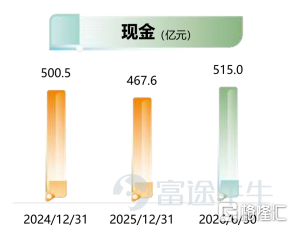
Self-sustaining capability ultimately translates into cash reserves. As of June 30, 2026, the company’s cash balance increased by 10.1% from the beginning of the year to RMB 51.5 billion, covering short-term debt by 2.1 times.

(Source: Company Data)
Currently, the value of cash reserves will become even more prominent amid institutional changes. New policies require that personal housing loans for pre-sale projects be disbursed only after completion filing, meaning the time cycle from project launch and sales to actual receipt of mortgage payments will be extended. For real estate developers with weak cash reserves that rely on sales collections to maintain operations, this institutional change may bring liquidity pressure.
It is evident that Yuexiu Property’s current cash reserves are sufficient to cover the phased impact brought about by this institutional transition, while also preserving room for proactive moves in the land market and M&A opportunities.
The second observation anchor is land bank quality.
In the first half of the year, Yuexiu Property acquired six land parcels across five cities, with a total gross floor area (GFA) of 680,000 square meters and an equity investment of RMB 7 billion. Notably, 96.8% of this equity investment was concentrated in six core cities, including Guangzhou, Shanghai, and Chengdu. As of the end of the first half, the company's total land bank stood at 16.57 million square meters, with 94% located in Tier-1 and Tier-2 cities. The total unsold property value was approximately RMB 290.5 billion, with about 73% attributed to the six core cities.

(Source: Company Data)
Against the backdrop of an overall sluggish land market, this selective counter-cyclical land replenishment reflects its judgment on the medium-to-long-term value of core cities. Additionally, the company recorded RMB 132.4 billion in contracted sales not yet recognized as revenue, providing relatively clear visibility for future revenue recognition.
The third key observation point is financing costs.
The company's weighted average annual borrowing rate fell below 3% for the first time, reaching 2.91%, a year-on-year decrease of 25 basis points. The coupon rate on the RMB 1.9 billion domestic corporate bonds issued in June was only 1.97%. The net gearing ratio dropped to 49.2%, nearly 6 percentage points lower than at the end of 2025. The company remained in the 'green' category across all three red-line metrics. Both S&P and Fitch maintained their BBB- investment-grade credit ratings with a stable outlook.

(Source: Company Data)
New policies explicitly support refinancing and corporate bond issuance for listed real estate developers. Yuexiu Property's current financing costs and credit rating give it a first-mover advantage during this policy window.
The convergence of cash flow, land bank structure, and financing costs leads to a clear conclusion. While the industry is still digesting the legacy issues of high-leverage expansion, Yuexiu Property has adjusted its financial foundation to a relatively comfortable position. This financial framework provides sufficient flexibility to meet new policy requirements for project-level fund closure and to cope with pressure from elongated collection cycles on the sales side, serving as the foundational condition for navigating institutional transitions.
02
"One Core, Two Wings": Moat Deepens During Transformation
Financial data determines current survival status, while the construction of a business model dictates the position a company can occupy in the industry's new equilibrium.
The "One Core, Two Wings" strategic framework gradually formed by Yuexiu Property in recent years aligns well with new policies on multiple levels.
The first alignment is the extension of property management services from residential to non-residential sectors.
Yuexiu Services reported total revenue of RMB 1.915 billion in the first half of the year. Revenue from basic property management services reached RMB 840 million, a year-on-year increase of 17.3%, raising its share of total revenue to 44%. Newly contracted gross floor area (GFA) totaled 10.42 million square meters, up 74.8% year-on-year, with non-residential segments accounting for 68%.
The expansion from residential property management into non-residential sectors such as corporate headquarters, public facility support, and airport cultural tourism essentially extends property management capabilities across multiple scenarios. This shift is crucial for diversifying the revenue structure and enhancing resilience against economic cycles.
The second synergy lies in the alignment between commercial operations and REITs policies.
Yuexiu Real Estate Investment Trust generated revenue of RMB 767 million in the first half of the year, with office properties contributing approximately RMB 329 million. High-quality commercial and office assets in core cities demonstrated strong operational resilience.
The company continues to introduce high-quality brands and industrial resources. In the first half of the year, the Racecourse Project successfully secured two benchmark brands, Waldorf Astoria and SKP, while the Google Cross-Border E-Commerce Acceleration Center officially settled in Guangzhou IFC. Continuous improvement in asset quality provides fundamental support for the long-term stability of commercial operations.
The CSRC's new policy explicitly calls for the steady and prudent development of commercial real estate REITs, supporting the issuance of REITs for rental housing and urban renewal projects. For Yuexiu REIT, its asset layout in core cities of the Greater Bay Area positions it with a clear first-mover advantage in this new wave of asset securitization.
In particular, as a Hong Kong-listed commercial real estate investment trust platform, Yuexiu REIT occupies a relatively favorable position in this round of institutional reforms, benefiting from the combination of its high-quality asset reserves, cross-border platform experience, and policy dividends.

(Source: Company Data)
The third synergy involves the simultaneous advancement of revitalizing existing assets and optimizing the balance sheet.
In the first half of the year, the company generated RMB 4.46 billion in cash by transferring assets such as Nansha IFC, Zhigu Industrial Park, and Yungu Industrial Park to its parent company, Yuexiu Group, resulting in a 1.3 percentage point decrease in the gearing ratio. The simultaneous occurrence of asset lightening, cash accumulation, and deleveraging represents a rare form of proactive management capability during an industry adjustment period.
The logic behind the 'One Core, Two Wings' business model is that the core development business provides scale and cash flow, while property management and commercial operations deliver sustained operating income, creating synergies among the three. When the development business faces cyclical downturns, property management and commercial operations can provide relatively stable income streams.
Yuexiu Services saw its newly contracted gross floor area (GFA) increase by 74.8% year-on-year to 10.42 million square meters in the first half of the year, while Yuejianke's revenue bucked the trend with a 17% rise to RMB 890 million. These figures underscore the independent growth potential of its "two wings" businesses. The introduction of new policies has also provided a clearer institutional pathway for the asset securitization of these two business segments.
Following the release of the new policies, Everbright Securities stated in a research report that leading central and state-owned real estate enterprises, characterized by strong credit profiles and lower financing costs, will continue to benefit from an optimized competitive landscape, establishing a robust "brand moat," while industry concentration is expected to accelerate further. On the same day, Guosen Securities explicitly included Yuexiu Property on its recommended list in its commentary on the new regulations for existing home sales.
03
Conclusion
Yuexiu Property's 2026 interim report reflects the genuine state of a real estate developer operating at the bottom of the industry cycle.
Pressure on profits is an objective reality, reflecting the common challenges faced during the industry's transition period. However, ample cash reserves, low financing costs, a high proportion of land banks in core cities, and consecutive periods of positive operating cash flow, combined with the synergistic effects of its "one core, two wings" business structure, have jointly built a counter-cyclical buffer mechanism.
The introduction of new policies signals that the industry is formally moving from a phase of risk mitigation to one of institutional building, with the potential to reshape the competitive rules of the entire sector. Yuexiu Property's accumulated strengths in cash reserves, financing costs, and asset operations place it in a relatively advantageous position amid this round of institutional reform.
As the industry shifts from scale expansion to quality competition, and from policy arbitrage to institutional building, companies that maintain financial safety margins, exhibit strategic discipline, and construct diversified, synergistic business structures are more likely to find their footing in the new industry equilibrium.
Risk Disclaimer: The above content only represents the author's view. It does not represent any position or investment advice of Futu. Futu makes no representation or warranty.Read more

Comments
to post a comment
1
1