Institutional Q2 Holdings Revealed! What Is "Smart Money" Buying?
After six months of silence, Peter Thiel has made a move again.
As of Q3 2025, Peter Thiel's fund, Thiel Macro, still held Tesla, Microsoft, and Apple; however, by Q4, the fund reduced its 13F reportable holdings to zero, maintaining an empty portfolio in Q1 of this year.
It was not until Q2 of this year that Thiel Macro returned to the US stock market, purchasing eight stocks in one go, raising the total market value of its holdings to approximately $419 million. This marks the fund's first reallocation into public equities since clearing its positions in Q4 last year.
This time, however, Peter Thiel did not buy back Apple, Microsoft, or Tesla, nor did he chase popular AI chip stocks like NVIDIA.
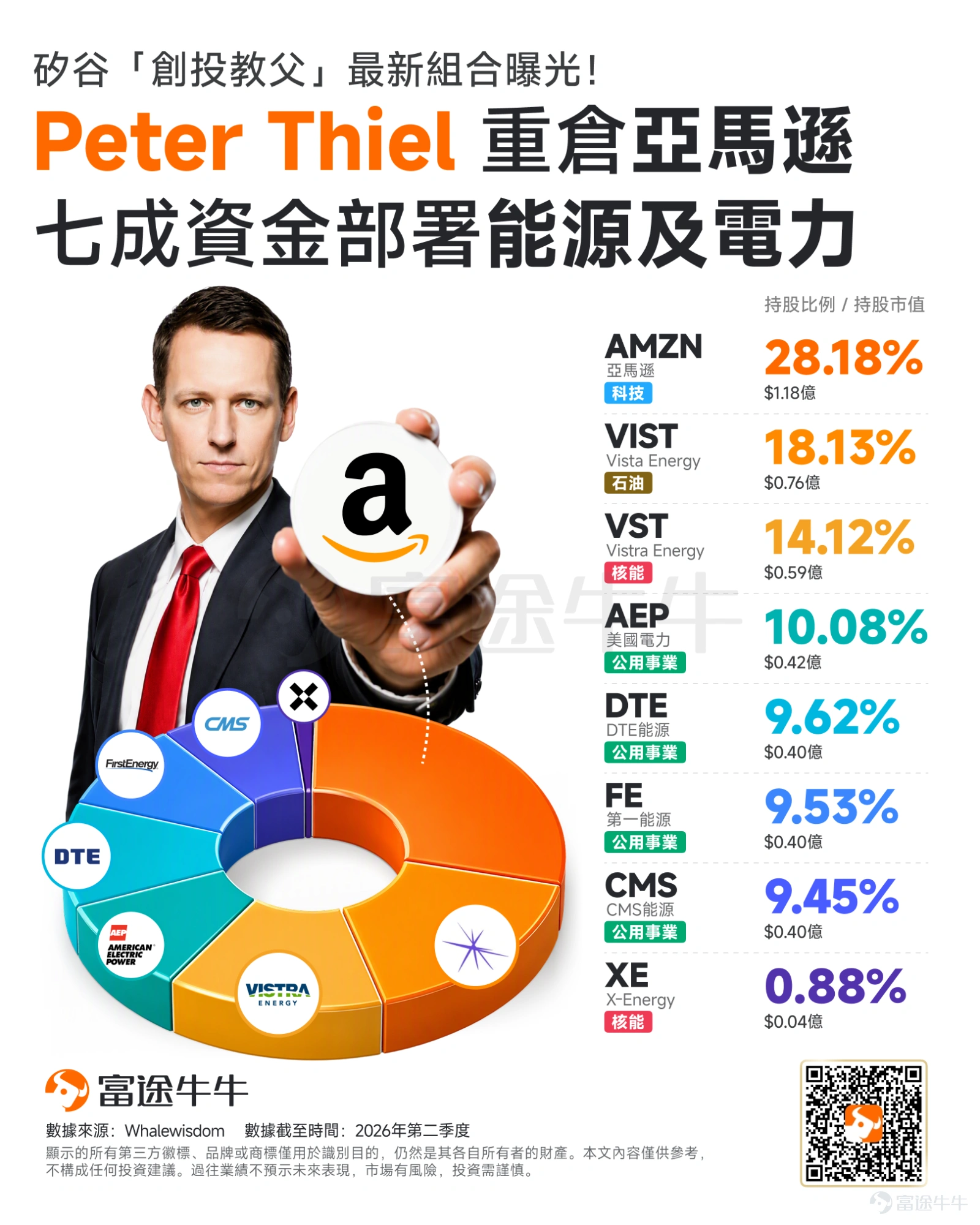
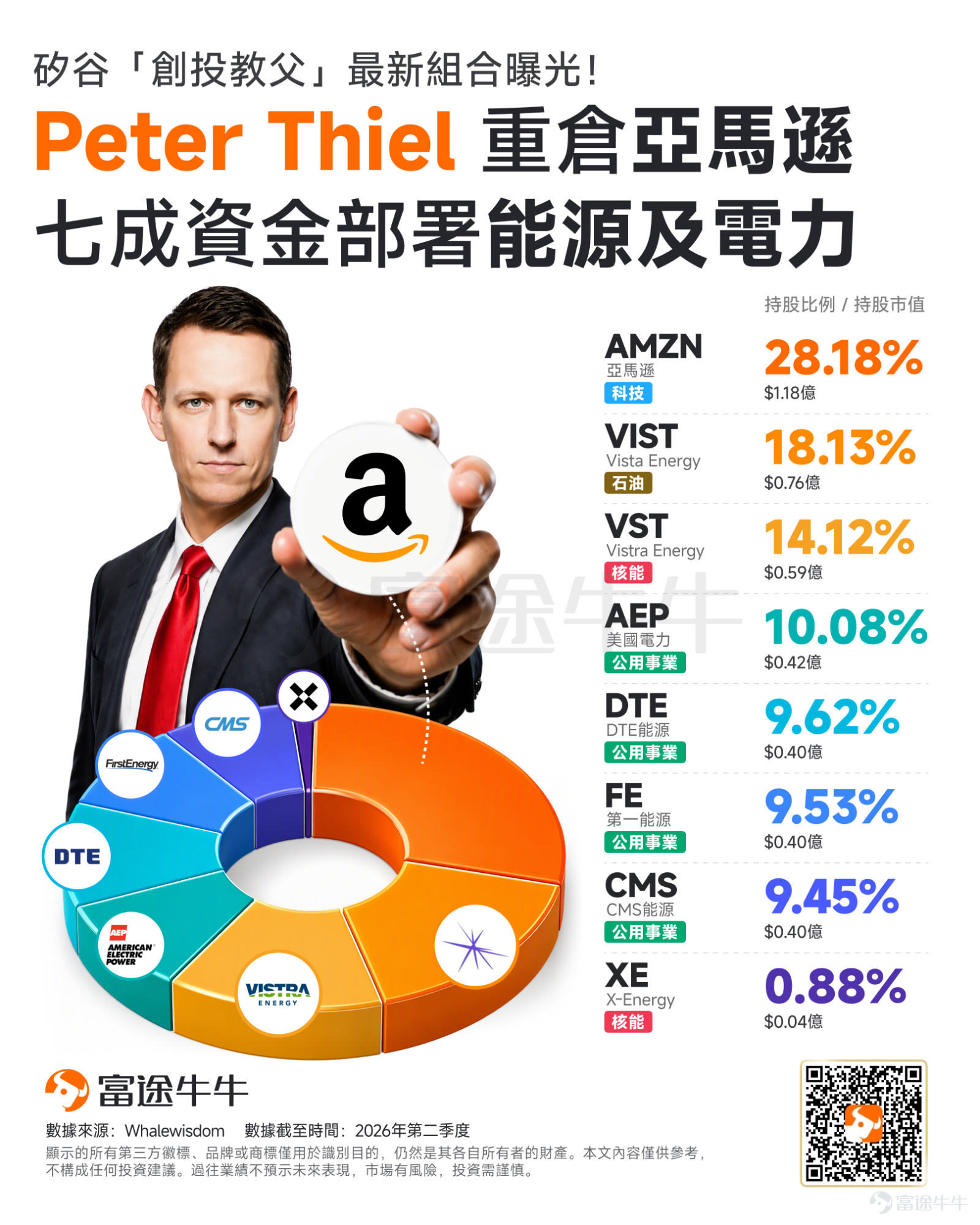
Instead, he made $Amazon (AMZN.US)$ it his largest holding, allocating nearly all remaining capital to energy and power companies. Excluding Amazon, the other seven holdings collectively account for 71.82% of the portfolio, covering power generation, nuclear energy, grid infrastructure, utilities, and traditional oil and gas.

--
--
--
This portfolio sends a clear signal:Peter Thiel has not exited the AI sector; rather, he has shifted his investment focus from computing power itself to the next bottleneck constraining its expansion: electricity.
Amazon has become the largest holding.
Thiel Macro holds 495,000 shares $Amazon (AMZN.US)$, with a market value of approximately $118 million at the end of the quarter, accounting for 28.18% of the portfolio, making it the largest holding.
Amazon plays a unique role in this portfolio. On one hand, AWS is one of the most direct beneficiaries of AI computing demand; on the other, Amazon is also a major purchaser of electricity and nuclear energy for global data centers. The company has committed to investing $500 million in $X-Energy (XE.US)$ , aiming to drive over 5GW of new nuclear capacity by 2039, while X-Energy also appears in Thiel Macro's latest holdings.
In other words, Peter Thiel has simultaneously invested in the demand side of AI computing power and the upstream suppliers providing energy to data centers.
Amazon serves more as the entry point for the entire investment thesis: AWS expansion drives electricity demand, which is then met by nuclear power, power generation companies, and utilities.
Seven energy stocks covering the entire electricity supply chain
Aside from Amazon, Thiel Macro's remaining holdings can be roughly categorized into three groups:
Grid & Utilities: $American Electric Power (AEP.US)$ 、 $DTE Energy (DTE.US)$ 、 $FirstEnergy (FE.US)$ 、 $CMS Energy (CMS.US)$ ;
Notably, Vistra has signed a 20-year power purchase agreement (PPA) with AWS, committing to supply up to 1,200 MW of electricity from its nuclear plants; meanwhile, DTE Energy will provide power for Google's planned 1 GW data center.
The second-largest holding, Vista Energy, which focuses primarily on Argentine shale oil and gas, completes the traditional energy supply link in the portfolio.
From Amazon on the demand side, to Vistra and X-Energy on the generation side, and further to American Electric Power, DTE Energy, FirstEnergy, and CMS Energy in transmission and distribution, Peter Thiel has effectively invested across the entire power value chain supporting AI data centers.
Shifting from "compute trading" to "bottleneck trading"
This shift in holdings does not necessarily indicate that Peter Thiel is bearish on AI.
More accurately, he may be shifting his investment focus from "who can provide the most compute power" to "what will constrain the continued expansion of compute capacity."
While chip production capacity can be increased gradually, power plants, nuclear reactors, transmission lines, and grid connections often require years to build. As large tech companies race to expand AI data centers, the bottleneck limiting their growth is extending beyond GPU supply to include power capacity.
If the AI investment race over the past two years was about who had more GPUs and who could train more powerful models, then the next phase may be about who can secure sufficient electricity, connect to the grid faster, and provide long-term, stable baseload power.
This also explains why nuclear power, natural gas power generation, and utility companies are beginning to emerge as indirect beneficiaries of AI capital expenditure.
The next battleground for AI could well be electricity.
Of course, this document only reflects the US stocks held by the fund at the end of the quarter; it does not represent Peter Thiel's entire asset allocation, nor does it show trading activity during the quarter.
However, the shift from being completely out of the market for two consecutive quarters to establishing a position worth approximately $419 million in one go, with 71.82% of capital concentrated in energy and utility companies, still signals a clear directional trend.
Rather than saying Peter Thiel is exiting AI, it is more accurate to say he is shifting from trading AI 'valuations' to trading AI 'bottlenecks'.
Regardless of which GPU, cloud platform, or large language model ultimately prevails, they all share a common requirement:More abundant and stable electricity supply.

Risk Disclaimer: The above content only represents the author's view. It does not represent any position or investment advice of Futu. Futu makes no representation or warranty.Read more
Comments
to post a comment
55
110