
What was your first ETF purchase?
Has everyone recently opened their trading app and felt like 'the market has dropped so much it makes you question your existence'?
The market really can turn on a dime! On July 27 (U.S. Eastern Time), U.S. tech stocks suffered a sharp sell-off, with semiconductor giant ASML Holding opening significantly lower and plunging further. Beyond pressure from a pullback after reaching elevated levels, bearish news circulated that 'domestically produced DUV lithography equipment has entered the shipment phase,' directly triggering investor concerns over the giant’s market share.
Then, today (July 28), AI hardware stocks in the Hong Kong and broader Asia-Pacific markets also experienced a sharp correction from recent highs, with previously surging segments—including AI memory chips, optical communications, and software—plummeting collectively.
🔍 Institutional Breakdown: The Macro and Fundamental Truth Behind the Sell-Off
According to comprehensive reports from major institutions, this sell-off isn’t driven purely by panic but rather by an interplay of multiple headwinds and a fundamental shift in underlying investment logic:
1️⃣ A 'Paradigm Shift' in AI Investment Logic: From 'Narrative Hype' to 'Demanding Results'
This is the biggest change in today’s market!This downturn doesn’t mean the long-term AI investment thesis has disappeared—it simply reflects a fundamental shift in investor focus. In the past, whenever companies announced they would 'increase AI investment and purchase more chips,' the market responded with applause and high valuations. But now, market sentiment has shifted to relentless questioning:"You've spent tens of billions of dollars on capital expenditures (CapEx)—when exactly will this translate into tangible cash flow and profits?" This concern was fully ignited when recent earnings reports from some tech giants showed negative free cash flow due to massive AI-related investments.
2️⃣ Crowded Trades and Profit-Taking
AI-related stocks have been significantly overvalued and extremely crowded over the past year. Amid growing fundamental doubts, bullish sentiment has wavered, prompting investors to rush to lock in gains and 'take profits off the table,' triggering a collective sell-off in these high-flying sectors.
3️⃣ Reassessment of AI Hardware Outlook
Institutional investors are starting to worry that adoption of next-generation High Numerical Aperture Extreme Ultraviolet (High NA EUV) systems could slow down, potentially leading to temporary saturation and decelerating capacity expansion in the global AI hardware market.
4️⃣ Dual Macro Headwinds: Geopolitical Tinderbox + Rate Panic
– Unresolved Geopolitical TensionsU.S. airstrikes against Iran have continued for nearly two weeks, with the U.S.-Iran conflict remaining deadlocked. This geopolitical crisis has driven up global energy prices, keeping oil prices elevated and exacerbating already persistent inflationary pressures.
– Rate hike expectations surge dramatically: Constrained by oil prices and inflation, data from the interest rate swap market shows thatthe probability of the Federal Reserve raising rates by 25 basis points next week has jumped sharply to around 38%, up from roughly 13% a week ago! Not only have rate cut expectations evaporated, but the specter of a rate hike is once again casting a shadow over the market.Institutions widely warn that if the Fed actually goes ahead with a counter-trend rate hike next week, it would deliver another blow to already fragile market confidence.
🛡️ When no one dares to 'buy the dip,' where is 'safe-haven' money flowing?
During this awkward period—when investors fear being 'left holding the bag' if they buy tech stocks at high valuations, yet also worry about cash losing value to inflation—smart safe-haven capital is mostly rotating into two main 'refuges' besides returning to money market funds and other cash-like assets: Broad-based ETFs and High-dividend ETFs。
What exactly is the difference between these two?
⚔️ Two-pronged strategy: Broad-based ETFs vs. High-dividend ETFs
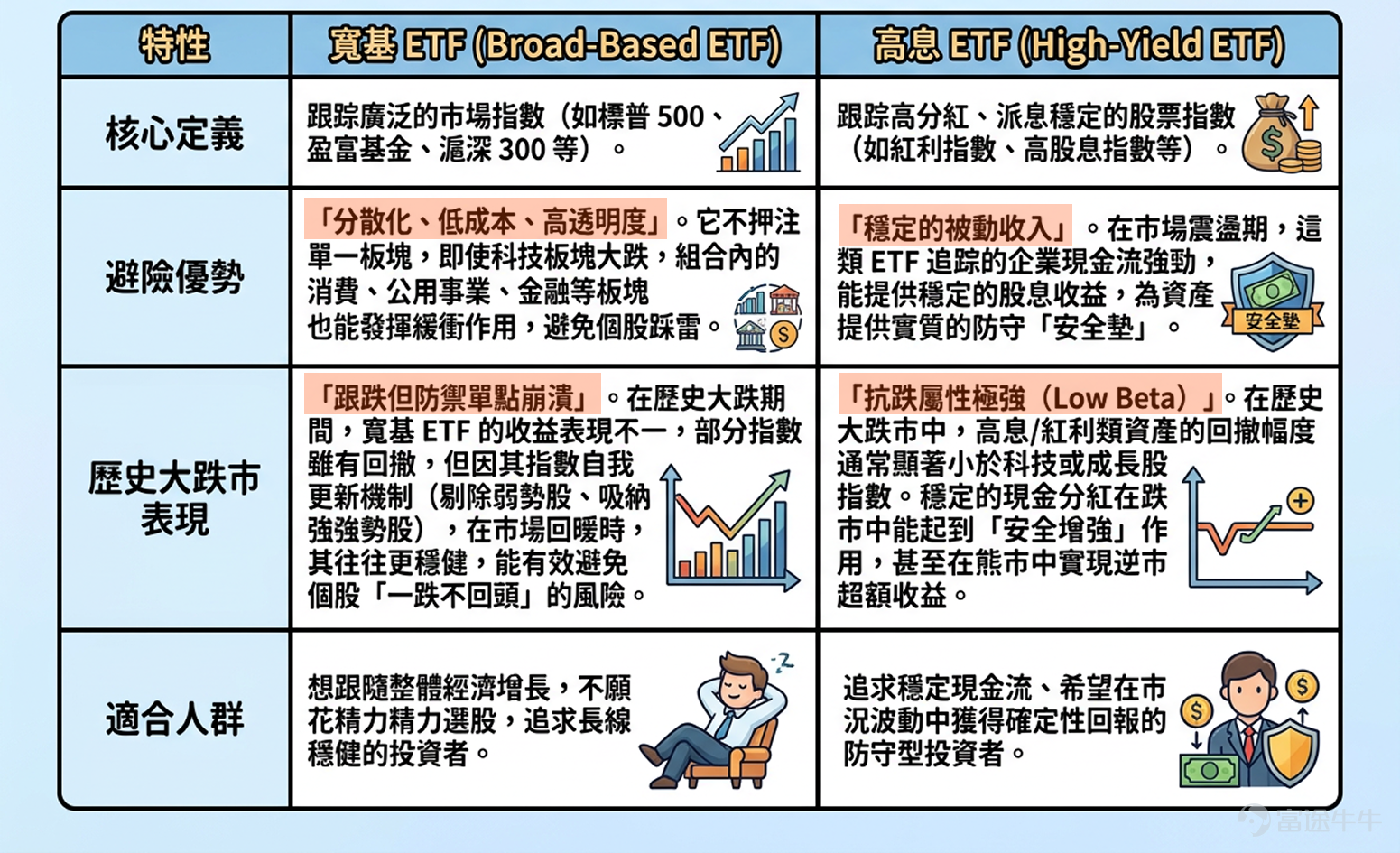
To help you compare them more intuitively, let’s directly examine how each performs duringmarket downturns or volatile conditions:

💡 Advanced Insight: What’s the relationship between high-dividend ETFs and ‘Hang Seng China Enterprises Covered Call ETFs’?
When discussing high-dividend defensive strategies, many Hong Kong equity investors have recently heard a new term frequently—Hang Seng China Enterprises Covered Call ETF. How are these two related? Can they be discussed together?
The answer is: absolutely! A ‘covered call ETF’ is essentially an ‘evolved, upgraded version’ of a high-dividend ETF.
A conventional high-dividend ETF derives its yield entirely from dividends paid by underlying companies (i.e., dividends from constituent stocks). However,Hang Seng China Enterprises Covered Call ETF (or Hang Seng Index Covered Call ETF), in addition to holding the index constituent stocks, also employs acovered call strategy.:
1. How does it work?
- While holding the underlying stocks, the ETFcontinuously sells call options on the corresponding indexto collect option premiums.
2. Why can it offer 'ultra-high dividends'?
- By combining the collected option premiums with dividends from the underlying stocks, this type of ETF can distribute stable, high monthly dividends. For example, the popular GlobalX Hang Seng Index Covered Call ETF、CSOP China Enterprise (Hang Seng China Enterprises Index) Covered Call ETF , all operate using this strategy.
3. Advantage in Range-Bound Markets:
- The covered call strategy performs best when the broader market is range-bound or experiencing gradual declines. Premium income from options provides additional downside protection, further enhancing overall returns—making it an excellent defensive income-generating tool in volatile markets.
⚠️ Important Reminder: Hedging Does Not Mean 'No Losses'
Although these three types of ETFs are excellent defensive tools, beginners must remember:“Hedging” does not mean “principal protection.” You can still incur losses under certain market conditions!
We’ll break them down using the simplest logicunder what circumstances you would actually incur losses, and their respectiveLimitations (Disadvantages/Opportunity Cost):
🚨 When does a 'real cash loss' occur? (Risk Points)
1. Broad-based ETFs — Losses occur during a 'systemic, market-wide crash'
- Loss Scenarios: If a global financial crisis, severe macroeconomic recession, or extreme geopolitical conflict triggers a 'non-discriminatory market plunge,' all sectors within the broad-based ETF will decline collectively, significantly reducing the market value of your holdings.
2. High-dividend ETFs — Losses occur when caught in a 'dividend trap' (earning dividends but losing capital)
- Loss Scenarios: High-dividend stocks are often concentrated in cyclical, traditional sectors (e.g., banking, energy, real estate). If fundamentals in these sectors deteriorate, causing share prices to fall far more than the dividends paid (e.g., a 15% price drop with only a 6% dividend yield), your account will still show an overall loss despite receiving dividend income.
3. Hang Seng Index/Hang Seng China Enterprises Index Covered Call ETFs — Losses occur during a 'one-sided sharp decline (bear market)'
- Loss ScenariosCovered-call ETFs still hold the underlying equity assets. If the underlying index (e.g., Hang Seng Index, Hang Seng China Enterprises Index) experiencesa sharp one-sided plunge,even though you earn option premiums from selling options,those premiums are far from sufficient to offset the substantial decline in the market value of the underlying stocks.In such a scenario, the NAV of the covered-call ETF would still suffer a noticeable loss.
⚖️ What are their respective “drawbacks/pain points”? (Not losses per se, but opportunity costs)
1. Drawbacks of broad-market ETFs: “Returns can be diluted by mediocre sectors”
- Manifestation of this pain point:Because broad-market ETFs represent the market’s average performance, during a one-sided bull market—when a single sector (e.g., AI-related tech stocks previously) surges dramatically—the ETF’s gains get dragged down by other underperforming or average-performing sectors in its portfolio (such as utilities or traditional financials), causing its overall return to significantly lag behind the hottest investment theme at the time.
2. Drawbacks of standard high-dividend ETFs: ‘Lack of price elasticity and growth potential’
- Pain points:High-dividend stocks are typically mature, traditional companies with limited high-growth narratives. During strong bull markets, these stocks usually exhibit weak price momentum, potentially leaving investors in an awkward position—earning dividends while missing out on the explosive gains from tech stocks that double or more.
3. Drawbacks of covered-call ETFs: ‘Upside returns are artificially capped’
- Pain points:Because this strategy inherently involves selling call options, when the market experiences a sharp, one-sided rally (a bull run), any gains above the strike price accrue entirely to the option buyer. As a result, the upside potential of covered-call ETFs is effectively ‘locked,’ causing them to significantly underperform plain index holdings.
📲 How to allocate? One-click ‘Add to Watchlist’!
Given today’s highly uncertain macro environment, rather than stressing daily over volatile swings in tech stocks, consider allocating a portion of your capital to broad-market, high-dividend, or covered-call ETFs—to act as a ‘shock absorber’ for your portfolio.
Open Futubull now and go to [Market] - [ETF]to enter the [ETF Zone], and search for thebroad-market index ETFs or Hang Seng Index covered call ETFs,and add them to your watchlist with one click. Accumulate positions in batches during market pullbacks and establish solid bottom positioning—this is how you go the distance in the investment marathon!
– Sample broad-market Hong Kong index ETFs: $TRACKER FUND OF HONG KONG (02800.HK)$$TRACKER FUND OF HONG KONG (82800.HK)$$CSOP Hang Seng TECH Index ETF (03033.HK)$
Data source:Selected from Futubull app – Market – ETF – Hong Kong – Index ETFs, top 3 by assets under management; Data source: Futubull;DataAs of July 28, 2026.
– Reference: Broad-based U.S. equity index ETFs: $Invesco NASDAQ 100 ETF (QQQM.US)$$Invesco QQQ Trust (QQQ.US)$$iShares Core S&P 500 ETF (IVV.US)$$Vanguard S&P 500 ETF (VOO.US)$$SPDR S&P 500 ETF (SPY.US)$

Selection criteria: Based on U.S. market closing prices as of July 27, 2026, the top 5 ETFs listed under 'Index ETFs' in the Futubull app with assets under management of at least USD 10 billion and the highest 3-year total return, limited to unleveraged ETFs tracking the Dow Jones Industrial Average, S&P 500, or Nasdaq-100. Data source: Futubull; data date: July 27, 2026.

Selection criteria: Based on Hong Kong market closing prices as of July 27, 2026, the top 3 Hong Kong-listed ETFs with assets under management of at least HKD 500 million, a trailing twelve-month (LTM) dividend yield of at least 6%, and the highest 3-year total return. Data source: Futubull; data date: July 27, 2026.

Risk and Disclaimer: Futubull is an all-in-one financial investment and trading platform. Brokerage services are provided by Futu Securities International (Hong Kong) Limited. This content does not constitute an offer, solicitation, recommendation, opinion, or any form of guarantee regarding any securities, financial products, or instruments.
Risk Disclaimer: The above content only represents the author's view. It does not represent any position or investment advice of Futu. Futu makes no representation or warranty.Read more
Comments (2)
to post a comment
34
46
