English
Back
Open Account
Apple and Amazon reported starkly contrasting earnings— which one are you bullish on?

Futubull Options Sir
joined discussion · ·

Earnings Options Strategy | After Google's decline, can Meta's earnings provide clear guidance on its AI investments?

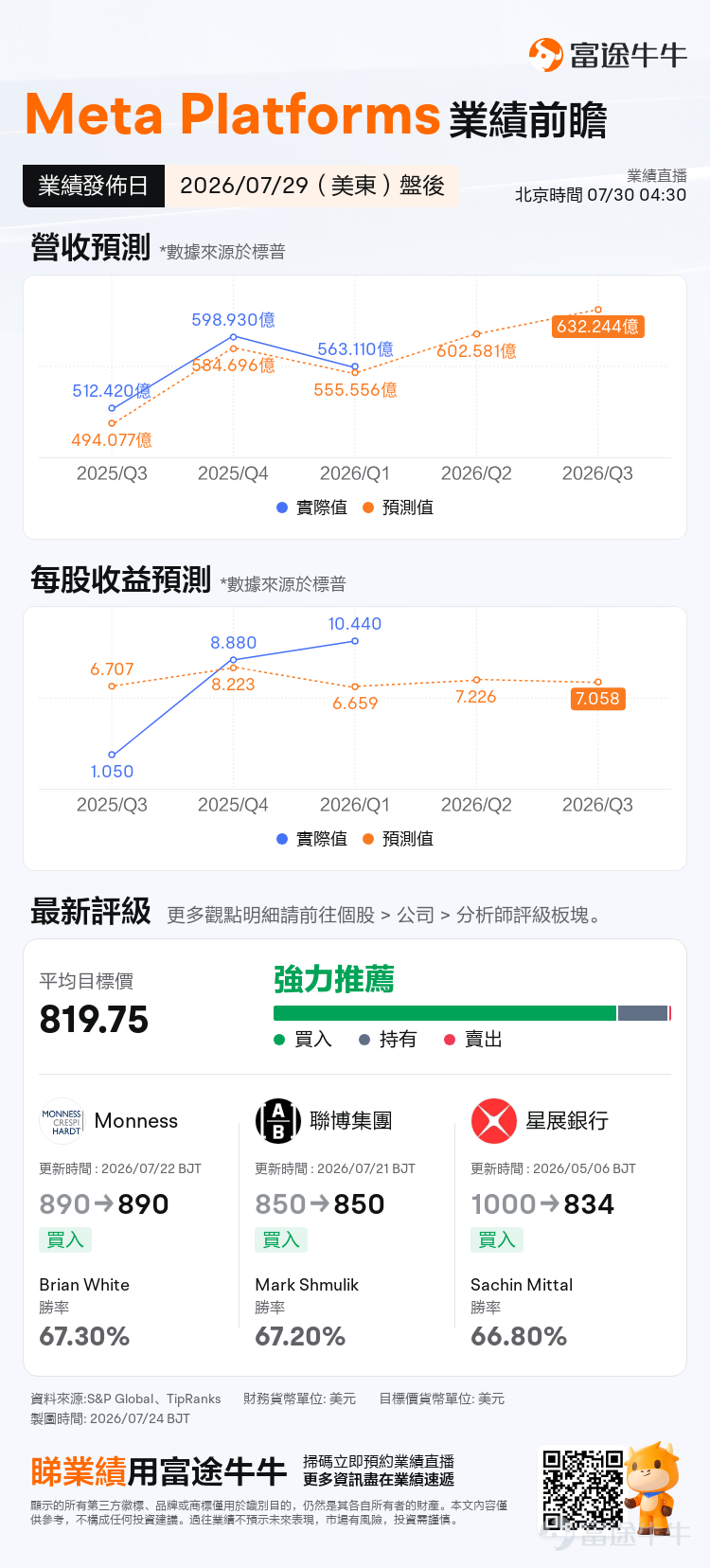
$Meta Platforms (META.US)$ will report earnings after market close on July 29.As another tech giant with significant AI-related spending, the market is currently focused on Meta’s capital expenditures and its ability to monetize these investments.Last week, $Alphabet-A (GOOGL.US)$ reported earnings, with AI-related expenses doubling year-over-year capital expenditures, resulting in negative free cash flow for the first time since going public; the stock closed down -6.89% that day.
The market currently expects Meta’s revenue to be $60.258 billion, up 7.01% quarter-over-quarter; EPS is expected at $7.23, down 30.79% quarter-over-quarter.The divergence between rising revenue expectations and falling EPS forecasts also reflects institutional concerns that massive AI spending is eroding profits.
$Meta Platforms (META.US)$ will report earnings after market close on July 29.As another tech giant with significant AI-related spending, the market is currently focused on Meta’s capital expenditures and its ability to monetize these investments.Last week, $Alphabet-A (GOOGL.US)$ reported earnings, with AI-related expenses doubling year-over-year capital expenditures, resulting in negative free cash flow for the first time since going public; the stock closed down -6.89% that day. The market currently expects Meta’s revenue to be $60.258 billion, up 7.01% quarter-over-quarter; EPS is expected at $7.23, down 30.79% quarter-over-quarter.The divergence between rising revenue expectations and falling EPS forecasts also reflects institutional concerns that massive AI spending is eroding profits. 1. Advertising Business: The core revenue driver, hinging on how effectively AI-powered ads boost conversion metrics Advertising remains Meta’s primary cash-generating business. According to Q1 financial results, Meta’s ad revenue reached $55.024 billion in Q1 2026, accounting for 97.7% of total revenue. Bank of America and Deutsche Bank currently hold optimistic views on Meta’s advertising revenue performance.Bank of America raised its Q2 revenue forecast to $60.6 billion and EPS to $7.50, stating that Meta will 'benefit from strong ad demand and AI-driven efficiency gains, with overall results likely to beat consensus estimates; weaker foreign exchange rates will only slightly weigh on performance.' Deutsche Bank's report dated July 26...
1. Advertising Business: The core revenue driver, hinging on how effectively AI-powered ads boost conversion metrics
Advertising remains Meta’s primary cash-generating business. According to Q1 financial results, Meta’s ad revenue reached $55.024 billion in Q1 2026, accounting for 97.7% of total revenue.
Bank of America and Deutsche Bank currently hold optimistic views on Meta’s advertising revenue performance.Bank of America raised its Q2 revenue forecast to $60.6 billion and EPS to $7.50, stating that Meta will 'benefit from strong ad demand and AI-driven efficiency gains, with overall results likely to beat consensus estimates; weaker foreign exchange rates will only slightly weigh on performance.' In its July 26 report, Deutsche Bank described its channel checks on Meta’s ad business as 'overwhelmingly positive'—advertisers are seeing stronger conversion rates and better return on ad spend, thanks to Meta’s investments in AI-driven ad ranking, retrieval, and automation. Its Advantage+ suite of automated advertising products has become a key growth engine, with 82% of Meta advertisers now using some form of Advantage+ automation. Tools like the Value Optimization Suite have already generated over $20 billion in annualized revenue, more than double the amount from a year ago.
$Meta Platforms (META.US)$ will report earnings after market close on July 29.As another tech giant with significant AI-related spending, the market is currently focused on Meta’s capital expenditures and its ability to monetize these investments.Last week, $Alphabet-A (GOOGL.US)$ reported earnings, with AI-related expenses doubling year-over-year capital expenditures, resulting in negative free cash flow for the first time since going public; the stock closed down -6.89% that day. The market currently expects Meta’s revenue to be $60.258 billion, up 7.01% quarter-over-quarter; EPS is expected at $7.23, down 30.79% quarter-over-quarter.The divergence between rising revenue expectations and falling EPS forecasts also reflects institutional concerns that massive AI spending is eroding profits. 1. Advertising Business: The core revenue driver, hinging on how effectively AI-powered ads boost conversion metrics Advertising remains Meta’s primary cash-generating business. According to Q1 financial results, Meta’s ad revenue reached $55.024 billion in Q1 2026, accounting for 97.7% of total revenue. Bank of America and Deutsche Bank currently hold optimistic views on Meta’s advertising revenue performance.Bank of America raised its Q2 revenue forecast to $60.6 billion and EPS to $7.50, stating that Meta will 'benefit from strong ad demand and AI-driven efficiency gains, with overall results likely to beat consensus estimates; weaker foreign exchange rates will only slightly weigh on performance.' Deutsche Bank's report dated July 26...
2. AI Capital Expenditure and Monetization Capability
The market’s current concern is whether Meta’s substantial AI-related capital expenditures will weigh on its cash flow and near-term monetization capability.In April, Meta raised its full-year 2026 capital expenditure guidance to $125–145 billion—nearly double the $72.2 billion projected for 2025—to fund GPUs, data centers, and AI infrastructure. Bank of America believes that due to rising memory and chip costs, management could further increase full-year capex to $135–150 billion.
Therefore, another key focus of this earnings report is whether Meta can deliver monetization guidance that satisfies the market amid such massive capital spending.According to a July 1 report, Meta is planning to sell AI computing power and model access to external customers, potentially through two models: (1) offering hosted access to its full suite of AI models (comparable to AWS Bedrock), and (2) leasing underlying GPU compute capacity (similar to 'new cloud' providers like CoreWeave).
This new business initiative is seen as a critical step in transforming Meta’s AI infrastructure from a 'pure cost burden' into a revenue-generating asset. On the announcement day, Meta’s stock surged 8.81%. According to Deutsche Bank’s base-case forecast, Meta will add 5 GW of computing capacity in 2026, reaching a total of 7 GW by year-end. Meta plans to lease out 15%–20% of its idle capacity, while prioritizing internal needs for Facebook/Instagram ad recommendations, the Muse large model, and AI Agents—ensuring no cannibalization of its core business resources. However, clarity on near-term execution will depend on further guidance from the upcoming earnings call.
$Meta Platforms (META.US)$ will report earnings after market close on July 29.As another tech giant with significant AI-related spending, the market is currently focused on Meta’s capital expenditures and its ability to monetize these investments.Last week, $Alphabet-A (GOOGL.US)$ reported earnings, with AI-related expenses doubling year-over-year capital expenditures, resulting in negative free cash flow for the first time since going public; the stock closed down -6.89% that day. The market currently expects Meta’s revenue to be $60.258 billion, up 7.01% quarter-over-quarter; EPS is expected at $7.23, down 30.79% quarter-over-quarter.The divergence between rising revenue expectations and falling EPS forecasts also reflects institutional concerns that massive AI spending is eroding profits. 1. Advertising Business: The core revenue driver, hinging on how effectively AI-powered ads boost conversion metrics Advertising remains Meta’s primary cash-generating business. According to Q1 financial results, Meta’s ad revenue reached $55.024 billion in Q1 2026, accounting for 97.7% of total revenue. Bank of America and Deutsche Bank currently hold optimistic views on Meta’s advertising revenue performance.Bank of America raised its Q2 revenue forecast to $60.6 billion and EPS to $7.50, stating that Meta will 'benefit from strong ad demand and AI-driven efficiency gains, with overall results likely to beat consensus estimates; weaker foreign exchange rates will only slightly weigh on performance.' Deutsche Bank's report dated July 26...
Options Market: How to Balance Offense and Defense in a High-Volatility Environment?
Each earnings release may shift market expectations and the company’s narrative, potentially triggering significant stock price swings. From theOptions–Earnings Analysiswe can see that inIn 9 out of the past 16 earnings reports, post-earnings stock price volatility exceeded the volatility priced in by the options market, and the stock experienced significant moves following each of the last four earnings announcements.
$Meta Platforms (META.US)$ will report earnings after market close on July 29.As another tech giant with significant AI-related spending, the market is currently focused on Meta’s capital expenditures and its ability to monetize these investments.Last week, $Alphabet-A (GOOGL.US)$ reported earnings, with AI-related expenses doubling year-over-year capital expenditures, resulting in negative free cash flow for the first time since going public; the stock closed down -6.89% that day. The market currently expects Meta’s revenue to be $60.258 billion, up 7.01% quarter-over-quarter; EPS is expected at $7.23, down 30.79% quarter-over-quarter.The divergence between rising revenue expectations and falling EPS forecasts also reflects institutional concerns that massive AI spending is eroding profits. 1. Advertising Business: The core revenue driver, hinging on how effectively AI-powered ads boost conversion metrics Advertising remains Meta’s primary cash-generating business. According to Q1 financial results, Meta’s ad revenue reached $55.024 billion in Q1 2026, accounting for 97.7% of total revenue. Bank of America and Deutsche Bank currently hold optimistic views on Meta’s advertising revenue performance.Bank of America raised its Q2 revenue forecast to $60.6 billion and EPS to $7.50, stating that Meta will 'benefit from strong ad demand and AI-driven efficiency gains, with overall results likely to beat consensus estimates; weaker foreign exchange rates will only slightly weigh on performance.' Deutsche Bank's report dated July 26...
Currently, Meta’s options implied volatility (IV) stands at 51.87%, with an IV percentile of 96%, indicating that expected volatility is historically elevated. Additionally, the put/call volume ratio is 0.43 and the open interest ratio is 0.45, reflecting a relatively strong bullish sentiment.
$Meta Platforms (META.US)$ will report earnings after market close on July 29.As another tech giant with significant AI-related spending, the market is currently focused on Meta’s capital expenditures and its ability to monetize these investments.Last week, $Alphabet-A (GOOGL.US)$ reported earnings, with AI-related expenses doubling year-over-year capital expenditures, resulting in negative free cash flow for the first time since going public; the stock closed down -6.89% that day. The market currently expects Meta’s revenue to be $60.258 billion, up 7.01% quarter-over-quarter; EPS is expected at $7.23, down 30.79% quarter-over-quarter.The divergence between rising revenue expectations and falling EPS forecasts also reflects institutional concerns that massive AI spending is eroding profits. 1. Advertising Business: The core revenue driver, hinging on how effectively AI-powered ads boost conversion metrics Advertising remains Meta’s primary cash-generating business. According to Q1 financial results, Meta’s ad revenue reached $55.024 billion in Q1 2026, accounting for 97.7% of total revenue. Bank of America and Deutsche Bank currently hold optimistic views on Meta’s advertising revenue performance.Bank of America raised its Q2 revenue forecast to $60.6 billion and EPS to $7.50, stating that Meta will 'benefit from strong ad demand and AI-driven efficiency gains, with overall results likely to beat consensus estimates; weaker foreign exchange rates will only slightly weigh on performance.' Deutsche Bank's report dated July 26...
1. If you are uncertain about the direction but believe the stock’s post-earnings move will exceed expectations—as it did in the last four reports,
then long volatility strategies such asbuying a straddle or buying a stranglemay be more suitable. This strategy involvesbuying one call option and one put option.The intrinsic values of the call and put offset each other as the stock price moves up or down, but if the stock experiences heightened volatility after the earnings release, the overall value of this position increases, generating profit for you.
However, note that Meta’s current options implied volatility is elevated. If the market reaction to earnings turns out to be muted, IV could drop sharply, causing rapid decay in option value—a phenomenon commonly known as “IV crush.” Buyers of options should remain mindful of time decay.
$Meta Platforms (META.US)$ will report earnings after market close on July 29.As another tech giant with significant AI-related spending, the market is currently focused on Meta’s capital expenditures and its ability to monetize these investments.Last week, $Alphabet-A (GOOGL.US)$ reported earnings, with AI-related expenses doubling year-over-year capital expenditures, resulting in negative free cash flow for the first time since going public; the stock closed down -6.89% that day. The market currently expects Meta’s revenue to be $60.258 billion, up 7.01% quarter-over-quarter; EPS is expected at $7.23, down 30.79% quarter-over-quarter.The divergence between rising revenue expectations and falling EPS forecasts also reflects institutional concerns that massive AI spending is eroding profits. 1. Advertising Business: The core revenue driver, hinging on how effectively AI-powered ads boost conversion metrics Advertising remains Meta’s primary cash-generating business. According to Q1 financial results, Meta’s ad revenue reached $55.024 billion in Q1 2026, accounting for 97.7% of total revenue. Bank of America and Deutsche Bank currently hold optimistic views on Meta’s advertising revenue performance.Bank of America raised its Q2 revenue forecast to $60.6 billion and EPS to $7.50, stating that Meta will 'benefit from strong ad demand and AI-driven efficiency gains, with overall results likely to beat consensus estimates; weaker foreign exchange rates will only slightly weigh on performance.' Deutsche Bank's report dated July 26...
2. If you hold a long position in Meta and intend to keep it for the long term but want to hedge against potential price swings around earnings,
You can then establish a collar strategy. This strategy involves holding the underlying stock while buying a put option and selling a call option to create a 'protective collar' around the stock position.Role of the optionsis:
1) Buy a put: Limits the maximum loss on the stock and hedges against downside risk if the stock price falls;
2) Sell a call: Earns premium income to reduce the initial cost of the position. If the strike price is chosen appropriately, it can fully offset the cost of buying the put, but it caps the maximum upside gain if the stock surges.
Compared to simply holding the underlying stock, this strategy limits potential losses from a sharp decline in the stock price at the expense of capping the maximum upside gain, resulting in a more moderate risk-return profile.
$Meta Platforms (META.US)$ will report earnings after market close on July 29.As another tech giant with significant AI-related spending, the market is currently focused on Meta’s capital expenditures and its ability to monetize these investments.Last week, $Alphabet-A (GOOGL.US)$ reported earnings, with AI-related expenses doubling year-over-year capital expenditures, resulting in negative free cash flow for the first time since going public; the stock closed down -6.89% that day. The market currently expects Meta’s revenue to be $60.258 billion, up 7.01% quarter-over-quarter; EPS is expected at $7.23, down 30.79% quarter-over-quarter.The divergence between rising revenue expectations and falling EPS forecasts also reflects institutional concerns that massive AI spending is eroding profits. 1. Advertising Business: The core revenue driver, hinging on how effectively AI-powered ads boost conversion metrics Advertising remains Meta’s primary cash-generating business. According to Q1 financial results, Meta’s ad revenue reached $55.024 billion in Q1 2026, accounting for 97.7% of total revenue. Bank of America and Deutsche Bank currently hold optimistic views on Meta’s advertising revenue performance.Bank of America raised its Q2 revenue forecast to $60.6 billion and EPS to $7.50, stating that Meta will 'benefit from strong ad demand and AI-driven efficiency gains, with overall results likely to beat consensus estimates; weaker foreign exchange rates will only slightly weigh on performance.' Deutsche Bank's report dated July 26...
Finally, Options Sir has a small giveaway for fellow investors—feel free to claim it!Options Starter Pack
*This promotion is exclusively available to invited Hong Kong users. Click to learn more.Detailed terms and conditions of the promotion >>
Market conditions are complex and ever-changing,Options strategiesToo many choices and unsure how to proceed? Let Futubull help you build a strategy in three simple stepsOptions strategies, making investing simple and efficient!
$Meta Platforms (META.US)$ will report earnings after market close on July 29.As another tech giant with significant AI-related spending, the market is currently focused on Meta’s capital expenditures and its ability to monetize these investments.Last week, $Alphabet-A (GOOGL.US)$ reported earnings, with AI-related expenses doubling year-over-year capital expenditures, resulting in negative free cash flow for the first time since going public; the stock closed down -6.89% that day. The market currently expects Meta’s revenue to be $60.258 billion, up 7.01% quarter-over-quarter; EPS is expected at $7.23, down 30.79% quarter-over-quarter.The divergence between rising revenue expectations and falling EPS forecasts also reflects institutional concerns that massive AI spending is eroding profits. 1. Advertising Business: The core revenue driver, hinging on how effectively AI-powered ads boost conversion metrics Advertising remains Meta’s primary cash-generating business. According to Q1 financial results, Meta’s ad revenue reached $55.024 billion in Q1 2026, accounting for 97.7% of total revenue. Bank of America and Deutsche Bank currently hold optimistic views on Meta’s advertising revenue performance.Bank of America raised its Q2 revenue forecast to $60.6 billion and EPS to $7.50, stating that Meta will 'benefit from strong ad demand and AI-driven efficiency gains, with overall results likely to beat consensus estimates; weaker foreign exchange rates will only slightly weigh on performance.' Deutsche Bank's report dated July 26...
Options Risk Disclosure:An option is a contract that grants the holder the right—but not the obligation—to buy or sell an underlying asset at a predetermined price on or before a specified date. Option prices are influenced by multiple factors, including the current price of the underlying asset, the strike price, time to expiration, and implied volatility. Implied volatility reflects the market’s expectation of future price fluctuations over the life of the option; it is derived by reverse-engineering the Black-Scholes pricing model and is commonly viewed as an indicator of market sentiment. When investors anticipate higher volatility, they may be willing to pay more for options to hedge their risk, resulting in higher implied volatility. Traders and investors use implied volatility to assess the attractiveness of option prices, identify potential mispricings, and manage their risk exposure.
Disclaimer:This content does not constitute an offer, solicitation, recommendation, opinion, or any form of guarantee regarding any securities, financial products, or instruments. The risk of loss in trading options can be substantial. In certain circumstances, your losses may exceed the initial margin deposit. Even if you place contingent orders such as 'stop-loss' or 'limit' orders, there is no assurance that losses will be avoided, as market conditions may prevent execution of these orders. You may be required to deposit additional margin on short notice. If you fail to meet such margin calls within the stipulated time, your open positions may be liquidated. You remain fully liable for any resulting deficit in your account. Therefore, prior to trading options, you should thoroughly research and understand how options work and carefully consider whether such trading aligns with your financial situation and investment objectives. If you trade options, you should become familiar with the procedures for exercising options and handling expiration, as well as your rights and obligations upon exercise or expiration. Options trading involves significant risk and is not suitable for all investors. Investors should carefully read"Characteristics and Risks of Standardized Options"
Risk Disclaimer: The above content only represents the author's view. It does not represent any position or investment advice of Futu. Futu makes no representation or warranty.Read more
Thumbs Up
21
Lol
1
Sob
1
191K Views
Report
Comments (10)
Write a Comment...
10
23
21