
English
Back
Open Account
Google reports earnings early Thursday morning—AI trading faces a 'critical test'!
Futubull Options Sir
joined discussion · ·

Earnings Options Strategy | Back to Where Q1 Started—How Should We View Nokia’s Q2 Earnings?

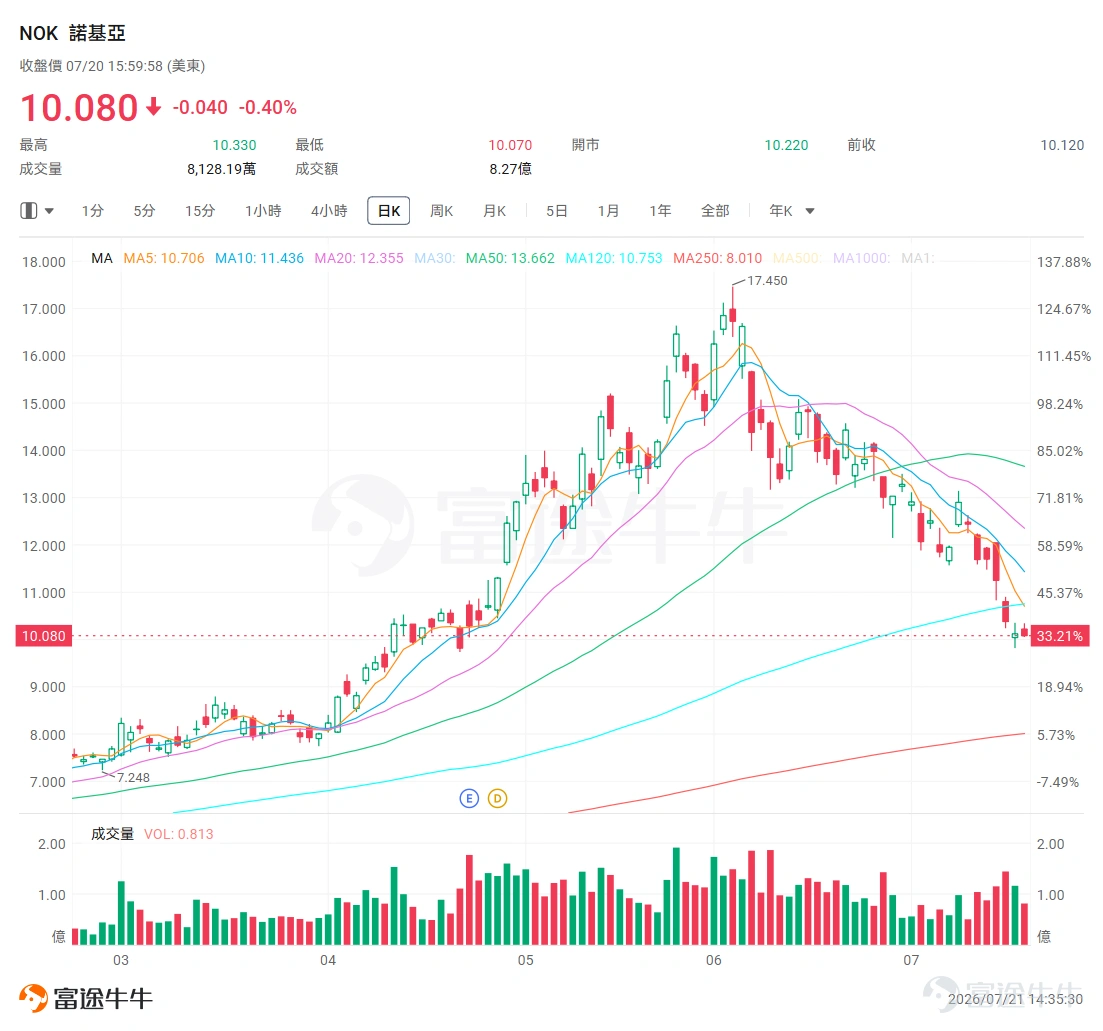
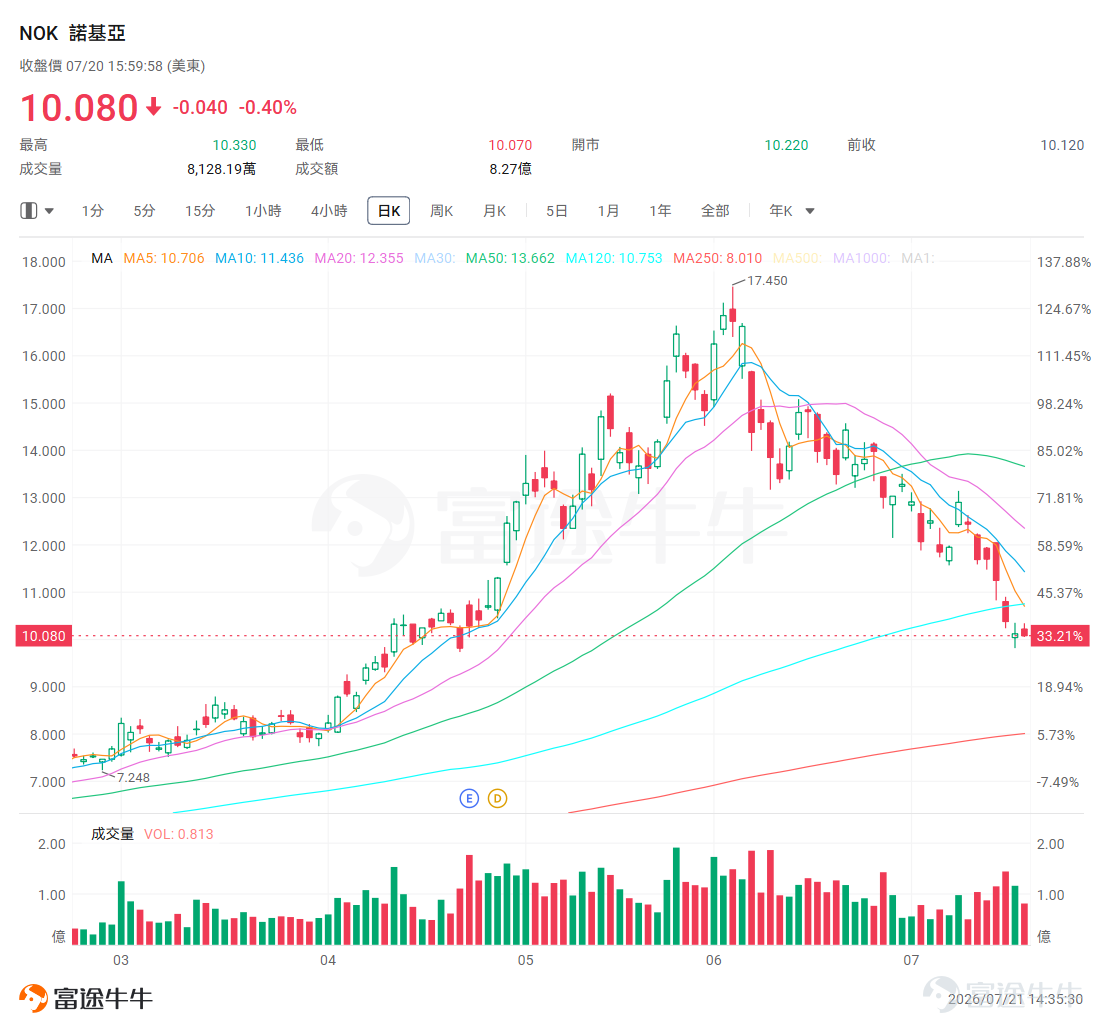
Before the US market opens on Thursday, July 23, Nokia will release its Q2 2026 earnings report.Looking back over the past three months, $Nokia Oyj (NOK.US)$the stock price has resembled a thrilling 'roller coaster':After reporting strong Q1 results at the end of April, fueled by robust expectations for AI optical networking, the stock surged to a peak in early June. However, as AI hardware stocks corrected and profit-taking kicked in, by the close on July 20,those gains had been completely erased, bringing the share price back to where it stood before the Q1 earnings announcement.
Before the US market opens on Thursday, July 23, Nokia will release its Q2 2026 earnings report.Looking back over the past three months, $Nokia Oyj (NOK.US)$the stock price has resembled a thrilling 'roller coaster':After reporting strong Q1 results at the end of April, fueled by robust expectations for AI optical networking, the stock surged to a peak in early June. However, as AI hardware stocks corrected and profit-taking kicked in, by the close on July 20,those gains had been completely erased, bringing the share price back to where it stood before the Q1 earnings announcement. This 'elevator-like' price action makes the upcoming Q2 report a critical inflection point for bulls and bears alike. Is the AI infrastructure wave merely a flash in the pan, or is the market offering investors another golden opportunity to get on board? We’ll walk through Nokia’s Q2 earnings preview together. Overall Market Expectations: Q2 serves as the first validation window for full-year guidance Before diving into Q2 expectations, some fellow investors may still associate Nokia with the 'former mobile giant that was phased out.' $Apple (AAPL.US)$ But today’s Nokia has quietly transformed into a global leader in telecom equipment and network infrastructure. Its core traditional business involves supplying mobile base stations (4G/5G radio access networks) and fixed broadband equipment to telecom operators, while also earning substantial technology licensing revenue from its deep patent portfolio.However, what truly revitalized this century-old company in the capital markets is its Network Infrastructure segment...
This 'elevator-like' price action makes the upcoming Q2 report a critical inflection point for bulls and bears alike. Is the AI infrastructure wave merely a flash in the pan, or is the market offering investors another golden opportunity to get on board? We’ll walk through Nokia’s Q2 earnings preview together.
Overall Market Expectations: Q2 serves as the first validation window for full-year guidance
Before diving into Q2 expectations, some fellow investors may still associate Nokia with the 'former mobile giant that was phased out.' $Apple (AAPL.US)$ But today’s Nokia has quietly transformed into a global leader in telecom equipment and network infrastructure.
Its core traditional business involves supplying mobile base stations (4G/5G radio access networks) and fixed broadband equipment to telecom operators, while also earning substantial technology licensing revenue from its deep patent portfolio.However, what has truly revitalized this century-old company in the eyes of capital markets is its Network Infrastructure segment—specifically its 'Optical Networks' and 'IP Networks' businesses.
Fueled by AI large model training and inference, the demand for massive data transfers between data centers is exploding exponentially, making Nokia’s high-speed optical communication modules (such as 800G products) and data center switches essential infrastructure in the AI boom.
Let’s revisit the guidance provided by management during the Q1 earnings call in April. At that time, Nokia significantly raised its full-year outlook—a move that greatly encouraged the market:
Network Infrastructure: Full-year growth forecast raised to 12–14%;
Optical and IP Networks: Combined growth forecast raised to 18–20% (JPMorgan even suggested it could be further revised upward to 28%);
Comparable operating profit: Expected to be in the range of €2.0–2.5 billion.
If Q1 represented the initial surge in expectations, then the upcoming Q2 results will serve as the first validation window for this full-year guidance. The market’s concern is clear: Can the explosive growth touted by management actually materialize?
Before the US market opens on Thursday, July 23, Nokia will release its Q2 2026 earnings report.Looking back over the past three months, $Nokia Oyj (NOK.US)$the stock price has resembled a thrilling 'roller coaster':After reporting strong Q1 results at the end of April, fueled by robust expectations for AI optical networking, the stock surged to a peak in early June. However, as AI hardware stocks corrected and profit-taking kicked in, by the close on July 20,those gains had been completely erased, bringing the share price back to where it stood before the Q1 earnings announcement. This 'elevator-like' price action makes the upcoming Q2 report a critical inflection point for bulls and bears alike. Is the AI infrastructure wave merely a flash in the pan, or is the market offering investors another golden opportunity to get on board? We’ll walk through Nokia’s Q2 earnings preview together. Overall Market Expectations: Q2 serves as the first validation window for full-year guidance Before diving into Q2 expectations, some fellow investors may still associate Nokia with the 'former mobile giant that was phased out.' $Apple (AAPL.US)$ But today’s Nokia has quietly transformed into a global leader in telecom equipment and network infrastructure. Its core traditional business involves supplying mobile base stations (4G/5G radio access networks) and fixed broadband equipment to telecom operators, while also earning substantial technology licensing revenue from its deep patent portfolio.However, what truly revitalized this century-old company in the capital markets is its Network Infrastructure segment...
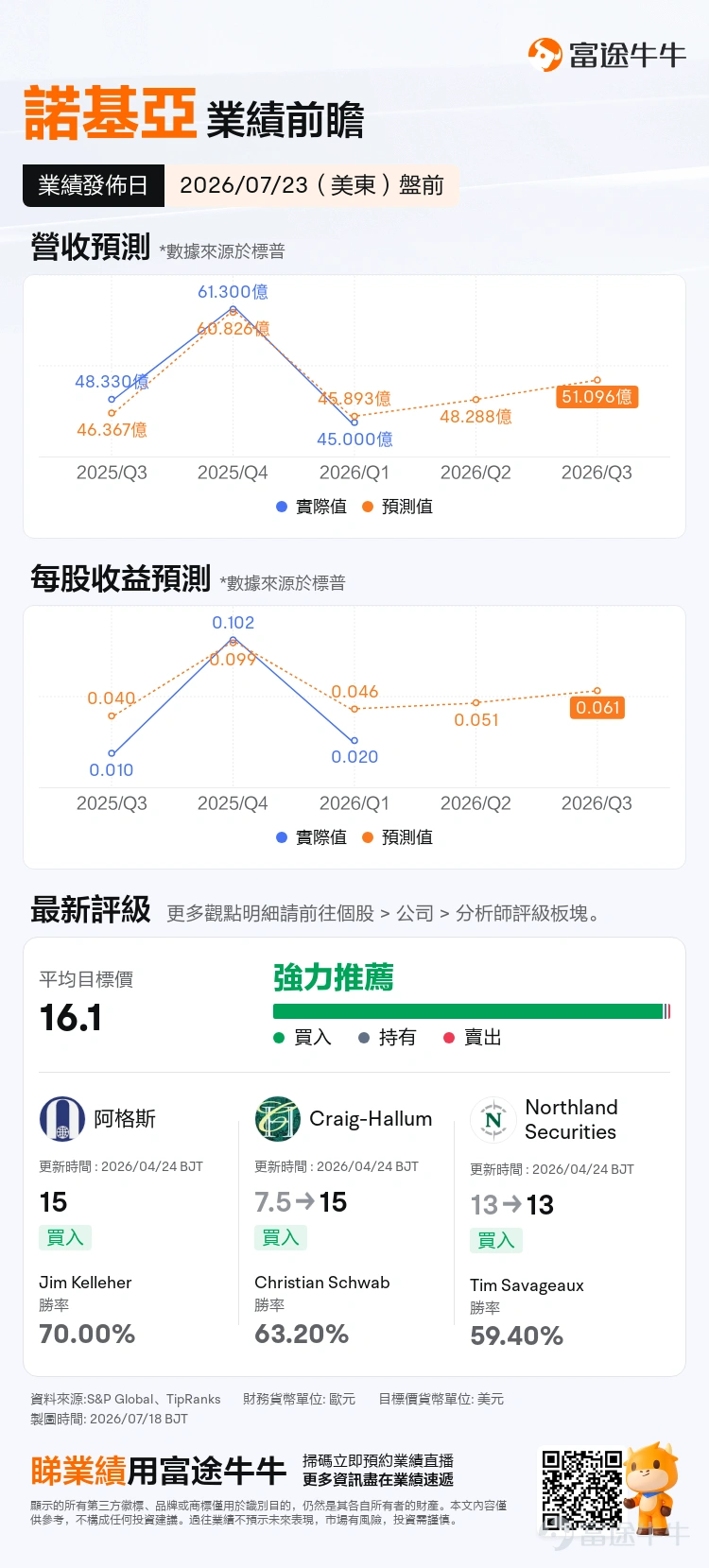
Analysts expect Nokia to report Q2 2026 revenue of €4.829 billion, up 6.10% year-over-year; EPS is expected to be €0.051, a substantial 154.77% increase year-over-year.(Note: The above figures are reported under US-GAAP accounting standards).
In absolute revenue terms, €4.829 billion represents a modest sequential increase compared to €4.637 billion in Q1.The strong EPS growth is primarily driven by the operating leverage effect resulting from an increased share of high-margin optical networks business. As long as Nokia’s actual Q2 results meet or slightly exceed this expectation, it would signal that Nokia’s AI narrative is genuinely translating into tangible financial gains, keeping its full-year high guidance firmly intact.Currently, the average analyst price target stands at $16.10, approximately 60% above the current share price and close to the late-June peak.
Key Focus Area #1: Deep Integration of Optical Networks Business with AI
For investors reviewing Nokia’s earnings report,the most critical element is the 'optical networks business.'Driven by AI large-model training and inference, data traffic between data centers is growing exponentially, directly fueling surging demand for high-speed optical modules and optical networking equipment.
In Q1, Nokia’s optical networks revenue surged 56% year-over-year, with AI and cloud customers contributing approximately €1 billion in orders during the quarter and a book-to-bill ratio of roughly 3x (meaning orders received were three times the actual shipments, indicating a robust backlog). At the time, management noted delivery lead times had stretched to 12–18 months.
In the upcoming Q2 earnings report, investors should closely monitor the following dimensions:
Conversion rate of the €1 billion order: Of the massive AI orders secured in Q1, how much was converted into recognized revenue in Q2? This directly determines whether Q2 revenue meets its target.
800G optical module shipment progress: 800G pluggable optical modules are core components connecting AI data centers. Nokia recently won multiple hyperscaler design wins, and actual volume shipments from these projects in Q2 will be key to assessing its market share gains—particularly at the expense of competitors like Ciena.
Infinera integration progress: Infinera, the optical networking giant acquired by Nokia, saw integration progress ahead of expectations in Q1. If Q2 financial results reflect synergistic revenue and cost savings from Infinera, it would significantly boost margin expansion.
Gross margin performance: Gross margin in the optical networks business improved by 150 basis points year-over-year to 43.4% in Q1, becoming a core growth engine. Continued increases in the mix of high-end AI-related products could further drive gross margins higher in this segment.
Key Focus #2: Current status of IP Networks and legacy businesses
Beyond optical networks, IP Networks is another growth engine for Nokia. If optical networks are the highway, IP Networks (such as data center switches) serve as the traffic control system.
JPMorgan noted in June thatNokia has achieved a new breakthrough in data center switches, which will become a new growth pillar going forward.Moreover, the ongoing wave of sovereign data center construction in Europe provides stable demand support for its IP networking business. The Q2 earnings report needs to confirm whether these switch orders have started contributing meaningful revenue.
Of course, we cannot overlook Nokia’s traditional core businesses—infrastructure (RAN, or Radio Access Network) and fixed networks.
Currently, these two segments are relatively flat. Declining wireless RAN spending in North America poses a headwind, and the overall RAN market is in a lull. However, Nokia is actively transforming its business toward software-driven solutions to enhance profitability; it is also collaborating with NVIDIA to explore AI-RAN (integrating AI into base stations), though this remains a longer-term story.
On the fixed networks front,due to non-strategic headwinds in consumer premises equipment (CPE), the company has opted to maintain discipline by focusing on high-value businesses,which will pressure near-term revenue but help improve long-term gross margins. While these legacy businesses are not the growth highlight for Q2, as long as they don’t significantly drag performance, they will allow optical networking growth to shine even brighter.
Earnings Play: How to Deploy Options Strategies?
For investors who enjoy trading around earnings season, the options market offers rich signals and strategic choices. Nokia’s current options market exhibits a highly distinctive structure:
Before the US market opens on Thursday, July 23, Nokia will release its Q2 2026 earnings report.Looking back over the past three months, $Nokia Oyj (NOK.US)$the stock price has resembled a thrilling 'roller coaster':After reporting strong Q1 results at the end of April, fueled by robust expectations for AI optical networking, the stock surged to a peak in early June. However, as AI hardware stocks corrected and profit-taking kicked in, by the close on July 20,those gains had been completely erased, bringing the share price back to where it stood before the Q1 earnings announcement. This 'elevator-like' price action makes the upcoming Q2 report a critical inflection point for bulls and bears alike. Is the AI infrastructure wave merely a flash in the pan, or is the market offering investors another golden opportunity to get on board? We’ll walk through Nokia’s Q2 earnings preview together. Overall Market Expectations: Q2 serves as the first validation window for full-year guidance Before diving into Q2 expectations, some fellow investors may still associate Nokia with the 'former mobile giant that was phased out.' $Apple (AAPL.US)$ But today’s Nokia has quietly transformed into a global leader in telecom equipment and network infrastructure. Its core traditional business involves supplying mobile base stations (4G/5G radio access networks) and fixed broadband equipment to telecom operators, while also earning substantial technology licensing revenue from its deep patent portfolio.However, what truly revitalized this century-old company in the capital markets is its Network Infrastructure segment...
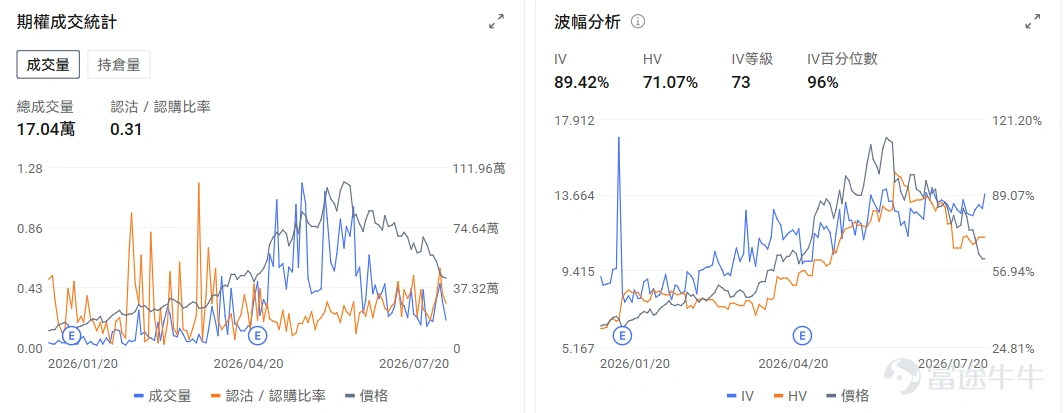
High implied volatility (IV) is theoretically unfavorable for options buyers:Nokia's current implied volatility (IV) is as high as 89.42%, with an IV percentile at a staggering 96% and an IV rank of 73. What does this mean? It means Nokia's options are currently very expensive, reflecting the market's expectation of significant price movement around earnings.Meanwhile, the put/call ratio stands at 0.31, indicating bullish sentiment, with substantial capital flowing into call options.
Before the US market opens on Thursday, July 23, Nokia will release its Q2 2026 earnings report.Looking back over the past three months, $Nokia Oyj (NOK.US)$the stock price has resembled a thrilling 'roller coaster':After reporting strong Q1 results at the end of April, fueled by robust expectations for AI optical networking, the stock surged to a peak in early June. However, as AI hardware stocks corrected and profit-taking kicked in, by the close on July 20,those gains had been completely erased, bringing the share price back to where it stood before the Q1 earnings announcement. This 'elevator-like' price action makes the upcoming Q2 report a critical inflection point for bulls and bears alike. Is the AI infrastructure wave merely a flash in the pan, or is the market offering investors another golden opportunity to get on board? We’ll walk through Nokia’s Q2 earnings preview together. Overall Market Expectations: Q2 serves as the first validation window for full-year guidance Before diving into Q2 expectations, some fellow investors may still associate Nokia with the 'former mobile giant that was phased out.' $Apple (AAPL.US)$ But today’s Nokia has quietly transformed into a global leader in telecom equipment and network infrastructure. Its core traditional business involves supplying mobile base stations (4G/5G radio access networks) and fixed broadband equipment to telecom operators, while also earning substantial technology licensing revenue from its deep patent portfolio.However, what truly revitalized this century-old company in the capital markets is its Network Infrastructure segment...
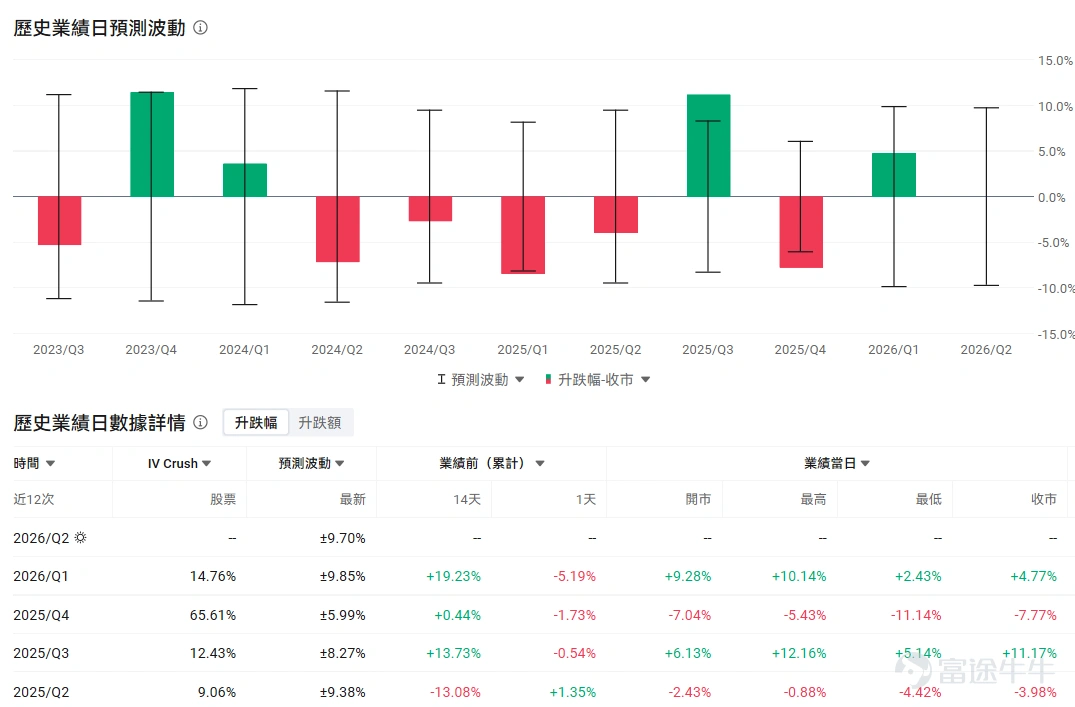
Currently, the options market is pricing in an expected move of up to±9.70%, meaning the options market anticipates high volatility on earnings day. Historically, Nokia’s stock has shown unpredictable behavior on earnings dates: it surged 19.23% 14 days before Q1 2026 earnings and closed up 4.77% on the earnings day itself, whereas it dropped nearly 8% on the Q4 2025 earnings day.
Based on the above data, investors may consider the following options strategies:
With IV at an extreme level (96th percentile), buying single-leg calls or puts is prohibitively expensive. Even if you correctly predict the direction of the stock, if the post-earnings move falls short of expectations, you could still incur losses due to 'IV crush'—the rapid decline in option value after earnings when uncertainty dissipates. Therefore, in such a high-IV environment,selling options or using spread strategies generally offers higher win rates.
Strategy 1: Covered Call
Suitable for investors who already hold Nokia shares and have a 'moderately bullish' or 'neutral' outlook on the Q2 earnings. For example, while holding 100 shares of Nokia, sell one call option with a strike price above the current stock price and an expiration shortly after earnings. Due to the elevated IV, this call option will generate a relatively high premium.
If earnings results are mediocre or fall short of expectations: the stock price declines or trades sideways, and the option premium goes directly into your pocket, providing a 'cushion' for your long stock position (note that if the stock drops sharply, your overall portfolio will still incur losses).
If earnings come in moderately positive: the stock price rises but doesn't reach your strike price—you profit from both the stock's price appreciation and the option premium you collected.
If earnings significantly beat expectations: the stock surges above the strike price, and your shares are called away at the strike price. While you miss out on additional gains beyond that point, you’ve effectively locked in profits at your target exit price.
Before the US market opens on Thursday, July 23, Nokia will release its Q2 2026 earnings report.Looking back over the past three months, $Nokia Oyj (NOK.US)$the stock price has resembled a thrilling 'roller coaster':After reporting strong Q1 results at the end of April, fueled by robust expectations for AI optical networking, the stock surged to a peak in early June. However, as AI hardware stocks corrected and profit-taking kicked in, by the close on July 20,those gains had been completely erased, bringing the share price back to where it stood before the Q1 earnings announcement. This 'elevator-like' price action makes the upcoming Q2 report a critical inflection point for bulls and bears alike. Is the AI infrastructure wave merely a flash in the pan, or is the market offering investors another golden opportunity to get on board? We’ll walk through Nokia’s Q2 earnings preview together. Overall Market Expectations: Q2 serves as the first validation window for full-year guidance Before diving into Q2 expectations, some fellow investors may still associate Nokia with the 'former mobile giant that was phased out.' $Apple (AAPL.US)$ But today’s Nokia has quietly transformed into a global leader in telecom equipment and network infrastructure. Its core traditional business involves supplying mobile base stations (4G/5G radio access networks) and fixed broadband equipment to telecom operators, while also earning substantial technology licensing revenue from its deep patent portfolio.However, what truly revitalized this century-old company in the capital markets is its Network Infrastructure segment...
(The illustrative graphics shown on screen are for demonstration purposes only and do not constitute investment advice or guarantees; market conditions change frequently, and the displayed option prices do not reflect real-time data.)
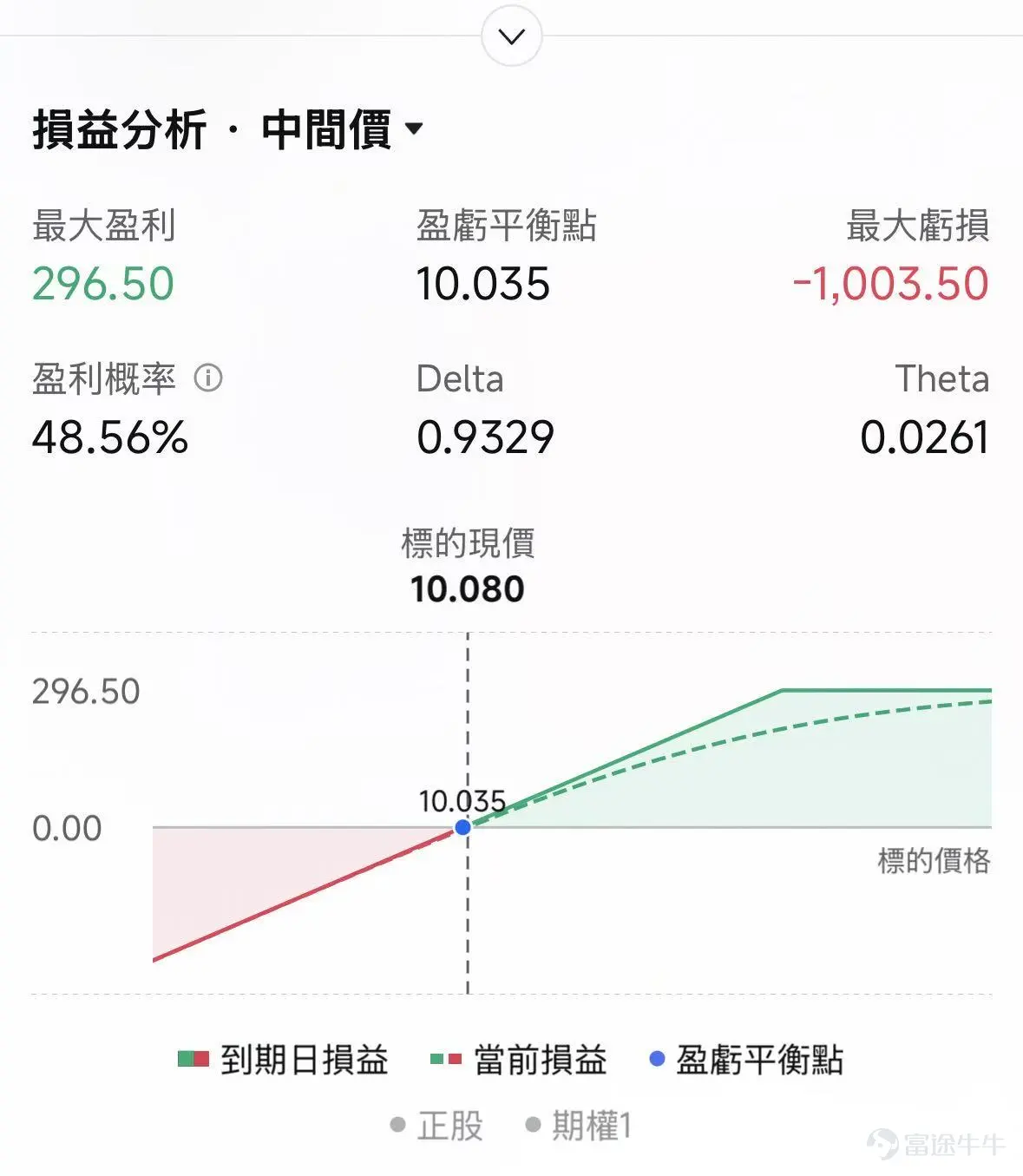
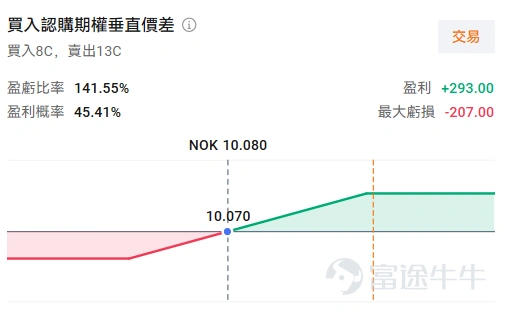
Strategy 2: Bull Call SpreadSuitable for investors who don’t hold the underlying stock but want to play the earnings announcement, expecting only a 'modest increase' (within a 5%–10% range) rather than a sharp rally. Consider buying an at-the-money or slightly out-of-the-money call option while simultaneously selling another call with the same expiration but a higher strike price. Buying a single-leg call outright can be very expensive; if implied volatility collapses (IV Crush) after earnings, the option could lose value even if the stock rises modestly.
By comparison, constructing a Bull Call Spread:
Lower your cost basisThe premium received from selling a call option with a higher strike price can partially offset the cost of buying the call.
Hedge against IV riskYou are both a buyer and a seller of options, so the negative impact of a decline in implied volatility (IV) is significantly mitigated.
Cap risk and rewardYour maximum loss is capped at the initial net debit paid, and your maximum profit is capped at the difference between the two strike prices minus the net debit—but you may miss out on gains from a sharp surge in the underlying stock price.
Before the US market opens on Thursday, July 23, Nokia will release its Q2 2026 earnings report.Looking back over the past three months, $Nokia Oyj (NOK.US)$the stock price has resembled a thrilling 'roller coaster':After reporting strong Q1 results at the end of April, fueled by robust expectations for AI optical networking, the stock surged to a peak in early June. However, as AI hardware stocks corrected and profit-taking kicked in, by the close on July 20,those gains had been completely erased, bringing the share price back to where it stood before the Q1 earnings announcement. This 'elevator-like' price action makes the upcoming Q2 report a critical inflection point for bulls and bears alike. Is the AI infrastructure wave merely a flash in the pan, or is the market offering investors another golden opportunity to get on board? We’ll walk through Nokia’s Q2 earnings preview together. Overall Market Expectations: Q2 serves as the first validation window for full-year guidance Before diving into Q2 expectations, some fellow investors may still associate Nokia with the 'former mobile giant that was phased out.' $Apple (AAPL.US)$ But today’s Nokia has quietly transformed into a global leader in telecom equipment and network infrastructure. Its core traditional business involves supplying mobile base stations (4G/5G radio access networks) and fixed broadband equipment to telecom operators, while also earning substantial technology licensing revenue from its deep patent portfolio.However, what truly revitalized this century-old company in the capital markets is its Network Infrastructure segment...
(The illustrative graphics shown on screen are for demonstration purposes only and do not constitute investment advice or guarantees; market conditions change frequently, and the displayed option prices do not reflect real-time data.)
Nokia’s upcoming Q2 earnings report will be a showdown between expectations and reality. With the stock price back to where it started, has the market already deflated the earlier overheated bubble and returned to a relatively rational valuation? If Q2 revenue and EPS meet or exceed consensus estimates (€4.829 billion / €0.051), and Nokia delivers solid results in converting optical networking and AI orders, its AI infrastructure investment thesis remains intact—and its strong full-year guidance could provide renewed support for the share price. Otherwise, further downside may follow.
Selling options in the current high-IV environment or waiting until after earnings—when uncertainty is resolved—to look for a right-side entry point are both more prudent strategies. Let’s watch closely on July 23.
Vote
Finally, we’ve got a little perk for our fellow investors—feel free to claim it!Options Starter Pack
*This promotion is exclusively available to invited Hong Kong users. Click to learn more.Detailed terms and conditions of the promotion >>
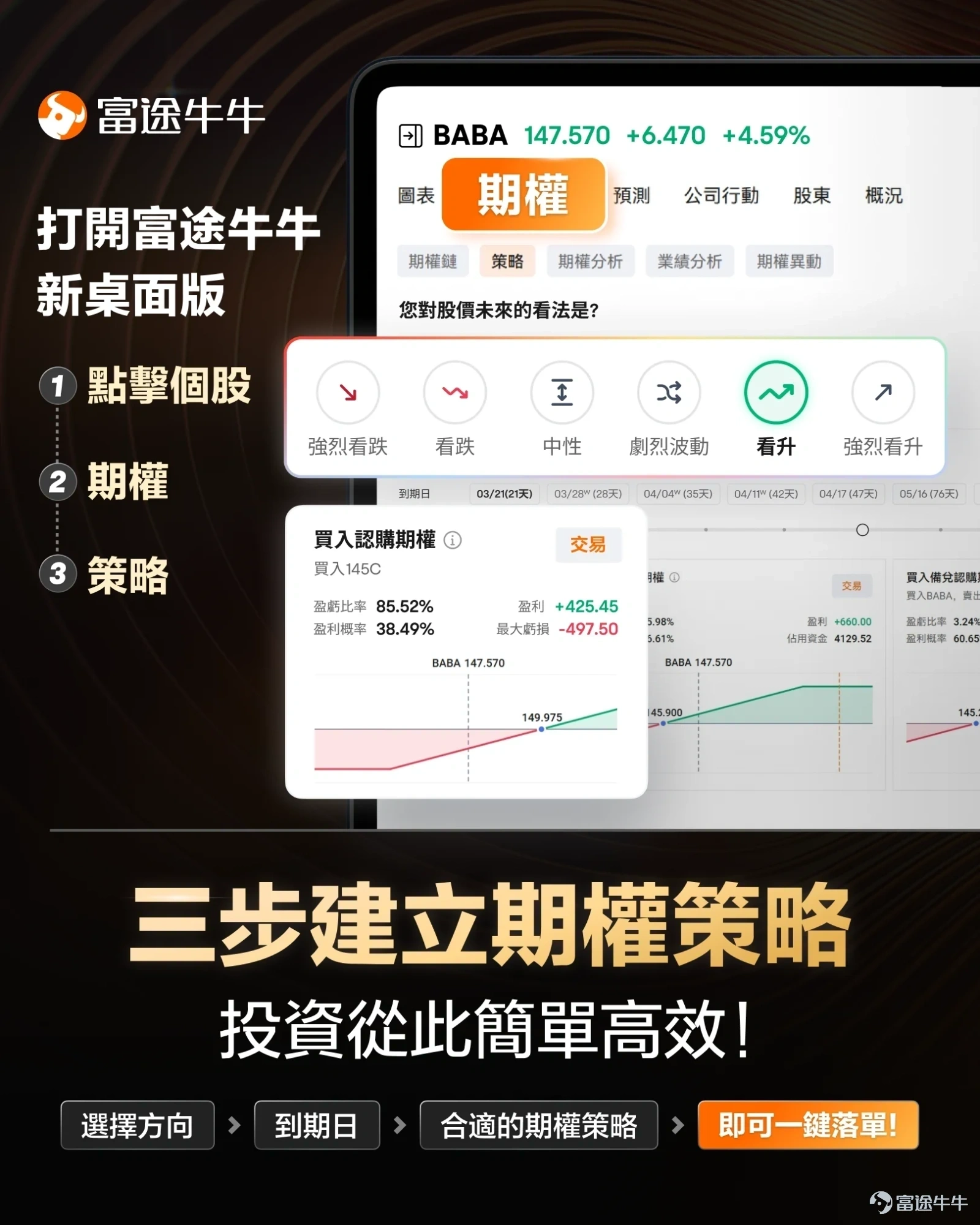
Market conditions are complex and ever-changing,Options strategiesToo many choices and unsure how to proceed? Let Futubull help you build a strategy in three simple stepsOptions strategies, making investing simple and efficient!
Before the US market opens on Thursday, July 23, Nokia will release its Q2 2026 earnings report.Looking back over the past three months, $Nokia Oyj (NOK.US)$the stock price has resembled a thrilling 'roller coaster':After reporting strong Q1 results at the end of April, fueled by robust expectations for AI optical networking, the stock surged to a peak in early June. However, as AI hardware stocks corrected and profit-taking kicked in, by the close on July 20,those gains had been completely erased, bringing the share price back to where it stood before the Q1 earnings announcement. This 'elevator-like' price action makes the upcoming Q2 report a critical inflection point for bulls and bears alike. Is the AI infrastructure wave merely a flash in the pan, or is the market offering investors another golden opportunity to get on board? We’ll walk through Nokia’s Q2 earnings preview together. Overall Market Expectations: Q2 serves as the first validation window for full-year guidance Before diving into Q2 expectations, some fellow investors may still associate Nokia with the 'former mobile giant that was phased out.' $Apple (AAPL.US)$ But today’s Nokia has quietly transformed into a global leader in telecom equipment and network infrastructure. Its core traditional business involves supplying mobile base stations (4G/5G radio access networks) and fixed broadband equipment to telecom operators, while also earning substantial technology licensing revenue from its deep patent portfolio.However, what truly revitalized this century-old company in the capital markets is its Network Infrastructure segment...
Risk Disclaimer: The above content only represents the author's view. It does not represent any position or investment advice of Futu. Futu makes no representation or warranty.Read more
Thumbs Up
20
Heart
2
134K Views
Report
Comments (2)
Write a Comment...
2
22
40