
[IPO Watch] Jianbang Metals Makes Another Bid for Hong Kong Listing: Leader in Photovoltaic Silver Powder Segment, Low-Margin Business Model Yet to Be Tested
On July 14, Jinan Jianbang Metal Materials Co., Ltd. (hereinafter referred to as 'Jianbang Metals') filed an application for a main board listing on the Hong Kong Stock Exchange, with China Securities (International) as the sole sponsor.
This marks Jianbang Metals' third attempt to list on the Hong Kong Stock Exchange. The company previously filed for a Hong Kong IPO in May and November 2025, but both prospectuses have since lapsed. According to available information, the company was formerly known as 'Jianbang Metals Limited' and 'Jianbang Materials Limited.'
Jianbang Metals boasts an impressive shareholder lineup and has secured multiple rounds of financing since its inception. Investors include AV China Holdings PCC Limited, an affiliate of Saudi Aramco—the global oil giant—as well as$Jinko Solar (688223.SH)$Emerald Investment Limited, an affiliate of JinkoSolar, and Jiao Shuge, founder of CDH Investments, among other prominent industrial and financial investors.
The photovoltaic (PV) silver powder segment in which Jianbang Metals operates offers ample growth potential: it links directly to PV silver paste on one end and mainstream solar cell technologies—including PERC, TOPCon, HJT, and xBC—on the other. Combined with narratives around domestic substitution and material upgrading, the sector easily attracts market attention. However, the company faces several more immediate challenges: declining market position, extremely low gross margins from its business model, high concentration among customers and suppliers, and volatile cash flows.
Positioned in the PV silver powder segment, yet market share continues to shrink year after year
Jianbang Metals’ core product is silver powder, primarily used in the production of PV silver paste, which itself is a critical raw material in solar cell manufacturing.
The company’s product portfolio includes both standard and high-end PV silver powders, with the latter mainly applied in newer-generation technologies such as PERC, TOPCon, HJT, and xBC solar cells. In other words, the company does not merely benefit from overall PV installation growth; rather, it sits closer to the front lines of battery material innovation. Its growth trajectory is tightly linked to technological iteration, performance requirements for materials, and shifts in downstream solar cell technology roadmaps.

Although Jianbang Metals holds a significant position in the industry, it is experiencing a decline in market share. According to Frost & Sullivan data, based on revenue from PV silver powder sales in China, Jianbang Metals ranked first, third, and third among all domestic producers in 2023, 2024, and 2025, respectively, with market shares of 10.0%, 9.8%, and 9.3%. Notably, in terms of revenue from xBC-cell-specific silver powder sales in China in 2025, the company ranked first.
Competition in the sector is intensifying. Data shows that total revenue from China’s PV silver powder market reached RMB 52.5 billion in 2025 (all figures in RMB unless otherwise stated), with the top five manufacturers accounting for approximately 54.2% of the total. The top two players captured market shares of 21.1% and 13.1%, respectively, overtaking Jianbang Metals and underscoring the mounting competitive pressure the company faces.
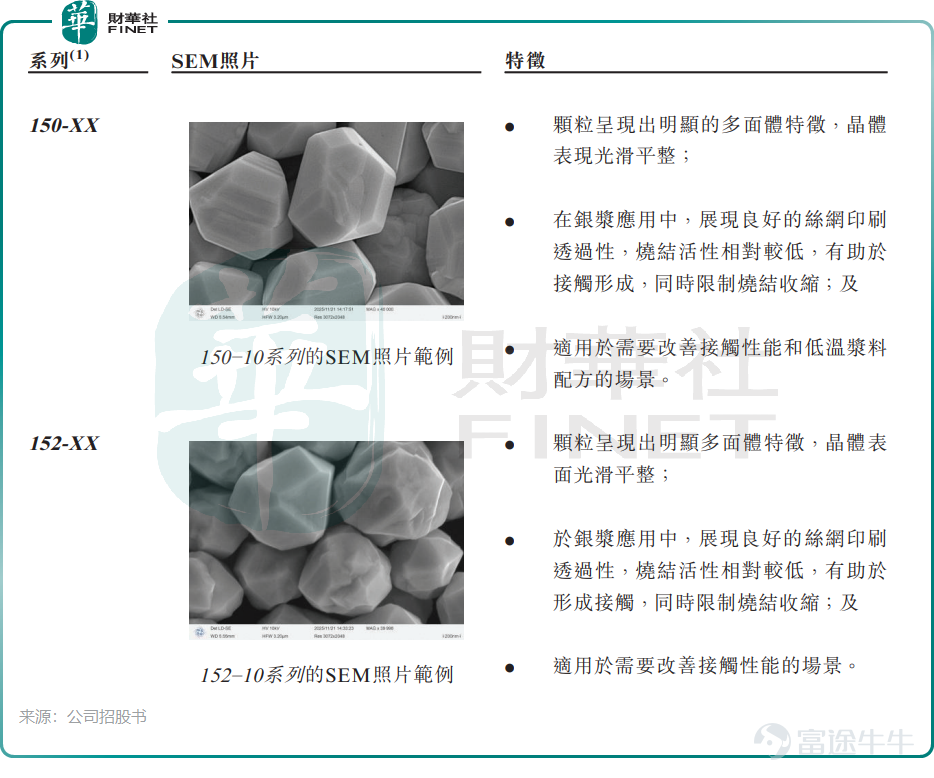
Technology and process capabilities represent another key pillar in the company’s strategy to strengthen its market position. Jianbang Metals has developed an independent and comprehensive silver powder production technology and process system covering critical aspects such as particle size control, crystal structure management, morphology control, and surface modification. The company holds dozens of patents covering core production technologies. On the customer side, its products have already been integrated into the supply chains of leading domestic PV silver paste manufacturers, and it maintains long-standing, stable partnerships with multiple key clients.
However, Jianbang Metals faces significant concentration risks related to both customers and suppliers.
According to the prospectus, from 2023 to 2025 and the first five months of 2026, sales to the company’s largest customer accounted for 45.1%, 36.7%, 21.4%, and 20.7% of total revenue, respectively, while the top five customers collectively contributed 94.8%, 84.4%, 71.1%, and 72.7% of total revenue. Although the trend shows a decline in concentration, the company remains heavily reliant on its key clients.
Supplier concentration is similarly high. During the same periods, purchases from the largest raw material supplier represented 51.1%, 47.9%, 68.7%, and 75.1% of total procurement costs, respectively, with the top five suppliers accounting for nearly 100% of total procurement. The company attributes this to the inherently concentrated nature of the silver nitrate market. Simultaneous high concentration among both customers and suppliers amplifies vulnerabilities in pricing negotiations, credit terms, and supply chain stability.
Behind Rapid Revenue Growth: Low Margins and Volatile Cash Flows
Benefiting from robust growth in China’s photovoltaic sector and rising silver prices, Jianbang Metals has delivered strong operational performance in recent years. However, due to industry characteristics, the company operates with low profit margins.
Per the prospectus, the company reported revenues of RMB 2.782 billion, RMB 3.950 billion, and RMB 5.067 billion in 2023, 2024, and 2025, respectively; net profits for the same periods were RMB 598.9 million, RMB 790.82 million, and RMB 1.69 billion. In the first five months of 2026, revenue surged 187.4% year-over-year to RMB 4.050 billion, and net profit rose sharply to RMB 557.13 million, reflecting significantly improved profitability.

Focusing solely on profit growth while ignoring the inherent characteristics of the business model can lead to misleading conclusions. The prospectus explicitly cautions that its core business—selling silver powder—is typically a low-margin activity. Gross margins in 2023, 2024, and 2025 were as low as 3.9%, 3.3%, and 4.7%, respectively, with net profit margins of 2.2%, 2.0%, and 3.3%. In the first five months of 2026, gross margin stood at 2.0% and net margin at 1.4%.
The fundamental reason for these low margins lies in the nature of the business, which is essentially 'material processing and performance realization based on precious metal prices.' The company prices its silver powder products by adding a markup to the underlying silver price, which constitutes the majority of both the product’s total selling price and raw material costs. In the first five months of 2026, raw material costs accounted for 99.7% of cost of sales, with silver nitrate alone representing 99.6% of total raw material procurement costs. This means that although revenue appears substantial, most of it reflects pass-through silver prices and material costs, leaving minimal room for profit retention.

The company’s financial quality also shows signs of strain. Operating cash flow was negative in both 2023 and 2024, turned positive at RMB 291 million in 2025, but reverted to a net outflow of RMB 196.22 million in the first five months of 2026, indicating that operating cash flows have yet to stabilize into consistent positive generation. This metric is often more telling than profit growth—once a materials company enters an expansion phase, if profit growth fails to translate into cash inflows, financing needs and working capital pressures can emerge rapidly.
On the balance sheet and liquidity front, the company’s current ratio improved from 1.1 in 2023 to 1.8 as of the end of May 2026, and its quick ratio rose from 0.7 to 1.2. Short-term solvency indicators have generally strengthened, while the leverage ratio declined from 61.6% to 47.8%, reflecting an overall improvement in financial health compared to prior years.
Regarding the use of proceeds from this Hong Kong listing, Jianbang Metals plans to primarily allocate funds toward R&D investment, equipment upgrades, overseas market expansion, repayment of bank loans, and working capital supplementation. This allocation balances long-term growth with financial structure optimization and is not aggressive.
Growth prospects are promising, but two key challenges cannot be ignored.
Jianbang Metals is riding a golden wave. According to Frost & Sullivan, driven by surging downstream demand in the photovoltaic (PV) sector, rapid adoption of N-type solar cells, and continuous technological innovation, China’s PV silver paste industry has grown rapidly in recent years—sales revenue rising from approximately RMB 16.9 billion in 2021 to an estimated RMB 67.6 billion in 2025, representing a compound annual growth rate (CAGR) of 41.4%. Revenue is projected to reach RMB 162.9 billion by 2030, with a CAGR of 19.2% from 2025 to 2030.
However, for Jianbang Metals to achieve steady growth, it must overcome two major challenges.
The first challenge lies in the alignment between industry cyclicality and the company’s profit model. As a relatively upstream player in the PV supply chain, suppliers of PV silver powder are rarely insulated when downstream sectors—such as solar cells and silver paste—experience price wars, overcapacity, or inventory adjustments.
The prospectus explicitly notes that China’s PV cell industry currently faces some overcapacity risks. Leading cell manufacturers are gaining stronger bargaining power, which could transmit cost pressures downstream to silver paste producers and further upstream to silver powder suppliers. The company reported profit growth in the first five months of both 2025 and 2026, indicating solid near-term operational capability. However, investors are more concerned about whether the company can maintain its margins and cash flow during industry downturns or periods of volatility. With current gross margins ranging only between 2% and 5%, the company has limited cushion against adverse conditions.
The second challenge concerns whether its 'overseas expansion plus new materials diversification' narrative can truly materialize. The prospectus discloses that the company plans to expand into Middle Eastern markets and intends to build a local manufacturing facility with an annual capacity of approximately 1,500 metric tons for silver powder and other conductive materials. It also plans to establish an R&D center in East Asia to advance development of advanced powder materials.
These initiatives align with industry trends toward silver reduction, alternative materials, and localized overseas production—the logic is sound. However, as of now, the Middle East factory project remains in the planning phase and has not yet formally submitted required permit applications. In other words, this component represents a medium- to long-term strategic vision rather than a near-term, verifiable profit driver. While Hong Kong markets do assign some premium to forward-looking narratives, they typically expect companies to first demonstrate robust fundamentals and solid cash flows from core operations before granting higher valuation multiples based on future potential.
Summary: Strong positioning in a high-growth segment, but valuation still hinges on operational validation.
Based on the prospectus, Jianbang Metals exhibits both clear strengths and notable risks.
Its strength lies in the fact that it is not merely a concept-driven company riding the photovoltaic (PV) hype; rather, it has already established a certain scale, accumulated technological expertise, and secured customer validation in the critical niche segment of silver powder for PV applications. Its revenue and profits have generally trended upward over the past few years, and there are signs of improvement in its asset-liability structure.
The underlying concern, however, stems from its business model, which inherently entails low gross margins that are difficult to avoid. The company faces high concentration risks among both customers and suppliers, exhibits significant volatility in operating cash flow, and its overseas expansion and material diversification initiatives still require time to prove their viability. Markets typically view such companies more appropriately through the lens of 'having established industrial relevance but requiring ongoing validation of earnings quality.'
Undeniably, Jianbang Metal has aligned itself with multiple powerful trends—domestic substitution, technological iteration, and upgrades across the photovoltaic supply chain. However, whether it can achieve sustainable growth ultimately hinges on several key indicators: whether its low-margin model can generate more stable cash inflows, whether concentration risks related to customers and suppliers can continue to be mitigated, and whether investments in R&D, equipment upgrades, and overseas expansion can translate into higher-quality—not merely more volatile—growth in the future.
Risk Disclaimer: The above content only represents the author's view. It does not represent any position or investment advice of Futu. Futu makes no representation or warranty.Read more
Comments
to post a comment