
Hong Kong Market Barometer | Hang Seng Index revised upward to 25,000! Can the rebound continue?
Market Weekly Report | June 29 – July 5, 2026
US nonfarm payrolls for June added only 57,000 jobs, far below expectations, pushing back rate hike expectations; Meta's move to 'sell computing power' triggered a global semiconductor selloff, but Hong Kong stocks ended a seven-week losing streak, rallying 2.99% for the week on low valuations and policy support for innovative drugs; southbound capital turned into a net outflow of HK$1.88 billion; A-shares saw an extreme rotation from high-flying sectors into undervalued ones, with healthcare surging 10.5% in a week while communications plunged 9%; KOSPI crashed 7.89% in a single day due to leveraged ETF rebalancing
1. Overview of the Global Macroeconomy
The core theme in global markets this week was"Cooling NFP + AI computing anxiety + Hong Kong market recovery"— June U.S. employment data showed a significant weakening, sharply reducing the probability of a Fed rate hike in July; Meta’s announcement to offer AI computing services to external clients sparked a wave of selling in global semiconductors; meanwhile, after last week's sharp decline, Hong Kong equities rebounded for the first time in seven weeks, supported by valuation floors and policy tailwinds for innovative drugs.
On the U.S. front,, the June nonfarm payroll report released on July 2 was the biggest macro variable this week. Nonfarm payrolls added only57,000, significantly below the market expectation of 110,000, and April and May figures were revised down by a combined74,000 people(April was revised down from 179,000 to 148,000, and May from 172,000 to 129,000). The unemployment rate edged down slightly from 4.3% to4.2%, but this was primarily due to a decline in labor force participation rather than improved employment—the labor force participation rate and employment-to-population ratio both fell to their lowest levels since 2021. By sector, leisure and hospitality shed61,000(World Cup-related seasonal hiring was weaker than in previous years), representing the largest drag for the month; education and health services added 69,000 jobs, the biggest contributor. Hourly earnings year-over-year3.5%and month-over-month rose 0.3%, indicating wage stickiness persists but is no longer accelerating. This data pushed market expectations for the Fed to hold rates steady at the July FOMC meeting up to approximately80%. The June dot plot’s implied expectation for rate hikes within the year has been significantly delayed. Although Fed Chair Waller reiterated in his speech at the ECB forum that inflation remains "too high," he noted that inflation expectations have recently moderated and declined to provide clear guidance on the July policy meeting.
Meta's "selling computing power" announcementwas the key shock to the tech sector this week. Meta’s plan to offer AI computing capacity to external clients sparked concerns over potential oversupply in AI infrastructure and a reshuffling of competitive dynamics among cloud providers. On July 2, the Philadelphia Semiconductor Index plunged-6.27%, triggering a broad sell-off in global semiconductor stocks. South Korea’s KOSPI index experienced a sharp intraday drop, amplified by quarter-end rebalancing of leveraged ETFs.-7.89%。
In China,. The manufacturing PMI for June, released on June 30, rose to50.3(expected 50.1, previous 50.0), with new export orders returning to expansion territory50.1, and new orders climbed to51.2, indicating a marginal recovery in both domestic and external demand. However, the producer price index dropped below the 50-point mark to48.2(51.9 in May), suggesting that the month-on-month PPI may turn negative, though the year-on-year figure could rise to approximately 4.5% due to a low base effect. The PMI for high-tech manufacturing 53.5and equipment manufacturing52.5, with the AI industry chain continuing to lead in terms of business sentiment
Innovative drug policiesbecame the strongest catalyst in China’s markets this week. On June 29, the National Healthcare Security Administration released the preliminary review results for the 2026 drug reimbursement directory adjustment, establishing for the first time an independent commercial insurance innovative drug list and introducing a 'pre-application' mechanism along with an eight-year price protection mechanism, triggering a rally in the pharmaceutical sectors of both A-shares and Hong Kong stocks. Institutions forecast Q2 GDP at around4.1%-4.4%year-on-year (Q1 was 5.0%), and the Politburo meeting in July may accelerate fiscal stimulus.
Geopolitical and commodity developments: OPEC+ agreed on July 5 to increase production in August by188,000 barrels per day, marking the fifth consecutive month of production increases. The resumption of shipping through the Strait of Hormuz has caused geopolitical risk premiums to fade, allowing fundamentals to once again dominate oil prices. The U.S.-Iran memorandum of understanding remains in place but is fragile; Iran plans to impose a new service fee on vessels transiting the Strait of Hormuz, keeping some geopolitical risk premium intact.
II. Performance of Global Asset Classes
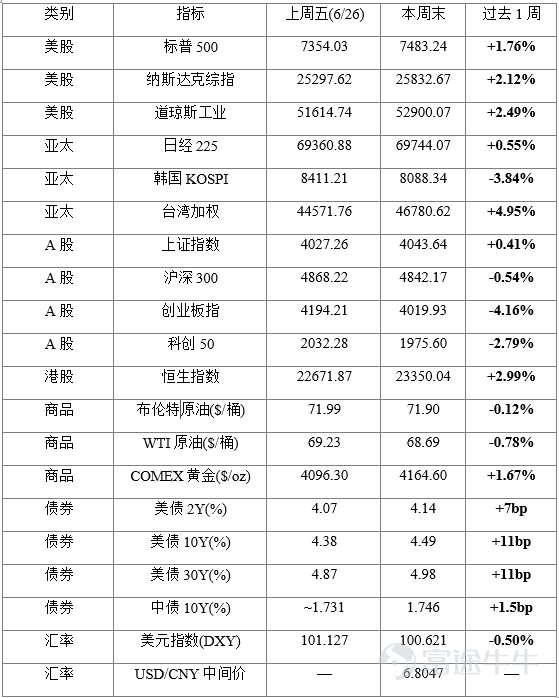
Scope clarification: U.S. equities are calculated based on closing prices from June 26 to July 2 (July 3 is a market holiday for Independence Day); Hong Kong stocks, A-shares, Asia-Pacific markets, commodities, and exchange rates are calculated from June 26 closing to July 3 closing.
Key theme of the week: Cooling nonfarm payroll data boosted risk appetite, driving broad gains in equities, strength in gold, a slight decline in crude oil, and weakness in the dollar—but U.S. Treasury yields rose instead of falling. The yield increase occurred mainly before the jobs report, reflecting delayed market pricing of the hawkish June FOMC dot plot and persistent PCE inflation.

Equity MarketOn the equity front, all three major U.S. indices closed higher for the week, though with clear divergence—Dow Jones rose by+2.49%leading the gains, while the Nasdaq dropped sharply on July 2 following Meta-related news,-0.80%yet still posted a weekly gain of+2.12%, resulting in a 'Dow strong, Nasdaq weak' pattern, with value outperforming growth. Divergence intensified across Asia-Pacific markets: Taiwan’s stock market surged by+4.95%as AI hardware supply chains continued to attract capital, while Japan’s Nikkei edged up by+0.55%. Meanwhile, South Korea’s KOSPI plunged sharply on July 2 due to a flash crash triggered by leveraged ETF rebalancing (institutional net selling surged from KRW 114.6 billion to KRW 2.08 trillion in the final three minutes before market close), dropping by-7.89%before rebounding on July 3.+5.76%, still down for the full week-3.84%, making it the worst-performing major global index.
A-share markets exhibited an extreme rotation from high-flying to lagging sectors—the Shanghai Composite edged up+0.41%, but the ChiNext Index plunged-4.16%and the STAR 50 Index fell-2.79%. On July 2 alone, the ChiNext Index dropped 4.6% and the STAR 50 Index tumbled 7.8%. Profit-taking hit high-flying tech stocks (communications sector down 9%, electronics down 4%), while previously oversold sectors saw valuation rebounds (pharmaceuticals up 10.5%, beauty and personal care up 7.6%, automobiles up 7.0%).
CommodityOn the commodities front, Brent crude edged down slightly for the week-0.12%to $71.90 per barrel, as OPEC+ continued increasing output and the resumption of shipping through the Strait of Hormuz eroded geopolitical risk premiums, returning focus to fundamentals. Gold prices rose for four consecutive days, with COMEX gold gaining+1.67%to$4,164.6 per ounce, marking its first weekly gain in nearly five weeks. Cooling U.S. nonfarm payroll data accelerated gains—the clear transmission chain being: weakening employment → delayed rate hike expectations → lower real interest rate outlook → gold valuation rebound.
bondsOn the one hand, U.S. Treasury yields rose across the board for the week, but the key characteristic wasthat the increase was concentrated before the release of the nonfarm payrolls data: the 10-year yield climbed from 4.38% on June 26 to 4.48% on July 1 (+10 bps), and rose only marginally by 1 bp to 4.49% on July 2, the day of the nonfarm payrolls release. This suggests that the rise in yields reflected delayed pricing of the hawkish dot plot from the June FOMC meeting and persistent May PCE data, rather than being driven by the nonfarm payrolls report. The yield curve steepened in a 'bear steepening' pattern—2-year yields rose by 7 bps, while both 10-year and 30-year yields increased by 11 bps, indicating a greater rise at the long end versus the short end, reflecting higher term premiums. The China 10-year yield edged up by 1.5 bps to1.746%。
Exchange rateOn the other hand, the dollar index declined for the week-0.50%to 100.621, with the weak nonfarm payrolls data accelerating the dollar's decline; the yuan's central parity rate was set at6.8047。
III. Weekly Review of the Hong Kong Market
Scope clarificationHong Kong stocks traded for four sessions this week (June 29, June 30, July 2, and July 3), with markets closed on Wednesday, July 1, for the Hong Kong Special Administrative Region Establishment Day. Weekly returns are calculated from the close on June 26 to the close on July 3.
Index Performance
The Hang Seng Index closed the week at23350.04points, rising by+2.99%for the week, ending a seven-week losing streak. The Hang Seng Tech Index closed at4499.00points, gaining+5.72%, significantly outperforming the broader market; the Hang Seng China Enterprises Index rose approximately+3.20%. On a daily basis, the market saw a technical rebound on Monday, June 29, following the previous week's sharp sell-off (HSI +1.56%), gave back gains on Tuesday, June 30 (-0.63%), witnessed bargain hunting on Thursday, July 2 (+0.76%), and accelerated its rally on Friday, July 3, fueled by cooler-than-expected nonfarm payroll data (+1.28%), with two consecutive days of gains confirming a short-term stabilization.
Style divergence was pronounced: tech growth stocks substantially outperformed high-dividend defensive names, with the Hang Seng Tech Index rising+5.72%while the Hang Seng High Dividend Yield Index gained only+1.4%, reflecting a market rotation from the prior "risk-off/defensive" stance toward "oversold rebound plus theme-driven" trades. The Hang Seng Tech Index trades at approximately21.85xP/E (23rd percentile historically), while the Hang Seng Index is at about11.29xP/E (68th percentile) and approximately1.12x P/B(41st percentile), Hang Seng Index equity risk premium4.49%is at a historically low level, around the 10th percentile since 2010, indicating that the equity risk premium remains attractive. The AH premium index closed at123.3。
Industry sector gains and losses

This week, sector leadership in the Hong Kong market was clear:Innovative pharmaceuticals + oversold reboundserved as the primary driver of gains,while the semiconductor sectorwas the only drag. The healthcare sector surged sharply, driven by policy catalysts related to the innovative drug reimbursement list,14.0%, making it the strongest theme across the entire market; the materials sector benefited from gold prices rising for the fourth consecutive session,8.3%; and discretionary consumption rose, led by automobile stocks,6.2%. Semiconductors declined due to the impact of Meta's 'selling computing power' announcement.7.1%, hardware equipment stocks followed the broader market decline4.8%。
Stock Highlights / Notable Movements in Stock Connect
Top five gainers among Hang Seng Tech Index constituents:

The internet sector as a whole showed broad-based valuation recovery; in the semiconductor segment, some chip stocks experienced delayed pullbacks on Friday due to related events, though they still posted gains for the week; the gold and auto sectors also saw varying degrees of upside.
Southbound funds recorded a net outflow of HK$1.88 billion this week(compared with a net inflow of HK$8.924 billion the previous week, marking a sharp reversal in direction):

Southbound flows exhibited a typical volatile pattern of 'panic selling → dip-buying → event-driven outflow → catalyst-triggered return.' Monday saw a single-day net outflow exceeding HK$10 billion—the largest daily outflow since March—but Tuesday immediately flipped to a net inflow of HK$5.9 billion, reflecting institutional investors actively stepping in at lower levels. The week’s net outflow of HK$1.88 billion remained manageable in scale and displayed a structural shift characterized by 'selling large-cap names, buying thematic plays'—capital rotated out of high-flying tech and high-dividend stocks into innovative pharmaceuticals and oversold internet names.
Hong Kong Exchanges’ average daily turnover reached HK$234.601 billion(over four trading days), showing an increase from the prior period:

Turnover peaked at HK$258.4 billion on July 2, the highest of the week, reflecting heightened long-short divergence amid the Meta-related event; although the market rebounded on July 3, turnover shrank to HK$215.1 billion, indicating mediocre price-volume confirmation, and the sustainability of the rebound remains to be seen.
IV. Outlook for the Market Ahead
Key calendar

Core Thesis
Short-term (1–2 weeks)This week's rebound in Hong Kong equities reflects technical recovery, but its sustainability faces three key tests: First, southbound capital recorded a net outflow of HK$1.88 billion for the week, indicating that mainland investor confidence has yet to fully recover; the 'scarring effect' from Monday's panic-driven outflow exceeding HK$10 billion persists. Second, trading volume on the July 3 rebound day shrank to HK$215.1 billion, signaling insufficient price-volume confirmation. Third, next week’s U.S. CPI release (July 10) and China’s CPI/PPI data (July 9) represent critical validation windows—if the U.S. CPI continues to show sticky core inflation, rate hike expectations could re-accelerate, constraining valuation recovery potential for Hong Kong stocks. The Hang Seng Index faces23500-23800as a near-term resistance zone, with22800serving as key support.
Medium-term (1–3 months): The core tension for Hong Kong equities remains 'Fed rate hike expectations versus China’s economic fundamentals.' If the cooling labor market trend continues, the probability of the Fed holding rates steady at the July FOMC meeting rises to around 80%, which would ease external liquidity pressure on Hong Kong equities. However, China’s June PMI output prices falling below 50 suggest a month-on-month decline in PPI, and the projected Q2 GDP slowdown to approximately 4.1–4.4% may prompt accelerated fiscal stimulus at the Politburo meeting in July. From a valuation perspective, the Hang Seng Index’s equity risk premium stands at 4.49%, sitting at the 10th percentile historically—an extremely low level that limits downside risk. Upside potential, however, hinges on catalysts such as confirmed policy stimulus or a material retreat in Fed rate hike expectations.
Allocation strategy
1. Innovative drug industry chain: The establishment of a separate commercial insurance formulary for innovative drugs under the national reimbursement drug list, coupled with an eight-year price protection mechanism, constitutes structural policy tailwinds. Valuations for Hong Kong-listed healthcare stocks remain at historical lows, presenting opportunities in valuation recovery for innovative drug leaders and CXO (contract research, development, and manufacturing) companies.
2. Oversold internet mega-caps: Some mega-cap names have posted notable recent gains, yet their price-to-earnings ratios remain in the lower-to-mid range of historical levels. Continued progress in AI commercialization (search, advertising, cloud) offers sustained upside catalysts, and structural return flows from southbound capital are anticipated.
3. High-dividend defensive core holdingsThe Hang Seng High Dividend Yield Index rose just 1.4% this week, underperforming in relative terms but offering a margin of safety amid heightened market volatility; maintaining defensive allocations within a barbell portfolio structure is recommended.
4. Second-order beneficiaries among gold stocksCooling non-farm payroll data → delayed rate hike expectations → expectations of lower real rates → valuation recovery for gold. With COMEX gold breaking above USD 4,160 per ounce, the uptrend is confirmed, making Hong Kong-listed gold stocks attractive for allocation.
Risk Warning
⚠️ Stickier-than-expected US CPIIf June core CPI comes in above the consensus forecast of 2.9%, rate hike expectations could reheat, pushing US Treasury yields higher and capping valuation recovery in Hong Kong equities | ⚠️ Spillover effects from Meta-related developmentsIf concerns over AI computing capacity oversupply spread from semiconductors to cloud providers’ capital expenditure outlook, tech stocks could see a second leg down | ⚠️ China’s PPI turns negative, triggering downstream effectsFactory-gate prices falling below 50 signal mounting corporate earnings pressure; a Q2 GDP slowdown could prompt downward revisions to earnings forecasts | ⚠️ Escalating US-Iran tensions: Escalation of the Strait of Hormuz transit fee dispute could reignite geopolitical risk premium, pressuring oil prices and risk appetite | ⚠️ Southbound funds continue to flow out.: If southbound capital continues its net outflow trend next week, the liquidity support for a Hong Kong equities rebound will weaken
Disclaimer: This report is for internal discussion purposes only and does not constitute investment advice.
Data sources: AlphaPai database and publicly available market data

$CMS Hang Seng Tech Index ETF (03423.HK)$ $BABA-W (09988.HK)$ $TENCENT (00700.HK)$ $XIAOMI-W (01810.HK)$ $NTES (09999.HK)$ $MEITUAN-W (03690.HK)$ $KUAISHOU-W (01024.HK)$ $SMIC (00981.HK)$ $BYD COMPANY (01211.HK)$ $JD-SW (09618.HK)$ $LI AUTO-W (02015.HK)$ $TRIP.COM-S (09961.HK)$ $XPENG-W (09868.HK)$ $BIDU-SW (09888.HK)$ $LENOVO GROUP (00992.HK)$ $HAIER SMARTHOME (06690.HK)$ $JD HEALTH (06618.HK)$ $KINGDEE INT'L (00268.HK)$ $SUNNY OPTICAL (02382.HK)$ $BILIBILI-W (09626.HK)$ $MIDEA GROUP (00300.HK)$ $SENSETIME-W (00020.HK)$ $KINGSOFT (03888.HK)$ $ALI HEALTH (00241.HK)$ $HUA HONG GRACE (01347.HK)$ $TONGCHENGTRAVEL (00780.HK)$ $BYD ELECTRONIC (00285.HK)$ $ASMPT (00522.HK)$ $NIO-SW (09866.HK)$ $HORIZONROBOT-W (09660.HK)$ $TME-SW (01698.HK)$
Risk Disclaimer: The above content only represents the author's view. It does not represent any position or investment advice of Futu. Futu makes no representation or warranty.Read more

Comments
to post a comment
3
2