
Seek safety when the market is roaring with excitement
By Chen Ningdi
Recently, while on a business trip in Taiwan, I accompanied a client for a massage. When the therapist learned I worked in investment, he started talking about stocks, saying he had invested all his savings in the ** stock market. At its peak, he made several million New Taiwan dollars, but has now lost over one million. He asked me whether he should keep holding. This reminded me of Hong Kong in 2015. Back then, the Hong Kong stock market was also booming—the Hang Seng Index surged by 3,233 points in April alone, reaching its yearly high of 28,588. During a hotel massage at the time, the therapist told me he had also put all his savings into Hong Kong equities. But the market crash followed shortly after; starting in June, the Hang Seng Index plunged sharply, ending the year down 36% and causing massive losses for many investors.
I was deeply moved—these individuals earned their savings through hard manual labor, one massage at a time, yet they so easily risked their life savings in the stock market. They had no real understanding of equities; they were merely chasing trends, and their likely outcome is total loss.
01
A Booming Stock Market
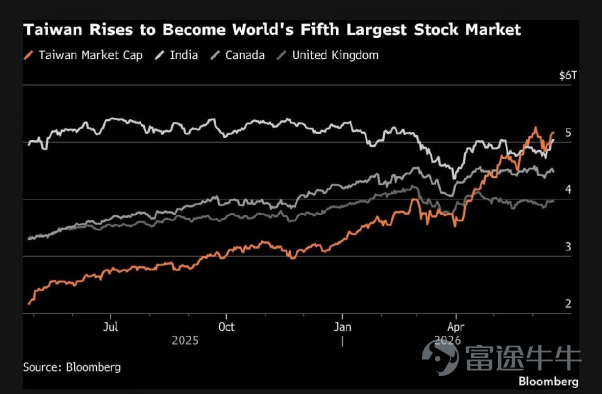
Taiwan’s stock market has risen more than 50% year-to-date, ranking among the world’s top performers. As of June, its market capitalization exceeded USD 5 trillion, surpassing the UK, Canada, and India to become the world’s fifth-largest equity market, behind only the United States, mainland China, Japan, and Hong Kong. In contrast, Taiwan’s GDP ranks just outside the global top 20, making its stock market an extraordinary spectacle of exuberance.

Figure 1: Taiwan’s stock market capitalization surpasses that of the UK, Canada, and India, becoming the world’s fifth largest. Source: Bloomberg
The surge in Taiwan’s stock market has drawn in many new retail investors, some even borrowing money to trade. According to data from the Taiwan Stock Exchange, margin loans used by investors to buy stocks have skyrocketed by 160%, reaching NT$600 billion—approaching the record high set just before the dot-com bubble burst in 2000.

Figure 2: Leverage in Taiwan’s stock market surges. Source: Taiwan Stock Exchange, Bloomberg
South Korea presents a similar picture. Retail investors dominate trading activity in the Korean equity market. As measured by trading volume, individual investors accounted for as much as 71% of South Korean stock trades through May. The total number of domestic stock trading accounts in Korea stands at 108.77 million—more than double the country’s population of just over 50 million—meaning each person holds more than two accounts on average. Substantial capital has poured into equities via highly leveraged ETFs. By comparison, retail investors account for only about 20% of trading volume in the U.S. and Hong Kong markets.
Since the start of 2026, South Korea’s stock market has surged 87%, leading global gains. However, the market has recently experienced sharp volatility due to excessive leverage, triggering circuit breakers five times this year alone—out of only 11 such events in the entire history of the Korean market. Fear of missing out (FOMO) is the primary driver pushing retail investors into equities. When everyone around seems to be making a fortune from stocks, even the most cautious individuals get swept up emotionally and pour their savings into the market. But once stock talk reaches massage therapists, it becomes extremely difficult to attract fresh capital. At that point, a correction is inevitable—it’s only a question of depth. In the past week (June 26–July 2), the KOSPI fell 13.22%. On June 23 and 26, sharp declines in SK Hynix triggered consecutive circuit breakers in the Korean market.

Figure 3: Korea Composite Stock Price Index (KOSPI)
02
A flight-to-safety trend in capital flows has already emerged.
Since the beginning of 2026, the S&P 500 has risen 8.49%. However, excluding the semiconductor sector, the rest of the index has gained only 2.1%. In other words, the U.S. market rally has been driven entirely by AI-related stocks.

Figure 4: The S&P 500 shows modest performance when excluding semiconductors. Source: Bloomberg
As signs of a market bubble emerge, 'smart money' has already begun quietly shifting positions. On June 18, newly appointed Federal Reserve Chair Kevin Warsh held his first FOMC meeting. Warsh did not submit a dot plot forecasting interest rates and eliminated forward guidance. Markets now widely expect rate hikes are likely before year-end. According to CME FedWatch, the probability of a July rate hike stands at 8.8%, rising to 34.4% in September and nearing 50% by October. The price of the well-known ETF tracking the 'Magnificent Seven' tech stocks—Roundhill Magnificent Seven ETF—has declined 14% from its May peak.
With rising expectations of rate hikes and warnings of equity bubbles, substantial capital is exiting tech stocks to reduce risk exposure. EPFR Global data shows that for the week ending June 24, U.S. equity funds recorded $8.5 billion in outflows, with technology-sector outflows hitting a record $9.3 billion. Just the prior week, tech funds had attracted $19.2 billion in inflows. This marks the first time since March that capital has flowed out of U.S. equities.
Where is the money going?
US Treasury bonds remain the best safe-haven asset in the United States at present. Although Turkey sold most of its holdings of US Treasuries in March this year—amounting to USD 14 billion, aimed at alleviating lira depreciation pressures amid high oil prices—and Japan has recently been selling US Treasuries to counter yen depreciation, the yield on the 10-year US Treasury note has declined rather than risen, falling from 4.6% to below 4.4%. This indicates that capital is flowing into US Treasuries as a safe haven.

Figure 5: US 10-Year Treasury Yield, Source: MacroMicro
Gold is another ultimate safe-haven asset. Despite entering a bear market since March, central banks around the world have not ceased their purchases. The People's Bank of China added another 320,000 ounces of gold in May, marking its 19th consecutive month of gold purchases. A special survey released by the World Gold Council on June 16, 2026, showed that 89% of reserve managers expect global central bank gold reserves to continue expanding over the next year; 45% of institutions plan to actively increase their national gold reserves, up from 43% in 2025, reaching a record high since the survey began. Historically, central bank buying has often provided a solid floor for gold prices, owing to their characteristic of buying but rarely selling.
03
With storm clouds gathering, which assets should one choose for safety?
Cycles are eternal, and every cycle represents a redistribution of wealth.
The railway mania of the 1840s and the internet bubble at the end of the 20th century can both serve as cautionary parallels to today’s AI boom. Undoubtedly, these technological revolutions were real: railways reduced transportation costs, and the internet transformed how information is transmitted. These innovations genuinely enhanced productivity, yet capital flooded in so rapidly that valuations far exceeded normal levels of commercial return. While railways and the internet survived and continue to play vital roles in the economy today, not everyone profited—many early investors and companies suffered heavy losses after the bubbles burst. What remained for the market was extensive railway and internet infrastructure, which undoubtedly benefited industries overall, though whether investors came out ahead remains a matter of perspective.

Figure 6: Historical Equity Valuation Bubbles, Source: Bank of America
Smart money has already started seeking safe havens—avoiding the temptation to capture the last coin is what enables one to endure longer on the investment journey.I’ve mentioned many times in previous articles that top-tier US real estate is now at the beginning of a new cycle. The wealth effect generated by the AI industry has once again created a cohort of newly affluent individuals in Silicon Valley, whose demand for luxury properties has led to severe supply shortages in Carmel, driving prices steadily higher. I recently saw a house for sale in Carmel with 2,500 square feet listed for over USD 19 million—equivalent to more than USD 7,000 per square foot. Delin never chases cycles; instead, it identifies and positions itself ahead of them. Delin is based in Silicon Valley, USA.ONE Carmel ProjectThe project has already invested over $100 million of its own capital, spans an area of 3.6 square kilometers, and includes plans for 66 luxury residences, each averaging 20,000 square meters. The total revenue from the project is expected to reach as high as $4 billion!
It's easy to chase trends, but you're very likely to get caught up in a bubble.Real value lies in identifying market cycles—entering the game when no one else is paying attention and patiently waiting for the tide to turn before the wave arrives.
04
Conclusion
1. The AI industry boom has overheated the stock market, with risks now highly concentrated.
2. Smart money in the market has already started quietly moving into safe-haven assets, with U.S. Treasuries absorbing substantial inflows.
Author Bio:
Ningdi Chen, a graduate of the University of Chicago with an Honors Bachelor's degree in Economics and Statistics, has over 26 years of experience in the global financial industry. He founded Delin Securities and Delin Family Office and was previously a licensed responsible person for Type 1, 4, and 6 licenses granted by the Hong Kong Securities and Futures Commission. He currently serves as Chairman of the Board, Executive Director, and Chief Executive Officer of Delin Holdings Group, Vice President of the Hong Kong Limited Partnership Fund Association, and authored 'The Era of Wealth Transformation: Discovering Counter-Cyclical Survival Wisdom.'
Disclaimer
This article is for reference purposes only. Investors should base their investment decisions solely on information disclosed in the company's official announcements.
The information and materials provided on this platform, including text, graphics, links, or other items sourced from third-party information terminals, are for general reference only. Under no circumstances shall the information published on this platform constitute investment advice.
No person may reproduce or republish any content without authorization from this official account.
Content shared via WeChat is for reference only and is the property of DL Holdings and its respective content providers. For the full disclaimer, please visit DL Holdings’ official website: https://www.dl-holdings.com/
Risk Disclaimer: The above content only represents the author's view. It does not represent any position or investment advice of Futu. Futu makes no representation or warranty.Read more

Comments
to post a comment
3