
NVIDIA publicly showcases CPO switches—could optical communication stocks be turning around?

Daily Options Seller Strategy | SemiAnalysis Report Triggers Panic! AAOI Plunged Over 17% in the Previous Session—How to Trade the Expectation Gap in the Optical Communications Sector?
I. Market Barometer
Major U.S. indices ended mixed in the previous session, with the optical communications sector facing heavy selling pressure. Overnight, prominent research firm SemiAnalysis released a report asserting that two core AI technology pathways—CPO (Co-Packaged Optics) and 800VDC—will be delayed until 2028. This sharp market volatility has created a high-premium window for options seller strategies.
II. Focus on Hot Targets
$Applied Optoelectronics (AAOI.US)$ : SemiAnalysis Report Sparks Sell-Off; Stock Dropped Over 17% in the Previous Session
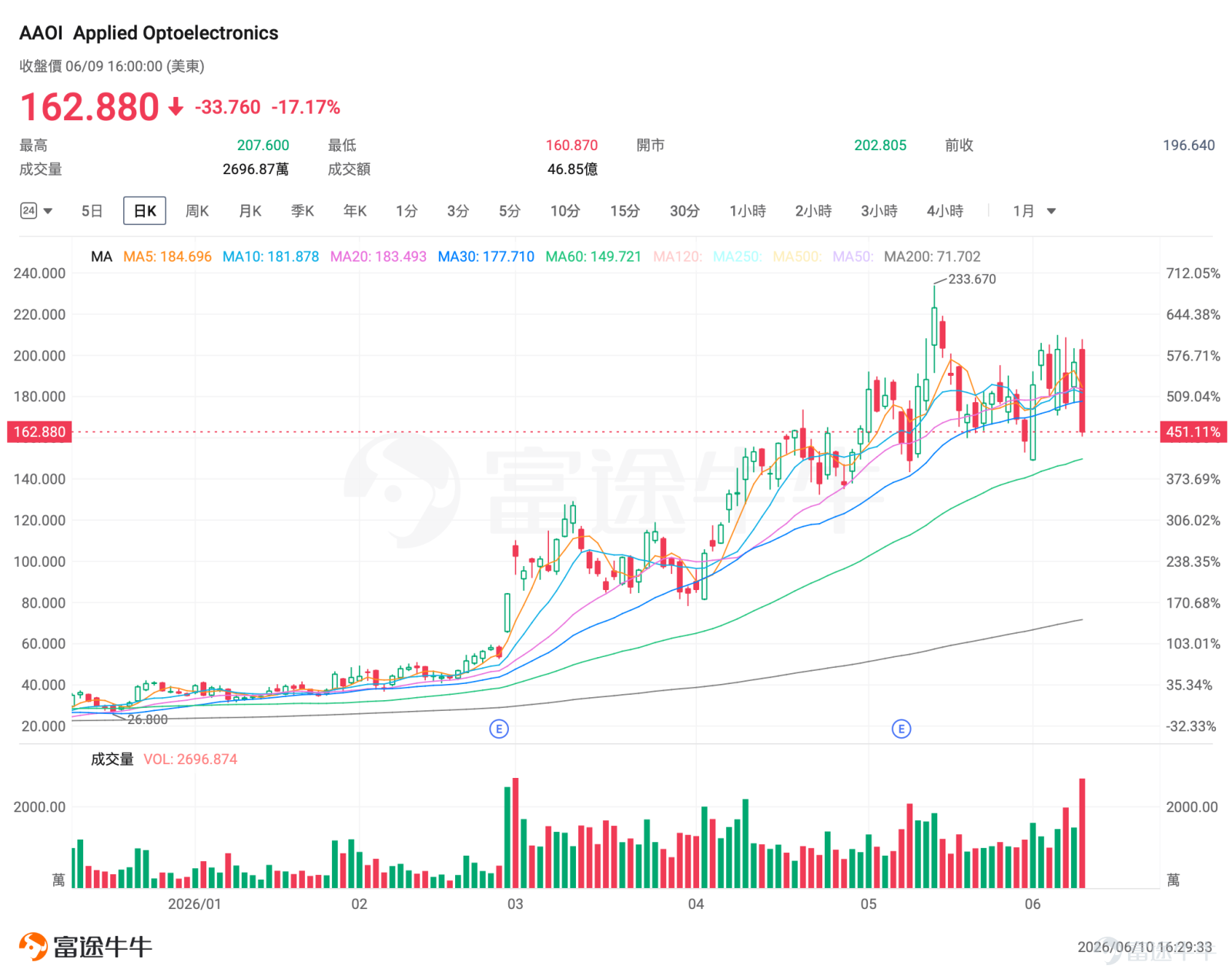
$Applied Optoelectronics (AAOI.US)$ The stock experienced a roller-coaster session the previous day, initially surging to an intraday high of $207.60 before plummeting sharply to close at $162.880—a massive 17.17% drop—with a full-day price swing exceeding 23%. Turnover ratio stood at approximately 35.45%, and trading volume surged to $4.685 billion.

Technical indicators show a breakdown pattern: the June 9 plunge directly breached both the 5-day and 20-day moving averages, damaging the short-term technical structure. The stock closed near its session low, forming a bearish 'Dark Cloud Cover' candlestick pattern. Key support lies in the $150–$152 range (Bollinger Band lower band and psychological level); major resistance is at the round-number $200 mark.
The core catalyst behind AAOI's sharp stock price decline was a major report released overnight by SemiAnalysis, a well-known AI supply chain research firm.The report directly highlighted delays in two key technological pathways for AI data centers: large-scale production of CPO (co-packaged optics) could be pushed back to 2028–2029, and the 800VDC power architecture has been postponed to 2028, as hyperscale cloud providers reportedly remain cautious about NVIDIA-led 800VDC architecture.
However, the industry has presented a starkly contrasting outlook. NVIDIA’s Senior Vice President of Networking explicitly stated during Computex that there would be no delay in CPO product deliveries in the second half of the year. Lumentum’s CEO also indicated that CPO products are expected to begin shipping in the second half of 2027.
U.S.-listed optical communications stocks collectively tumbled, with AAOI—being a key player in the sector—facing heavy selling pressure. Meanwhile, the company’s fundamental investment thesis remains intact, with a clear inflection point for volume ramp-up in 800G/1.6T high-speed optical modules.
As of now, Wall Street analysts have assigned an average price target of $190.00 for the stock, with a high target of $220.00 and a low target of $160.00. The current share price of $162.88 is already approaching the lower end of analysts’ target range.
III. Seller Options Strategy
1. Covered Call
Holding 100 shares $Applied Optoelectronics (AAOI.US)$Underlying stock: Sell 1 contract of AAOI 260717 300C

Opportunity filtering logic:
For investors already holding AAOI shares and experiencing significant unrealized losses, the stock faces near-term technical resistance after plunging 17% in a single day and breaking below multiple short-term moving averages. The divergence in expectations regarding CPO production timelines is unlikely to resolve quickly, and the tug-of-war between SemiAnalysis’s bearish report and bullish industry developments may continue to drive sharp volatility.
Although investors remain bullish on the company’s long-term growth prospects from optical module volume ramp-up and capacity expansion, they worry that the near-term disruption to the CPO narrative could keep valuation pressure elevated. In this context, selling a covered call allows them to collect option premium to reduce cost basis; the premium income can effectively offset time decay. If the stock rebounds above $300 and gets called away, it would effectively lock in profits near all-time highs.
IV. Risk Control Reminder
Although the seller strategy has a high probability of success, investors must still manage risks effectively:
– Position management is key:The biggest risk for option sellers lies in black swan events. It is recommended that margin exposure for a single underlying should not exceed 20% of total capital. Never sell options beyond your capacity for the sake of greedy premiums.
– Timely rolling of covered call options: When a covered call option becomes deeply in-the-money (stock price far exceeds the strike price), and if the underlying stock is still viewed favorably, decisively 'roll' the position — that is, close the current option by buying it back and simultaneously sell an option with a later expiration date and a higher strike price to avoid having the stock called away at a low price.
– Cash-secured put options warn of 'left-tail risk':For cash-secured puts, if the stock price collapses due to deteriorating fundamentals (rather than a normal pullback), do not hold on stubbornly. At this time, stop losses should be executed, or 'rolling down' can be employed to buy time and wait for volatility to normalize.
Make good use of the options seller zone to understand the income strategies for selling optionsEarn option premiums!
Make good use of the options seller zone to understand the income strategies for selling optionsEarn option premiums!

Options Risk Warning
An option is a contract that grants the holder the right, but not the obligation, to buy or sell an asset at a fixed price on a specific date or at any time before that date. The price of an option is influenced by various factors, including the current price of the underlying asset, the strike price, time to expiration, and implied volatility. Implied volatility reflects the market’s expectations for the level of volatility in the option over a future period. It is a data point derived inversely from the Black-Scholes option pricing model and is generally regarded as an indicator of market sentiment. When investors anticipate greater volatility, they may be more willing to pay a higher price for options to hedge risks, resulting in higher implied volatility. Traders and investors use implied volatility to assess the attractiveness of option prices, identify potential mispricings, and manage risk exposure.
Disclaimer
This content does not constitute any offer, solicitation, recommendation, opinion, or guarantee for any securities, financial products, or tools. The risk of loss in trading options can be substantial. In some cases, losses incurred may exceed the initial margin deposited. Even if you set contingency orders, such as 'stop-loss' or 'limit' orders, these may not necessarily prevent losses. Market conditions may make such orders unexecutable. You may be required to deposit additional margin within a short period. If you fail to provide the required amount within the specified time, your open positions may be liquidated. However, you will still be responsible for any shortfall in your account resulting from such liquidation. Therefore, before trading, you should study and understand options and carefully consider whether such trading suits you based on your financial situation and investment objectives. If you trade options, you should be familiar with the procedures for exercising options and the rights and obligations upon expiration. Options trading involves extremely high risks and is not suitable for all investors. Investors should read Characteristics and Risks of Standardized Options carefully before engaging in any options trading strategy.
Risk Disclaimer: The above content only represents the author's view. It does not represent any position or investment advice of Futu. Futu makes no representation or warranty.Read more

Comments
to post a comment
12
16