
English
Back
Open Account
Futubull Options Sir
wrote a column · ·

Options Sir Breaks Down the Hot Topics | Semiconductors Prop Up U.S. Market Rebound! Is the Pullback Over?

US stocks rebounded on Monday, with semiconductors once again emerging as the market's strongest theme.
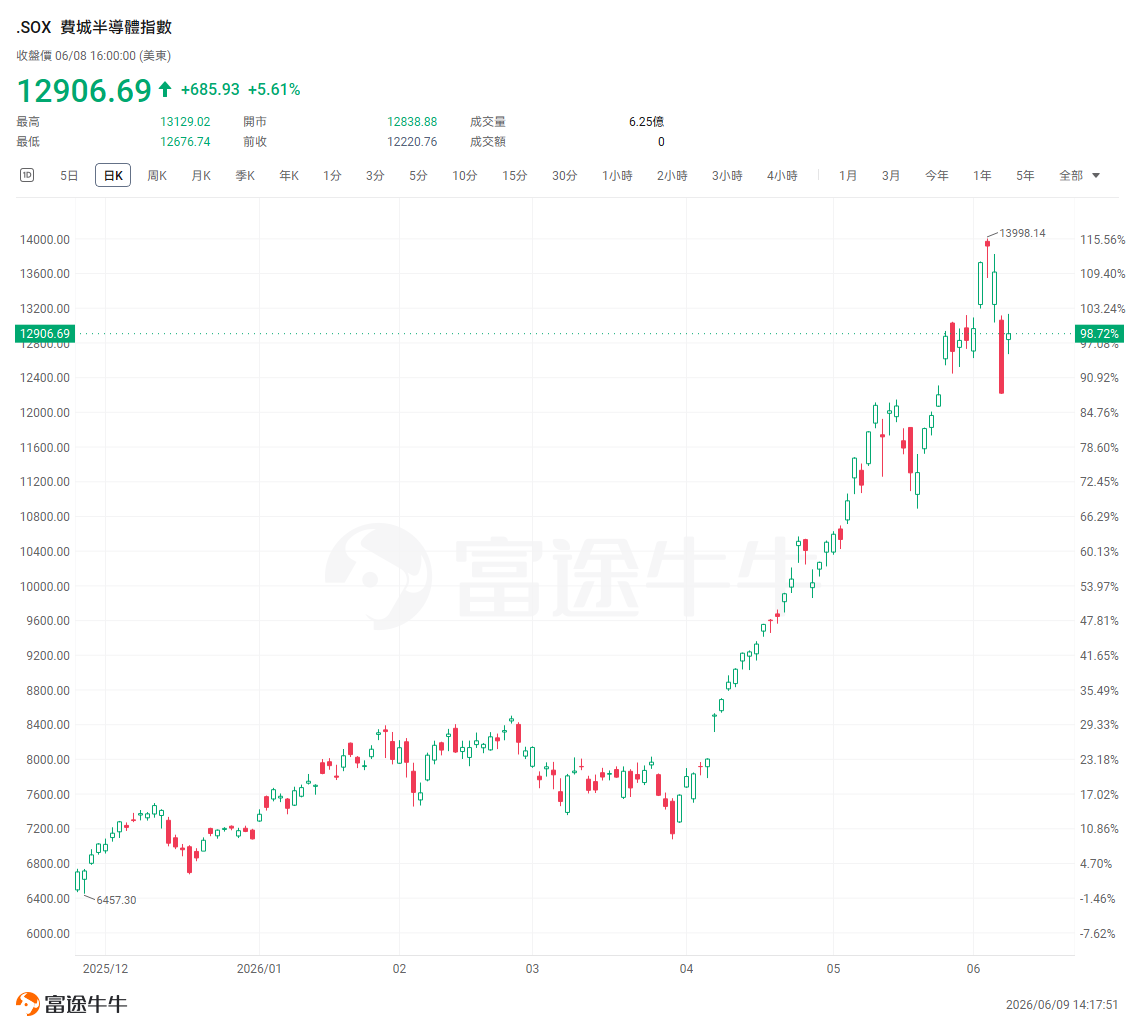
Intraday, $PHLX Semiconductor Index (.SOX.US)$ surged more than 6% at one point, $NASDAQ 100 Index (.NDX.US)$ gained nearly 2%. From the market action, the AI hardware chain rebounded quickly, $NVIDIA (NVDA.US)$$Broadcom (AVGO.US)$$Micron Technology (MU.US)$$Intel (INTC.US)$$Marvell Technology (MRVL.US)$ and other core names all saw varying degrees of recovery.
After Friday’s sharp sell-off, this kind of rebound feels quite encouraging.But following this rebound, has the risk been resolved? How should investors navigate trading opportunities and risks?
US stocks rebounded on Monday, with semiconductors once again emerging as the market's strongest theme. Intraday, $PHLX Semiconductor Index (.SOX.US)$ surged more than 6% at one point, $NASDAQ 100 Index (.NDX.US)$ gained nearly 2%. From the market action, the AI hardware chain rebounded quickly, $NVIDIA (NVDA.US)$ 、 $Broadcom (AVGO.US)$ 、 $Micron Technology (MU.US)$ 、 $Intel (INTC.US)$ 、 $Marvell Technology (MRVL.US)$ and other core names all saw varying degrees of recovery. After Friday’s sharp sell-off, this kind of rebound feels quite encouraging.But following this rebound, has the risk been resolved? How should investors navigate trading opportunities and risks? Marginal easing of macro pressures: New York Fed inflation expectations remain under control. The first backdrop for yesterday’s market rebound was that Middle East risks did not escalate further. Tensions between Israel and Iran temporarily eased, oil price gains narrowed, and the feared chain reaction—'geopolitical conflict → surging oil prices → reignited inflation → a more hawkish Fed'—did not worsen further. Inflation expectations from the New York Fed remain under control.The New York Fed's May Survey of Consumer Expectations showed that one-year inflation expectations edged down slightly from 3.6% to 3.5%, while three- and five-year inflation expectations remained broadly stable. Employment expectations, however, began to weaken, with the perceived probability of finding a new job after unemployment falling to 43.7%, and the perceived likelihood of job loss over the next year rising to 15.1%. Inflation expect...
Marginal easing of macro pressures: New York Fed inflation expectations remain under control.
The first backdrop for yesterday’s market rebound was that Middle East risks did not escalate further.
Tensions between Israel and Iran temporarily eased, oil price gains narrowed, and the feared chain reaction—'geopolitical conflict → surging oil prices → reignited inflation → a more hawkish Fed'—did not worsen further.
Inflation expectations from the New York Fed remain under control.The New York Fed's May Survey of Consumer Expectations showed that one-year inflation expectations edged down slightly from 3.6% to 3.5%, while three- and five-year inflation expectations remained broadly stable. Employment expectations, however, began to weaken, with the perceived probability of finding a new job after unemployment falling to 43.7%, and the perceived likelihood of job loss over the next year rising to 15.1%.
With inflation expectations contained but the employment outlook softening, in market terms, the pressure on the Fed to turn significantly more hawkish has temporarily diminished.
Stock-specific catalysts have reignited sentiment in the AI hardware chain:Marvell’s custom AI chips plus potential inclusion in the S&P 500; Intel’s potential foundry orders driving valuation reassessment; and Micron still operating in a strong phase of the memory cycle.
US stocks rebounded on Monday, with semiconductors once again emerging as the market's strongest theme. Intraday, $PHLX Semiconductor Index (.SOX.US)$ surged more than 6% at one point, $NASDAQ 100 Index (.NDX.US)$ gained nearly 2%. From the market action, the AI hardware chain rebounded quickly, $NVIDIA (NVDA.US)$ 、 $Broadcom (AVGO.US)$ 、 $Micron Technology (MU.US)$ 、 $Intel (INTC.US)$ 、 $Marvell Technology (MRVL.US)$ and other core names all saw varying degrees of recovery. After Friday’s sharp sell-off, this kind of rebound feels quite encouraging.But following this rebound, has the risk been resolved? How should investors navigate trading opportunities and risks? Marginal easing of macro pressures: New York Fed inflation expectations remain under control. The first backdrop for yesterday’s market rebound was that Middle East risks did not escalate further. Tensions between Israel and Iran temporarily eased, oil price gains narrowed, and the feared chain reaction—'geopolitical conflict → surging oil prices → reignited inflation → a more hawkish Fed'—did not worsen further. Inflation expectations from the New York Fed remain under control.The New York Fed's May Survey of Consumer Expectations showed that one-year inflation expectations edged down slightly from 3.6% to 3.5%, while three- and five-year inflation expectations remained broadly stable. Employment expectations, however, began to weaken, with the perceived probability of finding a new job after unemployment falling to 43.7%, and the perceived likelihood of job loss over the next year rising to 15.1%. Inflation expect...
AI trading is not over; this is a recovery after a stampede.
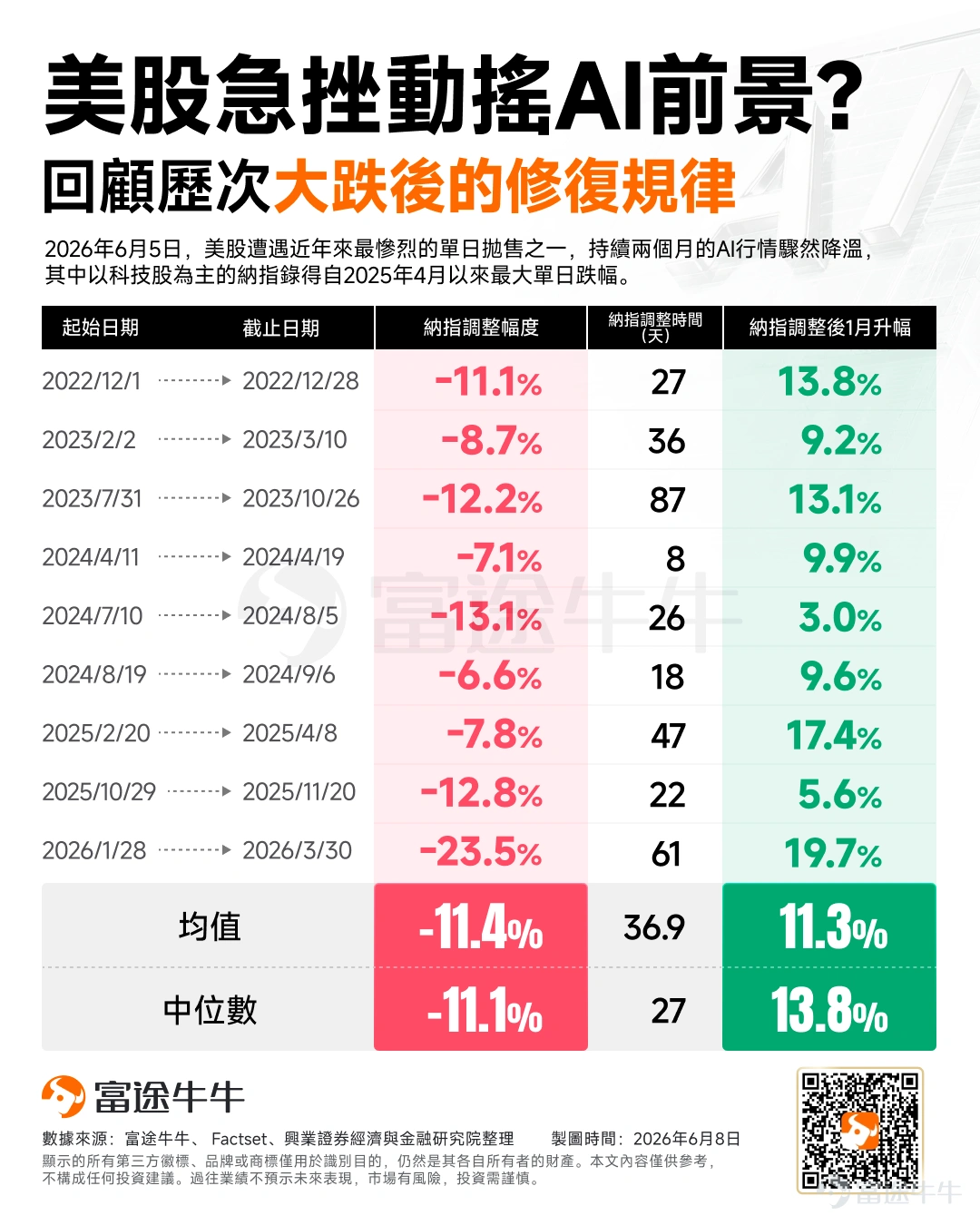
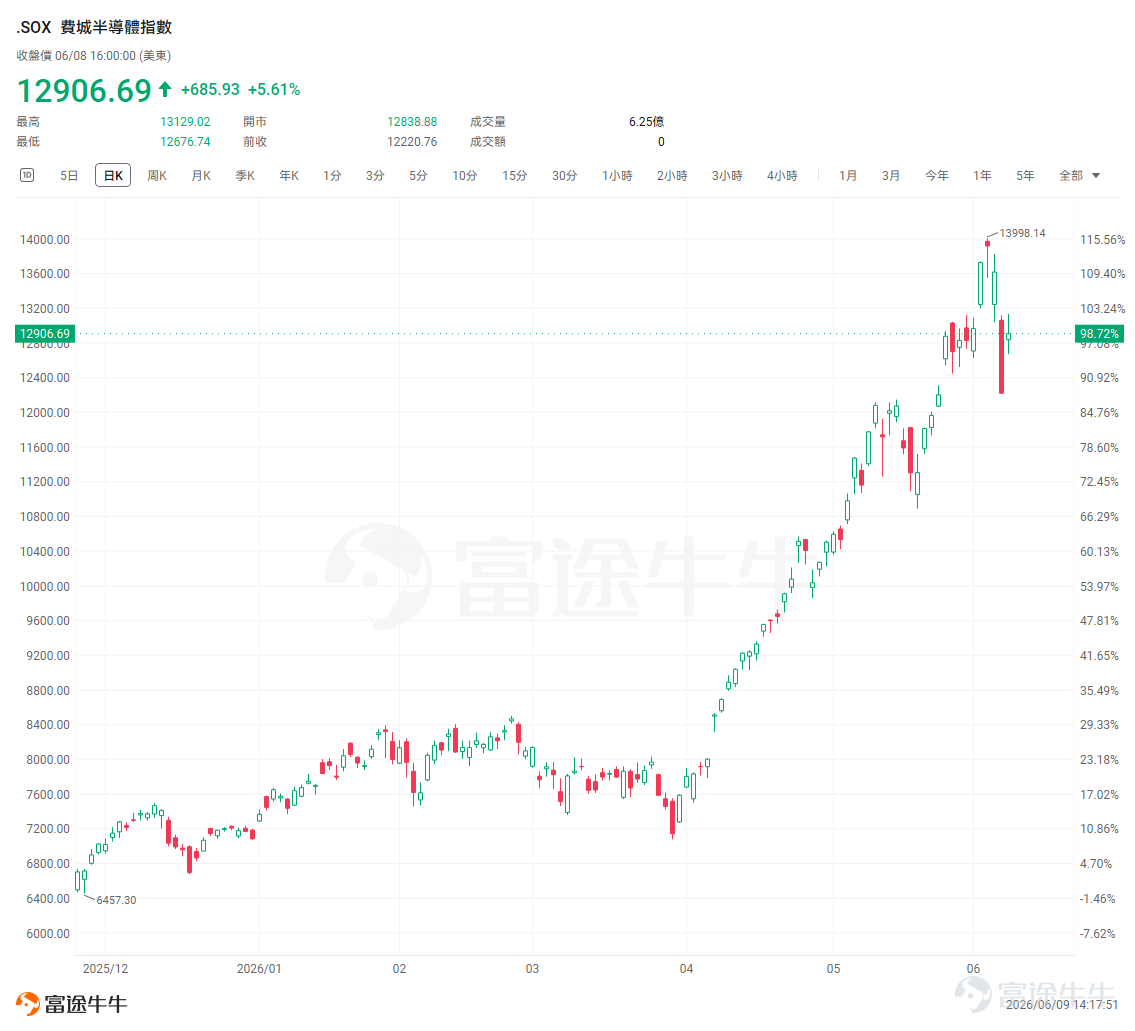
Friday's sharp sell-off resembled a trading-structure issue rather than a sudden deterioration in fundamentals.Last Friday, the Philadelphia Semiconductor Index fell nearly 10%, marking its worst single-day performance since 2020.
However, there has been no negative catalyst significant enough to trigger a complete reversal in AI semiconductor fundamentals.Stronger-than-expected nonfarm payrolls, interest rate pressures, and elevated AI valuations can certainly lead to pullbacks, but under normal circumstances, they wouldn’t cause such extreme single-day swings in the Nasdaq and SMH.A more plausible explanation is that AI and chip trades had become overly crowded, with leveraged funds, CTAs, quant strategies, and options gamma collectively amplifying volatility.
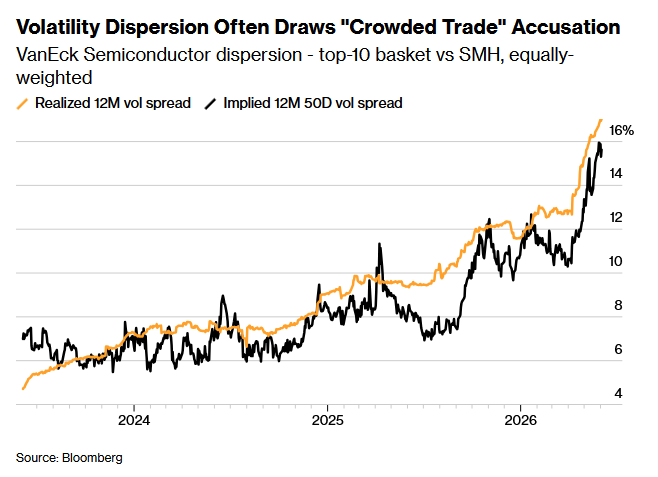
Prior to that, the Philadelphia Semiconductor Index had already risen about 96% year-to-date and at one point traded roughly 35% above its 50-day moving average. The dispersion of volatility across U.S. semiconductor stocks expanded sharply at the start of 2026,with the portfolio composed of the top 10 stocks $VanEck Semiconductor ETF (SMH.US)$ showing a 12-month volatility spread exceeding 16%. Such a divergence itself indicates that semiconductor trades had already reached an extremely crowded position.
US stocks rebounded on Monday, with semiconductors once again emerging as the market's strongest theme. Intraday, $PHLX Semiconductor Index (.SOX.US)$ surged more than 6% at one point, $NASDAQ 100 Index (.NDX.US)$ gained nearly 2%. From the market action, the AI hardware chain rebounded quickly, $NVIDIA (NVDA.US)$ 、 $Broadcom (AVGO.US)$ 、 $Micron Technology (MU.US)$ 、 $Intel (INTC.US)$ 、 $Marvell Technology (MRVL.US)$ and other core names all saw varying degrees of recovery. After Friday’s sharp sell-off, this kind of rebound feels quite encouraging.But following this rebound, has the risk been resolved? How should investors navigate trading opportunities and risks? Marginal easing of macro pressures: New York Fed inflation expectations remain under control. The first backdrop for yesterday’s market rebound was that Middle East risks did not escalate further. Tensions between Israel and Iran temporarily eased, oil price gains narrowed, and the feared chain reaction—'geopolitical conflict → surging oil prices → reignited inflation → a more hawkish Fed'—did not worsen further. Inflation expectations from the New York Fed remain under control.The New York Fed's May Survey of Consumer Expectations showed that one-year inflation expectations edged down slightly from 3.6% to 3.5%, while three- and five-year inflation expectations remained broadly stable. Employment expectations, however, began to weaken, with the perceived probability of finding a new job after unemployment falling to 43.7%, and the perceived likelihood of job loss over the next year rising to 15.1%. Inflation expect...
Morgan Stanley strategist Mike Wilson described last Friday’s plunge as a “healthy reset.”According to Morgan Stanley data, semiconductors account for approximately 25% of global hedge fund holdings. Meanwhile, leveraged ETFs have generated over $225 billion in demand for global equities this year, but on Friday alone, roughly $55 billion was wiped out in reverse flows. This capital structure means that once the market starts declining, profit-taking, stop-losses, deleveraging, CTA selling, and market-maker gamma hedging can all be triggered simultaneously.
What might originally have been a 3% to 4% pullback can easily escalate into a sector-wide selloff of nearly 10% due to amplification by algorithmic trading and leveraged unwinds.
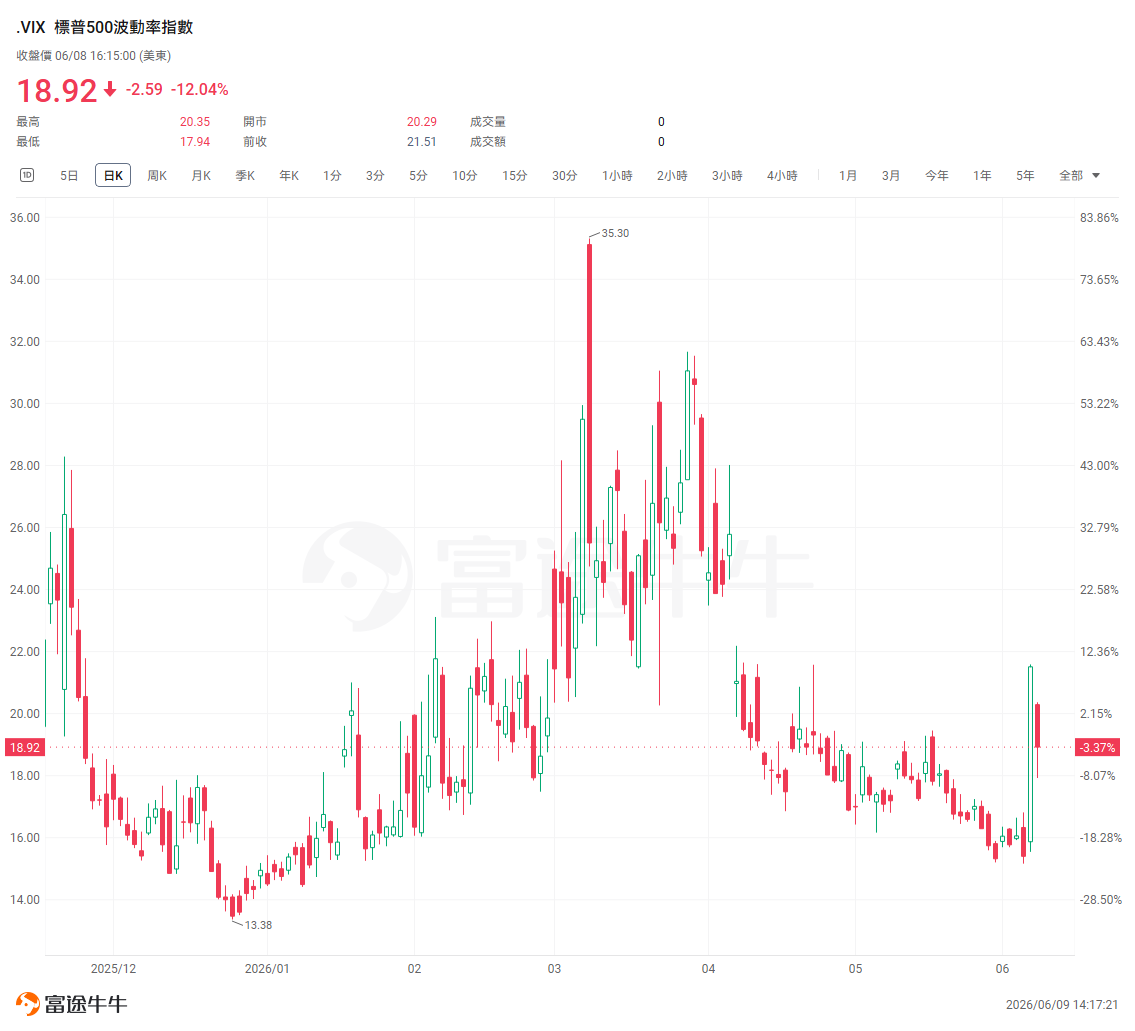
Therefore, Monday's rebound wasn't surprising. Historically, when $S&P 500 Index (.SPX.US)$ Friday’s decline exceeded 2.5%, yet $CBOE Volatility S&P 500 Index (.VIX.US)$ the close remained below 25, it typically reflects short-term crowded-trade unwinds rather than systemic panic.When mechanical selling overshoots on one trading day, a bounce-back the next day aligns with typical market dynamics.
US stocks rebounded on Monday, with semiconductors once again emerging as the market's strongest theme. Intraday, $PHLX Semiconductor Index (.SOX.US)$ surged more than 6% at one point, $NASDAQ 100 Index (.NDX.US)$ gained nearly 2%. From the market action, the AI hardware chain rebounded quickly, $NVIDIA (NVDA.US)$ 、 $Broadcom (AVGO.US)$ 、 $Micron Technology (MU.US)$ 、 $Intel (INTC.US)$ 、 $Marvell Technology (MRVL.US)$ and other core names all saw varying degrees of recovery. After Friday’s sharp sell-off, this kind of rebound feels quite encouraging.But following this rebound, has the risk been resolved? How should investors navigate trading opportunities and risks? Marginal easing of macro pressures: New York Fed inflation expectations remain under control. The first backdrop for yesterday’s market rebound was that Middle East risks did not escalate further. Tensions between Israel and Iran temporarily eased, oil price gains narrowed, and the feared chain reaction—'geopolitical conflict → surging oil prices → reignited inflation → a more hawkish Fed'—did not worsen further. Inflation expectations from the New York Fed remain under control.The New York Fed's May Survey of Consumer Expectations showed that one-year inflation expectations edged down slightly from 3.6% to 3.5%, while three- and five-year inflation expectations remained broadly stable. Employment expectations, however, began to weaken, with the perceived probability of finding a new job after unemployment falling to 43.7%, and the perceived likelihood of job loss over the next year rising to 15.1%. Inflation expect...
Buy sector-level hedges; bet on catalyst-driven individual stocks (Marvell, Intel)
However, yesterday’s rebound wasn’t smooth—while the S&P 500 rose, a significant portion of its constituents still declined. In other words, the index gain was primarily driven by tech mega-caps, semiconductors, and the AI hardware chain, not by broad-based risk appetite across the entire market.
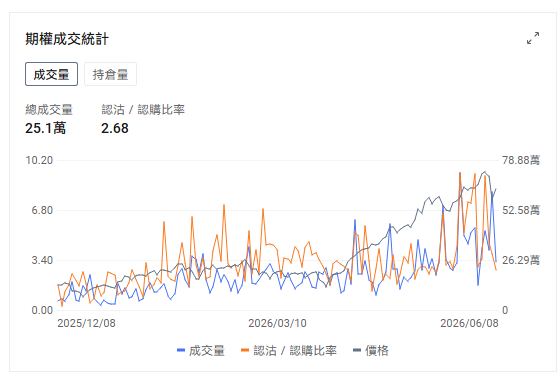
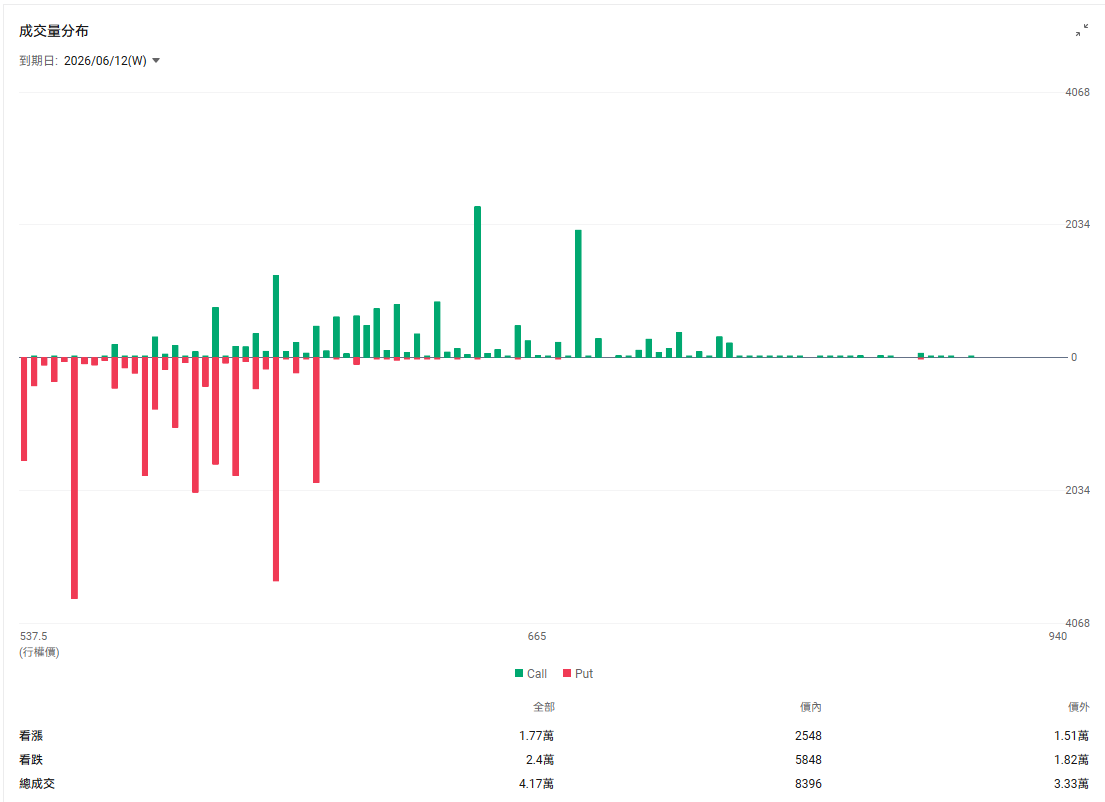
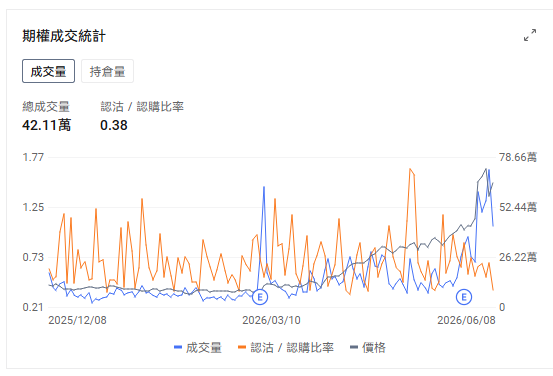
During yesterday’s semiconductor rally, $VanEck Semiconductor ETF (SMH.US)$put option volume exceeded call option volume by more than twofold., This week's expiring put options are concentrated at the $550 and $600 strike prices.
US stocks rebounded on Monday, with semiconductors once again emerging as the market's strongest theme. Intraday, $PHLX Semiconductor Index (.SOX.US)$ surged more than 6% at one point, $NASDAQ 100 Index (.NDX.US)$ gained nearly 2%. From the market action, the AI hardware chain rebounded quickly, $NVIDIA (NVDA.US)$ 、 $Broadcom (AVGO.US)$ 、 $Micron Technology (MU.US)$ 、 $Intel (INTC.US)$ 、 $Marvell Technology (MRVL.US)$ and other core names all saw varying degrees of recovery. After Friday’s sharp sell-off, this kind of rebound feels quite encouraging.But following this rebound, has the risk been resolved? How should investors navigate trading opportunities and risks? Marginal easing of macro pressures: New York Fed inflation expectations remain under control. The first backdrop for yesterday’s market rebound was that Middle East risks did not escalate further. Tensions between Israel and Iran temporarily eased, oil price gains narrowed, and the feared chain reaction—'geopolitical conflict → surging oil prices → reignited inflation → a more hawkish Fed'—did not worsen further. Inflation expectations from the New York Fed remain under control.The New York Fed's May Survey of Consumer Expectations showed that one-year inflation expectations edged down slightly from 3.6% to 3.5%, while three- and five-year inflation expectations remained broadly stable. Employment expectations, however, began to weaken, with the perceived probability of finding a new job after unemployment falling to 43.7%, and the perceived likelihood of job loss over the next year rising to 15.1%. Inflation expect...
Many institutions already held long positions in AI and semiconductor stocks, and after Friday's sharp sell-off,Monday's rebound gave them an opportunity to add protective puts.
Marvell: Index inclusion + AI interconnect narrative
$Marvell Technology (MRVL.US)$ is a typical example. In Monday’s options trading, Marvell call volume was roughly three times that of put volume.Marvell will be added to the S&P 500 index before the market opens on June 22, creating expectations of passive fund inflows.; meanwhile, the company is also positioned along key themes such as custom AI chips, optical interconnects, and data center interconnects.
US stocks rebounded on Monday, with semiconductors once again emerging as the market's strongest theme. Intraday, $PHLX Semiconductor Index (.SOX.US)$ surged more than 6% at one point, $NASDAQ 100 Index (.NDX.US)$ gained nearly 2%. From the market action, the AI hardware chain rebounded quickly, $NVIDIA (NVDA.US)$ 、 $Broadcom (AVGO.US)$ 、 $Micron Technology (MU.US)$ 、 $Intel (INTC.US)$ 、 $Marvell Technology (MRVL.US)$ and other core names all saw varying degrees of recovery. After Friday’s sharp sell-off, this kind of rebound feels quite encouraging.But following this rebound, has the risk been resolved? How should investors navigate trading opportunities and risks? Marginal easing of macro pressures: New York Fed inflation expectations remain under control. The first backdrop for yesterday’s market rebound was that Middle East risks did not escalate further. Tensions between Israel and Iran temporarily eased, oil price gains narrowed, and the feared chain reaction—'geopolitical conflict → surging oil prices → reignited inflation → a more hawkish Fed'—did not worsen further. Inflation expectations from the New York Fed remain under control.The New York Fed's May Survey of Consumer Expectations showed that one-year inflation expectations edged down slightly from 3.6% to 3.5%, while three- and five-year inflation expectations remained broadly stable. Employment expectations, however, began to weaken, with the perceived probability of finding a new job after unemployment falling to 43.7%, and the perceived likelihood of job loss over the next year rising to 15.1%. Inflation expect...
Intel: The foundry story reignites
$Intel (INTC.US)$ The rally stems from market expectations of a revaluation of its foundry business.
According to The Information, $Alphabet-A (GOOGL.US)$$Alphabet-A (GOOGL.US)$ An order has already been placed with Intel, planning to produce over 3 million TPUs by 2028; NVIDIA is testing its Intel 18A process and EMIB packaging technology for its new architecture slated for 2028. It should be emphasized that Intel declined to comment, and neither Google nor NVIDIA responded immediately—this report has not yet been officially confirmed.
Nevertheless, the market reaction remains strong. Intel's options trading volume neared double its average daily level, with more than 70% being call options, many of which were out-of-the-money by over 5%.
Even using a rough estimate based on the rumored 3 million TPUs, the order size is indeed substantial. Assuming each wafer ultimately yields 15 to 20 finished TPUs, and referencing $Taiwan Semiconductor (TSM.US)$ the current market price of approximately $20,000 per wafer for advanced nodes, potential foundry revenue would be in the range of roughly $3 billion to $4 billion. However, this is a very rough scenario estimate—the actual figure hinges critically on the TPU die size, yield, packaging solution, and Intel’s real pricing for its 18A node. For Intel’s current external foundry revenue, this would represent a significant incremental boost.
How to capture trading opportunities and manage risk? Next up: CPI, FOMC, SpaceX IPO…
The market hasn’t forgotten last Friday’s sharp sell-off, but capital still isn’t willing to fully exit AI.Thus, the most straightforward move is to sell weaker AI narratives and buy back into AI hardware with clearer orders, tighter supply, and more central positions in the supply chain.
Looking ahead, Wednesday's CPI release remains the most critical near-term risk event.
The New York Fed survey only reflects expectations; it’s ultimately the CPI data that drives rate-sensitive trading. If core inflation and core services inflation continue to cool on a month-over-month basis, markets will view the pressure on the Fed to turn hawkish as easing, offering semiconductors room to extend their rebound.
However, if CPI comes in hotter than expected again, high-valuation tech stocks will once more face rate-related pressure. The stronger yesterday’s rally was, the more pronounced the pullback could be if the data disappoints.
If the FOMC next week strikes a neutral tone—neither hawkish nor dovish,markets would interpret this as a moderation in policy risk, reducing pressure across equities, bonds, and gold. However, if the Fed signals a stronger commitment to fighting inflation, high-valuation tech stocks would remain under pressure.
SpaceX’s IPO on June 12 is approaching and will become a focal point for the entire market in the short term.On one hand, it could reinforce risk appetite for tech growth names,If the market can absorb this massive IPO smoothly, it would signal ample liquidity still supports tech growth stocks; if the IPO drains capital and causes heightened volatility in other tech names, semiconductors could also face indirect spillover effects.
In terms of options strategies, differentiate based on your current position:
(1) Investors with heavy positions who don’t want to incur substantial additional hedging costs
Investors who already have substantial unrealized gains or heavy positions may consider implementing a collar structure on their existing holdings.
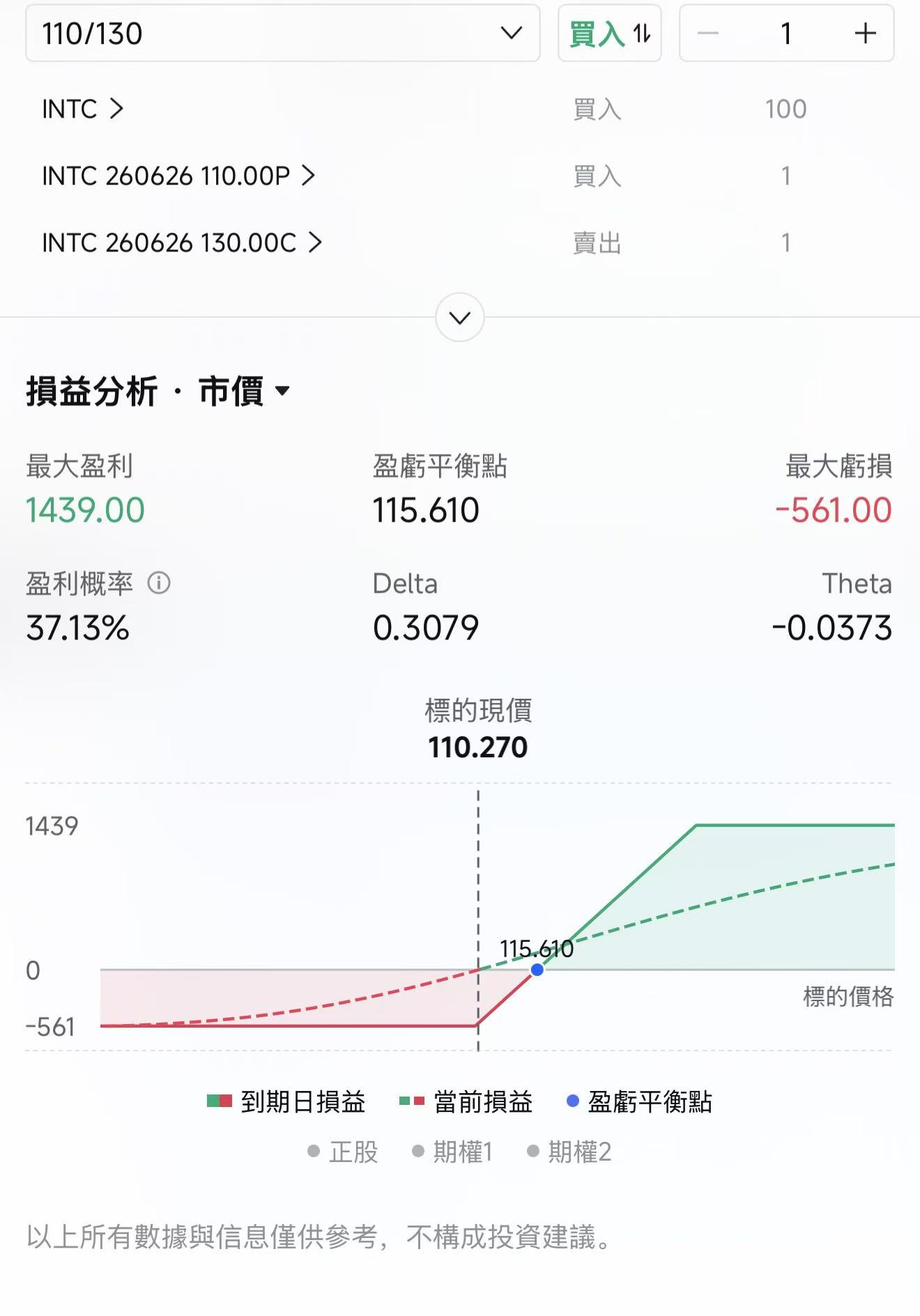
The approach involves holding the underlying stock or ETF, buying a protective put at a lower strike price, and simultaneously selling an out-of-the-money call at a higher strike price. The premium received from selling the call partially offsets the cost of purchasing the put.
This strategy suits two types of investors: first, those who already hold significant semiconductor positions and wish to avoid being forced to sell due to short-term volatility; second, those who remain bullish on the AI theme over the medium to long term but are concerned about sharp swings around upcoming macro events. Note that a collar sacrifices some upside potential—meaning if semiconductors rally further, the sold call will cap part of the gains. Using Intel (INTC) as an example:
(The figure below illustrates the simulated profit and loss scenario of this strategy on the expiration date. The design image displayed on the screen is for demonstration purposes only and does not constitute any investment advice or guarantee; market conditions fluctuate frequently, and the prices shown do not represent actual values.)
US stocks rebounded on Monday, with semiconductors once again emerging as the market's strongest theme. Intraday, $PHLX Semiconductor Index (.SOX.US)$ surged more than 6% at one point, $NASDAQ 100 Index (.NDX.US)$ gained nearly 2%. From the market action, the AI hardware chain rebounded quickly, $NVIDIA (NVDA.US)$ 、 $Broadcom (AVGO.US)$ 、 $Micron Technology (MU.US)$ 、 $Intel (INTC.US)$ 、 $Marvell Technology (MRVL.US)$ and other core names all saw varying degrees of recovery. After Friday’s sharp sell-off, this kind of rebound feels quite encouraging.But following this rebound, has the risk been resolved? How should investors navigate trading opportunities and risks? Marginal easing of macro pressures: New York Fed inflation expectations remain under control. The first backdrop for yesterday’s market rebound was that Middle East risks did not escalate further. Tensions between Israel and Iran temporarily eased, oil price gains narrowed, and the feared chain reaction—'geopolitical conflict → surging oil prices → reignited inflation → a more hawkish Fed'—did not worsen further. Inflation expectations from the New York Fed remain under control.The New York Fed's May Survey of Consumer Expectations showed that one-year inflation expectations edged down slightly from 3.6% to 3.5%, while three- and five-year inflation expectations remained broadly stable. Employment expectations, however, began to weaken, with the perceived probability of finding a new job after unemployment falling to 43.7%, and the perceived likelihood of job loss over the next year rising to 15.1%. Inflation expect...
(2) If you already hold AI-related long positions and are worried about future volatility, consider buying protection after a bounce.
If you already hold AI-related stocks, adding some downside protection after Monday’s rebound is not too late. You could also consider buying protective puts on SMH or SOXX. Compared to purchasing individual puts for each stock, using a sector ETF for hedging is simpler and better suited for investors who already hold a diversified basket of semiconductor long positions.
The goal of such strategies is not to bet against semiconductors, but to guard against renewed shocks to high-valuation growth stocks from macro data releases, interest rate expectations, or geopolitical risks—especially after the sector has already rallied sharply. This is particularly relevant for investors with heavier positions who prioritize drawdown control.
(3) If you are currently flat or lightly positioned and considering chasing the rally, it’s preferable to wait for a pullback and confirmation first.
With volatility currently elevated, buying naked calls ahead of CPI and FOMC announcements carries significant risk. If the sector pulls back overnight, losses could occur from time decay and declining implied volatility before your directional view even has a chance to play out.
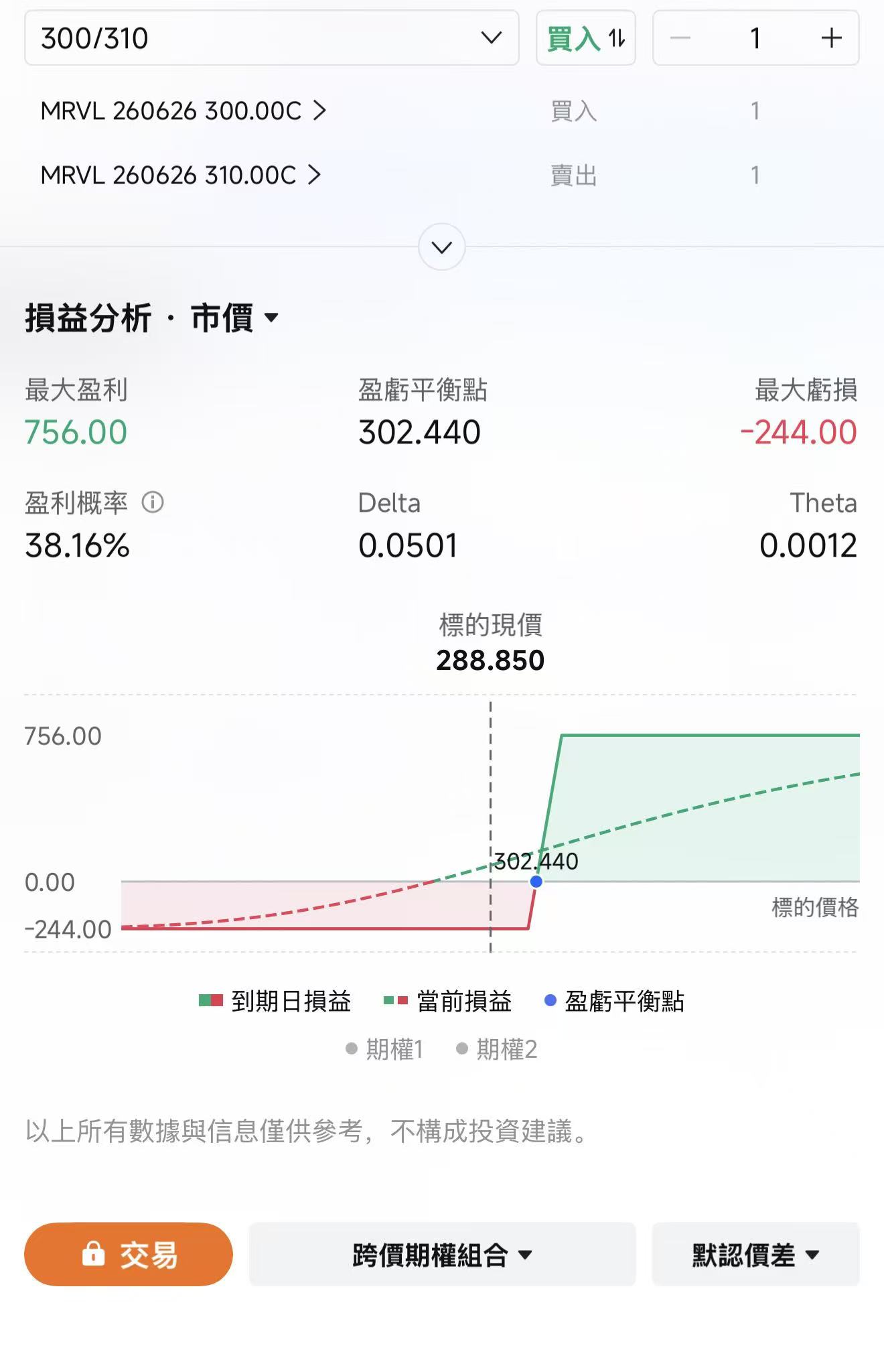
Conservative investors should wait for confirmation from upcoming economic data or other signals before participating in the rebound using a 3- to 6-week bull call spread. This involves buying an at-the-money or slightly in-the-money call while simultaneously selling a call with a higher strike price. This approach allows participation in the upside while reducing the premium cost compared to buying a naked call outright. Using Marvell Technology (MRVL) as an example:
(The figure below illustrates the simulated profit and loss scenario of this strategy on the expiration date. The design image displayed on the screen is for demonstration purposes only and does not constitute any investment advice or guarantee; market conditions fluctuate frequently, and the prices shown do not represent actual values.)
US stocks rebounded on Monday, with semiconductors once again emerging as the market's strongest theme. Intraday, $PHLX Semiconductor Index (.SOX.US)$ surged more than 6% at one point, $NASDAQ 100 Index (.NDX.US)$ gained nearly 2%. From the market action, the AI hardware chain rebounded quickly, $NVIDIA (NVDA.US)$ 、 $Broadcom (AVGO.US)$ 、 $Micron Technology (MU.US)$ 、 $Intel (INTC.US)$ 、 $Marvell Technology (MRVL.US)$ and other core names all saw varying degrees of recovery. After Friday’s sharp sell-off, this kind of rebound feels quite encouraging.But following this rebound, has the risk been resolved? How should investors navigate trading opportunities and risks? Marginal easing of macro pressures: New York Fed inflation expectations remain under control. The first backdrop for yesterday’s market rebound was that Middle East risks did not escalate further. Tensions between Israel and Iran temporarily eased, oil price gains narrowed, and the feared chain reaction—'geopolitical conflict → surging oil prices → reignited inflation → a more hawkish Fed'—did not worsen further. Inflation expectations from the New York Fed remain under control.The New York Fed's May Survey of Consumer Expectations showed that one-year inflation expectations edged down slightly from 3.6% to 3.5%, while three- and five-year inflation expectations remained broadly stable. Employment expectations, however, began to weaken, with the perceived probability of finding a new job after unemployment falling to 43.7%, and the perceived likelihood of job loss over the next year rising to 15.1%. Inflation expect...
Finally, Option Sir brings a small perk for fellow investors, welcome to claim it.Options Beginner Pack
*This event is exclusive to invited HK users. Click to learn more.Detailed event rules>>
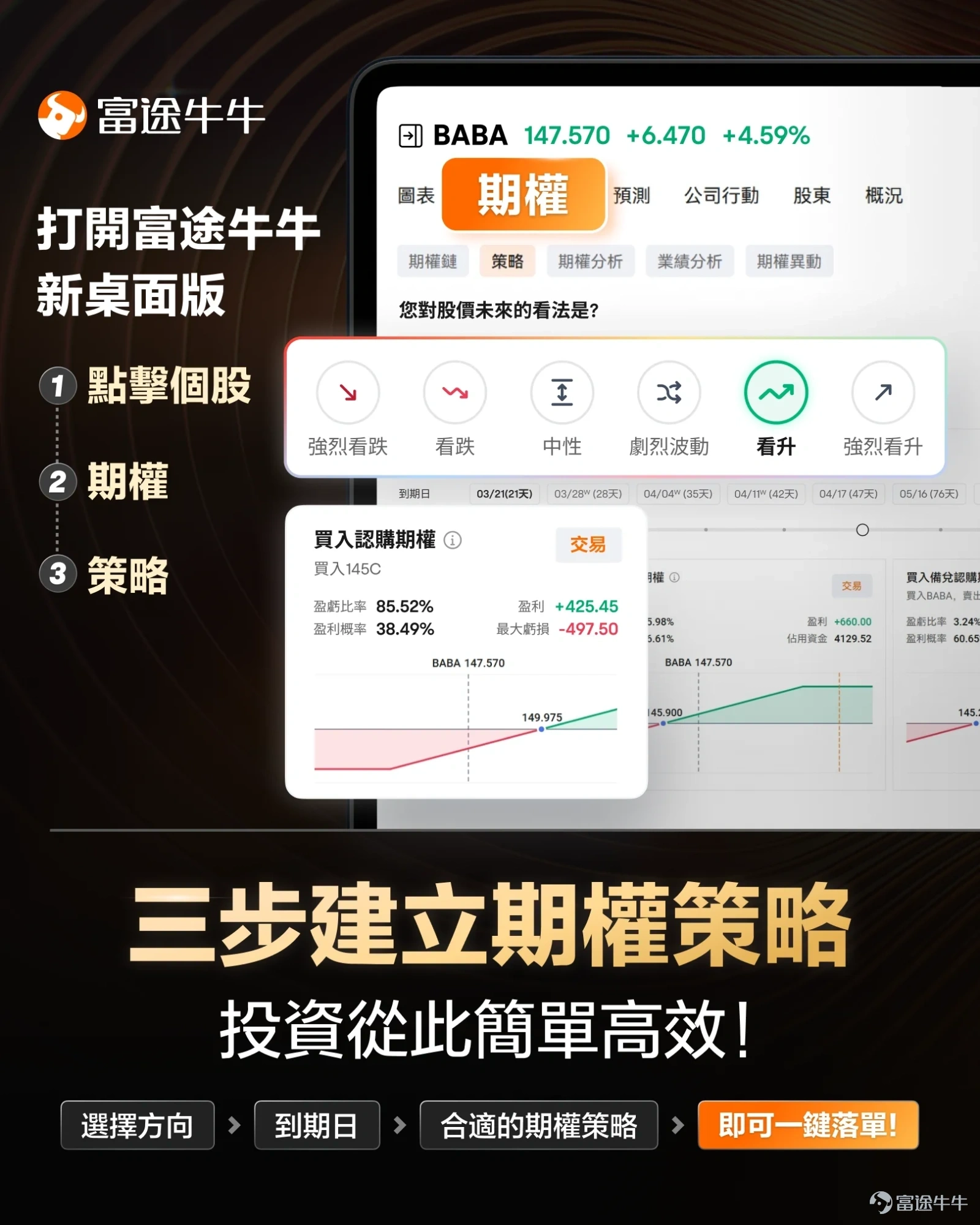
Market conditions are complex and volatile,Options StrategyOverwhelmed by choices? Futubull helps you build a portfolio in three steps.Options Strategymaking investing simple and efficient!
US stocks rebounded on Monday, with semiconductors once again emerging as the market's strongest theme. Intraday, $PHLX Semiconductor Index (.SOX.US)$ surged more than 6% at one point, $NASDAQ 100 Index (.NDX.US)$ gained nearly 2%. From the market action, the AI hardware chain rebounded quickly, $NVIDIA (NVDA.US)$ 、 $Broadcom (AVGO.US)$ 、 $Micron Technology (MU.US)$ 、 $Intel (INTC.US)$ 、 $Marvell Technology (MRVL.US)$ and other core names all saw varying degrees of recovery. After Friday’s sharp sell-off, this kind of rebound feels quite encouraging.But following this rebound, has the risk been resolved? How should investors navigate trading opportunities and risks? Marginal easing of macro pressures: New York Fed inflation expectations remain under control. The first backdrop for yesterday’s market rebound was that Middle East risks did not escalate further. Tensions between Israel and Iran temporarily eased, oil price gains narrowed, and the feared chain reaction—'geopolitical conflict → surging oil prices → reignited inflation → a more hawkish Fed'—did not worsen further. Inflation expectations from the New York Fed remain under control.The New York Fed's May Survey of Consumer Expectations showed that one-year inflation expectations edged down slightly from 3.6% to 3.5%, while three- and five-year inflation expectations remained broadly stable. Employment expectations, however, began to weaken, with the perceived probability of finding a new job after unemployment falling to 43.7%, and the perceived likelihood of job loss over the next year rising to 15.1%. Inflation expect...
Option Risk Warning:An option is a contract that grants the holder the right, but not the obligation, to buy or sell an asset at a fixed price on a specific date or at any time before that date. The price of an option is influenced by various factors, including the current price of the underlying asset, the strike price, time to expiration, and implied volatility. Implied volatility reflects the market’s expectations for the level of volatility in the option over a future period. It is a data point derived inversely from the Black-Scholes option pricing model and is generally regarded as an indicator of market sentiment. When investors anticipate greater volatility, they may be more willing to pay a higher price for options to hedge risks, resulting in higher implied volatility. Traders and investors use implied volatility to assess the attractiveness of option prices, identify potential mispricings, and manage risk exposure.
Disclaimer:This content does not constitute any offer, solicitation, recommendation, opinion, or guarantee of any securities, financial products, or tools. The risk of loss in trading options can be substantial. In some cases, losses may exceed the initial margin deposited. Even if you set contingent orders such as 'stop-loss' or 'limit' orders, these may not prevent losses. Market conditions may make such orders unexecutable. You may be required to deposit additional margin within a short period. If you fail to provide the required amount within the specified time, your open positions may be liquidated. However, you will still be responsible for any shortfall in your account. Therefore, before trading, you should study and understand options and carefully consider whether such trading is suitable for you based on your financial situation and investment objectives. If you trade options, you should be familiar with the procedures for exercising options and the rights and obligations upon exercise and expiration. Options trading carries extremely high risks and is not suitable for all investors. Investors should carefully readCharacteristics and Risks of Standardized Options
Risk Disclaimer: The above content only represents the author's view. It does not represent any position or investment advice of Futu. Futu makes no representation or warranty.Read more
Thumbs Up
28
374K Views
Report
Comment (1)
Write a Comment...
1
28
22