
English
Back
Open Account
Option Mover The Moo
wrote a column · Jun 8 19:18

Daily Options Selling Strategy | Philadelphia Semiconductor Index Plunges on Black Friday; SOXL Drops Over 30% in a Single Day – Short-Term Correction or Trend Reversal?

I. Market Barometer
Major U.S. equity indices tumbled sharply in the previous session, with the semiconductor sector hit especially hard. Disappointing nonfarm payroll data combined with Broadcom's weaker-than-expected earnings guidance triggered a chain reaction, sending the Philadelphia Semiconductor Index down more than 10% in a single day. This high-volatility environment has created a high-premium window for options sellers.
II. Focus on Hot Targets
SOXL: Broadcom Drags Down Chip Stocks; Intense Battle Between Bulls and Bears After Breach of $200 Level
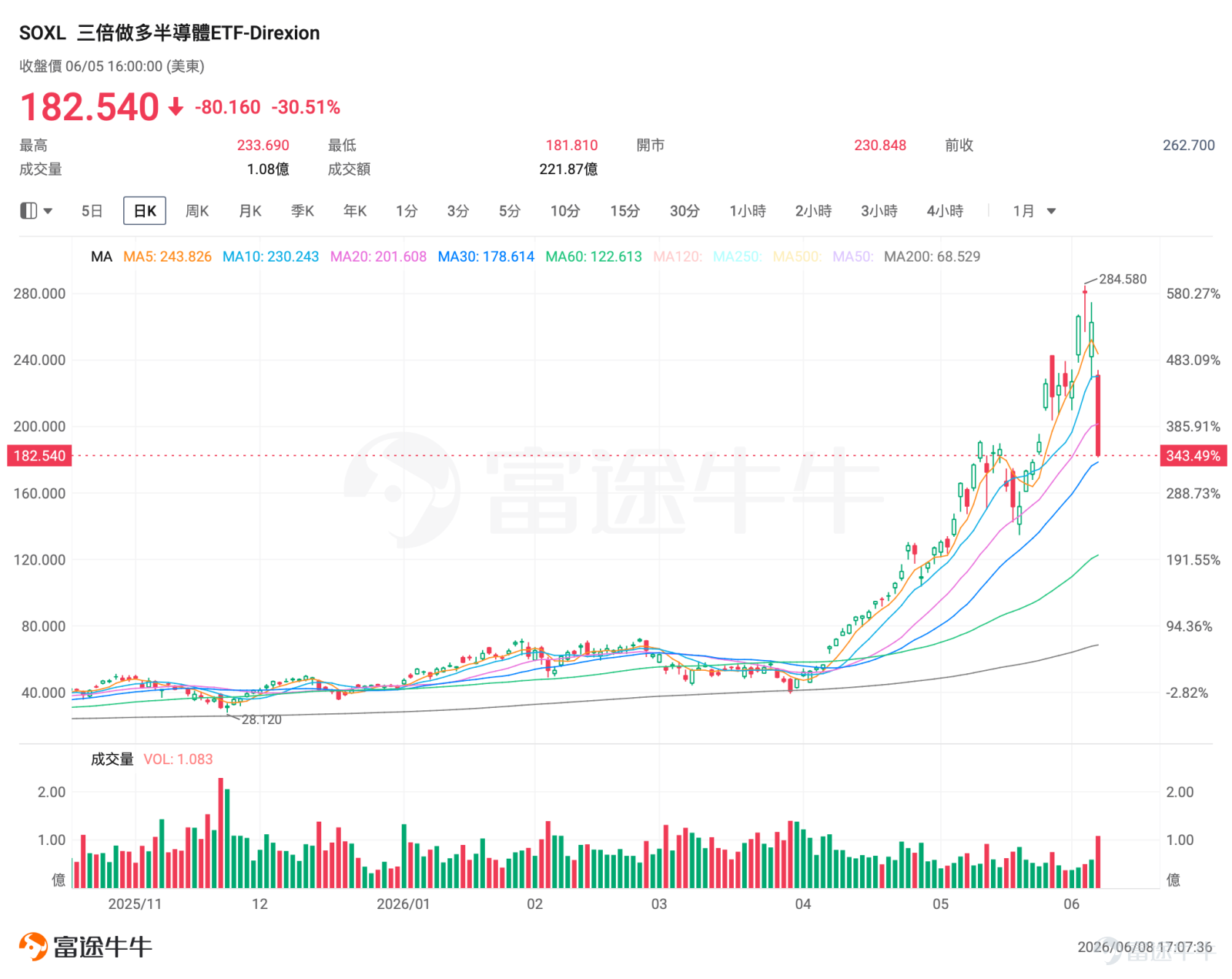
SOXL fell 30.51% in after-hours trading the previous session, closing at $182.51, briefly touching an intraday low of $181.81—a short-term trough—with turnover surging to 98.04%, signaling that capital positioning has entered a white-hot phase.
I. Market Barometer Major U.S. equity indices tumbled sharply in the previous session, with the semiconductor sector hit especially hard. Disappointing nonfarm payroll data combined with Broadcom's weaker-than-expected earnings guidance triggered a chain reaction, sending the Philadelphia Semiconductor Index down more than 10% in a single day. This high-volatility environment has created a high-premium window for options sellers. II. Focus on Hot Targets SOXL: Broadcom Drags Down Chip Stocks; Intense Battle Between Bulls and Bears After Breach of $200 Level SOXL closed down 30.51% after hours in the previous session at $182.51, briefly touching an intraday low of $181.81—the lowest level in recent periods—with turnover surging to 98.04%, signaling that capital positioning has entered a white-hot phase. From a technical perspective, all indicators are under severe pressure. On June 5, SOXL opened with a sharp downward gap, breaking through key support zones and decisively breaching the $200 level. Implied volatility (IV) has spiked to an extreme high of 168.3%, with an IV percentile of 100%, indicating rich option premium levels. The immediate catalyst for the plunge was Broadcom’s weaker-than-expected revenue guidance for its fiscal second quarter. Although Broadcom reported a 143% year-over-year increase in AI-related semiconductor revenue, its outlook for next quarter failed to meet already elevated market expectations, leading investors to interpret it as a potential signal of slowing demand for AI infrastructure. Broadcom’s stock has fallen nearly 20% over the past two trading days. Amid mounting pressure on chip stocks, the macro environment has also suddenly tightened...
From a technical perspective, all indicators are under pressure. On June 5, SOXL opened with a sharp downward gap, breaking below its support zone and piercing through the $200 mark. Implied volatility (IV) has spiked to an extreme high of 168.3%, with an IV percentile of 100%, indicating significantly elevated option premiums.
I. Market Barometer Major U.S. equity indices tumbled sharply in the previous session, with the semiconductor sector hit especially hard. Disappointing nonfarm payroll data combined with Broadcom's weaker-than-expected earnings guidance triggered a chain reaction, sending the Philadelphia Semiconductor Index down more than 10% in a single day. This high-volatility environment has created a high-premium window for options sellers. II. Focus on Hot Targets SOXL: Broadcom Drags Down Chip Stocks; Intense Battle Between Bulls and Bears After Breach of $200 Level SOXL closed down 30.51% after hours in the previous session at $182.51, briefly touching an intraday low of $181.81—the lowest level in recent periods—with turnover surging to 98.04%, signaling that capital positioning has entered a white-hot phase. From a technical perspective, all indicators are under severe pressure. On June 5, SOXL opened with a sharp downward gap, breaking through key support zones and decisively breaching the $200 level. Implied volatility (IV) has spiked to an extreme high of 168.3%, with an IV percentile of 100%, indicating rich option premium levels. The immediate catalyst for the plunge was Broadcom’s weaker-than-expected revenue guidance for its fiscal second quarter. Although Broadcom reported a 143% year-over-year increase in AI-related semiconductor revenue, its outlook for next quarter failed to meet already elevated market expectations, leading investors to interpret it as a potential signal of slowing demand for AI infrastructure. Broadcom’s stock has fallen nearly 20% over the past two trading days. Amid mounting pressure on chip stocks, the macro environment has also suddenly tightened...
The immediate catalyst for the plunge was Broadcom's weaker-than-expected guidance in its fiscal second-quarter earnings report. Although Broadcom’s AI semiconductor revenue surged 143% year-over-year, its revenue outlook for the next quarter failed to meet already lofty market expectations, which investors interpreted as a signal that demand for AI infrastructure might be slowing. Broadcom’s stock has tumbled nearly 20% over the past two days.
Amid inherent weakness in semiconductor stocks, a sudden tightening in the macro environment added another straw to break the camel’s back. The U.S. May nonfarm payrolls data released that day significantly exceeded expectations, virtually eliminating any remaining hope in the market for a near-term Federal Reserve rate cut. Markets began pricing in the possibility of a rate hike within the year, sending Treasury yields sharply higher—an immediate headwind for tech stocks that rely heavily on financing for capital expenditures.
Beyond these fundamental factors, market fragility itself amplified the sell-off. Prior to the plunge, the Philadelphia Semiconductor Index had already gained more than 70% year-to-date, amassing substantial unrealized profits—making it highly susceptible to profit-taking on any negative trigger. Concerns also mounted that the upcoming massive SpaceX IPO could divert capital away from AI-related sectors. Investors sold semiconductor stocks to raise cash, compounded by deleveraging from leveraged positions, ultimately triggering a sharp sector-wide decline.
III. Seller Options Strategy
1. Cash Secured Put
Sell 1 SOXL Jun 18, 2026 $100 Put; estimated margin requirement (for reference only): $10,000 ($100 × 100)
I. Market Barometer Major U.S. equity indices tumbled sharply in the previous session, with the semiconductor sector hit especially hard. Disappointing nonfarm payroll data combined with Broadcom's weaker-than-expected earnings guidance triggered a chain reaction, sending the Philadelphia Semiconductor Index down more than 10% in a single day. This high-volatility environment has created a high-premium window for options sellers. II. Focus on Hot Targets SOXL: Broadcom Drags Down Chip Stocks; Intense Battle Between Bulls and Bears After Breach of $200 Level SOXL closed down 30.51% after hours in the previous session at $182.51, briefly touching an intraday low of $181.81—the lowest level in recent periods—with turnover surging to 98.04%, signaling that capital positioning has entered a white-hot phase. From a technical perspective, all indicators are under severe pressure. On June 5, SOXL opened with a sharp downward gap, breaking through key support zones and decisively breaching the $200 level. Implied volatility (IV) has spiked to an extreme high of 168.3%, with an IV percentile of 100%, indicating rich option premium levels. The immediate catalyst for the plunge was Broadcom’s weaker-than-expected revenue guidance for its fiscal second quarter. Although Broadcom reported a 143% year-over-year increase in AI-related semiconductor revenue, its outlook for next quarter failed to meet already elevated market expectations, leading investors to interpret it as a potential signal of slowing demand for AI infrastructure. Broadcom’s stock has fallen nearly 20% over the past two trading days. Amid mounting pressure on chip stocks, the macro environment has also suddenly tightened...
Opportunity Screening Logic:
For investors who do not yet hold a position but seek to establish long-term exposure to the semiconductor sector, SOXL’s recent consecutive declines—driven by macro sentiment—pose significant downside risk if attempting to buy the dip outright.
However, the long-term fundamental thesis for the sector remains intact—AI demand remains robust, and the clear trend of AI evolving from training to inference continues. By selling puts, investors can collect high premiums if the stock stabilizes or rebounds modestly from current depressed levels, thereby enhancing the annualized return on idle capital. Should the price decline further toward the $100 strike price, they would also gain exposure at a lower effective cost basis.
2. Covered Call
Hold 100 shares of SOXL and sell 1 SOXL Jun 18, 2026 $280 Call
I. Market Barometer Major U.S. equity indices tumbled sharply in the previous session, with the semiconductor sector hit especially hard. Disappointing nonfarm payroll data combined with Broadcom's weaker-than-expected earnings guidance triggered a chain reaction, sending the Philadelphia Semiconductor Index down more than 10% in a single day. This high-volatility environment has created a high-premium window for options sellers. II. Focus on Hot Targets SOXL: Broadcom Drags Down Chip Stocks; Intense Battle Between Bulls and Bears After Breach of $200 Level SOXL closed down 30.51% after hours in the previous session at $182.51, briefly touching an intraday low of $181.81—the lowest level in recent periods—with turnover surging to 98.04%, signaling that capital positioning has entered a white-hot phase. From a technical perspective, all indicators are under severe pressure. On June 5, SOXL opened with a sharp downward gap, breaking through key support zones and decisively breaching the $200 level. Implied volatility (IV) has spiked to an extreme high of 168.3%, with an IV percentile of 100%, indicating rich option premium levels. The immediate catalyst for the plunge was Broadcom’s weaker-than-expected revenue guidance for its fiscal second quarter. Although Broadcom reported a 143% year-over-year increase in AI-related semiconductor revenue, its outlook for next quarter failed to meet already elevated market expectations, leading investors to interpret it as a potential signal of slowing demand for AI infrastructure. Broadcom’s stock has fallen nearly 20% over the past two trading days. Amid mounting pressure on chip stocks, the macro environment has also suddenly tightened...
Opportunity filtering logic:
For investors already holding SOXL shares and facing unrealized losses, the stock faces multiple technical headwinds in the near term following the recent extreme sell-off from elevated levels.
Although investors remain bullish on the AI-driven structural bull market in semiconductors over the long term, they are concerned about deteriorating sentiment in the short term and the negative feedback loop from leveraged ETFs. Selling covered calls at this point allows them to collect high premiums to lower their cost basis. If the stock price consolidates within the current low range, the premium income can effectively offset time decay; if the price rebounds above $280 and the option is exercised, it would effectively amount to a successful exit near the previous high.
IV. Risk Control Reminder
Although the seller strategy has a high probability of success, investors must still manage risks effectively:
– Position management is key:The biggest risk for option sellers lies in black swan events. It is recommended that margin exposure for a single underlying should not exceed 20% of total capital. Never sell options beyond your capacity for the sake of greedy premiums.
– Timely rolling of covered call options: When a covered call option becomes deeply in-the-money (stock price far exceeds the strike price), and if the underlying stock is still viewed favorably, decisively 'roll' the position — that is, close the current option by buying it back and simultaneously sell an option with a later expiration date and a higher strike price to avoid having the stock called away at a low price.
– Cash-secured put options warn of 'left-tail risk':For cash-secured puts, if the stock price collapses due to deteriorating fundamentals (rather than a normal pullback), do not hold on stubbornly. At this time, stop losses should be executed, or 'rolling down' can be employed to buy time and wait for volatility to normalize.

Make good use of the options seller zone to understand the income strategies for selling optionsEarn option premiums!
I. Market Barometer Major U.S. equity indices tumbled sharply in the previous session, with the semiconductor sector hit especially hard. Disappointing nonfarm payroll data combined with Broadcom's weaker-than-expected earnings guidance triggered a chain reaction, sending the Philadelphia Semiconductor Index down more than 10% in a single day. This high-volatility environment has created a high-premium window for options sellers. II. Focus on Hot Targets SOXL: Broadcom Drags Down Chip Stocks; Intense Battle Between Bulls and Bears After Breach of $200 Level SOXL closed down 30.51% after hours in the previous session at $182.51, briefly touching an intraday low of $181.81—the lowest level in recent periods—with turnover surging to 98.04%, signaling that capital positioning has entered a white-hot phase. From a technical perspective, all indicators are under severe pressure. On June 5, SOXL opened with a sharp downward gap, breaking through key support zones and decisively breaching the $200 level. Implied volatility (IV) has spiked to an extreme high of 168.3%, with an IV percentile of 100%, indicating rich option premium levels. The immediate catalyst for the plunge was Broadcom’s weaker-than-expected revenue guidance for its fiscal second quarter. Although Broadcom reported a 143% year-over-year increase in AI-related semiconductor revenue, its outlook for next quarter failed to meet already elevated market expectations, leading investors to interpret it as a potential signal of slowing demand for AI infrastructure. Broadcom’s stock has fallen nearly 20% over the past two trading days. Amid mounting pressure on chip stocks, the macro environment has also suddenly tightened...
Options Risk Warning
An option is a contract that grants the holder the right, but not the obligation, to buy or sell an asset at a fixed price on a specific date or at any time before that date. The price of an option is influenced by various factors, including the current price of the underlying asset, the strike price, time to expiration, and implied volatility. Implied volatility reflects the market’s expectations for the level of volatility in the option over a future period. It is a data point derived inversely from the Black-Scholes option pricing model and is generally regarded as an indicator of market sentiment. When investors anticipate greater volatility, they may be more willing to pay a higher price for options to hedge risks, resulting in higher implied volatility. Traders and investors use implied volatility to assess the attractiveness of option prices, identify potential mispricings, and manage risk exposure.
Disclaimer
This content does not constitute any offer, solicitation, recommendation, opinion, or guarantee for any securities, financial products, or tools. The risk of loss in trading options can be substantial. In some cases, losses incurred may exceed the initial margin deposited. Even if you set contingency orders, such as 'stop-loss' or 'limit' orders, these may not necessarily prevent losses. Market conditions may make such orders unexecutable. You may be required to deposit additional margin within a short period. If you fail to provide the required amount within the specified time, your open positions may be liquidated. However, you will still be responsible for any shortfall in your account resulting from such liquidation. Therefore, before trading, you should study and understand options and carefully consider whether such trading suits you based on your financial situation and investment objectives. If you trade options, you should be familiar with the procedures for exercising options and the rights and obligations upon expiration. Options trading involves extremely high risks and is not suitable for all investors. Investors should read Characteristics and Risks of Standardized Options carefully before engaging in any options trading strategy.
Editor/Doris
Risk Disclaimer: The above content only represents the author's view. It does not represent any position or investment advice of Futu. Futu makes no representation or warranty.Read more
Thumbs Up
4
202K Views
Report
Comments
Write a Comment...
4
10