
The S&P has risen for nine consecutive weeks! How strong is this rally in US stocks?

Daily Options Seller Strategy | AI Cloud Providers Surge Collectively! Oracle Jumped Nearly 10% in the Previous Session—Is Now the Right Time to Position in Cloud Computing?
I. Market Barometer
All three major U.S. stock indices hit record highs in the previous trading session, as the AI cloud infrastructure sector surged dramatically, $CoreWeave (CRWV.US)$ rose nearly 14%, $NEBIUS (NBIS.US)$ gained over 14%, $Oracle (ORCL.US)$ and climbed close to 10%, with the high level of market enthusiasm providing options sellers with a window of elevated volatility.
II. Focus on Hot Targets
$Oracle (ORCL.US)$ : The AI cloud computing segment exploded higher, with Wall Street’s highest price target reaching $400.
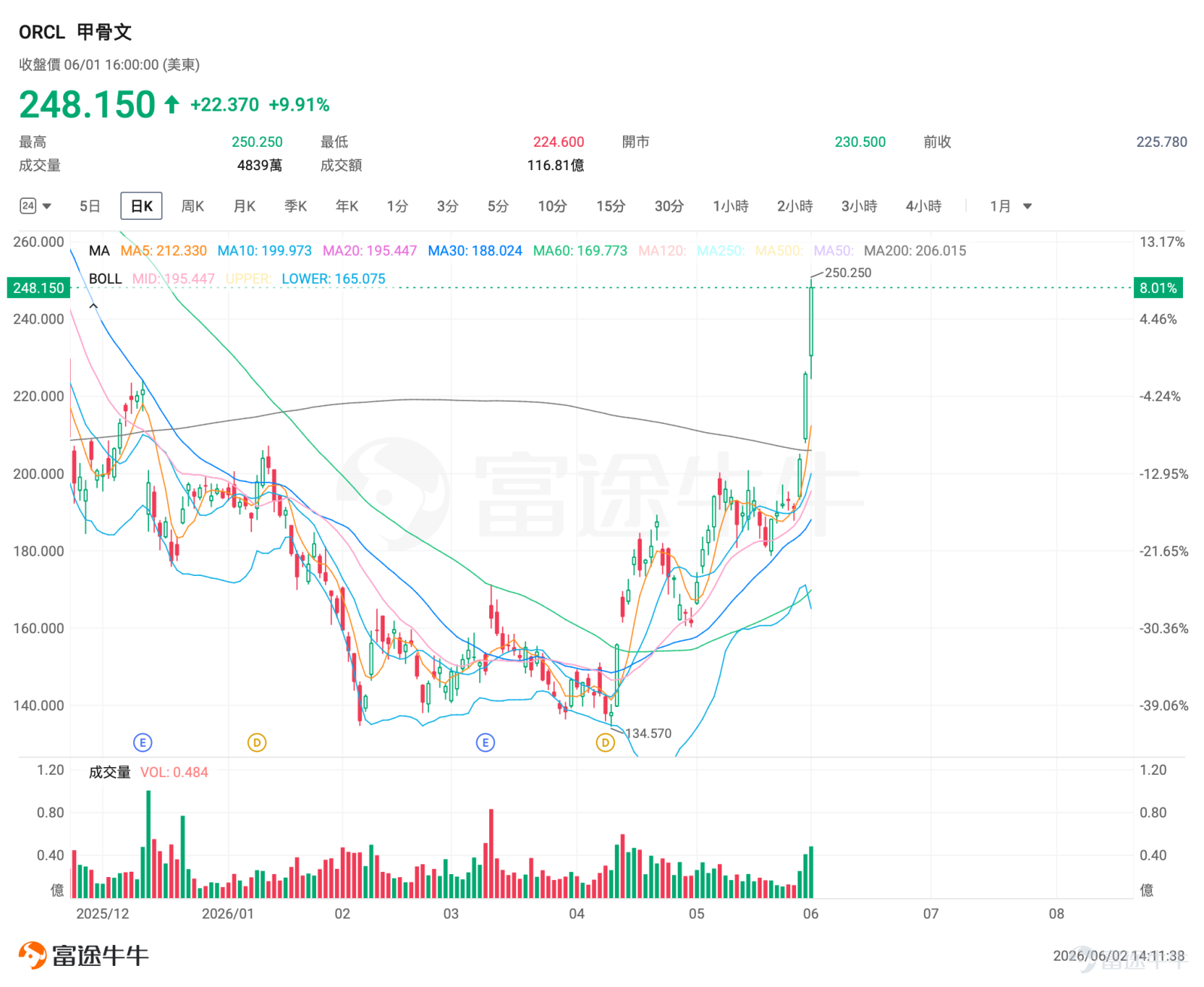
$Oracle (ORCL.US)$ Oracle closed up 9.91% in the previous session at $248.15, hitting an intraday high of $250.25, with trading volume surging to $11.681 billion. Continuously expanding volume indicates significant capital inflows. The stock has gained 29.19% cumulatively over the past five trading days.

From a technical perspective, Oracle’s stock is currently in a steep uptrend. Last Friday, it gapped higher on strong volume and successfully broke above its 200-day moving average. Near-term resistance sits at the psychological $250 level; a breakout could propel the stock toward the prior dense trading zone between $270 and $300. Immediate support lies near the 200-day moving average at around $206. The short-term RSI has entered overbought territory, suggesting potential for a technical pullback following the rapid rally.
The core driver behind Oracle’s share price appreciation stems from the market’s repricing of the long-term value of Oracle Cloud Infrastructure (OCI).Oracle Cloud Infrastructure (OCI) reported revenue of $3.3 billion in the first quarter of fiscal year 2026, a 54% year-over-year increase. The company’s remaining performance obligations (RPO) skyrocketed by 359% year-over-year to a record $455 billion. Chairman Larry Ellison previously outlined a four-year OCI revenue roadmap: $18 billion in FY2026, rising逐年 to $32 billion, $73 billion, and $114 billion, ultimately targeting $144 billion by FY2030. Additionally, the company plans to raise $45–50 billion in 2026 to expand its cloud infrastructure capacity to meet AI computing demand from major clients such as AMD, NVIDIA, Meta, and OpenAI.
Wall Street analysts are broadly optimistic about Oracle’s AI-driven cloud transformation outlook.To date, 85% of analysts maintain a consensus 'Buy' rating: Guggenheim assigned the highest price target of $400 (Strong Buy), Citi set a $320 target, and Jefferies also maintained its $320 target, resulting in an average price target of $250.26.
The company's earnings report is scheduled for release after market close on June 10, with growth and demand for Oracle Cloud Infrastructure (OCI) services and earnings quality expected to be key market focal points.
Regarding OCI growth,The market widely views Oracle’s AI cloud infrastructure services as the undisputed highlight of this earnings report, with its performance directly determining the stock’s direction. In prior guidance, the company projected cloud revenue growth of 46% to 50%, but several institutions have even more optimistic expectations—Morgan Stanley, for instance, forecasts OCI growth could accelerate from 50% to over 70%. The company’s Remaining Performance Obligations (RPO) serve as a critical metric for assessing future revenue potential, and the market will closely watch whether this figure can sustain its previous triple-digit growth trajectory.
Despite the promising growth outlook, Oracle’s aggressive expansion strategy is exerting pressure on near-term profitability. To expand data centers to meet AI demand, Oracle plans to invest approximately $50 billion in capital expenditures during fiscal year 2026, which has resulted in negative free cash flow. The market will scrutinize management’s plans to address this situation.
III. Seller Options Strategy
1. Cash Secured Put
Sell 1 contract of $Oracle (ORCL.US)$ ORCL Jun 18, 2026 $210 Put; estimated required margin (for reference only): $21,000 ($210 × 100)

Opportunity Screening Logic:
For investors who do not yet hold a position but wish to participate in the long-term growth thesis of AI cloud infrastructure, Oracle’s nearly 10% single-day gain presents a risk of technical pullback if they chase the price upward directly.
By selling a Put, if the stock price consolidates at current elevated levels or continues rising, investors can collect premium income to enhance the annualized return on idle cash. If the stock price pulls back toward the $210 strike price due to short-term profit-taking, investors can still acquire shares at a cost below the current market price, thereby establishing a position in the AI cloud infrastructure leader at a more attractive valuation.
2. Covered Call

Opportunity Screening Logic:
For investors already holding Oracle shares with substantial unrealized gains, despite their long-term confidence in the OCI-driven valuation re-rating thesis following the recent sharp rally, they remain concerned that a short-term technical correction could erode those gains. Additionally, uncertainty surrounding the upcoming earnings release on June 10 may trigger significant volatility.
At this point, selling a covered call allows you to collect the premium and lower your cost basis. If the stock price consolidates or experiences a modest pullback within the current high range, the premium income can effectively offset time value decay. If the stock continues its strong rally and is called away above $330, it would be equivalent to successfully taking profit at a significantly higher price than the current level, locking in interim gains.
IV. Risk Control Reminder
Although the seller strategy has a high probability of success, investors must still manage risks effectively:
– Position management is key:The biggest risk for option sellers lies in black swan events. It is recommended that margin exposure for a single underlying should not exceed 20% of total capital. Never sell options beyond your capacity for the sake of greedy premiums.
– Timely rolling of covered call options: When a covered call option becomes deeply in-the-money (stock price far exceeds the strike price), and if the underlying stock is still viewed favorably, decisively 'roll' the position — that is, close the current option by buying it back and simultaneously sell an option with a later expiration date and a higher strike price to avoid having the stock called away at a low price.
– Cash-secured put options warn of 'left-tail risk':For cash-secured puts, if the stock price collapses due to deteriorating fundamentals (rather than a normal pullback), do not hold on stubbornly. At this time, stop losses should be executed, or 'rolling down' can be employed to buy time and wait for volatility to normalize.
Make good use of the options seller zone to understand the income strategies for selling optionsEarn option premiums!
Make good use of the options seller zone to understand the income strategies for selling optionsEarn option premiums!

Options Risk Warning
An option is a contract that grants the holder the right, but not the obligation, to buy or sell an asset at a fixed price on a specific date or at any time before that date. The price of an option is influenced by various factors, including the current price of the underlying asset, the strike price, time to expiration, and implied volatility. Implied volatility reflects the market’s expectations for the level of volatility in the option over a future period. It is a data point derived inversely from the Black-Scholes option pricing model and is generally regarded as an indicator of market sentiment. When investors anticipate greater volatility, they may be more willing to pay a higher price for options to hedge risks, resulting in higher implied volatility. Traders and investors use implied volatility to assess the attractiveness of option prices, identify potential mispricings, and manage risk exposure.
Disclaimer
This content does not constitute any offer, solicitation, recommendation, opinion, or guarantee for any securities, financial products, or tools. The risk of loss in trading options can be substantial. In some cases, losses incurred may exceed the initial margin deposited. Even if you set contingency orders, such as 'stop-loss' or 'limit' orders, these may not necessarily prevent losses. Market conditions may make such orders unexecutable. You may be required to deposit additional margin within a short period. If you fail to provide the required amount within the specified time, your open positions may be liquidated. However, you will still be responsible for any shortfall in your account resulting from such liquidation. Therefore, before trading, you should study and understand options and carefully consider whether such trading suits you based on your financial situation and investment objectives. If you trade options, you should be familiar with the procedures for exercising options and the rights and obligations upon expiration. Options trading involves extremely high risks and is not suitable for all investors. Investors should read Characteristics and Risks of Standardized Options carefully before engaging in any options trading strategy.
Editor/Doris
Risk Disclaimer: The above content only represents the author's view. It does not represent any position or investment advice of Futu. Futu makes no representation or warranty.Read more


Comments
to post a comment
10
10