NVIDIA is pushing hard on 800V—so who’s selling the shovels in power semiconductor?
I. Market Barometer
On the previous trading day, the three major U.S. indices ended mixed, while the AI data center infrastructure sector continued to heat up. A leading gallium nitride (GaN) company$Navitas Semiconductor (NVTS.US)$ saw its stock price surge 8.68% on high volume, hitting a new all-time high. The 'essential power demand' underpinning AI computing capacity has become a new market focus and is also providing options sellers with a window of elevated volatility.
II. Focus on Hot Targets
$Navitas Semiconductor (NVTS.US)$: A core play in the AI power revolution, up over 92% in a single month to a record high
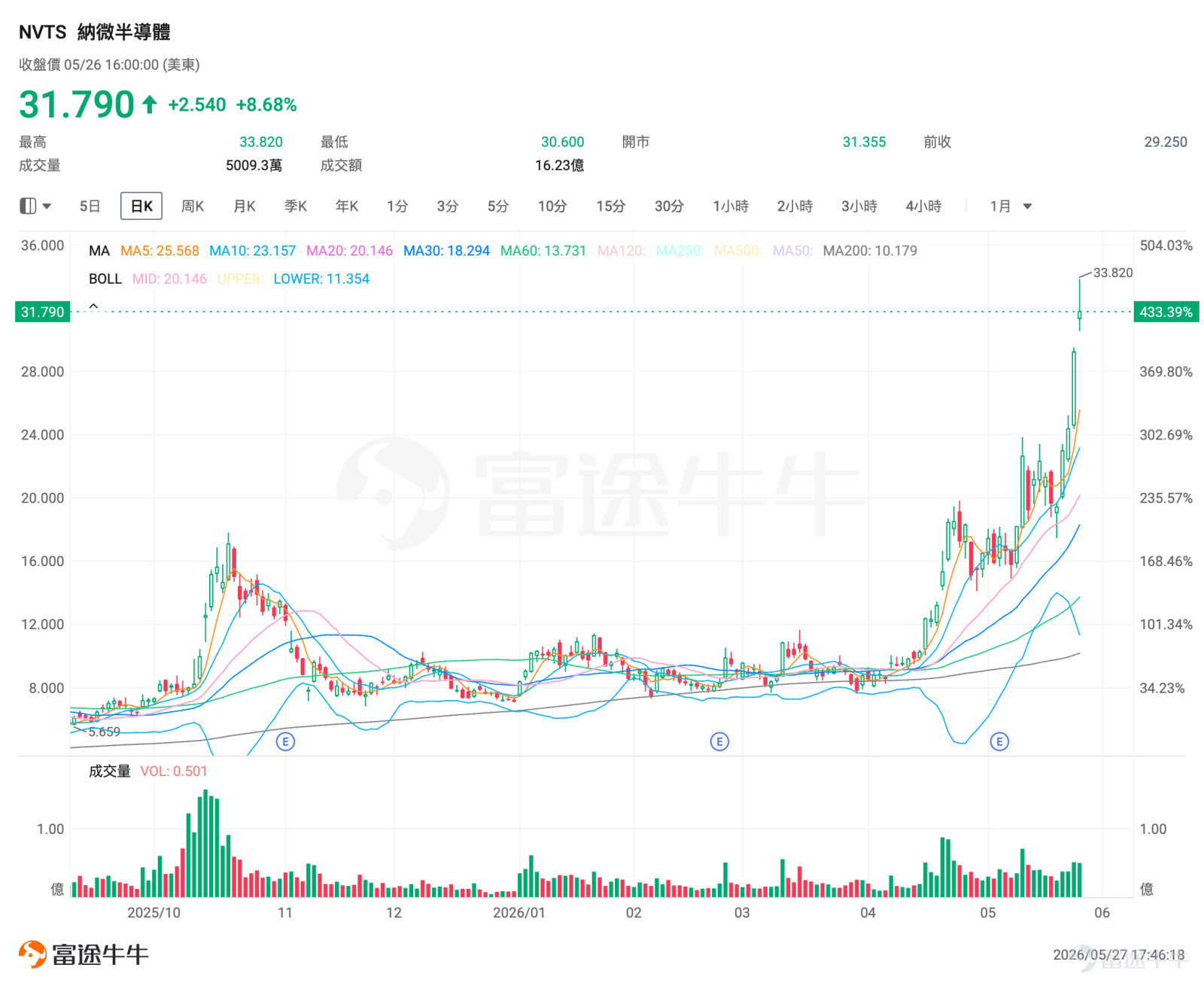
$Navitas Semiconductor (NVTS.US)$ closed up 8.68% on the previous trading day at $31.79, reaching an intraday high of $33.82—another record peak—with a turnover rate of approximately 25% and trading volume exceeding $1.6 billion.The stock has gained roughly 93% since May and is up a staggering 345% year-to-date.

The stock is in a historically strong primary uptrend, trading well above both its 200-day and 30-day moving averages. The RSI has entered overbought territory, with near-term resistance at the psychological $34 level and support in the $23–$25 range formed by the 5-day and 10-day moving averages.
The key catalyst behind the stock's explosive rally stems from strong signals of increased spending on AI data center infrastructure. Hyperscale customers are accelerating their investments in AI power infrastructure, and Navitas, as $NVIDIA (NVDA.US)$ a partner supplying next-generation power management chips for data centers, is highly sensitive to—and directly benefits from—this positive trend. The company is currently accelerating its pivot toward the high-power market, with its 20kW 800V-to-6V power board achieving a peak efficiency of 98.5%, specifically designed for next-generation AI data centers.
III. Seller Options Strategy
1. Cash Secured Put
Sell 1 contract of $Navitas Semiconductor (NVTS.US)$ June 5, 2026, $23 Put; estimated required margin (for reference only): $2,300 ($23 × 100)

Opportunity filtering logic:
For investors who do not yet hold a position but wish to participate in the long-term growth of the AI power revolution, Navitas’ stock is currently trading at an all-time high, with gains exceeding 92% in May alone—making chasing the rally now susceptible to technical pullback risk.
However, the company's fundamentals continue to strengthen—demand for 800V high-voltage architectures in AI data centers is surging, and the company has become a core component supplier for NVIDIA’s 800V HVDC power architecture in AI factories, with mass shipments scheduled to begin in Q2 2026, as orders and production capacity are simultaneously secured.
By selling puts, if the stock price remains range-bound at current elevated levels or continues to rise, investors can collect premiums to enhance the annualized return on idle cash; if the stock price pulls back to around the $23 strike price due to short-term profit-taking, investors can still acquire shares at a cost lower than the current market price.
IV. Risk Control Reminder
Although the seller strategy has a high probability of success, investors must still manage risks effectively:
– Position management is key:The biggest risk for option sellers lies in black swan events. It is recommended that margin exposure for a single underlying should not exceed 20% of total capital. Never sell options beyond your capacity for the sake of greedy premiums.
– Timely rolling of covered call options: When a covered call option becomes deeply in-the-money (stock price far exceeds the strike price), and if the underlying stock is still viewed favorably, decisively 'roll' the position — that is, close the current option by buying it back and simultaneously sell an option with a later expiration date and a higher strike price to avoid having the stock called away at a low price.
– Cash-secured put options warn of 'left-tail risk':For cash-secured puts, if the stock price collapses due to deteriorating fundamentals (rather than a normal pullback), do not hold on stubbornly. At this time, stop losses should be executed, or 'rolling down' can be employed to buy time and wait for volatility to normalize.
Make good use of the options seller zone to understand the income strategies for selling optionsEarn option premiums!

Options Risk Warning
An option is a contract that grants the holder the right, but not the obligation, to buy or sell an asset at a fixed price on a specific date or at any time before that date. The price of an option is influenced by various factors, including the current price of the underlying asset, the strike price, time to expiration, and implied volatility. Implied volatility reflects the market’s expectations for the level of volatility in the option over a future period. It is a data point derived inversely from the Black-Scholes option pricing model and is generally regarded as an indicator of market sentiment. When investors anticipate greater volatility, they may be more willing to pay a higher price for options to hedge risks, resulting in higher implied volatility. Traders and investors use implied volatility to assess the attractiveness of option prices, identify potential mispricings, and manage risk exposure.
Disclaimer
This content does not constitute any offer, solicitation, recommendation, opinion, or guarantee for any securities, financial products, or tools. The risk of loss in trading options can be substantial. In some cases, losses incurred may exceed the initial margin deposited. Even if you set contingency orders, such as 'stop-loss' or 'limit' orders, these may not necessarily prevent losses. Market conditions may make such orders unexecutable. You may be required to deposit additional margin within a short period. If you fail to provide the required amount within the specified time, your open positions may be liquidated. However, you will still be responsible for any shortfall in your account resulting from such liquidation. Therefore, before trading, you should study and understand options and carefully consider whether such trading suits you based on your financial situation and investment objectives. If you trade options, you should be familiar with the procedures for exercising options and the rights and obligations upon expiration. Options trading involves extremely high risks and is not suitable for all investors. Investors should read Characteristics and Risks of Standardized Options carefully before engaging in any options trading strategy.
Editor/Doris
Risk Disclaimer: The above content only represents the author's view. It does not represent any position or investment advice of Futu. Futu makes no representation or warranty.Read more
Comments
to post a comment
5
14